The Marvels (2023), directed by Nia DaCosta, brings together three heroines: Carol Danvers (born in Marvel Super-Heroes #13, 1968), Monica Rambeau (appeared in Amazing Spider-Man Annual #16 , 1982) and Kamala Khan / Ms. Marvel ( Ms. Marvel #1, 2014). The film preserves the spirit of these three characters and their link to the name “Marvel”, but invents the source of their intertwined powers. Detailed comparison, film versus comics.
A sequel to Captain Marvel and the Ms. Marvel series, The Marvels brings together three generations of heroines linked to the publisher's most iconic title. Under the direction of Nia DaCosta, the film draws on several decades of comics to compose its trio. Source-by-source decryption.
As in each article in the series, only verified information (distribution, dates, numbers, creators) is stated; the comparative analysis is ours, without reproducing dialogue or protected images.
Title : The Marvels (2023)
Director: Nia DaCosta
Actors: Brie Larson (Carol Danvers), Teyonah Parris (Monica Rambeau), Iman Vellani (Kamala Khan / Ms. Marvel), Zawe Ashton (Dar-Benn), Samuel L. Jackson (Nick Fury)
Exit : November 10, 2023 (United States)
Studio: Marvel Studios
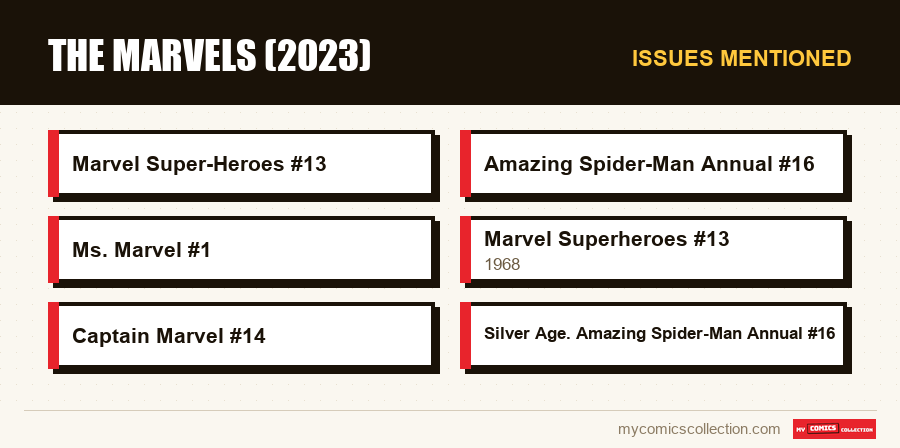
Marvel Superheroes #13 (1968): 1st appearance of Carol Danvers
Amazing Spider-Man Annual #16 (1982): 1st appearance of Monica Rambeau
Ms. Marvel #1 (2014): 1st series by Kamala Khan (Wilson & Alphona)
The Kree-Skrull War: great cosmic conflict
- THE three bearers of the name “Marvel”, a heritage passed down from generation to generation.
- Carol Danvers, the cosmic power, and his past with the Kree.
- Monica Rambeau, capable of manipulating energy and light.
- Kamala Khan, young fan turned heroine, with infectious enthusiasm.
- The conflict with the empire kree, faithful to cosmic mythology.
- The intertwined powers which force the three heroines to exchange places are an invention of the film.
- The origin of Kamala's powers (bracelet, ancestry) differs from its Inhuman origin in the comics.
- Monica Rambeau takes his powers from the events of the previous series.
- Dar Benn, the antagonist, is a secondary figure from the comics reworked.
- The story condenses decades of history into one cosmic adventure.
Three heroines, three eras
The Marvels draws its richness from the reunion of three characters born decades apart. Carol Danvers, appearing in Marvel Super-Heroes #13 (1968), embodies the cosmic power and legacy of the title, as recalled his first film. Monica Rambeau, who appeared in Amazing Spider-Man Annual #16 (1982), created by Roger Stern and John Romita Jr., was one of the first black women to bear the name Captain Marvel before adopting other identities (Photon, Spectrum); it manipulates energy in all its forms. Kamala Khan, aka Ms. Marvel, is the most recent: her series began with Ms. Marvel #1 (2014), created by G. Willow Wilson and Adrian Alphona, and she became a phenomenon as a young Muslim heroine fan of Captain Marvel. The film respects the essence of each and highlights the idea of a name passed down from generation to generation.
This three-generation structure is faithful to the spirit of the comics, where the title of Captain/Ms. Marvel has actually been carried by several successive characters. The film makes it the very subject of its story, celebrating this transmission and the sorority that unites the three heroines.
The spring of intertwined powers
The film's great invention is its central mechanism: the powers of the three heroines intertwine, forcing them to swap places each time they use their abilities simultaneously. This spring, which does not exist in comics, structures the entire plot and its acrobatic staging. It serves the theme of the film (learning to act together, as a team) by literally forcing the three characters to coordinate. It is an example of purely cinematographic invention, grafted onto characters faithful to their sources, to create an original visual and narrative dynamic. The film uses this gimmick to transform the meeting of three heroines into a real team choreography.
Kamala Khan and the repurposed origin
Kamala Khan deserves special attention. In the comics, she is an Inhuman, whose elastic powers are revealed after exposure to Terrigen fog. The film and the series that preceded it reorganize this origin, linking her powers to an ancestral bracelet and a particular ancestry, while retaining the essential: a teenager from Jersey City, daughter of Pakistani immigrants, absolute fan of Captain Marvel, who herself becomes a heroine. This fan enthusiasm, this freshness and this humor make up all the charm of the character, faithfully transposed by Iman Vellani. Kamala brings her energy and her look of wonder to the film, as a counterpoint to Carol's more serious power.
The characters, from paper to screen
- Carol Danvers: The cosmic power, true to its heritage, haunted by its Kree past.
- Monica Rambeau: Energy manipulator, her powers coming from the events of the previous series.
- Kamala Khan: Young fan turned heroine, rearranged origin but faithful spirit.
- Dar Benn: Kree antagonist, secondary figure from the comics reworked for the film.
- Nick Fury: Always there to orchestrate and guide.
Collecting this series?
Track what you own, what you are missing and what your collection is worth. 7 day trial.
Start my trial →A title carried by several generations
The Marvels perfectly illustrates a specificity of the Marvel universe: the transmission of heroic identities. The name “Marvel” has been carried in comics by a long lineage: the Kree Mar-Vell, then Carol Danvers, Monica Rambeau, Kamala Khan and others. This succession, far from being a simple editorial curiosity, recounts the evolution of the publisher and the company: from an extraterrestrial warrior of the 1960s to a Muslim teenager of the 2010s, the title has married its times. The film brings this story to the forefront by bringing together three of these bearers, celebrating the diversity and continuity of a legacy. It is an elegant way of transforming editorial complexity into narrative strength, by making transmission the very subject of the story.
This generational dimension resonates with an underlying trend in modern comics, keen to renew their figures and diversify their faces. By bringing together three generations of heroines, the film reflects this evolution and affirms that the legacy of a title is measured less by an individual than by the lineage that carries it through time.
Kamala Khan, a cultural phenomenon
Among the three heroines, Kamala Khan deserves special attention for the importance of her creation. When her series began in 2014, under the pen of G. Willow Wilson and the pencil of Adrian Alphona, she became one of the first Muslim characters to have her own series at Marvel. An American teenager of Pakistani origin and fan of superheroes, Kamala embodies a generation of readers that was hitherto little represented. Its success, immediate and lasting, made it a cultural phenomenon well beyond comics, hailed for its freshness, its humor and its way of addressing questions of identity and belonging. The film and the series before it faithfully capture this energy, making Kamala the emotional heart of the trio.
This dimension illustrates a major evolution of comics in the 2010s, keen to diversify their heroes and reflect the plurality of their readers. Kamala Khan is not just a new heroine: she is the symbol of a Marvel that is opening up to new faces and new voices. By bringing her to the screen alongside Carol Danvers and Monica Rambeau, the film celebrates this diversity and affirms that heroism has no age, no origin, no single face. For the reader, discovering the 2014 series is measuring the extent to which a recent character can, in a few years, become an essential figure, and a first appearance already sought after by collectors.
Where to start reading
To discover this trio, we can start with the series “Ms. Marvel” by G. Willow Wilson (2014), one of the freshest and most acclaimed of the decade, which made Kamala a phenomenon. For Carol, Kelly Sue DeConnick's run (2012) remains the reference. Monica Rambeau, for her part, discovered herself in the Avengers of the 1980s and in the “Nextwave” series. Finally, the “Kree-Skrull War” (1971-1972) sheds light on the cosmic context. From 1968 to 2014, this journey covers the history of the three bearers of the “Marvel” name, a half-century of evolution which tells, implicitly, that of the publisher and its audience.
Chronology of comics to know
- 1968: Marvel Super-Heroes #13: First appearance of Carol Danvers.
- 1982: Amazing Spider-Man Annual #16: First appearance of Monica Rambeau.
- 2014: Ms. Marvel #1: Kamala Khan's series (after a cameo in Captain Marvel #14, 2013).
Collection side: what numbers to aim for after the film
The Marvels highlights keys from various eras. Marvel Superheroes #13 (first appearance of Carol Danvers) is the centerpiece of the Silver Age. Amazing Spider-Man Annual #16 (first appearance of Monica Rambeau) is a sought-after Bronze Age key. Ms. Marvel #1 (2014, Kamala Khan) is an accessible and promising modern issue, the first serial appearance of a character who has become very popular. These targets cover all budgets. As always, condition and gradation determine value; relying on real recent sales is strongly recommended. Ms. Marvel #1 is a great opportunity to bet on an emerging heroine at a still reasonable price, especially since the character is gaining popularity with each appearance on screen, which sustainably supports demand.
Its place in the saga and for the collector
The Marvels extends the cosmic mythology of Captain Marvel while establishing Kamala Khan and Monica Rambeau as figures of the future. For the collector, the film reignited interest in Ms. Marvel #1, the first appearance of a popular heroine, as well as the Carol and Monica issues. This film illustrates the effect of cinema on recent first appearances, the popularity of which can rise with an adaptation. Beyond speculation, it invites us to discover three endearing heroines and the story of a title passed down through the generations. By celebrating this lineage, the film highlights a richness specific to the Marvel universe: the capacity of a heroic identity to reinvent itself and reflect, in each era, a new face of heroism: a richness that few other fictional universes can boast of.
The verdict: three generations united
- Loyalty: the three heroines, their heritage of the name “Marvel” and the Kree conflict come from the comics.
- Freedoms: the powers intertwined, Kamala's origin retooled, Dar-Benn revamped.
- Collectible numbers: Marvel Super-Heroes #13 (Carol), Amazing Spider-Man Annual #16 (Monica), Ms. Marvel #1 (Kamala).
The Marvels brings together three generations of heroines linked to the publisher's most emblematic title, celebrating transmission and sorority. Faithful to the spirit of Carol, Monica and Kamala while inventing the source of their intertwined powers, the film highlights a richness specific to Marvel. For the reader as for the collector, it is an invitation to discover three characters and the history of a name carried through the decades. By bringing together a cosmic veteran, an energy manipulator and a young fan-turned-hero, the film affirms that the legacy of a title is measured by the diversity of those who wear it. For the collector, it is also an opportunity to bet on first appearances spanning more than forty years, from Carol Danvers' Silver Age to Kamala Khan's modern comic: a rare range, reflecting the evolution of an entire genre.
Frequently asked questions
Of the three heroines brought together: Carol Danvers (Marvel Super-Heroes #13, 1968), Monica Rambeau (Amazing Spider-Man Annual #16, 1982) and Kamala Khan (Ms. Marvel #1, 2014), all linked to the title of Captain/Ms. Marvel.
No, it's an invention of the film: the powers of the three heroines intertwine, forcing them to exchange places. This spring structures the plot and serves the theme of teamwork.
In the comics, yes: his powers are revealed after exposure to Terrigen fog. The film and the series reorganize this origin by linking it to an ancestral bracelet, while retaining the spirit of the character.
A heroine who appeared in Amazing Spider-Man Annual #16 (1982), one of the first black women to bear the name Captain Marvel, before adopting other identities (Photon, Spectrum). She manipulates energy and light.
Marvel Super-Heroes #13 (Carol Danvers) on the Silver Age side, Amazing Spider-Man Annual #16 (Monica Rambeau) on the Bronze Age side, and Ms. Marvel #1 (2014, Kamala Khan) on the modern, more accessible side.
Does the film make you want to collect? Estimate the value for free of your issues (Marvel Super-Heroes #13, Ms. Marvel #1…) with our tool based on current eBay listings.