The comics collector is not a marginal phenomenon: in France, women today represent nearly 53% of buyers of comics, mangas and comics according to the GfK/Syndicat national de l'édition study, and up to 42% of digital comics readers worldwide. This presence is based on a long history (from Tarpé Mills, creator of the superhero Miss Fury in 1941, to Kelly Sue DeConnick and her Carol Corps in 2012) and on key series (Ms. Marvel, Captain Marvel, Spider-Gwen, Harley Quinn) that have become sought-after collector's pillars, regardless of who buys them.
For decades, the American comic book industry has built a very particular image: that of a boys' hobby, sold on newsstands and then in specialized stores frequented almost exclusively by a male audience. This image has never been completely false, but it has always been partial. Women have drawn, written, edited and bought comics since the very first issues of the golden age, often without their contribution being visible or recognized at its true value.
Today, the question is no longer whether women read and collect comics, the figures answer for themselves, but to understand how this presence was built, which series and which characters have concretely moved the lines, and what this changes, or not, for the value and research of certain issues on the collection market. This is what this article aims to document, with supporting facts and sources, without giving in to anecdote or marketing.
There we will find a historical overview of the pioneers who laid the foundations from the 1940s-1970s, the most solid market data available on the distribution of readers, the series which have structurally expanded the female audience of the medium since the 2010s, and finally concrete benchmarks for those wishing to build or refine a collection around these titles.
An industry that has long thought of itself as masculine, but never entirely
The dominant narrative on the history of American comic books almost always places the founding figures on the male side: Jerry Siegel and Joe Shuster for Superman, Bob Kane and Bill Finger for Batman, Stan Lee and Jack Kirby for the Marvel universe. This story is not invented, but it obscures a more complex reality. As early as 1941, a woman signing under the name Tarpé Mills alone created, wrote and drew a full-fledged superheroine: an extremely rare case at a time when even strong female characters, like Wonder Woman, were designed by men.
This invisibility is partly due to editorial choices and market dynamics: comic shops born in the 1970s and 1980s have built a very masculine niche culture, reinforced by aesthetic standards (pin-up, hypersexualization of female characters) which may have alienated a part of the female readership rather than attracting it. But it is also due to a simple lack of historical documentation, which researchers like Trina Robbins began to fill in the 1980s by systematically tracing the contribution of women to the medium.
The pioneers who shaped comics before the word “collector” even existed
Tarpé Mills and Miss Fury, the first superhero written by a woman
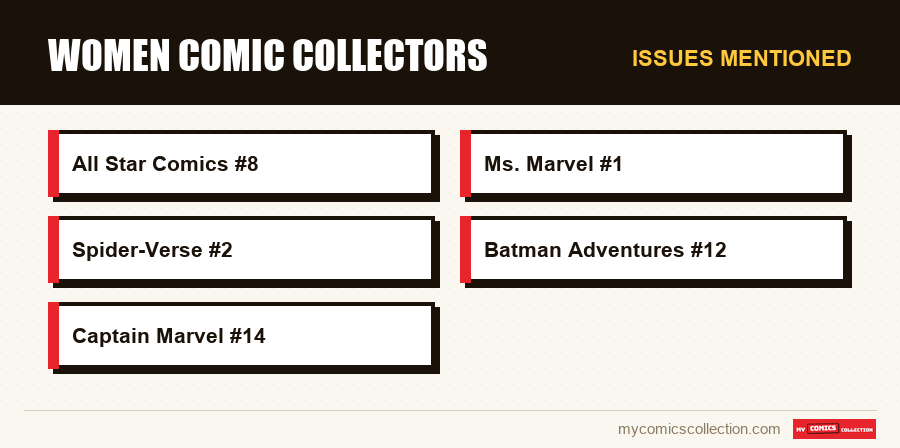
On April 6, 1941, a Sunday strip entitled "The Black Fury" appeared in newspapers distributed by the Bell Syndicate. It is signed Tarpé Mills: in reality June Tarpé Mills, who chose to publish only under her first name to conceal her gender from a profession which then had almost no women behind the drawing table. Renamed Miss Fury in November 1941, the strip anticipated the first appearance of Wonder Woman (December 1941, in All Star Comics #8) by more than six months.
Miss Fury lasted a full decade, until December 1951, syndicated in around 100 newspapers at its peak during World War II. The reissues published by Timely Comics, the ancestor of Marvel, have sold, according to available sources, up to a million copies per issue on newsstands. This is a circulation figure, not a current collector's value: period copies in good condition are today rare and sought after by Golden Age specialists, precisely because Miss Fury remains the first great superheroine entirely designed by a woman.
Marie Severin and Ramona Fradon, the artists of the Silver Age
We had to wait until the 1950s and 1960s to see the emergence, this time among the two major publishers, of women artists occupying leading creative positions. Marie Severin joined Marvel in the 1950s and worked on the covers and interior pages of Namor, Hulk, The Amazing Spider-Man, Iron Man, Conan the Barbarian, Kull the Conqueror, Hellcat and Daredevil: a CV that covers a good part of the Marvel catalog of the time. His work earned him an Eisner Award, the industry's highest honor.
At DC, Ramona Fradon co-created two characters still active in the DC universe today: Metamorpho and Aqualad, Aquaman's young teammate. Honored with two Eisner Awards during her career, she is today considered one of the artists who paved the way for a next generation of cartoonists, several of whom went on to engage more explicitly with feminist causes within the medium.
Trina Robbins, the historian and activist
A pivotal figure in the 1970s, Trina Robbins first drew in the underground press before co-producing It Ain't Me Babe in 1970, considered the first comic book entirely designed by women: script, drawing, inking, lettering. She is also credited with designing Vampirella's costume for Warren Publishing. But it is above all her work as a historian that has changed the way the industry tells its own history: her books Women and the Comics (1985), A Century of Women Cartoonists (1993) and Pretty in Ink (2013) have documented, name by name, decades of female contributions previously absent from reference books on the medium.
What the figures really show about female readers and collectors
The numerical data available on the distribution by genre of comics readership remains partial and comes from different methodologies, which prohibits any strict term-to-term comparison. But when taken together, they show a clear trend: a continuous progression on the part of women since the 1990s.
In France, the GfK study carried out in partnership with the National Publishing Union (covering a sample of 15,000 respondents aged 10 and over, with data collected since 2013) placed in 2017 the share of female buyers of comics, comics and manga at 53%, compared to 59% for the entire book market and for general literature specifically. The comics/comics/mangas segment therefore remained, at that date, the one where the male share was the most marked among the major editorial categories, while being far from a "men only" market: the typical buyer in this segment also had an average age of 33.6 years, significantly younger than the average for the book market.
In the United States, an NPD BookScan study presented during the NYCC Insider Sessions in October 2017 put forward more contrasting figures: 63% of comics and graphic novels were then purchased by men compared to 37% by women across the market as a whole, this imbalance widening significantly in physical comic shops (72% men) and narrowing in online sales channels. This gap between specialized stores and online purchases is consistent with the observation, widely documented elsewhere, of a comic shop culture that is historically less welcoming to newcomers than digital channels or general bookstores.
In the specific segment of digital comics, more recent and less marked by the legacy of the traditional comic shop, the distribution is significantly more balanced: the most recent market studies suggest a share of 42% of female readers compared to 58% of male readers, for a global total estimated at around 50 million monthly readers of digital comics. The digital format, which bypasses both the geography of the comic shop and part of its social codes, therefore seems to have played an accelerating role in the expansion of the female readership over the last ten to fifteen years.
For the collector who is interested in market value rather than reading alone, this demographic shift has a concrete consequence: series and runs that have historically mobilized a large and loyal female readership benefit from a deeper and more lasting demand base than certain titles driven by a single media peak.
Collecting this series?
Track what you own, what you are missing and what your collection is worth. 7 day trial.
Start my trial →The series and characters that have redesigned the market since the 2010s
Wonder Woman: a more collective origin than it seems
Wonder Woman herself illustrates the complexity of this story. The character is officially created by psychologist William Moulton Marston, inventor with his wife Elizabeth Holloway Marston of an early prototype of the lie detector. But historical sources converge on one point: it was Elizabeth Holloway Marston who suggested to her husband that the new superhero he planned to create for DC should be a woman. The character's physique (black hair, slender silhouette) would also have been inspired by Olive Byrne, the couple's life partner, whose heavy metal bracelets would have directly inspired those worn by Wonder Woman to deflect bullets. The character made his first appearance in All Star Comics #8, dated December 1941.
Captain Marvel and the Carol Corps: when a readership gives itself a name
In 2012, screenwriter Kelly Sue DeConnick took over the character of Carol Danvers and took her from the status of Ms. Marvel to that of Captain Marvel, with a redesigned costume, abandoning the low-cut swimsuit-style jumpsuit in favor of a more functional pilot outfit, and highlighting her military past in the US Air Force. DeConnick's run sparked a fan phenomenon unusual for the time: a largely female readership nicknamed itself the "Carol Corps", tattooed itself with the character's symbol, organized gatherings at conventions and popularized the hashtag #carolcorps. This fan movement was sufficiently recognized by the publisher to inspire its own miniseries, Captain Marvel and the Carol Corps, published as part of the Secret Wars event. The Captain Marvel film released in 2019, starring Brie Larson, then became the first superheroine feature film to exceed $1 billion in global revenue, consolidating the character's place among the most recognized figures in the Marvel universe.
Kamala Khan: the first Muslim heroine to have her own title at Marvel
In November 2013, Marvel announced that an American-Pakistani teenager from Jersey City, Kamala Khan, would take up the name Ms. Marvel starting in February 2014. The character was born from a conversation between editors Sana Amanat and Stephen Wacker, then developed by screenwriter G. Willow Wilson with artists Adrian Alphona and Jamie McKelvie. On this occasion, Kamala Khan becomes the first Muslim character to carry a monthly series in her own name at Marvel. The series will enjoy lasting critical and commercial recognition, before being adapted into a television series on Disney+ in 2022, which made Ms. Marvel #1 from 2014 one of the most sought-after "key issues" of the 2010 decade among collectors, all categories combined.
Spider-Gwen: a character born from a simple cover test that became a full-fledged series
In September 2014, screenwriter Jason Latour and artist Robbi Rodriguez introduced, in Edge of Spider-Verse #2, an alternative version of Gwen Stacy bitten by the radioactive spider in place of Peter Parker on Earth-65: Spider-Woman, quickly nicknamed Spider-Gwen by fans. The reception was such that publisher Nick Lowe announced in October 2014, during New York Comic Con, the launch of a dedicated monthly series, which would begin in February 2015. The character, carried by his distinctive costume design (white and pink hood instead of the traditional full face mask), quickly became one of the most worn costumes in cosplay at conventions, a qualitative indicator often correlated with the demand for collection on the first appearances.
Harley Quinn: from cartoon to cult comic book
Unlike previous characters, Harley Quinn was not created by a woman: she was imagined by Paul Dini and Bruce Timm for the series Batman: The Animated Series in 1992, before making her very first comic book appearance in Batman Adventures #12, dated September 1993, where she shared the cover with the Joker in a story entitled "The Last Laugh?". But the character was then carried, developed and widely adopted by screenwriters and a very predominantly female readership, to the point of becoming one of the most cosplayed DC characters in the world. The number of copies of Batman Adventures #12 certified by CGC is now around 9,000, with no reliable distinction in the census between the newsstand edition, which is significantly rarer, and the edition intended for comic shops. A CGC 7.0 graded copy was, for example, recently offered for sale at around $600, with higher grades trading significantly higher, with demand exceeding the supply available at very high grades since the success of the Suicide Squad film in 2016.
The impact of adaptations on the rating
The transition to the screen remains, for characters born or relaunched with a strong female readership, one of the main triggers of demand for collecting: a mechanism which has nothing specific to the gender of the characters, but which is observed with striking regularity on these specific titles.
The film Captain Marvel (2019) placed Carol Danvers among the most recognized figures in the Marvel Cinematic Universe, with over $1 billion in worldwide revenue and the status of the first superheroine film to cross that threshold. The character's seminal runs, particularly those related to Kelly Sue DeConnick's 2012 relaunch that redefined her visual identity and military background, remain sought-after references by collectors who follow the character's full editorial history rather than just the much earlier historic first appearance of Carol Danvers.
The Disney+ series Ms. Marvel, broadcast from 2022, had a comparable effect on Ms. Marvel #1 (2014): the issue is now systematically presented by specialist sellers as a "key issue" linked to a Disney+ adaptation, alongside its intrinsic value of the first appearance of Kamala Khan in her own costume and under her own superhero name.
Finally, the animated series Harley Quinn, broadcast since November 2019 first on DC Universe then on HBO Max, has established itself as one of the most popular programs on the platform, with 87% positive reviews recorded on Rotten Tomatoes. This success continues a movement already started by the 2016 film Suicide Squad, which initially propelled Batman Adventures #12 to the forefront of the collection, and continues to fuel a sustained demand for the character's first appearances and notable runs, including those which do not have a direct link to animation.
Buying guide for building a collection around these series
Whether you are the collector yourself or are looking to build a coherent collection around characters and designers who have marked this history, a few concrete guidelines allow you to buy methodically rather than instinctively:
- Distinguish the first appearance from the series launch. For Kamala Khan, the first appearance as a character dates back to Captain Marvel #14, while Ms. Marvel #1 (2014) marks the start of her own series under her own name: the two issues do not have the same meaning for a collector and deserve to be identified separately before any purchase.
- Systematically check whether there is a newsstand (kiosk) variant. This is the case of Batman Adventures #12: these editions, distributed on newsstands rather than in comic shops, are structurally rarer than the standard direct market edition, without this always being visible at first glance on an ad.
- Do not confuse original edition and reissue distribution. The "million copies per issue" sometimes cited for reissues of Miss Fury at Timely concerns newsstand circulation in the 1940s, not the current rarity of period copies still in circulation, which remains very limited after more than eight decades.
- Consider a character's entire editorial history, not just its first issue. For Captain Marvel, Kelly Sue DeConnick's 2012 run is as sought-after, for different reasons, as Carol Danvers' very first appearance in the 1960s: they are two distinct moments in the same collecting story.
- Be wary of ads that date a “first appearance” without specifying the context. Harley Quinn first appeared on screen in 1992 before her first appearance in comic books in 1993: a seller who confused the two dates misled the real nature of the item offered.
- Monitor the latest adaptations upstream rather than in reaction. Series or movie announcements almost always generate a peak in demand before the broadcast itself; Identifying the characters considered for adaptation early allows you to buy before the odds adjust.
- Accurately document each issue in your collection. Publisher, exact publication date, cover artist, print run (newsstand or direct market) and provenance are information that is quickly lost if not noted at the time of purchase: a use for which a dedicated collection tracking application, such as the comic collection application, significantly simplifies the work compared to a general spreadsheet.