Comics centered on female heroines have experienced a remarkable renaissance since the 2010s. Between the explosion of characters like Kamala Khan (Ms. Marvel) and Gwen Stacy (Spider-Gwen), the resurgence of classics like Wonder Woman and Captain Marvel boosted by MCU adaptations, and the emergence of revolutionary indie works like Saga and Monstress, the female comics market has never been richer or more diverse.
Comics centered on female heroines have experienced a remarkable renaissance since the 2010s. Between the explosion of characters like Kamala Khan (Ms. Marvel) and Gwen Stacy (Spider-Gwen), the resurgence of classics like Wonder Woman and Captain Marvel boosted by MCU adaptations, and the emergence of revolutionary indie works like Saga and Monstress, the female comics market has never been richer or more diverse.
This guide covers the best series and key issues centered on heroines to collect in 2026. Whether you're a Marvel or DC superheroine fan, a visual heroic-fantasy enthusiast, or a narrative sci-fi lover, this selection covers iconic issues, must-read runs, and the most significant first appearances in the genre. A guide for passionate collectors, men and women, who recognize that comic heroines deserve a prime spot in any serious collection.
Wonder Woman: iconic series
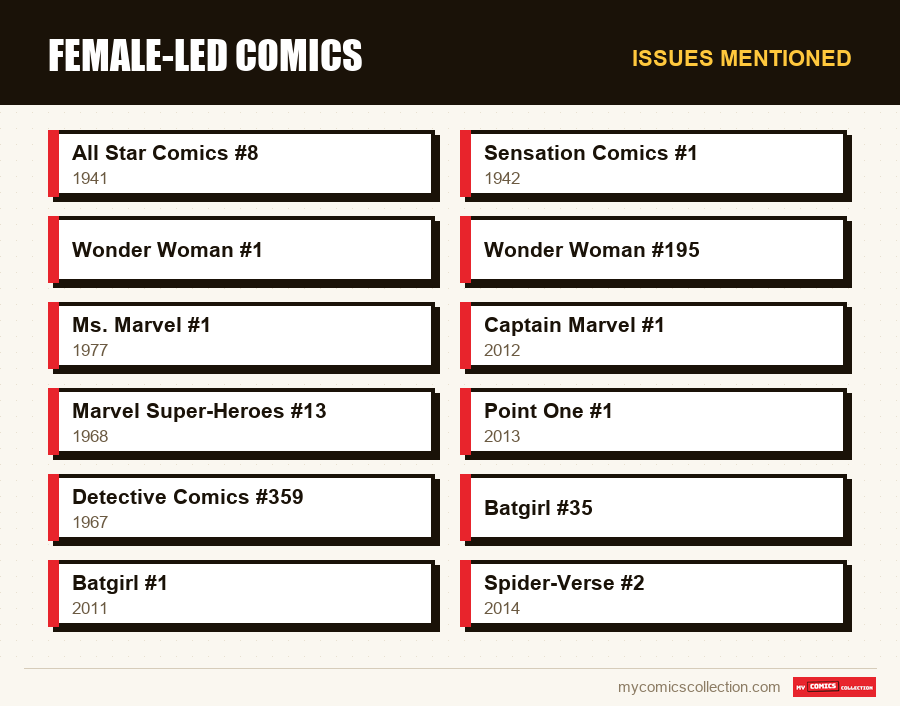
Wonder Woman is the oldest and most influential superheroine in comics history. Created by William Moulton Marston and H.G. Peter in 1941, she's embodied the archetype of the divine warrior for over 80 years. Her first appearance in All Star Comics #8 (1941) is an extremely rare and expensive Golden Age issue. Her first solo series Sensation Comics #1 (1942) is in the same rarity bracket.
For modern collectors, the most interesting runs are multiple. George Pérez's run (Wonder Woman #1-62, 1987-1992) redefined the character after Crisis on Infinite Earths by deeply anchoring Greek mythology in the DC universe. Greg Rucka's run (Wonder Woman #195-226, 2003-2005) is considered one of the most serious and nuanced treatments of the character. Finally, Brian Azzarello and Cliff Chiang's New 52 run (Wonder Woman #1-35, 2011-2014) is the most accessible today and offers a dark, fascinating vision of Olympus.
Captain Marvel and Ms. Marvel: MCU key issues
Captain Marvel (Carol Danvers) held several identities before taking that name: Ms. Marvel from Ms. Marvel #1 (1977), Binary, Warbird, and finally Captain Marvel from Captain Marvel #1 (2012): the first issue of her first solo series as Captain Marvel, written by Kelly Sue DeConnick. This issue became a significant key issue after the Captain Marvel film announcement (2019) and remains an emblematic piece for any modern Marvel collector.
The most documented Carol Danvers key issues are: Marvel Super-Heroes #13 (1968), her very first appearance as a secondary character; Ms. Marvel #1 (1977), her first solo series; and Captain Marvel #1 (2012), which marks her definitive identity change to Captain Marvel.
Kamala Khan (Ms. Marvel) took over the Ms. Marvel title starting with All-New Marvel NOW! Point One #1 (2013) for her first appearance, and Ms. Marvel #1 (2014) for her first solo series. These issues saw a significant visibility bump with the Disney+ series announcement and The Marvels film.
Batgirl: must-read runs
Batgirl (Barbara Gordon in her best-known identity) is one of DC's narratively most complex heroines. Her first appearance as Batgirl is in Detective Comics #359 (1967): a significant and sought-after Silver Age DC issue. Barbara Gordon was later paralyzed in Batman: The Killing Joke (Alan Moore, 1988), one of the most controversial but best-selling comics in DC history.
The Batgirl of Burnside run (Cameron Stewart, Brenden Fletcher, and Babs Tarr, Batgirl #35-52, 2014-2016) radically modernized the character and still attracts new readers in 2026. In New 52, Batgirl #1 (2011) by Gail Simone shows Barbara Gordon's return to the mask after her rehabilitation: an emotionally powerful, accessible issue.
Spider-Gwen and Ghost-Spider: from fan favorite to icon
Spider-Gwen (Gwen Stacy as Spider-Woman of her alternate dimension) is one of Marvel's most remarkable characters of the 2010s. Created by Jason Latour and Robbi Rodriguez, she first appears in Edge of Spider-Verse #2 (2014). This issue literally exploded in popularity after the animated film Spider-Man: Into the Spider-Verse (2018) and its sequel Across the Spider-Verse (2023).
Her first solo series, Spider-Gwen #1 (2015), is also a number to document. The character was later renamed Ghost-Spider:Ghost-Spider #1 (2019): to avoid confusion with other characters named Spider-Woman. Rodriguez's original covers on the early issues are particularly sought-after for their unique aesthetic.
Create your heroines wishlist
Organize your Marvel, DC, and indie female series with My Comics Collection. Your heroines key-issues wishlist accessible everywhere, updated in real time.
Create my heroines wishlistHarley Quinn: from supervillain to must-know antihero
Harley Quinn is one of the DC characters with the biggest narrative and commercial arc since her creation. Born in the animated series Batman: The Animated Series in 1992, she first appears in comics in Batman Adventures #12 (1993): one of the earliest comic appearances of a TV-created character, and an issue whose price has significantly progressed.
Her first appearance in the main DC continuity is in Batman: Harley Quinn #1 (1999), a one-shot that transposes her into the regular DC universe. Her first solo series, Harley Quinn #1 (2013, New 52) by Amanda Conner and Jimmy Palmiotti, was a commercial hit and remains very accessible for collectors. The post-2016 Harley Quinn series, boosted by the Suicide Squad film, also has several notable issues.
Saga and the great indie heroines
Saga (Brian K. Vaughan and Fiona Staples, Image Comics, since 2012) is technically a sci-fantasy series, not a superheroine comic, but its heroine Alana is one of the most complex and endearing female figures in contemporary comics. Saga #1 (2012) quickly became hard to find in first printing: copies in very good condition are sought after. The series has won numerous Eisner Awards and is regularly cited among the best series of the 2010s.
Monstress (Marjorie Liu and Sana Takeda, Image Comics, since 2015) is perhaps the most visually dazzling comic of the last decade. Set in a unique Asian heroic-fantasy universe, it follows Maika Halfwolf, a disfigured young woman carrying a demon within her. Monstress #1 (2015) won six Eisner Awards in its first year, making it one of the most acclaimed contemporary indie comic debuts.
Collecting this series?
Track what you own, what you are missing and what your collection is worth. 7 day trial.
Start my trial →The female first appearances that have progressed most
Here's a recap of heroine-centered key issues whose visibility and demand have most evolved in recent years, per available market data:
- Edge of Spider-Verse #2 (2014): first Spider-Gwen. Significant progress post-Spider-Verse animated films.
- Ms. Marvel #1 (2014): first Kamala Khan solo series. Boosted by Disney+ series and The Marvels.
- Captain Marvel #1 (2012): first Carol Danvers solo as Captain Marvel. Progress post-2019 film.
- Batman Adventures #12 (1993): first Harley Quinn comic appearance. Strong sustained progress since 2016.
- Amazing Spider-Man #194 (1979): first Black Cat appearance. Renewed interest in recent years.
- Monstress #1 (2015): six Eisner Awards in year one, well-established collectible status.
- Saga #1 (2012): first printing sought after, hard to find in good condition.
- Ghost-Spider #1 (2019): follow-up to Spider-Gwen popularity, accessible modern issue.
- Detective Comics #359 (1967): first Batgirl (Barbara Gordon). Sought-after Silver Age DC.
- All-New Marvel NOW! Point One #1 (2013): first Kamala Khan appearance. Key issue for Ms. Marvel collectors.
Collecting tip: Modern heroine-related key issues (Edge of Spider-Verse #2, Ms. Marvel #1 2014) often exist in multiple cover variants. The standard A cover is generally the most sought-after for collection, but some artist variants also have their own value. Precisely document which variant you own in your catalog to avoid confusion on resale or trade.
How to build a cohesive heroines collection
Building a themed collection focused on heroines is one of the most satisfying approaches to comic collecting. Here are some principles to build it methodically:
Choose a thematic angle
Start by defining your angle: do you prefer Marvel, DC, or indie heroines? Historic first appearances or complete modern runs? A collection focused on one or two characters will give you more satisfaction than a scattered approach.
Document first appearances
For each heroine who interests you, identify her absolute first appearance, her first solo series, and her most important run. These three points form the backbone of your collection for that character.
Mix publishers and genres
The best heroines collections combine Marvel, DC, and indie publications. A Monstress #1 alongside a Captain Marvel #1 and a Batgirl #1 offers a richer, more representative vision of the genre's diversity than limiting yourself to one publisher.
Catalog precisely from the start
Systematically note the edition, volume, cover variant, and condition of each issue. For themed collections, catalog precision matters even more because variants are numerous and identification errors costly.
FAQ: Heroines comics to collect
Manage your collection with a complete catalog
My Comics Collection lets you catalog all your heroines series (Marvel, DC, Image) with cover variants, condition, and price for each issue.
Catalog my heroines