Ms. Marvel (2022), created by Bisha K. Ali with Iman Vellani, adapts Kamala Khan, the teenage superhero born in Ms. Marvel #1 (2014) by G. Willow Wilson and Adrian Alphona. The series maintains her fan energy and her daily life in Jersey City, but changes the origin of her powers: in the comics, she is an Inhuman transformed by the Terrigen mist; the series ties her powers to an ancestral bracelet and reveals that she is a mutant. Here is the detailed comparison, series versus comics.
The freshest and brightest series in the Marvel universe, Ms. Marvel adapts one of the most beloved creations of the 2010s. It captures the spirit of the character while revamping the origin of her powers. Source-by-source decryption.
As in each article in this series, only verified information (creators, distribution, dates, comic numbers) is stated; the comparative analysis is ours, without reproducing dialogue or protected images.
Title : Ms. Marvel (2022)
Creator: Bisha K. Ali
Main actress: Iman Vellani (Kamala Khan / Ms. Marvel)
Broadcast: June-July 2022, Disney+ (6 episodes)
Studio: Marvel Studios
Ms. Marvel #1 (2014): 1st series by Kamala Khan (Wilson & Alphona)
Inhuman Origin: the Terrigen mist (comics)
Captain Marvel #14 (2013): Kamala cameo
Magnification Powers (“embiggen”): his signature
- Kamala Khan, teenager from Jersey City, absolute fan of Captain Marvel.
- Sa Pakistani-American family and its Muslim community.
- Her fan energy, his humor and his enthusiasm.
- The theme of identity and belonging.
- His passage from dream of heroism, from fangirl to superheroine.
- The origin of powers: an ancestral bracelet, instead of the Terrigen mist from the comics.
- The nature of the powers: energy and light constructs, instead of the elasticity of comics.
- Kamala becomes a mutant, and not an Inhuman.
- A jinn ancestry (the ClanDestine) is added.
- The context of the Partition of India is integrated into his family history.
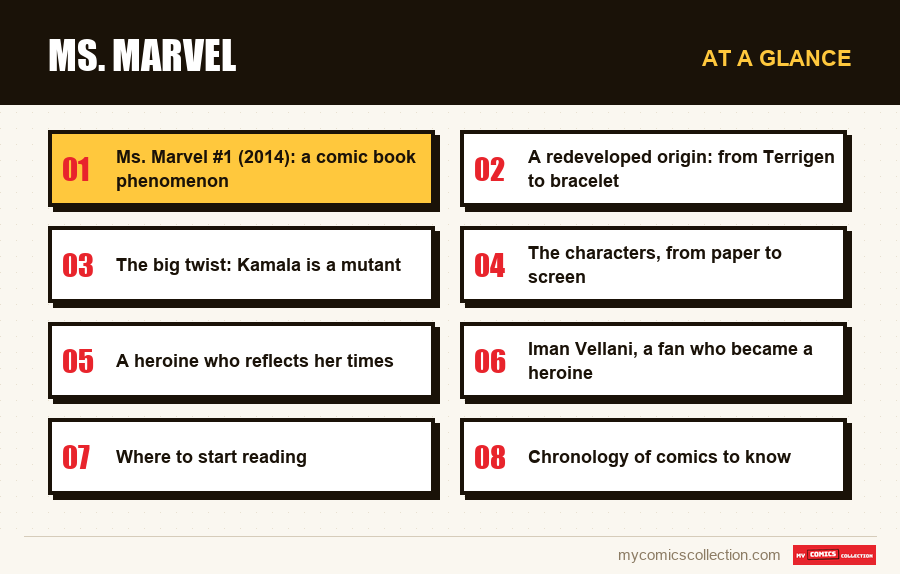
Ms. Marvel #1 (2014): a comic book phenomenon
Kamala Khan is one of Marvel's most notable creations of the 2010s. She first appeared in a cameo in Captain Marvel #14 (2013), before having her own series with Ms. Marvel #1 (2014), created by G. Willow Wilson and Adrian Alphona. An American teenager of Pakistani origin, Muslim, unconditional fan of superheroes and Captain Marvel in particular, she became a heroine herself: one of the first Muslim figures to carry her own series at Marvel. Its success, immediate and lasting, is due to its freshness, its humor and its way of embodying questions of identity, belonging and dual culture. The series faithfully adapts this spirit: everyday life in Jersey City, family, community, and above all this energy of a fangirl who becomes a superhero. Iman Vellani, herself a fan of the character, plays Kamala with praised accuracy.
This fidelity to the spirit of the character (his enthusiasm, his endearing awkwardness, his cultural anchoring) is the great success of the series. She captures what made Kamala a phenomenon: a heroine with whom a generation of readers could finally identify.
A redeveloped origin: from Terrigen to bracelet
The series takes major liberty with the origin of Kamala's powers. In the comics, she is an Inhuman: her abilities are revealed after exposure to the Terrigen mist, and her signature power is elasticity: she can enlarge or shrink parts of her body, notably her giant fists (the famous "embiggen"). The series changes all that: his powers come from an ancestral bracelet passed down in his family, allowing him to manipulate light energy and create solid constructs. This change, motivated in particular by questions of rights for Inhumans, transforms the very nature of the heroine. The series, however, retains a nod to his giant fists, a tribute to his comic book signature.
The big twist: Kamala is a mutant
The most commented revelation of the series comes in its finale: Kamala is not an Inhuman, but a mutant, carrying the X gene. This twist, absent from the original comics, realigns the character with the X-Men universe and prepares her integration into a major part of Marvel mythology. The series also adds a particular ancestry (a lineage linked to the djinns and the ClanDestine, a group of magical creatures from the comics) as well as a strong historical anchor in the Partition of India of 1947, which gives Kamala's family history a new depth. These additions, specific to the series, enrich the character while moving away from his Inhuman origins. Notably, following the series, the comics themselves ended up making Kamala a mutant, a rare example of an adaptation influencing its source material.
The characters, from paper to screen
- Kamala Khan / Ms. Marvel: Faithful to his fan spirit and his daily life, reorganized origin of powers.
- The Khan family: True to the warmth and Pakistani-American culture of comics.
- Bruno and Nakia: Kamala's friends, taken from the comic series.
- The ClanDestine: Magical creatures from the comics, integrated into Kamala's ancestry.
- Captain Marvel: Kamala's idol, whose shadow hovers over her journey.
Collecting this series?
Track what you own, what you are missing and what your collection is worth. 7 day trial.
Start my trial →A heroine who reflects her times
The strength of Ms. Marvel, in the comics and on screen, lies in its ability to reflect a generation that was hitherto little represented. Kamala is not just a superhero: she is a Muslim teenager, the daughter of immigrants, torn between her cultures, her family duties and her dreams. This dimension, at the heart of the 2014 comic series, is faithfully brought to the screen, with particular attention to cultural authenticity. The series tackles questions of identity, faith and belonging with an accuracy rare for mainstream entertainment, making Kamala a symbol of inclusion. In this, it extends the ambition of its creators, who wanted to offer a heroine with whom new readers could identify.
This authentic representation explains the strong emotional connection that the character arouses. Ms. Marvel is not just another heroine: she embodies an opening of the Marvel universe to new faces and new voices, a major evolution of the comics of the 2010s that the series fully celebrates. For many, seeing Kamala on screen has the same significance as her creation on paper: that of long-awaited recognition.
Iman Vellani, a fan who became a heroine
A tasty aspect of the series is due to its main performer: Iman Vellani, chosen to play Kamala, is herself an absolute fan of the character and the Marvel universe. This match between the actress and her role creates a disturbing echo with the character itself, Kamala being precisely a superhero fangirl who becomes one of them. This authenticity is felt on screen: Vellani's enthusiasm is not played, it is lived, which gives the series a rare sincerity. By entrusting the role to a young actress who shares the culture and passion of her character, the production captured what made the essence of Kamala in the comics: a heroine born from the love of superheroes, for the fans, by a generation which finally recognizes itself on screen.
This choice illustrates a truth that comics understood as early as 2014: Kamala Khan works because she is, above all, one of us. His strength does not lie in his powers, but in his amazed look at a world of heroes, and in his determination to find his place there. The series, carried by an actress who embodies this passion, faithfully extends this spirit. She also reminds us that representation matters: seeing a Muslim heroine, the daughter of immigrants, carried by an actress who looks like her, has a scope that few adaptations achieve. It is this meeting between a character and his interpreter that makes Ms. Marvel a success beyond its simple fidelity to the comics.
Where to start reading
Priority reading is the “Ms. Marvel” series by G. Willow Wilson and Adrian Alphona (2014), one of the freshest and most acclaimed of the decade, direct source of the series. We can then follow Kamala's adventures within the Avengers and the Champions. To understand the link with Captain Marvel, Kelly Sue DeConnick's run (2012) sheds light on Kamala's idol. From 2013 to today, this journey covers the rise of a heroine who has become essential.
Chronology of comics to know
- 2013: Captain Marvel #14: Kamala Khan cameo.
- 2014: Ms. Marvel #1: the Kamala Khan series (Wilson & Alphona).
- 2020s: the comics in turn make Kamala a mutant, in the wake of the series.
Collection side: what numbers to aim for after the series
Ms. Marvel highlights a promising modern key. Ms. Marvel #1 (2014, Kamala Khan's first series) is a recent issue whose popularity has soared with the growing popularity of the character on screen, both in the series and in The Marvels. It is a first appearance in series of a heroine who has become a phenomenon, still accessible for a first thematic purchase. As always, condition and gradation determine value; relying on real recent sales is strongly recommended. Ms. Marvel #1 is a great opportunity to bet on an emerging heroine whose importance continues to grow, a coherent bet for a collector attentive to trends.
Its place in the saga and for the collector
Ms. Marvel introduced a heroine destined to become central, while initiating, via the mutant twist, the integration of the X-Men into the saga. For the collector, the series has revived interest in Ms. Marvel #1, the first serial appearance of a very popular character. It illustrates the effect of series on the market, particularly for recent creations. Beyond speculation, the series invites you to discover one of the most refreshing comics of the 2010s, hailed for its authenticity and generosity. By bringing Kamala to the screen with such care, the series confirms that the most endearing heroes are often those in whom the audience can recognize themselves: a lesson that the comics had already understood in 2014.
The verdict: the faithful spirit, the reinvented origin
- Loyalty: Kamala's fan energy, her family, her community, and the theme of identity come from the comics.
- Freedoms: the origin of the powers (bracelet instead of the Terrigen), the nature of the powers, the mutant twist and the jinn ancestry.
- Collectible numbers: Ms. Marvel #1 (2014), Kamala Khan's first series.
Ms. Marvel adapts one of the most beloved heroines of recent comics with remarkable fidelity of spirit, while rearranging the origin of her powers. By making Kamala a mutant, the series moves away from its Inhuman source but prepares for its future: to the point of influencing the comics themselves. For the reader as well as the collector, it is an invitation to discover a comic book phenomenon and a first recent appearance to watch out for. In a rare case, the series even ended up influencing its source, the comics in turn adopting Kamala's mutant status: proof that a successful adaptation can dialogue with its original material, and not just copy it.
Frequently asked questions
From the series “Ms. Marvel” by G. Willow Wilson and Adrian Alphona (2014), which made Kamala Khan a phenomenon. The series retains its spirit while rearranging the origin of its powers.
In the comics, Kamala is an Inhuman with powers of elasticity ("embiggen"). The series links his powers to an ancestral bracelet and luminous energy, a change motivated in particular by questions of rights.
In the original comics, an Inhuman. The series reveals that she is a mutant, carrying the X gene. Notably, the comics then followed this choice, in turn making Kamala a mutant.
Very faithful: Kamala's fan energy, her daily life in Jersey City, her family and her community, as well as the themes of identity and belonging, are faithfully brought to the screen.
Ms. Marvel #1 (2014), Kamala Khan's first series, is the main target, a recent first appearance whose rating is rising with the popularity of the character.
Does the series make you want to collect? Estimate the value for free of your issues (Ms. Marvel #1…) with our tool based on current eBay listings.