WandaVision (2021), created by Jac Schaeffer with Elizabeth Olsen and Paul Bettany, adapts the married life of the Scarlet Witch and Vision, a theme explored in the miniseries “Vision and the Scarlet Witch”(1982 and 1985) by Steve Englehart and especially in “The Vision” (2015) by Tom King. Agatha Harkness comes from Fantastic Four #94 (1970), and Wanda's rewriting of reality evokes "House of M" (2005). Here is the detailed comparison, series versus comics.
The first Disney+ series from the Marvel universe, WandaVision left its mark with its audacious format: a tribute to American sitcoms which hides a deep drama on mourning. The series draws on several significant stories dedicated to Wanda and Vision. Source-by-source decryption.
As in each article in this series, only verified information (creators, distribution, dates, comic numbers) is stated; the comparative analysis is ours, without reproducing dialogue or protected images.
Title : WandaVision (2021)
Creator: Jac Schaeffer
Actors: Elizabeth Olsen (Wanda / Scarlet Witch), Paul Bettany (Vision), Kathryn Hahn (Agatha Harkness), Teyonah Parris (Monica Rambeau)
Broadcast: January-March 2021, Disney+ (9 episodes)
Studio: Marvel Studios
“Vision and the Scarlet Witch”(1982 & 1985): life as a couple (Englehart)
“The Vision”(2015): Tom King, the synthezoid family in the suburbs
Fantastic Four #94 (1970): Agatha Harkness's first appearance
“House of M”(2005): Wanda rewrites reality
- La domestic couple life of Wanda and Vision, in the suburbs.
- THE twins Billy and Tommy, children born from Wanda's magic.
- Agatha Harkness, witch and ambiguous mentor.
- Wanda's power rewrite reality, echoing “House of M”.
- Le grief as the tragic driving force of the story.
- The sitcom format, decade by decade, is an invention of the series.
- The Westview Hex, a bubble of altered reality, is specific to the series.
- Vision rebuilt by Wanda's magic, different from the comics.
- Monica Rambeau is integrated into the plot, an addition to the cinematic narrative.
- The origin of Wanda's powers (Red Witch, Darkhold) is redeveloped.
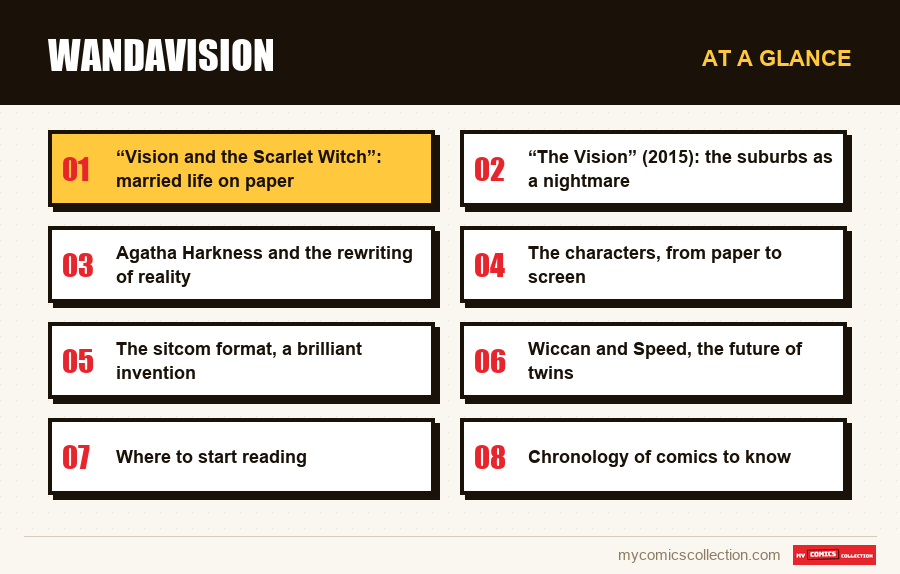
“Vision and the Scarlet Witch”: married life on paper
The heart of WandaVision, a superhero couple trying to live an ordinary domestic life, comes straight from the comics. The miniseries “Vision and the Scarlet Witch” (1982 and 1985), written by Steve Englehart, explored this idea: after getting married in the Avengers, Wanda and Vision move to the suburbs to start a home. These stories already mixed everyday suburban life and the supernatural, laying the foundations for everything that the series would develop. The drama arises from this tension: two extraordinary beings, one of whom is a synthezoid and the other a manipulator of chaos, seeking an impossible normality. The series faithfully takes up this premise, as well as the birth of the twins, Billy and Tommy, children that Wanda creates with her magic.
This quest for an ordinary life, doomed to failure by the very nature of the characters, is the tragic thread of the series and the comics. WandaVision makes it the subject of its discussion on mourning: the idyllic suburbs are only an illusion created by a woman incapable of accepting the loss of her loved one.
“The Vision” (2015): the suburbs as a nightmare
The series also owes a lot to a more recent and darker comic: “The Vision” (2015), by Tom King and Gabriel Hernández Walta. In this acclaimed story, Vision builds a synthezoid family, a wife and two children, and attempts to live a perfect suburban existence, in an impeccable house. But this forced normality slowly turns into a nightmare, revealing the impossibility for an artificial being to imitate human life. The WandaVision series directly takes up this aesthetic of the “Stepford suburb”, this perfect suburban setting where anxiety smolders. The idea of a facade of domestic happiness hiding a deep tragedy is at the heart of both works. King had made Vision's quest for normalcy a meditation on grief and identity; the series transposes this reflection onto Wanda.
Agatha Harkness and the rewriting of reality
Two other major elements come from the comics. Agatha Harkness, the witch revealed as an antagonist, first appears in Fantastic Four #94 (1970), created by Stan Lee and Jack Kirby, initially as a governess and ally. In the comics, she is also Wanda's mentor in witchcraft, a connection that the series exploits. Above all, Wanda's power to rewrite reality, at the center of the series via the Westview Hex, directly evokes “House of M” (2005) by Brian Michael Bendis, where Wanda, devastated by the loss of her children, turns the entire universe upside down. The series transposes this idea of a reality altered by grief, making the Hex a literal manifestation of Wanda's denial of grief.
The characters, from paper to screen
- Wanda / Scarlet Witch: Faithful to its power to rewrite reality, its mourning at the heart of the story.
- Vision: Reconstructed by Wanda's magic, echoing her quest for domestic life in the comics.
- Agatha Harkness: Witch from Fantastic Four #94, mentor and antagonist.
- Billy and Tommy: The twins born from magic, future Wiccan and Speed from the comics.
- Monica Rambeau: Integrated into the plot, a specific addition to the cinematic story.
Collecting this series?
Track what you own, what you are missing and what your collection is worth. 7 day trial.
Start my trial →The sitcom format, a brilliant invention
The greatest originality of the series, without equivalent in comics, is its format: each episode pays homage to a decade of American sitcoms, from the 1950s to the 2000s, with their visual codes, their recorded laughter and their aesthetic. This structure is not a simple gimmick: it is the very symptom of Wanda's disorder, who takes refuge in the reassuring world of television comedies from her childhood to escape her pain. The format thus becomes a metaphor for denial, each decade crossed reflecting a stage of its mourning. This purely television invention, grafted onto characters and themes faithful to the comics, illustrates the way in which adaptation can create its own form to serve the substance of its source.
This marriage between a new form and content deeply rooted in comics makes WandaVision a singular success. The series proves that an adaptation does not have to literally copy its sources to be faithful to them: by reinventing the form, it captures the spirit: here, the tragedy of a woman who refuses to accept loss, the central theme of the great stories of the Scarlet Witch.
Wiccan and Speed, the future of twins
An understated thread in the series deserves attention: the twins Billy and Tommy, whom Wanda creates with her magic. In the comics, their story is one of Marvel's most moving. Born from the magic of the Scarlet Witch, they are first "lost" during the upheavals which follow Wanda's decline, before being reborn under other identities: Billy becomes Wiccan and Tommy becomes Speed, both members of the Young Avengers, this team of young heroes called to succeed the Avengers. Wiccan, in particular, inherits some of his "mother's" reality-rewriting power, making him one of the most powerful characters of his generation. The series lays the foundations for this lineage by showing the creation of the twins, preparing their potential future in the saga.
This theme of children created and then lost, at the heart of Wanda's tragedy, resonates with the great stories of the Scarlet Witch. It illustrates a constant in comics: the way in which the consequences of an event extend over decades, reappearing in new forms. For the reader, discovering Wiccan and Speed in the Young Avengers is to understand the extent to which Wanda's maternal pain irrigated the Marvel universe well beyond her own story, and why the series made this mourning its most poignant subject.
Where to start reading
To extend the series, two readings are necessary. Tom King’s “The Vision” (2015) is the most direct source of aesthetic and subject matter, a masterpiece about family and loss. Steve Englehart's miniseries "Vision and the Scarlet Witch" (1980s) sheds light on the duo's married life. For Wanda's power, "House of M" (2005) is a must. Finally, the twins discover themselves in “Young Avengers” under the identities of Wiccan and Speed. From 1970 to 2015, this journey covers the sources of a series that draws on several decades of comics.
Chronology of comics to know
- 1970: Fantastic Four #94: First appearance of Agatha Harkness.
- 1982-1985: miniseries “Vision and the Scarlet Witch” (Englehart).
- 2005: “House of M”: Wanda rewrites reality.
- 2015: “The Vision” by Tom King: the synthezoid family in the suburbs.
Collection side: what numbers to aim for after the series
WandaVision highlights various keys. Fantastic Four #94 (first appearance of Agatha Harkness) is a sought-after Bronze Age issue, whose popularity has soared with the character's on-screen popularity. The issues of “House of M” (2005) and the collection of “The Vision” (2015) are accessible and important modern targets for understanding the series. These stories cover various budgets, from the Bronze Age to recent comics. As always, condition and gradation determine value; relying on real recent sales is strongly recommended. Fantastic Four #94 is a great target for a collector interested in mystical Marvel characters.
Its place in the saga and for the collector
WandaVision ushered in the era of Marvel series on Disney+ and laid the groundwork for Wanda's transformation into Scarlet Witch, an arc that Multiverse of Madness will continue. For the collector, the series reignited interest in Fantastic Four #94 and in the larger stories of Wanda and Vision. It illustrates the effect of series, in the same way as films, on the collectible market: a secondary character like Agatha Harkness can see the price of her first appearance increase. Beyond speculation, the series invites you to discover “The Vision” by Tom King, one of the most acclaimed comics of the 2010s, and to explore the tragic richness of the Scarlet Witch. By treating grief with rare formal audacity, WandaVision proved that series could rival films in ambition.
The verdict: mourning, in sitcom format
- Loyalty: the married life of Wanda and Vision, Agatha Harkness, the twins and the rewriting of reality come from the comics.
- Freedoms: the sitcom format, the Westview Hex, Vision rebuilt, the origin of the powers redeveloped.
- Collectible numbers: Fantastic Four #94 (Agatha), “House of M” (2005), “The Vision” (2015).
WandaVision adapts the life of the Scarlet Witch and Vision in a daring form, an homage to sitcoms, in the service of a moving statement on mourning. Faithful to “The Vision” by Tom King and the tragic power of Wanda, the series reinvents the form without betraying the substance. For both the reader and the collector, it is an invitation to discover one of Marvel's richest couples and the comics that shaped them.
Frequently asked questions
Miniseries “Vision and the Scarlet Witch” (1982-1985) on married life, “The Vision” by Tom King (2015) for the aesthetic of the suburbs, Agatha Harkness (Fantastic Four #94, 1970) and “House of M” (2005) for the rewriting of reality.
No, it's an invention of the series. Each episode pays homage to a decade of American sitcoms. This format is a symptom of Wanda's denial, who takes refuge in the comedies of her childhood to escape her grief.
A witch who appeared in Fantastic Four #94 (1970), first as a governess and ally, then as Wanda's mentor in witchcraft. The series makes him the antagonist who reveals to Wanda the extent of her powers.
The children that Wanda creates with her magic. In the comics, they return under the identities of Wiccan and Speed, members of the Young Avengers, after being "lost" during the upheavals of "House of M".
Fantastic Four #94 (first appearance of Agatha Harkness) Bronze Age side. The issues of “House of M” (2005) and the collection of “The Vision” (2015) are accessible modern targets.
Does the series make you want to collect? Estimate the value for free of your issues (Fantastic Four #94…) with our tool based on current eBay listings.