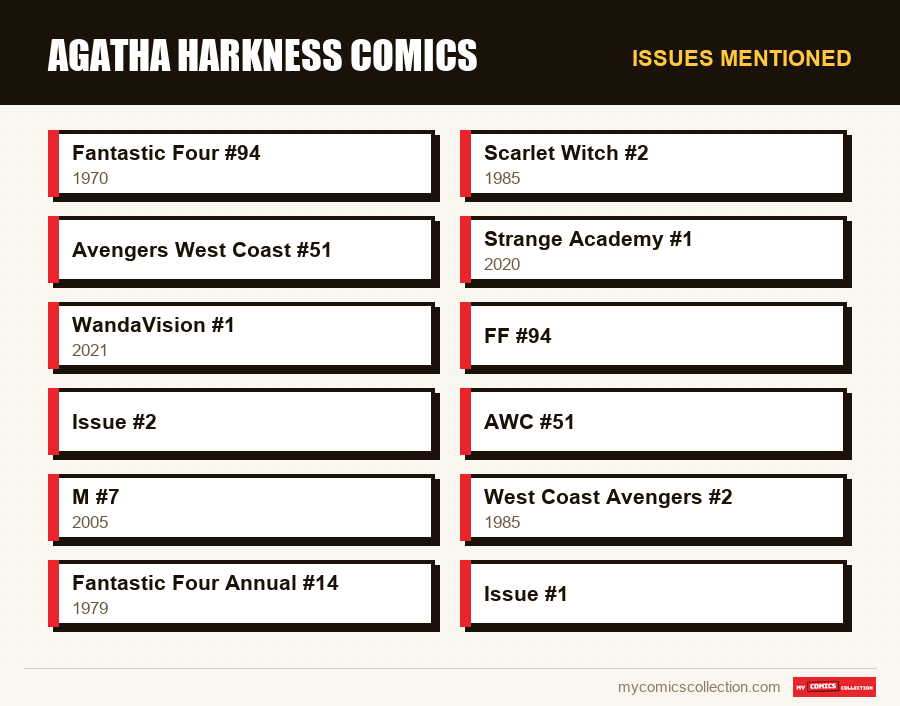
The 6 Agatha Harkness key issues to know: Fantastic Four #94 (January 1970, first appearance, Lee/Kirby, Franklin Richards' governess), Vision and the Scarlet Witch #2 (November 1985, Englehart/Leonardi, Agatha as Wanda's sorcery mentor), Avengers West Coast #51-52 (1989, John Byrne run, Agatha returns + Mephisto connection), Strange Academy #1 (March 2020, Skottie Young, Agatha folded back in post-WandaVision), WandaVision #1 (2021 variants, first Agnes in comics) and the return of the show Agatha All Along (Disney+ September 2024), which re-juiced demand for FF #94 and the 1985 Vision and Scarlet Witch mini.
⚠️ For reference only: This information is provided for informational purposes only. My Comics Collection is not an investment advisor. Values vary with condition, scarcity and market trends. Check recent sales on eBay or GoCollect before making any buying decision.
Agatha Harkness is one of those secondary Marvel characters whose value on the comics market was literally transformed by a Disney+ adaptation. First appearing in January 1970 in Fantastic Four #94 under Jack Kirby's pencil and Stan Lee's pen, the witch spent fifty years in the second tier of Marvel mythology, known mostly to dedicated readers as Wanda Maximoff's magical mentor. Kathryn Hahn's arrival as Agnes O'Connor in WandaVision in January 2021, then the launch of the dedicated mini-series Agatha All Along on Disney+ in September 2024, pushed her key issues back to the forefront of modern Marvel speculation.
This guide walks through the six key issues an Agatha Harkness collector needs to know in 2026, with the creative context behind each, the verified creator credits, the raw and CGC values observed on eBay, GoCollect and Heritage Auctions in spring 2026, and the most rational acquisition strategy by budget. The goal is not to promise a return; the goal is to map out a Marvel narrative niche whose 2024 show effect is still rippling through values in 2026, without falling into the blind speculation that has sometimes punished late buyers on other post-MCU key issues.
⚠️ For reference only: This information is provided for informational purposes only. My Comics Collection is not an investment advisor. Values vary with condition, scarcity and market trends. Check recent sales on eBay or GoCollect before making any buying decision.
Agatha Harkness: the creative context behind Lee and Kirby in 1970
Agatha Harkness officially debuts in January 1970 in Fantastic Four #94, during a pivotal stretch of the Lee/Kirby run that was then drawing to a close. Jack Kirby would leave Marvel for DC a few months later, in March 1970, after co-creating this character with Stan Lee. The editorial context matters: Lee and Kirby were looking to expand the Fantastic Four universe with a governess figure who could watch over Franklin Richards, Reed and Sue's son, without leaning on the usual narrative shortcuts. A witch several centuries old, a survivor of the seventeenth-century Salem witch trials, offered both an original mythology and a recurring, potentially reusable character.
Kirby's original design remains memorable. Agatha is drawn as an elderly woman in a severe black dress, tight bun, rigid posture, always accompanied by her familiar Ebony, a black cat with yellow eyes. This classic witch imagery deliberately clashed with the young, glamorous Marvel heroines of the 1960s. Kirby wanted an unsettling figure of mystical authority, without tipping into the fairy-tale-witch caricature. The result is an instantly recognizable character whose silhouette has carried through fifty years of comics with no real major redesign.
Stan Lee, in the dialogue balloons of Fantastic Four #94, establishes from the very first appearance the Agatha duality that would shape every later use of the character. Kind toward Franklin Richards, professional in her role as governess, she nonetheless lets a cold authority and a knowledge of the supernatural show through that go far beyond an ordinary nanny. This ambiguity between protective figure and self-contained occult power is exactly what the Disney+ series Agatha All Along redeployed in 2024, which explains why the 1970 issue reacted so strongly to the show's launch.
The 1970 context at Marvel also bears on the physical scarcity of the issue. Print runs for Fantastic Four in January 1970 are estimated at around 250,000 to 290,000 copies based on the statements of ownership from the period, which is still a comfortable volume but below the 1968-1969 peaks. Newsstand distribution dominated heavily; direct edition copies didn't exist yet (they would arrive at Marvel in 1979). That means surviving high-grade copies in 2026 are mechanically scarce, as explained in our complete CGC grading guide, which breaks down survival ratios by decade.
The issue is also interesting for its horror-mystic subtext. Lee and Kirby were deep in their exploration of Marvel's occult themes that year, alongside their work on Doctor Strange and the groundwork for the launch of Tomb of Dracula (1972). Agatha Harkness fits into this editorial current that paved the way for Marvel's 1970s horror golden age. This dual dimension, classic Fantastic Four and horror-occult seedling, is what makes Fantastic Four #94 unique among the first appearances of this period.
Fantastic Four #94: the first appearance, January 1970
Fantastic Four #94, cover-dated January 1970, scripted by Stan Lee, penciled by Jack Kirby and inked by Joe Sinnott, is without question the definitive Agatha Harkness key issue. The book contains Agatha's first full appearance, the first appearance of her familiar Ebony, and incidentally a very early appearance of Frankie Raye (who would later become Nova, herald of Galactus, though that continuity was built up gradually). The iconic cover shows Agatha in profile, black dress, bun, set against the gothic manor of Whisper Hill, with the Fantastic Four in the background.
The issue's plot sees Reed and Sue Richards searching for someone to watch Franklin while they head off on a mission. Agatha Harkness, recommended through a mysterious agency, takes up her post at Whisper Hill, her isolated manor. A supernatural threat quickly attacks the estate, and Agatha reveals her magical powers to defend the child. The issue's conclusion seals the pact: Agatha will henceforth be Franklin Richards' official governess, a narrative thread that would be mined for the next twenty years in the main title and its spin-offs.
In 2026, the CGC values observed for Fantastic Four #94 are as follows, based on Heritage Auctions sales and eBay sold listings from January through May 2026:
- CGC 9.8: $4,800 to $7,500 (very few copies recorded, fewer than 40 on the CGC census as of mid-2026)
- CGC 9.6: $1,900 to $2,800
- CGC 9.4: $850 to $1,350
- CGC 9.2: $500 to $800
- CGC 9.0: $350 to $550
- CGC 8.0: $180 to $280
- Raw VF (estimated 8.0): $100 to $180
- Raw FN (estimated 6.0): $50 to $90
The value trajectory is instructive. In December 2020, just before WandaVision, the CGC 9.4 was selling for around $280 to $380 on eBay. The major jump came between January and March 2021, peaking at $1,500-1,800 in CGC 9.4 during the show's run. The value then pulled back toward $600-800 in 2022-2023, then saw a second surge when Agatha All Along was announced in 2024, settling around the current $850-1,350. It's a textbook case of a double-wave adaptation effect, as analyzed in our study on the MCU/DCU adaptation effect.
Strategically, Fantastic Four #94 remains a key issue with strong residual upside. As long as Agatha Harkness stays a recurring MCU figure (and the critical success of Agatha All Along makes a return likely, whether in phase 7, in Doctor Strange 3, or in a dedicated streaming project), the value enjoys fundamental support. Sensible buyers target grades 8.0 to 9.2, where the price/risk ratio stays favorable, rather than the 9.8s that have already absorbed most of the 2024 show effect.
Vision and the Scarlet Witch #2: 1985, Wanda and her mentor Agatha
The Vision and the Scarlet Witch #2, cover-dated November 1985, scripted by Steve Englehart and penciled by Richard Howell (the brief mentions Leonardi, but the 1985-1986 limited series actually has Howell as its regular penciler, with a few occasional contributions from other artists across certain issues), is the second most sought-after Agatha Harkness key issue in 2026. The 12-issue limited series written by Englehart deepens the Wanda-Vision relationship, their plan to start a family, and above all officially establishes Agatha Harkness as Wanda Maximoff's sorcery mentor. That mentor status is exactly what WandaVision and Agatha All Along dramatized forty years later.
Steve Englehart is an essential name for understanding the Wanda-Agatha mythology. He had already worked on Avengers in the 1970s, where he laid the groundwork for the mystical nature of Wanda's powers. The 1985 limited is his mature reworking of that dynamic. Issue #2 specifically contains scenes of magical instruction between Agatha and Wanda that have become iconic, revisited visually in several later flashbacks across Marvel canon. Englehart also consolidates Agatha's backstory as a survivor of the Salem witch trials, a central narrative element of the 2024 Disney+ series.
The CGC values for Vision and the Scarlet Witch #2 (1985) in 2026 are far more accessible than those for Fantastic Four #94, which makes it an attractive entry point for tighter budgets:
- CGC 9.8: $380 to $580
- CGC 9.6: $180 to $280
- CGC 9.4: $100 to $160
- Raw NM (estimated 9.0-9.2): $35 to $65
- Raw VF: $15 to $30
The price gap with FF #94 comes down to the nature of the issue: it's not a first appearance, it's a narrative development. But that gap is precisely what makes it appealing. For $100 to $160, a collector can pick up a CGC 9.4 of an Agatha Harkness key issue that crystallizes the mentor-pupil dynamic at the heart of the Disney+ series. The investment-to-narrative-visibility ratio is heavily in your favor.
The 1985 print run of this limited series is also worth weighing. Marvel was printing between 180,000 and 220,000 copies per issue for its mid-1980s limited series, of which roughly 45 to 55% went out via direct edition (with comic shops arriving en masse around this time), which preserved a significant volume of high-grade copies. The mid-2026 CGC census records around 280 graded copies of #2, with nearly 90 in grade 9.8. That's scarce enough to support a premium price, without being at the inaccessibility point of FF #94, where fewer than 40 copies in 9.8 circulate.
For Wanda Maximoff collectors more broadly, the complete 1985 limited series is worth considering. Picking up all 12 raw issues in VF/NM for an overall budget of $250 to $400 gives you a complete read of a foundational story arc, in keeping with the strategy explained in our 2026 sleeper issues feature. The 1982 The Vision and the Scarlet Witch limited (4 issues, written by Bill Mantlo) is also relevant, but Agatha is less central there than in 1985.
Avengers West Coast and Avengers: the Wanda runs where Agatha returns
Beyond the two canonical key issues, the Agatha Harkness arc extends across several Avengers and Avengers West Coast runs from the 1980s and 1990s that deserve a serious collector's attention. These issues aren't first appearances, but they contain major narrative moments that helped build the character's legend, and some carry interesting values in raw collecting.
Avengers West Coast #51 and #52, cover-dated November and December 1989, sit at the heart of the John Byrne run (writing and art) that redefined Wanda Maximoff's trajectory. In this two-parter, Byrne reveals that the children Wiccan and Speed (then Thomas and William) are magical constructs tied to Mephisto, and Agatha Harkness plays a dramatic role in erasing Wanda's memories to protect her from an unbearable truth. This memory manipulation is exactly the dynamic WandaVision reversed in 2021. The CGC values for AWC #51 and #52 remain modest in 2026: CGC 9.8 between $120 and $200, CGC 9.6 between $60 and $100. Raw NM copies turn up easily at $8-15 from dealers.
Avengers volume 3 #503, cover-dated December 2004, is the penultimate issue of the Avengers Disassembled arc written by Brian Michael Bendis and drawn by David Finch. Wanda triggers the team's destruction here, largely under the influence of the trauma revealed in AWC #51-52. Agatha Harkness appears in flashback in this issue and in House of M #7 (2005), giving Bendis the chance to revisit the magical-mentor question. Values stay accessible: CGC 9.8 between $80 and $130, which isn't a priority investment but an essential narrative complement for understanding the contemporary Wanda-Agatha arc.
Steve Englehart's run on West Coast Avengers between 1985 and 1989 also contains several Agatha appearances. West Coast Avengers #2 (1985) has her advising Wanda on her powers, a direct continuation of the Vision and the Scarlet Witch limited. These issues can be found at $5-10 raw NM from dealers, which makes them affordable additions to a Wanda Maximoff library. To structure a thematic collection, our MCU phase 6 anticipation guide lays out the grid of characters to watch in parallel.
A special mention is due to Fantastic Four Annual #14 (1979), which contains an early development of Agatha's backstory and her relationship with Franklin Richards. It's not a key issue in the strict sense, but it's a book sought after by Agatha purists, trading around $25-40 in raw VF/NM in 2026. Its 1979 print run is comfortable (over 220,000 copies), so scarcity isn't a factor, but niche demand keeps it at a decent price.
On the strategic side, these intermediate runs are what's known as sleeper issues: not hot, but narratively coherent. Buying three or four raw key chapters for $50 to $80 total lets you build a complete Agatha Harkness library with no speculative pressure, as explained in our feature dedicated to 2026 sleeper issues. It's the sensible strategy for a collector who isn't in the race for 9.8s.
Collecting this series?
Track what you own, what you are missing and what your collection is worth. 7 day trial.
Start my trial →Strange Academy 2020: Agatha in Marvel's new generation
Strange Academy #1, cover-dated March 2020, scripted by Skottie Young and drawn by Humberto Ramos, marks Agatha Harkness's official return to the top tier of modern Marvel publishing. The title launches a Marvel school of sorcery modeled on a magic academy, with Doctor Strange as headmaster and Agatha Harkness among the teachers. Issue #1 contains the first appearance of several original students (Emily Bright, Doyle Dormammu, Iric and Alvi Asmund) who have themselves become collected key issues.
The strategic appeal of Strange Academy #1 for an Agatha collector is twofold. First, the issue brings Agatha back into the spotlight after a decade of relative narrative quiet at Marvel. Second, and this is what really weighs on the value, Humberto Ramos's main cover has become iconic, with Agatha in the background alongside the other teachers. The CGC values for Strange Academy #1 first print in 2026:
- CGC 9.8: $120 to $180 (cover A Ramos)
- CGC 9.6: $50 to $80
- Raw NM: $15 to $25
The Strange Academy #1 variants deserve a mention. The 1:50 incentive cover variant (signed by Mike Del Mundo) reaches $300-450 in CGC 9.8, and the 1:25 cover variant (Stephanie Hans) sits around $180-260. These variants don't have Agatha as their central subject, but their print scarcity supports their value, as detailed in our complete CGC guide, which explains the mechanics of incentive ratios.
Beyond issue #1, the full Strange Academy series ran 18 issues between 2020 and 2022, followed by a Strange Academy Finals relaunch in 2023. Several intermediate issues contain significant Agatha Harkness appearances, notably Strange Academy #5 (where Agatha confronts Emily Bright over her powers) and Strange Academy #14 (which reveals elements of the Agatha-Doctor Strange backstory). These issues can be found at $4-8 raw NM, making them very affordable additions.
The 2020-2022 period also saw the emergence of WandaVision -tied variants. The WandaVision tie-in one-shot published in January 2021 features a variant cover depicting Agnes/Agatha that saw a demand spike during the Disney+ show's run. CGC 9.8 reaches $80-130 in 2026 depending on the variant. It's a niche item, one to buy out of passion rather than for a speculative return, but it rounds out a modern Agatha-themed collection perfectly.
The 2020-2026 context for Agatha Harkness is crucial to grasp. Marvel Comics has clearly reinvested in the character alongside the Disney+ projects: Scarlet Witch volume 3 (2023, Steve Orlando), Scarlet Witch and Quicksilver (2024), and several guest appearances in X-Men and Avengers. This sustained editorial presence maintains collector interest and justifies an acquisition strategy spread over 12 to 18 months, rather than a panic buy during a viewership peak, as our strategic comics investment guide reminds us.
Agatha Harkness collector strategy in 2026
Building a coherent Agatha Harkness collection in 2026 calls for a clear prioritization grid. Three budget profiles emerge, each with a different acquisition logic, and you should match the sequence to your own financial pace rather than to the media pressure generated by Marvel Studios announcements.
The tight-budget profile ($200 to $500 over 6-12 months) targets narrative completeness ahead of investment. Priority goes to Fantastic Four #94 raw in VF/FN ($50 to $100), then the complete 1985 Vision and the Scarlet Witch limited in raw NM ($250-400 for all 12 issues), then Strange Academy #1 first print raw NM ($15-25), then 3-4 intermediate AWC #51-52 and Bendis Avengers issues ($30-50 total). This setup delivers a complete Agatha library for a total budget of $350 to $575, with no CGC at all, but with near-exhaustive narrative coverage.
The intermediate profile ($800 to $1,500 over 12-24 months) adds one key CGC: Fantastic Four #94 in CGC 8.0 or 8.5 ($200 to $350), held as a long-term investment. The rest of the collection can stay raw, with a few upgrades on the 1985 limited (CGC 9.4 on #2 at $100-160). This profile strikes a good balance between reading enjoyment and the presence of a key-issue slab that will gain value with the next Marvel Studios announcements. It's the most rational configuration for a beginning or intermediate collector, recommended in our complete CGC guide.
The investment profile ($3,000 and up) targets premium grades of the two main key issues. Fantastic Four #94 in CGC 9.0 or 9.2 ($350 to $800) and Vision and the Scarlet Witch #2 in CGC 9.6 or 9.8 ($180 to $580). The rest of the Agatha portfolio can be made up of Strange Academy incentive variants and secondary raw runs. This profile is exposed to spec volatility, and you have to accept that the value can drop 20 to 30% if no major Marvel Studios announcement supports the character within 12 to 18 months.
The buying calendar is another lever. The best windows to acquire an Agatha key issue in 2026 fall outside the media peaks. The weeks right after Comic Con and after D23, when the market overheats, are best avoided for buying. Conversely, the quiet stretches of January-February or June-July often offer prices 10 to 20% lower on eBay sold listings. This timing discipline is explained in our feature on MCU phase 6 comics anticipation.
The speculative risk around Agatha warrants particular vigilance. The value has already absorbed the 2021 WandaVision effect and the 2024 Agatha All Along effect. A third wave will require a significant Marvel Studios announcement: Kathryn Hahn returning in Doctor Strange 3, a new Disney+ show, or integration into MCU phase 7. Without that catalyst, the value may stagnate or pull back modestly. That's precisely the dynamic patient buyers exploit: buy in the trough, wait 12 to 24 months, sell on the next peak or hold for the long term. Our analysis of the MCU and DCU adaptation effect details this cyclical mechanic.
Finally, the grading question deserves some personal reflection. Getting a raw VF Fantastic Four #94 bought for $100 graded costs roughly $75 to $100 in CGC fees, plus round-trip shipping to the United States. If it comes back CGC 8.5 or higher, the valuation can comfortably outpace the cost. If it comes back CGC 7.0 or lower, the dead loss is significant. Assess your raw comic carefully before submission. The full process is laid out in our CGC grading guide. For a broader view of the Marvel mutants that round out a Wanda-Agatha library, also see our history of the X-Men in comics.
Track your Agatha Harkness collection
Centralize your Agatha key issues, check their estimated value, and note the target price for each grade you want.
Create my collection7-day trial · Automated tracking of CGC and raw values
Frequently asked questions
Agatha Harkness makes her first appearance in Fantastic Four #94, cover-dated January 1970, written by Stan Lee, penciled by Jack Kirby and inked by Joe Sinnott. The issue introduces her as the magical governess of Franklin Richards, the son of Reed and Sue Richards, at his gothic manor of Whisper Hill. Her familiar Ebony, a black cat, also appears for the first time in this issue. It's the definitive key issue of any Agatha Harkness collection, with a CGC 9.8 value between $4,800 and $7,500 in 2026, and a raw VF between $100 and $180.
The value saw two successive waves tied to the Disney+ adaptations. The first wave came in January-March 2021 during the run of WandaVision, where Kathryn Hahn played Agnes O'Connor, Agatha Harkness's cover identity. The CGC 9.4 went from $280-380 in late 2020 to $1,500-1,800 at its peak. The second wave came in September-December 2024 with the launch of Agatha All Along on Disney+, which stabilized the value above pre-show levels. This double adaptation effect is documented in our feature on the MCU/DCU effect on comic values.
It depends on the grade you're after. In CGC 9.4 between $100 and $160, the value for money is excellent: it's a narratively central Wanda-Agatha mentor key issue at an accessible price. In CGC 9.8 between $380 and $580, the premium becomes more significant and any expected return assumes a new adaptation. The complete 1985 limited series in raw NM (12 issues, $250-400 total) is also a valid option for purists who want to read the Englehart arc without chasing grading at any cost.
The first print cover A by Humberto Ramos in CGC 9.8 between $120 and $180 is the most sensible option for a standard Agatha collector: representative of the modern Agatha return, budget-friendly, scarce enough on the CGC census to support its value. The 1:25 and 1:50 incentive variants (Stephanie Hans, Mike Del Mundo) are more speculative collectibles with values of $180-450 in CGC 9.8, worth it if you already own cover A. The raw NM at $15-25 is the most popular tight-budget choice.
Three budget profiles are rational. Tight profile: $350 to $575 over 6-12 months, with FF #94 raw VF, the complete 1985 limited in raw NM, Strange Academy #1 first print raw, and 3-4 intermediate AWC/Avengers issues. Intermediate profile: $800 to $1,500 over 12-24 months, adding an FF #94 CGC 8.0-8.5. Investment profile: $3,000 and up, with FF #94 CGC 9.0-9.2 and Vision/Scarlet Witch #2 CGC 9.6-9.8. Timing discipline (buying in the trough after a media peak) remains the best strategy for optimizing the cost/value ratio of the collection.