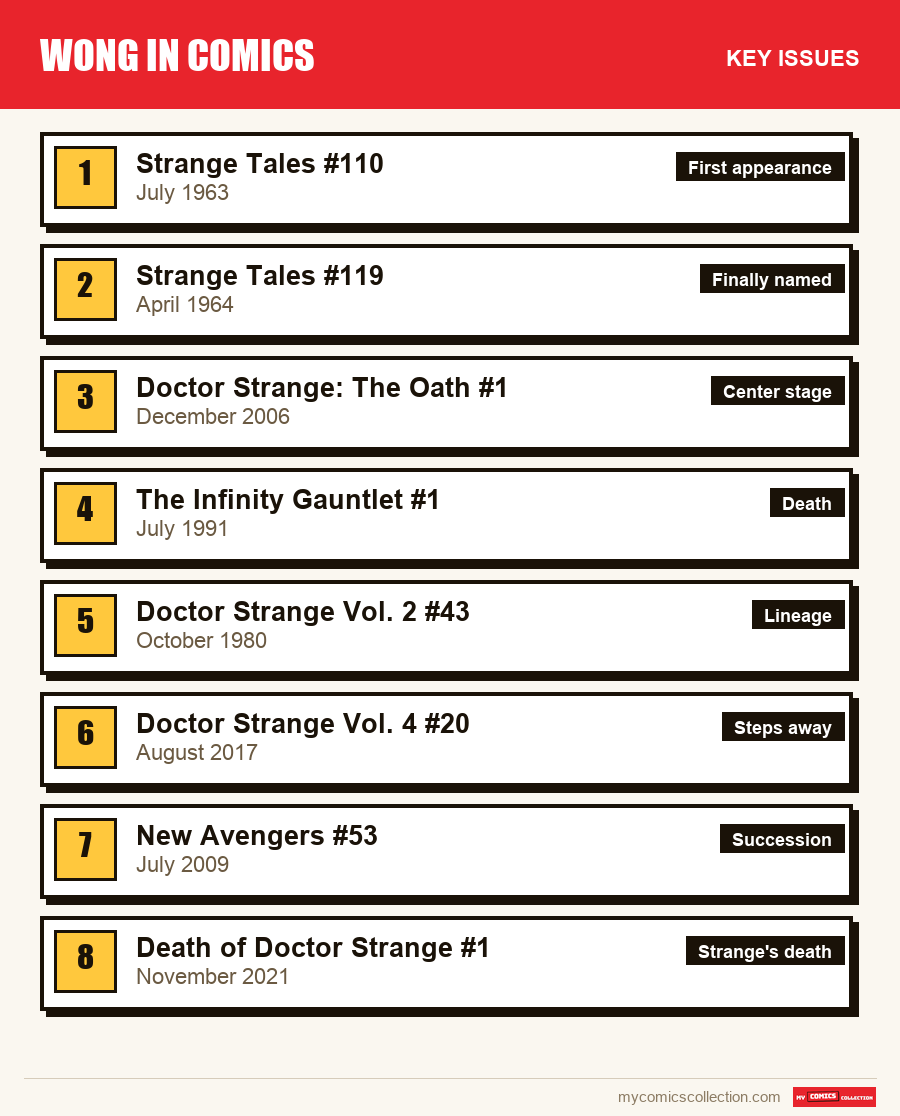
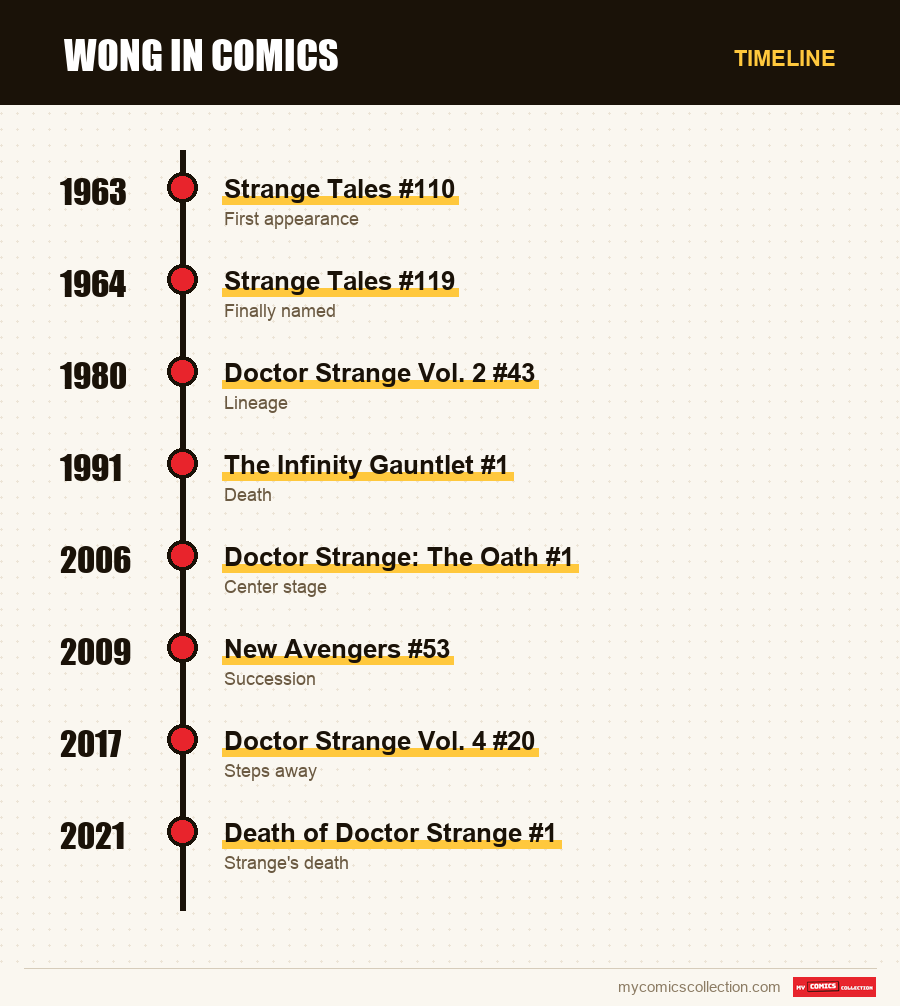
Wong first appears, unnamed, in Strange Tales #110 (July 1963), created by Stan Lee and Steve Ditko along with Doctor Strange, the Ancient One and Nightmare. He only received his name a year later, in Strange Tales #119 (April 1964). Initially confined to the role of servant of the Sanctum Sanctorum, the character becomes over the decades a master of martial arts and a narrative pillar of the Doctor Strange sagas, from The Oath (2006-2007) to The Death of Doctor Strange (2021). Its collector's rating remains inseparable from Strange Tales #110, a Silver Age key issue, a CGC 9.6 copy of which sold for $60,000 in 2016, the year the Marvel Studios film was announced.
There are secondary characters who cross the comics without ever really making an impression, and there is Wong. For more than sixty years, this discreet companion to the Sorcerer Supreme has occupied a singular position in the Marvel Universe: never quite in the forefront, but always present when the plot needs it. His editorial trajectory, from a simple anonymous silhouette in a story of magic from the Silver Age to a central figure in the most recent Doctor Strange events, also tells the story of the evolution of the treatment of Asian characters in American comics: a subject that the writers themselves ended up questioning head-on.
For collectors, Wong occupies a special place: he never carried his own regular series, never had a key issue which is entirely dedicated to him, and yet his name appears on the list of wanted characters as soon as a Silver Age issue of Strange Tales appears on sale. Understanding why requires us to return to the genesis of the character, to the screenwriters who really made him exist, and to the way in which Hollywood ended up reshuffling the cards of his rating.
Birth of an unnamed character: Strange Tales #110 (1963)
In July 1963 (on sale June 30), Marvel published Strange Tales #110, a 36-page issue sold for 12 cents which marks, without knowing it yet, one of the major turning points in the label's editorial history. Stan Lee, then editor-in-chief, looking for a concept capable of renewing the anthology Strange Tales, entrusted the design to Steve Ditko, already associated with the launch of Spider-Man a few months earlier. The result is a short story titled “Doctor Strange, Master of Black Magic,” which in one fell swoop introduces Stephen Strange, the Ancient One, the demon Nightmare, and, in a minor role, an Asian servant of the Himalayan shrine where the future Sorcerer Supreme begins his apprenticeship.
This character then has neither name nor significant line of dialogue. It belongs to the decor, just like the hangings and candles of the temple of the Elder. You will have to wait Strange Tales #119, published in April 1964, so that Lee and Ditko finally named him Wong: an almost anecdotal decision at the time, but which definitively anchored the character in the Doctor Strange mythology. This one-year gap between the appearance and the baptism clearly illustrates the status that Marvel then reserved for this type of secondary figure: useful for the production, but rarely thought of as a character to be developed for itself.
The editorial context also explains why Strange Tales #110 is now considered one of the most popular Silver Age issues in the Marvel catalog. This is not only the first appearance of Wong: it is also the beginning of Doctor Strange, the Ancient One and Nightmare, three founding elements of the entire “magic” side of the Marvel universe, until then almost absent from the superheroic catalog. Overstreet also ranks this issue in 22nd place in its Top 50 Silver Age comics, a recognition which is as much due to the editorial history as to the real rarity of well-preserved copies.
The servant of the Sanctum: a role tailored to the setting (1963-1990s)
In the stories by Lee and Ditko, then in those of the screenwriters who succeeded them during the 1960s and 1970s, Wong occupies an essentially domestic function. He prepares tea, watches over the Sanctum Sanctorum in New York, cares for Stephen Strange who is regularly exhausted by his mystical battles, and rarely intervenes in the action itself. This characterization reflects the narrative codes of the time, where the companion of a Western hero was frequently reduced to a role of logistical support rather than a true partner.
The biographical background of the character was nevertheless built little by little over the following decades. The stories establish that Wong was born in Kamar-Taj, that he is the son of Hamir the Hermit, and that he descends from a line of monks dating back to a certain Kan, a practitioner of the occult who lived almost a millennium earlier. According to this genealogy established by successive screenwriters, Wong's family would have devoted themselves body and soul to the service of the mystical protectors of the Earth in reparation for the actions of this ancestor: a background which gives greater meaning to the character's unfailing devotion to the Ancient One and then to Strange. Wong also begins, according to this continuity, his learning of the mystical arts at the age of four under the tutelage of the Ancient One, well before the arrival of Stephen Strange at Kamar-Taj.
The turning point: from butler to martial arts master
It is gradually, without a single pivotal number that we can point to, that the writers flesh out the character. Accounts from the 1980s and 1990s begin to show Wong capable of physical defense, revealing martial arts training previously unknown to readers. This development transforms the nature of his relationship with Strange: the hierarchical relationship of master and servant gradually gives way to a true friendship, where Wong becomes a confidant and a field ally rather than a simple domestic presence. This shift is now documented by Marvel itself, which describes the contemporary Wong as combining the roles of “chef, steward, martial arts instructor, mystical guardian and insatiable adventurer” within the Sanctum of Bleecker Street.
Wong at the center of the story: the great sagas from the 2000s to 2020
Wong's real change in status comes with the miniseries Doctor Strange: The Oath, published in five issues between 2006 and 2007, written by Brian K. Vaughan and drawn by Marcos Martin. The plot places Wong at the very heart of the story: the character discovers he is suffering from terminal cancer, and it is this announcement that pushes Stephen Strange to lead a desperate quest to find the stolen elixir of a demon named Otkid, the only remedy capable of saving him. After a series of trials, Strange uses the last drop of this elixir to cure his friend. This story, praised by critics for its tight writing and mystical thriller atmosphere, remains considered one of the best modern forays into the Doctor Strange mythology, and the first to make Wong a dramatic stake in his own right rather than a mere witness to the plot.
New Avengers and the question of succession
In the late 2000s, in the period following the event miniseries Civil War, Stephen Strange goes through a crisis which leads him to lose the title of Sorcerer Supreme. The screenwriters of New Avengers then explore the question of his succession, and Wong is among the suitors mentioned within the continuity: implicit recognition of the path taken by the character since his status as a simple servant. It is ultimately Jericho Drumm, aka Doctor Voodoo, who inherits the title in New Avengers #53 (July 2009), but the mere fact that Wong is mentioned as a credible candidate speaks to the character's repositioning within the Marvel mystical hierarchy.
Strange Academy: Wong teaching
Launched in March 2020 by screenwriter Skottie Young and designer Humberto Ramos, the series Strange Academy imagines a school founded by Stephen Strange in New Orleans to train young prodigies from around the world in the mystical arts. Wong joins the teaching staff alongside Doctor Voodoo, who serves as director, the Elder, the Scarlet Witch and Daimon Hellstrom. This series marks a new stage: Wong is explicitly shown as a teacher, capable of transmitting mystical knowledge accumulated over decades of continuity, far from the image of the mute servant of the 1960s. The character appears notably in Strange Academy #15 (2022), drawn by Todd Nauck and colored by Rachelle Rosenberg.
The Death of Doctor Strange (2021): Wong on the front line
The event The Death of Doctor Strange, published in 2021, permanently disrupts the continuity of the title character, and gives Wong one of his most notable roles. An unknown assailant assassinates Stephen Strange within the Sanctum Sanctorum itself, cutting off his hands afterwards and stealing the Eye of Agamotto as well as the Cloak of Levitation, replaced by copies. It is Wong, accompanied by Zelma Stanton and Doctor Voodoo, who discovers the body and, collapsed with grief, launches the investigation into this murder. Strange's death weakens the dimensional barriers protecting Earth, causing the irruption of warlords and Sorcerers Supreme from other worlds.
In this period of mystical chaos, Wong assumes an unprecedented role: he brings together a team of trusted allies and initiates them in record time in the mystical arts, in order to compensate for the absence of the deceased Sorcerer Supreme. The series which follows this event, Strange (2022), sees Clea, the former student and wife of Stephen Strange, inherit the title of Sorcerer Supreme and attempt to bring Strange back to life, with Wong always present to support the plot.
The impact of adaptations on the rating
Wong's entry into the cinematic landscape permanently changed the perception, and the market value, of his first appearances on paper. Actor Benedict Wong has played the character on screen since Doctor Strange (2016), then continued appearances in Avengers: Infinity War , Avengers: Endgame , Shang-Chi and the Legend of the Ten Rings , the animated series What If…? and Spider-Man: No Way Home . In Doctor Strange in the Multiverse of Madness (2022), the character takes an additional step on screen: he officially becomes Sorcerer Supreme of the cinematic Earth-616, a status specific to the continuity of the films and distinct from the succession established in the comics, where it is Clea who bears the title after the death of Strange.
This increase in visibility had a measurable consequence on the collection market: from the announcement of the film in 2014-2015, then with its release in 2016, the demand for Strange Tales #110 (which contains the very first appearance of the then anonymous Wong, alongside those of Doctor Strange, the Ancient One and Nightmare) has made significant progress. A CGC 9.6 graded copy of this issue sold for $60,000 in 2016, the same year the first feature film was released. This result illustrates a common phenomenon in comic book collecting: a secondary character brought to the screen by an actor who gains importance from film to film can raise the rating of a key number upwards, even when this number is primarily sought after for the first appearance of a more famous hero.
However, it must be kept in mind that Wong never had a cover dedicated to him during the Silver Age era, nor a classic solo series: his collector's rating therefore remains structurally linked to that of the issues where he shares the poster with Doctor Strange, and not to prints that belong to him in his own right.
Collecting this series?
Track what you own, what you are missing and what your collection is worth. 7 day trial.
Start my trial →Buying guide
Collecting around Wong requires a different approach from that of a titular character in his own series: it is above all a matter of identifying issues where his presence has a recognized narrative or historical value, rather than looking for a print exclusively dedicated to him.
- Target Strange Tales #110 as a priority: This is the cornerstone of any Wong-centric collection, as it is his very first appearance (albeit anonymous), alongside the debuts of Doctor Strange, the Ancient One, and Nightmare. Systematically check the condition of the spine and corners, which are frequently damaged on Silver Age examples from this period.
- Don't overlook Strange Tales #119: less popular than #110 but historically important, this April 1964 issue is the one where Wong finally receives his name: a precise benchmark to date the appearance of the character as we know him today.
- Consider Doctor Strange: The Oath (2006-2007) the benchmark miniseries: this is the story that takes Wong from the status of an extra to that of a full-fledged character, carried by the acclaimed writing of Brian K. Vaughan and the drawings of Marcos Martin.
- Watch The Death of Doctor Strange (2021) and Strange (2022) for readers and collectors interested in contemporary Wong, investigator and trainer of a new generation of mystics.
- Systematically check the CGC or CBCS certificate before any purchase of a Silver Age issue: restoration invisible to the naked eye remains common on old copies of Strange Tales, and strongly affects the value.
- Compare several recent sales rather than a single displayed price: the odds of a key issue shared between several characters fluctuate with cinematic news, as shown by the progression of Strange Tales #110 after the announcement of the 2016 film.
- Use a collection tracking tool to centralize your issues, especially if you collect several characters linked to Doctor Strange in parallel (Wong, the Ancient One, Clea): this makes it easier to spot holes in a thematic collection.
For collectors looking to track the evolution of the value of their issues over time, our collection tracking application allows you to centralize this information without relying on a manual spreadsheet: discover the collection management application.
The key issues to know
Strange Tales #110
The first Doctor Strange story, by Stan Lee and Steve Ditko, also introduces the Ancient One, Nightmare and a still-unnamed servant: Wong. He has no name and no notable role, but it is indeed his very first appearance. The cornerstone of any collection devoted to the character.
Strange Tales #119
Nine months after his debut, Doctor Strange's servant is called Wong for the first time. The same story introduces Aggamon and the Purple Veil dimension. A precise marker for dating the character as we know him.
Doctor Strange: The Oath #1
Brian K. Vaughan and Marcos Martín launch a five-issue miniseries in which Wong becomes the dramatic stakes: Strange was looking for a cure for his friend's inoperable brain tumor. The issue opens with Wong carrying the doctor's bleeding body into a secret clinic. The go-to story for understanding the modern character.
The Infinity Gauntlet #1
When Thanos, master of all six Gems, wipes out half of all living beings in the universe, Wong is among those who vanish. He shares the fate of Gamora and Mentor in this first issue by Jim Starlin and George Pérez. The end of the saga would undo these deaths.
Doctor Strange Vol. 2 #43
Chris Claremont and Gene Colan shed light on Wong's family past for the first time: held prisoner with Clea in another realm, he explains the part played a thousand years earlier by his ancestor Kan, who appears here. The issue gives new depth to Strange's loyal servant.
Doctor Strange Vol. 4 #20
In Jason Aaron's run, with Chris Bachalo on art, Strange saves Zelma Stanton's life by a method Wong disapproves of. Wong then decides to step away and build a life of his own. A rare rift between the two friends.
New Avengers #53
At the end of Brian Michael Bendis and Billy Tan's arc, the Eye of Agamotto chooses Brother Voodoo as the new Sorcerer Supreme. Wong was among the candidates deemed worthy of the title, a sign of how far he had come since his days as a servant. A milestone for the character's standing.
Death of Doctor Strange #1
Jed MacKay and Lee Garbett open the event in which Stephen Strange dies, leaving Earth without its Sorcerer Supreme. Wong, present from this first issue, finds himself on the front line of the mystical crisis that follows. A major step for the contemporary Wong.