Baron Mordo (Karl Amadeus Mordo) is created by Stan Lee and Steve Ditko and first appears in Strange Tales #111 (August 1963), issue which also marks the second appearance of Doctor Strange. Transylvanian nobleman who became a renegade disciple of the Ancient One, Mordo remained his sworn enemy for more than sixty years of publications, until becoming in the cinema the character played by Chiwetel Ejiofor in Doctor Strange (2016) and its sequel. On the old comics market, Strange Tales #111 is considered one of the second cheapest appearances of the Silver Age compared to its editorial counterpart, with an Overstreet guide value of $1,500 at grade 9.2 and only 52 copies listed at 8.0 or higher in the CGC census.
There are comic book villains that we associate with a single memorable scene, and there is Baron Mordo. Since 1963, this fallen noble, disciple of the Ancient One who became a renegade sorcerer, has embodied the permanent shadow that hangs over Doctor Strange's career. He never had the cosmic stature of Dormammu nor the tragic aura of Mephisto, but it is precisely this proximity, this almost brotherly rivalry with Stephen Strange, which made him one of the most constant antagonists in the entire Marvel universe.
Few Marvel villains can boast of having spanned the Silver Age, the Bronze Age, the Sorcerer Supreme era of the 1990s, the Jason Aaron/Chris Bachalo revamp of the 2010s and, most recently, the big screen with Chiwetel Ejiofor. Baron Mordo has done all this, while maintaining a surprisingly stable identity: that of a brilliant, proud man, convinced that he is right, and willing to sacrifice anyone, including his own master, to obtain the power he believes is his due.
This article traces the complete editorial history of the character, from the pages of Strange Tales to its most recent developments, before discussing what this story means in concrete terms for a collector today: which numbers to look for, what we know about their rarity and their value, and how to approach the purchase of an old copy with full knowledge of the facts.
The origins of Baron Mordo: Strange Tales #111 and the birth of a mystical rival
Baron Mordo was born at a very special moment in Marvel history. Doctor Strange had just been introduced, a month earlier, in Strange Tales #110 (July 1963), within an anthology which then shared its pages with the Human Torch. From the next number, Strange Tales #111 (August 1963), Stan Lee and Steve Ditko lay the cornerstone of the entire mythology of the character by giving Strange not only a mentor, the Ancient One, but also a rival worthy of him: Karl Mordo.
The story, titled “Face-to-Face with the Magic of Baron Mordo!” », opens with a betrayal. In the astral, Mordo secretly travels to the Himalayan home of the Ancient One to have his own master poisoned by a hypnotized servant, in the hope of extracting his mystical secrets from him before his death. Stephen Strange, then a simple cynical visitor who came to beg for a miraculous cure for his damaged hands, overhears the plot. Mordo immediately neutralizes him with a spell that prevents him from speaking to the Ancient One about the danger: a trap that Strange will only manage to circumvent by agreeing, precisely, to become the old sorcerer's student. Doctor Strange's entire trajectory, from wounded skeptic to Sorcerer Supreme, stems directly from this first confrontation with Mordo.
This issue has a double editorial value, which partly explains the interest it still arouses today among collectors: it is both the second appearance of Doctor Strange and the very first appearance of Baron Mordo. The same issue also contains, in the story dedicated to the Human Torch, the origin and first appearance of another minor character, the Asbestos Man. It is therefore a dense issue, published at a time when Marvel was still testing, month after month, which concepts would resonate with the readership, and where the anthological title Strange Tales served as a laboratory for several of the publisher's emerging franchises.
Who is Karl Mordo? Portrait of a Transylvanian nobleman fallen into darkness
In the Marvel continuity known as Earth-616, Karl Amadeus Mordo is presented as a nobleman from Transylvania, a region whose vampiric and gothic folklore is obviously not a coincidence for a character thought of as the obscure counterpart of a sorcerer. Before crossing paths with Strange, Mordo is already one of the Ancient One's most gifted students, installed in his remote sanctuary of Kamar-Taj, somewhere in the mountains of Asia. Unlike other disciples, Mordo does not seek wisdom for its own sake: he wants power, and he is willing to kill his own teacher to obtain it faster than patience would allow.
This all-consuming ambition is the key to reading the entire character. Mordo is never written as an idiot or a simple mystical gunslinger: he is a wizard of a comparable level to Strange himself, capable of mastering dark magic, astral projection, hypnosis and demonic summoning. What distinguishes him from his rival is therefore not competence, but ethics, and this is precisely why their duel has spanned the decades without ever completely wearing out: each confrontation replays the question of knowing what one is prepared to sacrifice for power.
A banished disciple, a sworn enemy
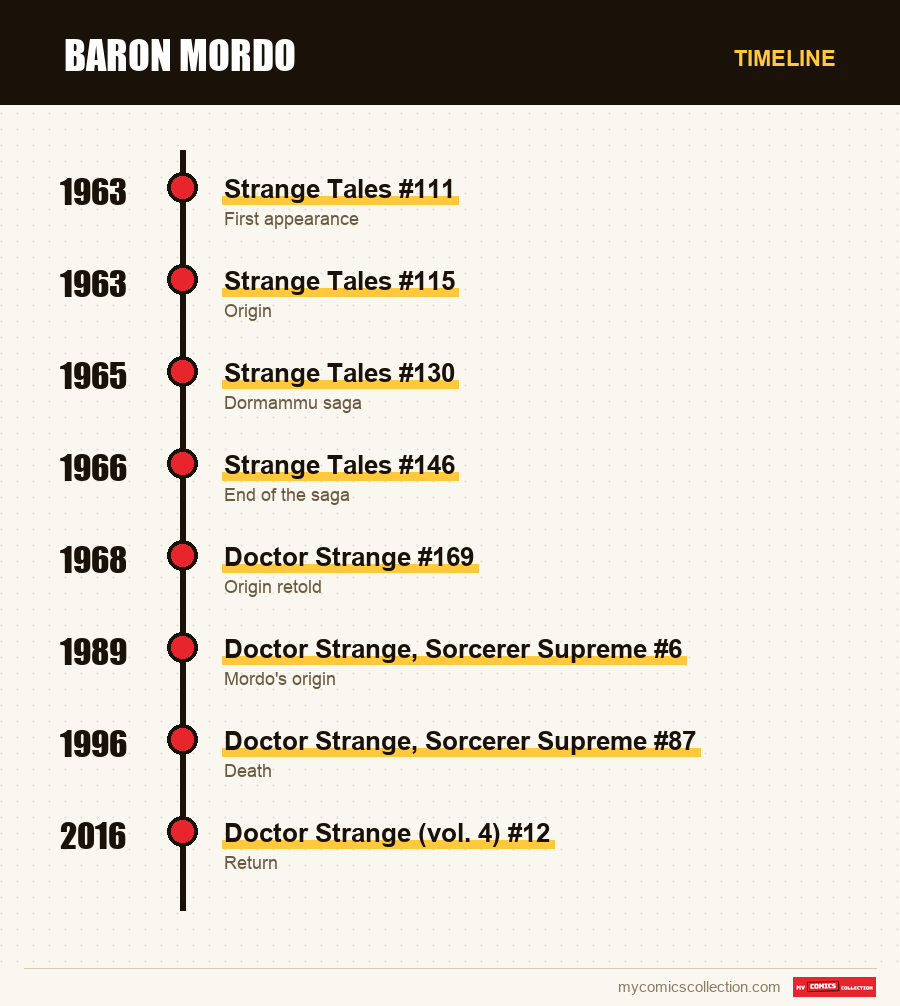
After the failure of his plot in Strange Tales #111, Mordo is driven out of the Elder's circle of trust, but he is not neutralized. The writers who succeeded him, notably during the run of the late 1960s and early 1970s when Doctor Strange obtained his own title (starting with issue #169, which takes up the numbering of Strange Tales), continue to use Mordo as the most "human" recurring threat in the series, alternating with cosmic adversaries like Dormammu or Nightmare. He becomes the occasional ally of forces much more powerful than himself, Dormammu first and foremost, without ever giving up his final objective: to dethrone Strange and seize the title of Sorcerer Supreme.
Demonic pacts and provisional redemptions
A narrative thread returns several times in the character's story: that of illness and death. In a powerful story, the prolonged use of dark magic eventually takes its toll on Mordo's health, and he contracts terminal cancer directly linked to his occult practices. Confronted with his own finitude, he briefly renounces evil before dying: a rare moment of redemption for a character usually portrayed without concession. But in a comic book universe, death is rarely permanent: Mordo comes back to life much later in circumstances linked to a temporal alteration caused by Strange's attempts to rescue Spider-Man outside the flow of time, proof that even his death ended up being rewoven into continuity to bring him back to the forefront.
The great editorial eras of Baron Mordo
Following Baron Mordo through the decades is a bit like following the editorial history of Doctor Strange himself, as the two characters are inseparable. Here are the main periods to know to locate any number featuring the Baron.
The Silver Age: the founding (1963-1969)
It was the Lee/Ditko period, then Lee accompanied by other artists after Ditko's departure in 1966, which established Mordo as the recurring counterpoint to Strange in the pages of Strange Tales. The character is still relatively simple in his motivations, the pure thirst for power, but Ditko's own visual alchemy, made of psychedelic compositions and shots expanded into improbable dimensions, gives these first clashes a graphic texture that the following runs have never quite found in the same way.
The Bronze Age and the return of Doctor Strange solo (1974 and following)
After a first title under his name in 1968-1969, Doctor Strange got a new solo title in 1974, which gave the writers more space to develop arcs involving Mordo over several consecutive issues rather than in the short anthology format of the 1960s. This was also the time when the character began to be more closely associated with major demonic powers like Dormammu, of whom he became a recurring occasional ally, as well as with other entities like Mephisto or Satannish over time. one-off pacts which temporarily increase its power in exchange for services rendered.
Sorcerer Supreme era (late 1980s: 1990s)
The series Doctor Strange, Sorcerer Supreme, launched in 1988, extends the rivalry over nearly ninety issues and sees Mordo regularly return as the adversary capable of directly threatening Strange's title of Sorcerer Supreme. This is a period where the character gains in strategic complexity: he no longer acts solely through brute force, but increases the number of long-term manipulations, even if it means pretending, in certain arcs, to be an ally before revealing his true intentions.
Blood in the Aether and the Jason Aaron/Chris Bachalo era (2015-2018)
The relaunch Doctor Strange of 2015 by Jason Aaron and Chris Bachalo marks an important turning point. The opening arc, "The Way of the Weird", features the invasion of the Empirikul, an army dedicated to eradicating all magic in the universe, who destroy much of Earth's mystical powers: including, in large part, those of Strange. In this context of bloodless magic, Mordo makes a remarkable return: protected by a pact with Dormammu, he retains part of his abilities where almost all other sorcerers are deprived of them, which paradoxically makes him one of the most dangerous characters of the moment. The arc that directly follows, “Blood in the Aether,” deepens this dynamic and sees the concept of multiple Sorcerers Supreme emerge across Earth, a notable reinvention of the mythology that places Mordo at the heart of issues of mystical power.
The 2020s: Death of Doctor Strange and the sequel
More recently, the event mini-series The Death of Doctor Strange (2021) then the runs that succeed it continue to explore Strange's mystical heritage and the question of his succession: a playing field in which a character like Mordo, obsessed for more than half a century with the title of Sorcerer Supreme, naturally finds his place. The character remains, even today, one of the obligatory points of reference whenever a screenwriter wants to question who really has the right to wear this title.
Collecting this series?
Track what you own, what you are missing and what your collection is worth. 7 day trial.
Start my trial →The impact of adaptations on the rating
As with many secondary Marvel characters who have become familiar thanks to the cinema, the arrival of Baron Mordo on the big screen was a game-changer for collectors who had previously been interested in a niche audience.
Doctor Strange was released in theaters at the end of 2016 and raked in nearly $678 million in worldwide revenue, driven by generally favorable reviews. The film entrusts the role of Karl Mordo to Chiwetel Ejiofor, already an Oscar-winning actor, in a version significantly rewritten compared to the comics: this cinematic Mordo is first of all a loyal Master of the Mystic Arts, close to the Ancient One and benevolent mentor of Strange, before switching towards antagonism at the very end of the film: an opposite trajectory to that of the original comics, where betrayal occurs from the first meeting. This hybrid version of the character actually combines several figures from Doctor Strange mythology rather than literally transposing the Transylvanian baron from the Silver Age.
Ejiofor reprises the role in 2022 in Doctor Strange in the Multiverse of Madness, but in the shoes of an alternative variant: the Mordo of Earth-838, who became Sorcerer Supreme of his universe and member of the Illuminati of this reality. The Mordo of Earth-616, the one installed as a potential antagonist at the end of the first film, does not appear in the sequel: a choice assumed by the production, which preferred to explore the alternative version rather than pay the narrative debt posed by the first opus.
In terms of the rating of old comics, this cinematographic exhibition has historically resulted in a renewed attention to the key issues associated with the character, first and foremost Strange Tales #111. The observation made by the specialist collecting press has remained relatively stable over time: compared to other significant second appearances from the Silver Age, this issue remains considered accessible. The Overstreet Guide (46th edition) thus placed its value at $432 in grade 8.0, $966 in grade 9.0 and $1,500 in grade 9.2: amounts significantly lower than those of other contemporary second appearances of the same editorial caliber, such as Tales of Suspense #40, listed at $5,800 in the same grade bracket according to the same source. At the top of the scale, the best example known to date, a CGC 9.8 NM/MT from the Pacific Coast pedigree, sold at auction for $20,315, illustrating the considerable gap that separates intermediate grades from near-perfect examples on a mintage of the period. The CGC census recorded, at the time of writing, only 52 copies rated 8.0 or higher across all submissions: a real rarity at very high grade, consistent with the age of the issue and the intrinsic fragility of pulp paper from the 1960s.
Buying guide
Buying an old comic featuring Baron Mordo, starting with his first appearance, requires a minimum of method. Here are the points to check before committing.
- Identify precisely the story you are looking for. Baron Mordo appears in dozens of issues over sixty years; alone Strange Tales #111 (August 1963) constitutes its very first appearance and concentrates most of the collector demand. Subsequent issues from the same period (#114, #116, etc.) have narrative interest but a significantly lower rating.
- Check the authenticity of the coverage grid. On a 1963 issue, the title page and price list must match the original format (12 cents for an American Marvel issue from that year); any inconsistency in font, color or paper should alert you.
- Favor examples graded CGC or CBCS for high grades. Given the very marked difference in value between a grade 8.0 and a grade 9.8 on this number, third-party certification secures the investment and avoids unpleasant surprises on the restoration or retouching invisible to the naked eye.
- Examine the stapling and the spine of the booklet. Silver Age issues frequently suffer from foxing, paper discoloration, and rusty staples; these defects, even on an ungraded copy, must be reflected in the asking price.
- Always compare several actual sales before deciding on a price. The prices displayed in stores or in a paper guide reflect an estimate, not necessarily the current market; cross-referencing several recent transactions remains the most reliable method for evaluating a specific item.
- Don't neglect reissues and completes. If the goal is to read the character's founding arc rather than build a collection of key issues, the Marvel omnibuses and complete works covering the early 1960s offer much more affordable access to the same story.
Whatever path you choose, keep in mind that the value of an old comic fluctuates with the character's news: a new significant appearance of Baron Mordo in the cinema, in a series or in a major comic event can change the demand for his first appearances in a few weeks. Using a tool that is based on actual sales rather than a fixed guide allows you to follow this dynamic more closely.
Key issues to know
Strange Tales #111
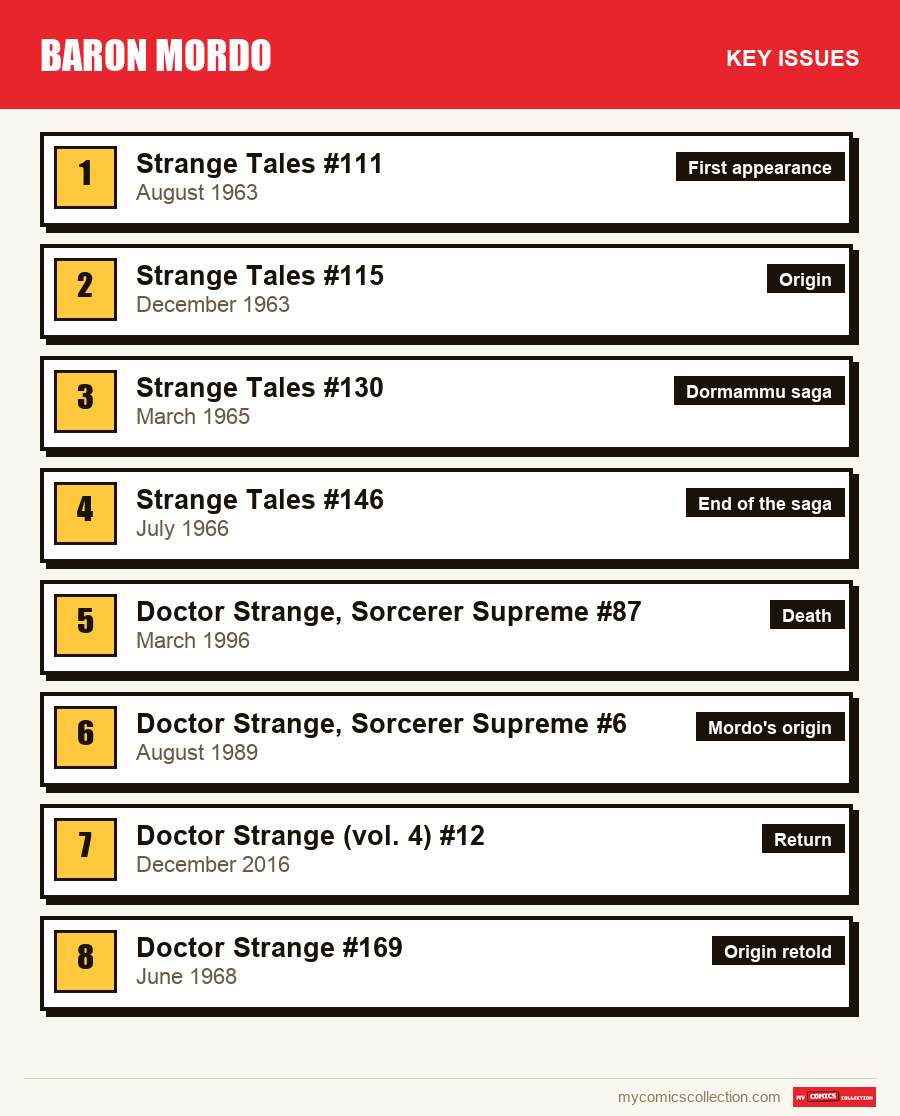
In "Face-to-Face with the Magic of Baron Mordo!", Stan Lee and Steve Ditko introduce the renegade disciple who tries to have the Ancient One poisoned to wrest his secrets from him. It is also Doctor Strange's second appearance.
Strange Tales #115
"The Origin of Dr. Strange" shows how the surgeon uncovers Mordo's plot against the Ancient One and is silenced by a spell. He foils it by choosing to become the master's pupil: the founding rivalry is set.
Strange Tales #130
Sent by Dormammu, Mordo attacks the Ancient One and sets every evil sorcerer on Strange's trail, all the way to Hong Kong. This issue opens Lee and Ditko's long saga that makes the baron the agent of the Dark Dimension's ruler.
Strange Tales #146
Dormammu tries to defeat Eternity, but Strange frees the entity and the Dark Dimension's ruler is beaten. Strange then reverses the spells binding Mordo. It is the last Doctor Strange episode drawn by Steve Ditko.
Doctor Strange, Sorcerer Supreme #87
Consumed by a cancer passed on by his own daughter Astrid, Mordo reverses the process before succumbing. J.M. DeMatteis's story gives the baron a peaceful end after he has sought forgiveness from his former enemies.
Doctor Strange, Sorcerer Supreme #6
Roy Thomas and Tom Sutton's backup story opens "The Mordo Chronicles": the baron's childhood in Transylvania, his father Nikolai and his grandfather Krowler, who initiates him into black magic. The character's youth is finally told.
Doctor Strange (vol. 4) #12
In Jason Aaron and Chris Bachalo's "Blood in the Aether", Mordo resurfaces and attacks Strange in front of the Sanctum Sanctorum while the Sorcerer Supreme's magic is nearly exhausted. The baron returns as Dormammu's agent.
Doctor Strange #169
The first issue of the Doctor Strange title, which continues Strange Tales' numbering. Roy Thomas and Dan Adkins expand the hero's origin, including his meeting with Mordo at the Ancient One's home.