
Tier list Doctor Strange 2026 in four levels. Tier S blue-chip: Strange Tales #110 (July 1963, Stan Lee/Steve Ditko, 1st Doctor Strange), Strange Tales #115 (December 1963, complete origin story), Marvel Premiere #10 (September 1973, Steve Englehart/Frank Brunner, 1st Shuma-Gorath), Doctor Strange volume 2 #1 (June 1974). Tier A: Strange Tales #114 (November 1963, 1st Baron Mordo), #126 (November 1964, 1st Dormammu and Clea), #150 (November 1966, 1st Umar), #169 (June 1968, series split), Marvel Premiere #14 (March 1974, 1st Sise-Neg). Tier B: sleepers Marvel Spotlight #15 (May 1974), Doctor Strange volume 2 #55 (1982), Doctor Strange volume 3 #1 (1988, Englehart). Tier C: 2026-2027 speculation on Multiverse of Madness sequel and Clea Strange arc by Jason Aaron.
⚠️For information only: This information is provided for informational purposes only. My Comics Collection is not an investment advisor. Grades vary depending on condition, rarity and market trends. Check recent sales on eBay or GoCollect before making any purchasing decisions.
Build a tier list Doctor Strange in 2026 requires prioritizing around fifty key issues spread over more than sixty years of publication. The character created by Stan Lee and Steve Ditko in July 1963 in Strange Tales #110 has generated some of Marvel's densest magical mythology, with galleries of supporting roles (Baron Mordo, Dormammu, Clea, Umar, Shuma-Gorath, Sise-Neg, Wong, Hela, Nightmare) who each have their own speculated key issues. The film adaptations by Scott Derrickson in 2016 then Sam Raimi in 2022 have profoundly reshaped the rating of the Silver Age and Bronze Age, and the horizon Doctor Strange in the Multiverse of Madness sequel announced for 2027 prepares a third speculative wave which should be anticipated without giving in to haste.
This tier list offers four levels: Tier S (absolute, fundamental and liquid blue-chip), Tier A (key issues of the emblematic supporting roles), Tier B (Bronze Age and Copper Age sleepers with high residual potential) and Tier C (speculative bets 2026-2027 fueled by the Marvel Studios pipeline and recent solo comic series). For each level, the guide specifies the verified publication dates, the names of the creators, the raw and CGC ratings observed in spring 2026 on eBay sold listings, GoCollect and Heritage Auctions, and the acquisition logic according to three budgetary profiles. The objective is to map the Doctor Strange market without promising added value, remaining faithful to the priority of collector passion rather than the race for short-term speculation which has penalized so many late buyers of other Marvel franchises in recent years.
Doctor Strange tier list methodology: ranking criteria
Prioritizing around fifty Doctor Strange key issues requires explicit criteria. This tier list is based on five weighted variables. The first is the narrative centrality of the character introduced or developed: a first appearance of a recurring antagonist (Dormammu, Mordo) weighs more than a guest appearance from a minor figure. The second is the market liquidity in 2026 measured on Heritage Auctions and eBay sales over the past twelve months, which distinguishes a consistently traded blue-chip from a low-volume sleeper. The third is the presence in the Marvel Studios and Disney+ pipelines, which determines the probability of a wave of speculative demand in the short term. The fourth is the high grade physical rarity, derived from the original print run and the CGC census, and the fifth is the long-term resilience, that is to say the ability of the number to retain its value in the event of a global speculative reversal.
Tier S brings together key issues that combine the five criteria at the highest level: these are fundamentals of the Silver Age and Bronze Age that any serious Doctor Strange collector must consider as a priority, whether they ultimately buy a CGC slab or a raw VF. Tier A brings together major supporting roles whose rating is supported by their cinema and series presence, with greater volatility than Tier S but a price/narrative visibility ratio that is still very favorable. Tier B includes Bronze Age and Copper Age sleepers, which have not yet experienced their media peak but which have solid fundamentals: first appearances of re-usable secondary characters, cult author runs, or tie-ins for major events. Tier C opens with 2026-2027 speculation fueled by Marvel Studios announcements, with explicitly risky but inexpensive bets to buy.
An important methodological remark concerns the distinction between Strange Tales and the solo Doctor Strange volumes. Doctor Strange was originally published as a backup story in Strange Tales from issue #110 (July 1963), sharing the title with the Human Torch and then Nick Fury. The series became truly solo from issue 169 (June 1968) which became Doctor Strange #169. Doctor Strange volume 2 begins in June 1974, after a period of transition through the collection Marvel Premiere (1972-1974). Doctor Strange volume 3 launched in 1988 by Roy and Dann Thomas then taken over by Roy Thomas, and the handover to Englehart on volume 3. This complex editorial genealogy is a classic source of confusion when purchasing, and several tier list traps that we detail below result directly from it. To delve deeper into this timeline, check out our story of Doctor Strange in comics and our filekey issues Doctor Strange Silver Age.
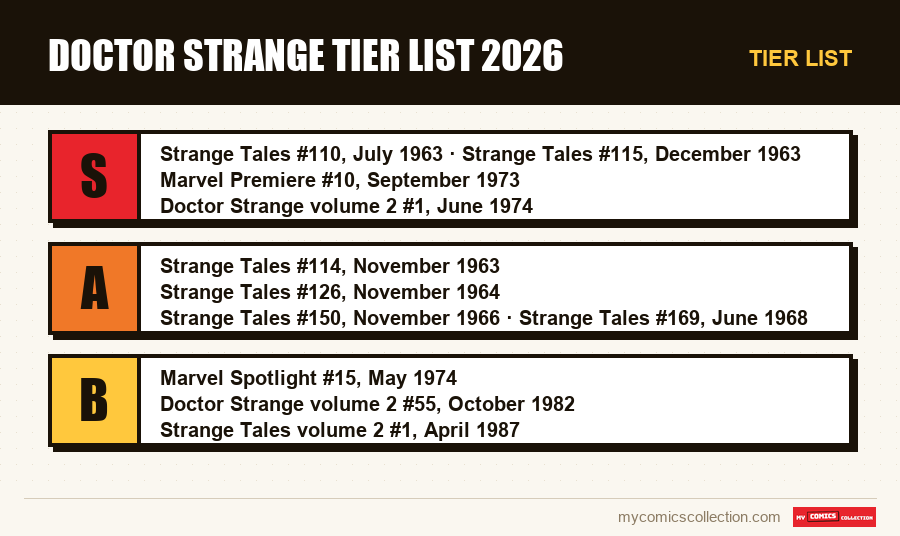
Tier S: the absolute blue-chip Doctor Strange of the Silver Age
Tier S brings together four key issues which dominate Doctor Strange valuation in 2026 through their narrative centrality and sustained market liquidity. These four issues are the pillars of any serious collection, whether conducted in raw or CGC, and their rating benefits from lasting fundamental support independent of short speculative cycles.
Strange Tales #110, July 1963, written by Stan Lee, drawn by Steve Ditko, is the first appearance of Doctor Strange in a 5-page backup story co-starring the Human Torch. The cover does not feature Doctor Strange (it features the Torch versus the Trapster), which is typical of backup debuts of supporting characters of the era. The 1963 print run is estimated between 165,000 and 200,000 copies according to the Marvel statements of ownership of the period, exclusive newsstand distribution. CGC prices observed in spring 2026 on Heritage Auctions and eBay: CGC 9.4 between 110,000 and 165,000 dollars (Heritage 2024 record at 175,000 dollars for a 9.4 white pages), CGC 9.0 between 55,000 and 85,000 dollars, CGC 8.0 between 18,000 and 32 000 dollars, CGC 6.0 between 5,500 and 9,500 dollars, CGC 4.0 between 2,200 and 4,200 dollars. Raw GD to VG (2.0-4.0 estimated) sells for between 1,200 and 3,000 euros at specialized French retailers. It is the absolute top of the Doctor Strange pyramid, and its price reflects its extreme high grade rarity: less than 65 CGC 9.0 or higher copies recorded in the CGC census in mid-2026.
Strange Tales #115, December 1963, Stan Lee screenplay and Steve Ditko art, contains the origin story complete Doctor Strange: flashback to Stephen Strange, arrogant New York surgeon, car accident that destroys his hands, initiatory journey to the Himalayas, meeting with the Ancient One and acceptance of the mystical path. Without this origin, the Doctor Strange narrative arc would not have taken on its mythological dimension. The issue also contains a fight against Baron Mordo which continues the antagonism posed in #114. CGC 2026 odds: CGC 9.4 between $14,000 and $22,000, CGC 9.0 between $6,500 and $11,000, CGC 8.0 between $2,800 and $4,800, CGC 6.0 between $950 and $1,600, CGC 4.0 between $380 and $650. Raw VG to FN (4.0-6.0 estimated) between 280 and 700 euros. The price/narrative centrality ratio is excellent: for a budget five to ten times lower than #110, we obtain the second narrative pillar of mythology, major for any coherent library.
Marvel Premiere #10, September 1973, written by Steve Englehart and drawn by Frank Brunner, is the first appearance of Shuma-Gorath, Lovecraftian chthonian deity who becomes the recurring cosmic antagonist of Doctor Strange. This number is central in the 2026 speculative strategy because Shuma-Gorath appeared in Multiverse of Madness in 2022 (Sam Raimi inserted the monster tentacle in the opening sequence, after acquisition of the rights by Marvel Studios), and its return is probable in the sequel expected in 2027. Odds 2026: CGC 9.8 between $4,800 and $7,800, CGC 9.6 between $1,800 and $2,800, CGC 9.4 between $850 and $1,800 350 dollars, CGC 9.0 between 350 and 550 dollars, CGC 8.0 between 180 and 280 dollars. Raw NM (9.0-9.2 estimated) between 200 and 350 euros, raw VF between 90 and 160 euros. The Bronze Age status partially protects against grade inflation: the 1973 print run (approximately 220,000 copies) and the arrival of direct editions (1979 at Marvel) are not yet in place, surviving copies in high grade remain rare.
Doctor Strange volume 2 #1, June 1974, written by Steve Englehart and drawn by Frank Brunner, launches the second solo Doctor Strange series after the passage Marvel Premiere and the end of Doctor Strange volume 1 in 1969. The issue ushered in the Englehart-Brunner-Colan golden age that would define the character's cosmic psychedelic aesthetic for the next twenty years. The first issue of a historic series popular with completionists, it benefits from structural demand. 2026 odds: CGC 9.8 between $950 and $1,600, CGC 9.6 between $450 and $750, CGC 9.4 between $220 and $380, CGC 9.0 between $110 and $180, CGC 8.0 between $55 and $95. Raw NM between 50 and 90 euros, raw VF between 25 and 45 euros. For a constrained budget who wants a Tier S Bronze Age, this is the most rational entry point, as recalled in our Doctor Strange collection guide.
Tier A: major key issues Mordo, Dormammu, Clea, Umar
Tier A brings together the first appearances of recurring antagonists and allies who structure the magical Marvel mythology. These key issues display a more accessible rating than Tier S, with a slightly more pronounced spec volatility, but an excellent narrative to purchase price ratio. They form the heart of any balanced Doctor Strange collection.
Strange Tales #114, November 1963, Stan Lee and Steve Ditko, is the first appearance of Baron Mordo, founding antagonist of Doctor Strange. Karl Amadeus Mordo is the rival student of the Ancient One and represents the corrupted path of magic against Strange. He was played by Chiwetel Ejiofor in both films Doctor Strange of 2016 and 2022, and his return as a major antagonist of the sequel 2027 is widely anticipated. 2026 odds: CGC 9.4 between $7,500 and $12,500, CGC 9.0 between $3,500 and $5,800, CGC 8.0 between $1,500 and $2,600, CGC 6.0 between $450 and $750, CGC 4.0 between $180 and $320. Raw VG to FN between 140 and 320 euros. OUR story of Baron Mordo in comics details the character's complete editorial trajectory and its secondary key issues.
Strange Tales #126, November 1964, Lee/Ditko, is a major double first appearance: Dormammu, lord of the Dark Dimension and primary cosmic antagonist of Doctor Strange, and Clea, niece of Dormammu who will become disciple then companion of Strange and heir to the title of Sorceress Supreme in the Jason Aaron 2022 run. The double first appearance in the same issue is exceptional and supports a particularly robust rating. Dormammu appeared in the first Doctor Strange 2016 (Mads Mikkelsen) and Clea in the post-credit of Multiverse of Madness 2022 (Charlize Theron). 2026 odds: CGC 9.4 between $12,500 and $22,000, CGC 9.0 between $5,500 and $9,500, CGC 8.0 between $2,200 and $3,800, CGC 6.0 between $850 and $1,400, CGC 4.0 between $320 and $580. Raw VG to FN between 280 and 600 euros. To learn more, consult our guides Dormammu story et Clea story in comics.
Strange Tales #150, November 1966, Lee and Bill Everett, contains the first appearance of Umar, sister of Dormammu and mother of Clea, completing the dark dimensional trinity that structures the cosmic Doctor Strange mythology. The issue is also notable as a split issue in the transition to the separation of the Strange Tales features (Doctor Strange and Nick Fury) which will result in #169. 2026 odds: CGC 9.4 between $2,200 and $3,800, CGC 9.0 between $950 and $1,600, CGC 8.0 between $380 and $650, CGC 6.0 between $140 and $240. Raw FN to VF between 90 and 180 euros, raw VG between 45 and 85 euros. The price-to-rarity ratio is exceptional for a Silver Age first appearance, in part because Umar has not yet had a major cinema incarnation: this is precisely what makes it an excellent candidate for the sleeper strategy explained in our pillar investment strategy 2027.
Strange Tales #169, June 1968, written by Roy Thomas and drawn by Dan Adkins, marks the split of the Strange Tales series into two distinct titles: Doctor Strange volume 1 repeating the numbering from #169, and Nick Fury, Agent of S.H.I.E.L.D. volume 1. This issue is therefore both the last Strange Tales history with Doctor Strange and the first standalone issue Doctor Strange volume 1, structuring editorial tipping point. 2026 odds: CGC 9.4 between $1,600 and $2,600, CGC 9.0 between $700 and $1,100, CGC 8.0 between $280 and $480. Raw FN to VF between 70 and 140 euros. More accessible than first appearances but central for the coherence of the editorial library.
Marvel Premiere #14, March 1974, Steve Englehart and Frank Brunner, is the first appearance of Sise-Neg, a humanoid mage who travels backwards in time to absorb all the magic of the universe, in a cult story arc considered a peak of the Bronze Age. Sise-Neg = Genesis in reverse: the revelation of this cosmological mirror constitutes one of Doctor Strange's most quotable twists. 2026 odds: CGC 9.8 between $1,200 and $1,900, CGC 9.6 between $480 and $780, CGC 9.4 between $220 and $380, CGC 9.0 between $90 and $150. Raw NM between 55 and 95 euros, raw VF between 25 and 45 euros. This is the most economical entry point to Tier A, with strong residual potential if Sise-Neg makes his MCU entry in Phases 7 or 8. For Marvel magical thematic consistency, also check out our Marvel magic key numbers.
Tier B: Bronze Age and Copper Age sleepers with high potential
Tier B brings together secondary key issues whose current rating does not yet fully reflect their narrative centrality or their link to future Marvel Studios announcements. These sleepers offer an excellent cost/risk ratio for the patient collector, with accessible entry points and strong fundamentals that partially protect them against a global speculative downturn.
Marvel Spotlight #15, May 1974, written by Gary Friedrich and drawn by Jim Mooney, is not a first appearance of Doctor Strange, but it marks an important crossover with Son of Satan (Daimon Hellstrom), whose first appearance was in Ghost Rider #1 (Sept 1973). This tie-in places Doctor Strange in the Marvel horror subgenre of the 1970s, which has regained value since Marvel Studios' expansion into the supernatural via Werewolf by Night (Disney+ 2022) and Blade expected in 2026-2027. 2026 odds: CGC 9.8 between $380 and $580, CGC 9.6 between $140 and $220, CGC 9.4 between $70 and $110. Raw NM between 20 and 35 euros. Sleeper credible if Son of Satan appears in a Marvel Studios horror production, a scenario that several 2025 leaks have mentioned without official confirmation.
Doctor Strange volume 2 #55, October 1982, written by Roger Stern and drawn by Marshall Rogers, contains a cult arc involving Morgan le Fay in the Stern run considered the pinnacle of the late Bronze Age Doctor Strange. The number is also sought after for the Marshall Rogers cover, an artist who has become cult in retrospect, and for his pivotal role in the Morgan le Fay arc which will be taken up forty years later in the Jason Aaron 2022 run. Odds 2026: CGC 9.8 between 220 and 350 dollars, CGC 9.6 between 90 and 140 dollars. Raw NM between 15 and 25 euros. Typically late Bronze Age sleeper, with strong residual potential if Morgan le Fay enters the MCU in phases 7 or 8.
Doctor Strange Sorcerer Supreme volume 3 #1, November 1988, written by Peter Gillis (then quickly taken over by Roy and Dann Thomas, and later Steve Englehart in around thirty issues), inaugurates the third solo Doctor Strange series which will last 90 issues until 1996. Volume 3 officially introduces the title of Sorcerer Supreme in the series name, an element which will be central in the Marvel Studios films. 2026 odds: CGC 9.8 between $280 and $420, CGC 9.6 between $110 and $170, CGC 9.4 between $55 and $85. Raw NM between 18 and 30 euros. First serial number collected by completionists, accessible Copper Age entry point.
Doctor Strange Sorcerer Supreme #50, February 1993, written and drawn by Geoff Isherwood, marks the anniversary and contains Clea's return alongside Strange in a commemorative arc. The issue is underpriced in 2026 (raw NM between 8 and 15 euros) precisely because 2025-2026 speculation has focused on the Silver Age. But its Clea narrative centrality makes it relevant to any cohesive library, especially if Clea Strange becomes a recurring character in the MCU. OUR story of Clea in comics details the character's editorial trajectory and 2022-2024 arc by Jason Aaron that transformed the perceived value of historic Clea issues.
Strange Tales volume 2 #1, April 1987, written by Peter Gillis and drawn by Tony Salmons, relaunches the Strange Tales brand as a shared anthology series Doctor Strange / Cloak and Dagger. The issue is interesting for purists Doctor Strange alternative volumes, with a 2026 raw NM rating around 8-15 euros. It is an unspectacular Copper Age sleeper but relevant in a strategy of editorial completeness, as recalled in our progressive investment approach explained in the pillar 2027 strategy guide.
A word about the Vengeance of Loki series tie-ins and Strange-Asgard crossovers. Several isolated issues between 1990 and 2010 contain Doctor Strange interactions with Asgardian mythology, some of which could gain value if the Loki-Strange crossover is exploited by Disney+ after season 2 of Loki. These numbers can be found at 4-10 euros raw at specialized French retailers, making them very inexpensive bets for the patient collector.
Tier C: 2026-2027 speculation on the Marvel Studios pipeline
Tier C opens on explicitly speculative bets fueled by the Marvel Studios pipeline and recent solo comic series. These choices require rigorous discipline: low-cost purchase only, exposure limited to 10-15% of the Doctor Strange collection budget, conservation of a cash reserve to take advantage of possible post-media peak retracements. It is in Tier C that the theoretical 5x to 15x multiples are hidden, but also the deadweight losses in the event of an unconfirmed scenario.
The central bet of Tier C in 2026 remains sequel Doctor Strange in the Multiverse of Madness 2 announced for 2027, whose storyline not confirmed by Marvel Studios is circulating according to several leaks from 2025. Anticipated key issues include post-credit Clea Strange appearances from the first sequel, Wanda Maximoff return flashbacks, and potentially Shuma-Gorath as a major antagonist. The strategic numbers to aim for are Marvel Premiere #10 (Tier S, already covered), Strange Tales #126 (Tier A, already covered for Clea/Dormammu), and the solo Strange volume 5 #1 (2022) by Jed MacKay and Marcelo Ferreira which marks the Clea Witch Supreme arc. Odds Strange #1 (2022): CGC 9.8 between 80 and 130 dollars, raw NM between 5 and 10 euros, therefore extremely accessible entry point for a spec bet.
Le Wong solo show Disney+ announced in development at Marvel Studios in 2025 (status not officially confirmed) creates a speculative window on Wong and his key issues. Wong first appears in Strange Tales #110 (first name mentioned) but his first real appearance as a full character is in Strange Tales #119 (April 1964). This number remains under the radar in 2026 with CGC 9.0 ratings between 800 and 1,400 dollars, raw VG to FN between 60 and 140 euros. If the Wong show is confirmed at the end of 2026 or in 2027, a speculative wave can triple these levels in 6-12 months, a scenario documented in our guide spec keys 2027. For character context, see also our Wong's story in comics.
The bow Clea Strange Witch Supreme by Jason Aaron (Strange #1-10, 2022-2023) constitutes the modern source material most likely to be adapted or cited. All the numbers in this arc are traded in raw NM between 4 and 10 euros, which makes them ultra accessible bets. The first print of Strange #1 (2022) cover A by Marcelo Ferreira is the main entry point, and the 1:25 and 1:50 incentive variants (notably the skybound cover Christopher Mitten) already reach $60-120 in CGC 9.8 depending on the variants. For ratio incentive variants, see our CGC grading guide which explains the mechanics of scarcity.
The bet Defenders Beyond (2022, Al Ewing/Javier Rodríguez) opens another Tier C avenue: the 5-issue miniseries puts Doctor Strange back on the cosmic Defenders team, and the cosmic-mystical imagery could inspire future Marvel Studios projects. NM raw odds between 5 and 12 euros per issue, possible accumulation for 30-50 euros of the complete mini. Spec bet at very low cost, without guarantee of return but without significant risk.
Finally, the modern variants Doctor Strange post-2020 constitute a rapidly emerging Tier C sub-segment. The Stanley Artgerm Lau, J. Scott Campbell, InHyuk Lee variants and the 1:50 and 1:100 incentive ratio variants on modern relaunches (Doctor Strange volume 6 by Mark Waid in 2023, Strange by Jed MacKay) display significant odds differences depending on the artists and the ratios. Typical odds: CGC 9.8 between 80 and 350 dollars depending on variant, raw NM between 15 and 60 euros. Very volatile market but inexpensive to enter, as recalled in our spec keys 2027.
Collecting this series?
Track what you own, what you are missing and what your collection is worth. 7 day trial.
Start my trial →Strategy by budget: three Doctor Strange collector profiles
Building a coherent Doctor Strange collection in 2026 requires a clear budgetary prioritization grid. Three profiles are emerging, each with a different acquisition logic, and the sequence must be adapted to its own financial rhythm rather than to the media pressure generated by Marvel Studios announcements.
Le constrained budget profile (500 to 1,200 euros over 12-18 months) targets narrative completeness before investment. Priority to Strange Tales #115 raw VG to FN (280 to 700 euros), origin story anchor point. Then Doctor Strange volume 2 #1 raw NM (50 to 90 euros), Marvel Premiere #14 raw VF (25 to 45 euros), Strange Tales #150 raw FN (90 to 180 euros), Strange Tales #169 raw FN (70 to 140 euros). For Tier C, add Strange #1 (2022) cover A raw NM (5 to 10 euros) and 3-4 issues of the Clea Aaron raw NM arc (20-40 euros total). This configuration gives a coherent library of eight to ten major key issues for a total budget of 540 to 1,205 euros, without CGC but with an almost exhaustive narrative exposition over the six decades of the character.
Le intermediate profile (2,500 to 5,000 euros over 18-30 months) adds key CGCs. Strange Tales #115 in CGC 6.0 ($950 to $1,600), kept as a long-term investment. Strange Tales #126 (Dormammu/Clea) in CGC 6.0 ($850 to $1,400), Marvel Premiere #10 (Shuma-Gorath) in CGC 9.0 ($350 to $550). The rest of the collection can remain raw, with a few upgrades on Strange Tales #114 (Mordo) in CGC 4.0 ($180 to $320). This profile offers an excellent balance between reading pleasure and the presence of three slabs key issues which will probably increase in value with the sequel Multiverse of Madness 2027. This is the most rational configuration for an intermediate French collector, recommended by our complete CGC guide.
Le investment profile (15,000 euros and more) targets premium Tier S grades. Strange Tales #110 (first Doctor Strange) in CGC 4.0 or 5.0 ($2,200 to $5,500), centerpiece of any serious collection. Strange Tales #115 in CGC 8.0 ($2,800 to $4,800), Strange Tales #126 in CGC 7.0 or 8.0 ($1,600 to $3,800), Strange Tales #114 in CGC 8.0 ($1,500 to $2,600), Marvel Premiere #10 in CGC 9.6 or 9.8 ($1,800 to $7,800 depending on availability). This profile is exposed to spec volatility, and we must accept that the rating can drop by 20 to 30% if no major Marvel Studios announcement supports the character within 12 to 18 months. Diversification remains essential: do not concentrate more than 30 to 40% of the Doctor Strange collection budget on the sole Strange Tales #110, despite his aura.
The purchasing schedule is also a decisive lever. The most relevant slots for acquiring a Doctor Strange key issue in 2026 are outside of media peaks. The post-Comic Con (July) and post-D23 (September) weeks when the market is racing should be avoided for purchasing. Conversely, off-peak periods of January-February or June-July outside of major listings often offer prices 10-20% lower on eBay sold listings. This temporal discipline is explained in our comics catalog and our monthly tracking ratings. To estimate the value of a Doctor Strange comic you already own, use our service free estimate which covers the Silver Age and Bronze Age key issues.
Common Pitfalls: Volumes, Numbering, Doctor Strange Reprints
The Doctor Strange editorial genealogy has several classic pitfalls that penalize first-time buyers. The most common concerns the Marvel Premiere numbering. Doctor Strange only appears in Marvel Premiere from issue 3 (July 1972), not from issue 1 (April 1972, Adam Warlock first appearance Him cocoon). Buy Marvel Premiere #1 thinking that it is a Doctor Strange key is a common mistake: it is an Adam Warlock key, whose value is carried by the Guardians of the Galaxy cinema, not by Doctor Strange. Systematically check the content of the number before purchasing, as recalled in ourguide key issues Doctor Strange Silver Age.
The second trap concerns the multiplicity of Doctor Strange #1. There are at least six Doctor Strange series numbered #1: volume 1 (#169 from Strange Tales, 1968), volume 2 (June 1974, Englehart-Brunner series), volume 3 (1988, Sorcerer Supreme), volume 4 (2015, Jason Aaron all-new), volume 5 (2018, Mark Waid), volume 6 (2023, Mark Waid second run). Odds and purchasing rationales diverge radically depending on volume. Volume 2 #1 (1974) is a Tier S Bronze Age. Volume 4 #1 (2015, Aaron) is an accessible modern entry point but without physical rarity. Volume 5 #1 (2018, Waid) is almost without speculative value despite its narrative quality. Always specify the volume and year in a search, never just Doctor Strange #1.
The third trap concerns reprints and facsimile editions. Marvel has published several facsimile editions of Strange Tales #110, #115 and #126 in the years 2010 and 2020. These facsimile exactly reproduce the cover and interior content of the original, but they are modern publications without significant speculative value (raw NM between 5 and 15 euros, CGC 9.8 rarely above 35 dollars). The mistake is to pay for a facsimile at the price of an original. Always check the small print mention at the top of the cover ("facsimile edition") and the modern publication date on the back. For grading and authentication, our complete CGC guide details the identification protocols.
The fourth trap concerns variants and second prints. On modern Doctor Strange series, the incentive ratios 1:25, 1:50, 1:100 display very different odds from standard A covers. A Strange #1 (2022) cover A raw NM costs 5-10 euros, but the 1:50 incentive variant can reach 80-120 dollars in CGC 9.8. The second prints are also distinct: the second print of Marvel Premiere #10 (reprint 1976) does not have the value of first print 1973. Always specify first print in an eBay search and check the date on the back. Our catalog key issues comics details these distinctions by title.
The fifth trap concerns the condition pages and Silver Age oxidation. Marvel comics 1963-1968 are particularly sensitive to paper oxidation (yellowing pages), foxing (moisture stains) and spine roll folding typical of newsstands. An apparently VF raw may actually be FN/VF due to cream pages instead of off-white. The difference in rating between cream and off-white can reach 30-40% on a premium Silver Age. Inspect in person or always request high-resolution double-sided and edge photos before any significant purchase. To organize and chart the condition of your library, use our comics manager complete guide.
Monitoring 2026-2030: Doctor Strange monitoring grid
The Doctor Strange market will enter a key phase 2026-2030 with the sequel Multiverse of Madness 2 expected in 2027, the potential Disney+ solo Wong in development, and the continuation of the Clea Strange and Strange Academy arcs at Marvel Comics. Building a monitoring grid to capture peaks and avoid purchases at media summits requires methodical discipline.
First monitor the official Marvel Studios announcements. The D23 Expo (September) and San Diego Comic Con (July) windows remain the main events for major MCU phase announcements. Anticipate speculative increases in the 4 to 8 weeks preceding these events, and avoid purchases in the 6 to 12 weeks following announcements where the media premium is maximum. A simple discipline: note the D23 and SDCC windows in a diary, and impose a period of non-purchase post-event to let the fever subside. This cyclical approach is explained in our pillar 2027 strategy guide.
Then monitor the solo series Marvel Comics. The possible launch of a Doctor Strange volume 7 or a new solo Clea Strange in 2026-2027 will create demand for classic key issues through the citation effect. Read the monthly Marvel releases (published 3 months in advance by Diamond Distributors and Penguin Random House), they reveal the key issues that will be referenced in upcoming arcs.
Also monitor the Quarterly Heritage Auctions sales. Heritage publishes Signature Auctions results every 3 months (February, May, August, November) which constitute the reference benchmarks for the Silver Age and Bronze Age market. Compare quarterly results on Tier S Doctor Strange CGC 9.0 and 8.0 to detect underlying trends. A drop of 10-15% over three consecutive sales signals a reversal, a sustained rise signals an ongoing speculative wave.
Finally, watch the census CGC. CGC publishes in real time the number of copies graded by grade for each title. A rapid increase in the census to grade 9.6 or 9.8 in a Bronze Age indicates that hoards (lots kept in long-term collections) are arriving on the market, which mechanically weighs on prices. Conversely, a stagnant census on Silver Age premium signals a physical rarity which sustainably supports the rating.
The long-term horizon 2030 remains positive for Doctor Strange due to the character's narrative centrality in cosmic and magical Marvel mythology. But short speculative cycles are volatile: a Strange Tales #110 CGC 8.0 varied between $18,000 and $35,000 over the 2022-2025 period alone according to Heritage sales. The collector discipline consists of buying at post-peak troughs and holding for the long term, avoiding rapid rotations which generate costs and loss of added value. To structure this discipline, our comics manager complete guide details the odds monitoring tools and price alerts.
Track your Doctor Strange collection
Centralize your Doctor Strange key issues, check their estimated value and set a target price for the grade you are after.
Create my collection7-day trial · Automated tracking of CGC and raw ratings
Frequently Asked Questions
The absolute key issue remains Strange Tales #110, dated July 1963, written by Stan Lee and drawn by Steve Ditko, which contains the first appearance of Doctor Strange in a 5-page backup story. It is the top of the Tier S pyramid, with a CGC 9.4 rating between 110,000 and 165,000 dollars and a raw GD to VG between 1,200 and 3,000 euros. If the budget does not allow this level, the second rational pillar is Strange Tales #115 (December 1963, complete origin story), accessible in raw VG to FN between 280 and 700 euros and which contains the founding narrative material of the character.
Yes, Marvel Premiere #10 (September 1973, Steve Englehart/Frank Brunner, 1st Shuma-Gorath) is a rational speculative bet in Tier S. Shuma-Gorath appeared in Multiverse of Madness 2022 and its return in the sequel 2027 is probable according to several leaks 2025. Odds 2026: CGC 9.4 between 850 and 1,350 dollars, raw NM between 200 and 350 euros, raw VF between 90 and 160 euros. The most rational entry point is CGC 9.0 or 9.2 between $350 and $550, where the price/risk ratio remains favorable before the official confirmation of the sequel scenario.
There are at least six Doctor Strange series numbered #1 (volumes 1 to 6 between 1968 and 2023). Always specify the volume and year in an eBay search: Doctor Strange volume 2 #1 June 1974 (Tier S Bronze Age Englehart/Brunner, raw NM 50-90 euros), Doctor Strange volume 3 #1 November 1988 (Sorcerer Supreme, raw NM 18-30 euros), Doctor Strange volume 4 #1 2015 (Aaron, without significant speculative value). Check the publication date on the back and the creative team on the inside page before purchasing. Our guide key numbers Doctor Strange details the complete chronology of the volumes.
Both. Strange Tales #126 (November 1964, Lee/Ditko) contains a rare double first appearance: Dormammu lord of the dark dimension, and his niece Clea, who will become Strange's disciple then companion and heir to the title of Witch Supreme in the Jason Aaron 2022 run. This double narrative centrality supports a particularly robust rating. 2026 odds: CGC 9.4 between 12,500 and 22,000 dollars, CGC 8.0 between 2,200 and 3,800 dollars, raw VG to FN between 280 and 600 euros. This is one of the best Tier A ratios in the Silver Age market, with double exposure to Marvel Studios pipelines (Dormammu already in MCU 2016, Clea post-credit 2022).
Three budgetary profiles are rational. Constrained profile (500-1,200 euros over 12-18 months): Strange Tales #115 raw VG/FN, Doctor Strange volume 2 #1 raw NM, Marvel Premiere #14 raw VF, Strange Tales #150 raw FN, Strange Tales #169 raw FN, plus 3-4 issues Tier C arc Clea Aaron. Intermediate profile (2,500-5,000 euros over 18-30 months): addition of Strange Tales #115 CGC 6.0, Strange Tales #126 CGC 6.0, Marvel Premiere #10 CGC 9.0. Investment profile (15,000 euros and more): Strange Tales #110 CGC 4.0-5.0, Strange Tales #115 CGC 8.0, Strange Tales #114 CGC 8.0, Marvel Premiere #10 CGC 9.6-9.8. Time discipline (buying at the trough post-media peak) remains the most relevant strategy for optimizing the cost/value ratio of the collection.
Related articles
- Doctor Strange key numbers: complete guide
- History of Doctor Strange in comics
- Doctor Strange Collection: Strategy Guide
- Key issues Doctor Strange Silver Age
- Marvel Magic Key Numbers