
Doctor Strange is the Sorcerer Supreme of the Marvel universe, created by Stan Lee and Steve Ditko in 1963. His collection is structured around three pillars: Strange Tales #110-168 (Ditko era, Silver Age), the major runs of the 70s and 80s (Englehart, Stern) and modern revivals (Aaron, Waid). The Silver Age key issues achieve high ratings, but the Bronze and Modern Age runs remain very accessible.
Doctor Strange, aka Stephen Strange, is one of the most unique characters in the Marvel universe. Created by Stan Lee and Steve Ditko In Strange Tales #110 (July 1963), the Sorcerer Supreme occupies a special place in the Marvel pantheon: he is neither mutant, nor super-soldier, nor billionaire in armor. His power comes from magic, the mystical arts and a spiritual discipline that radically distinguishes him from other heroes. For the collector, this translates into a unique visual catalog, marked by the psychedelia of Ditko and the graphic experiments of his estates.
Managing a Doctor Strange collection presents specific challenges. The character shared his title with other heroes for years (Strange Tales with Nick Fury, then the Human Torch), has had numerous relaunches under different names (Doctor Strange , Doctor Strange: Sorcerer Supreme , Strange), and his key appearances are scattered across several series. Without a method, the collector risks missing essential numbers or getting lost in the numbering. This guide gives you the guidelines for building a coherent Doctor Strange collection, from the Silver Age to contemporary series.
The Strange Tales era: Ditko and the birth of the Sorcerer Supreme (1963-1968)
Doctor Strange is born as a secondary story in Strange Tales, a Marvel anthology that he shares first with the Human Torch, then with Nick Fury, Agent of S.H.I.E.L.D. The first stories by Lee and Ditko, each 5 to 10 pages long, appeared in Strange Tales #110-146 (1963-1966). It is in this reduced space that Ditko invents a visual language without equivalent in comics of the time: parallel dimensions with organic forms, cosmic entities with impossible geometries, psychedelic landscapes which seem to anticipate the artistic movement of the same name.
The bow Strange Tales #130-146 , known as Eternity Saga, is considered one of the creative peaks of Silver Age Marvel. Ditko deploys astonishing graphic inventiveness, particularly in the representation of the Dark Dimension of Dormammu and the confrontation with Eternity, the incarnation of the universe itself. These issues are highly sought after and form the foundation of any serious Doctor Strange collection.
The Meaning of Ditko's Psychedelic Art
Steve Ditko left Marvel in 1966 after Strange Tales #146, but his impact on Doctor Strange remains indelible. Where Kirby built worlds with monumental geometry, Ditko drew fluid, surreal dimensions, populated with abstract shapes and unreal colors. His Doctor Strange pages are regularly cited among the most innovative in the history of American comics. During the 1960s, American college campuses adopted Doctor Strange as a countercultural icon: students recognized Strange's dimensional travels as a visual metaphor for the expansion of consciousness. This unique cultural status adds a historical dimension to these collector numbers.
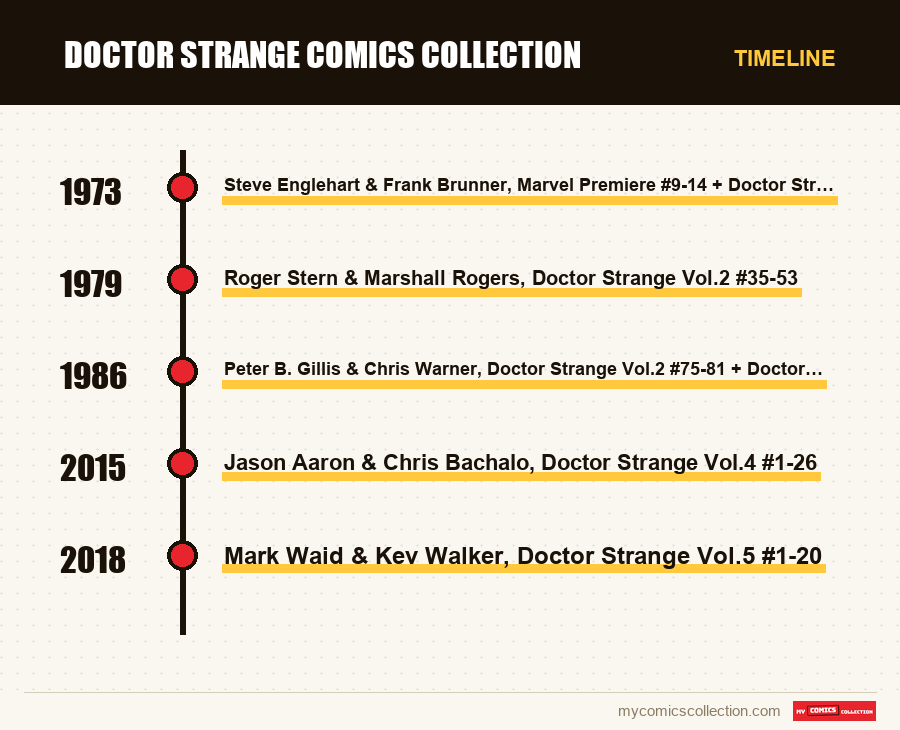
The big runs to know
Steve Englehart & Frank Brunner, Marvel Premiere #9-14 + Doctor Strange Vol.2 #1-18 (1973-1976)
After the end of Strange Tales and a down period, Doctor Strange is reborn thanks to Steve Englehart and Frank Brunner. Their collaboration begins in Marvel Premiere #9-14 (1973), then continues in the first solo volume, Doctor Strange Vol.2 (1974). Englehart delves deeper into the character's mythology by exploring the death of the Ancient One, the fight against Shuma-Gorath, and Strange's quest to truly become Sorcerer Supreme. Brunner, strongly influenced by Ditko but also by Art Nouveau and fantasy illustration, delivers sumptuous pages. Marvel Premiere #14 and Doctor Strange Vol.2 #1 are sought-after key issues from this period.
Roger Stern & Marshall Rogers, Doctor Strange Vol.2 #35-53 (1979-1982)
Roger Stern takes up the title with the designer Marshall Rogers and delivers a dense, well-written run, which considerably enriches the mystical lore of the Marvel universe. Stern introduces new antagonists, develops the relationship between Strange and Clea, and confronts the Sorcerer Supreme with increasingly cosmic threats. Rogers, known for his work on Batman in the 70s, brings a remarkable sense of composition and visual dynamism. These numbers remain very affordable on the secondary market (often less than $10 in good condition) and offer excellent value for money.
Peter B. Gillis & Chris Warner, Doctor Strange Vol.2 #75-81 + Doctor Strange: Sorcerer Supreme #1-4 (1986-1989)
The end of volume 2 by Peter B. Gillis is an underestimated period. Gillis pushes Strange to his limits by making him lose his powers and renounce the title of Sorcerer Supreme. The series ends at #81 and relaunches under the title Doctor Strange: Sorcerer Supreme in 1988, a volume of 90 issues which ran until 1996. The first issues of this relaunch, drawn by Jackson Guice, are good collector's items for lovers of the late-Bronze / early-Modern Age period.
Jason Aaron & Chris Bachalo, Doctor Strange Vol.4 #1-26 (2015-2017)
The 2015 relaunch by Jason Aaron and Chris Bachalo is the most successful modern revival of the character. Aaron rethinks magic as a finite resource, with a real physical and spiritual cost to Strange. The bow The Last Days of Magic (#6-10) confronts the Sorcerer Supreme with the Empirikul, a scientific order that is eradicating magic throughout the multiverse. Bachalo delivers vibrant, chaotic and colorful graphic work, which echoes Ditko's inventiveness. The run coincides with the 2016 MCU film, which has boosted demand for the #1, today available between 5 and 15 dollars depending on condition.
Mark Waid & Kev Walker, Doctor Strange Vol.5 #1-20 (2018-2019)
Mark Waid offers a more accessible and adventurous approach. Strange loses his magic and must find alternative solutions, a recurring narrative arc but treated here with intelligence and humor. The drawing of Kev Walker is solid and readable. This run is a good entry point for readers new to the character and the issues are very affordable on the second-hand market.
Where to start? If you're new to Doctor Strange, the run Jason Aaron / Chris Bachalo (Vol.4, 2015) is the ideal entry point: modern, accessible, visually spectacular. For lovers of classics, aim for the run Englehart / Brunner in Marvel Premiere and Doctor Strange Vol.2. To find out more, see our histoire complète de Doctor Strange en comics.
The essential Doctor Strange key issues
Here are the part numbers every Doctor Strange collector should know. For a detailed analysis, see our guide to issues clés Doctor Strange.
- Strange Tales #110 (1963): First appearance of Doctor Strange, in a 5-page story by Lee and Ditko. In CGC 6.0, count approximately 8,000 to 12,000 dollars. This is the absolute holy grail of any Doctor Strange collection.
- Strange Tales #111 (1963): Second appearance and first appearance of Baron Mordo, Strange's sworn enemy. Much more accessible than #110, between $1,000 and $3,000 in CGC 6.0.
- Strange Tales #114 (1963): First story of the origin of Doctor Strange (the car accident, the trip to Tibet, the apprenticeship with the Ancient One). Key issue fundamental to the mythology of the character.
- Strange Tales #126 (1964): First appearance of Dormammu and the Dark Dimension. Dormammu is the most iconic antagonist of Doctor Strange, popularized by the 2016 MCU film.
- Strange Tales #138 (1965): First appearance of Eternity, the incarnation of the Marvel universe. Key cosmic issue at the heart of Ditko's Eternity Saga.
- Strange Tales #169 (1973): First appearance of Brother Voodoo (Jericho Drumm), who later becomes the new Sorcerer Supreme in New Avengers.
- Marvel Premiere #14 (1974): First Doctor Strange issue from the Englehart/Brunner run. Key from the Bronze Age affordable ($20 to $60 depending on condition).
- Doctor Strange Vol.2 #1 (1974): First from the first solo series. Key from classic collection, available between 30 and 100 dollars in good condition.
- Doctor Strange: Sorcerer Supreme #1 (1988): Launch of the longest volume in the series (90 issues). Accessible item, generally under 10 dollars.
- Doctor Strange Vol.4 #1 (2015, Aaron/Bachalo): The most successful modern relaunch. Between $5 and $15, it's an affordable key to secure quickly.
Conservation and grading of Doctor Strange comics
The Silver Age issues of Strange Tales deserve special conservation attention. Here are the essential recommendations:
Pochettes et cartons
Les Strange Tales #110-168 date from 1963 to 1968: the paper is acidic, fragile, and yellows easily. Use Mylar pouches (type E. Gerber Mylites 2) with acid-free cardboard (full-back boards). Change the boxes every 3 to 5 years to avoid acidity transfer. For Bronze Age and newer issues, standard polypropylene sleeves are sufficient.
Getting your Doctor Strange graded
CGC or CBCS grading is recommended for Silver Age key issues (Strange Tales #110, #111, #114, #126). The cost of grading (around $30 to $75 depending on the tier) is quickly amortized by the capital gain on resale. On the other hand, grading common Bronze or Modern Age issues does not make economic sense unless they are in Near Mint (9.4+) condition. Store them raw in quality pouches.
Stockage et approximatelynement
Stable temperature between 18 and 22°C, relative humidity between 40 and 55%. Avoid direct light, including neon lights. Acid-free cardboard short boxes are the standard. Store numbers vertically, without compressing them. A outil de gestion de collection allows you to track the status of each issue and plan cover rotations.
Building your Doctor Strange collection on a controlled budget
Doctor Strange is a character whose collection can fit any budget. Here are three strategies depending on your means:
Budget serré (moins de 200 euros)
Focus on modern runs: the complete Jason Aaron/Bachalo Vol.4 run (26 issues) can be found for around 80 to 120 euros in lots on eBay. Add the Mark Waid Vol.5 run for 30 to 50 euros. You will have a solid base of over 45 quality issues, with modern key issues (#1 of each volume) included.
Budget moyen (500 à 1 500 euros)
Aim for the classic Bronze Age runs: the Englehart/Brunner run (Marvel Premiere #9-14 + Doctor Strange Vol.2 #1-18) and the Stern/Rogers run (Vol.2 #35-53) can be found in sets or individually for reasonable prices. Add a Strange Tales #126 (first appearance of Dormammu) in average condition (CGC 3.0-5.0), feasible between 200 and 500 dollars. You will have a collection that covers the character's highlights.
High budget (3,000 euros and more)
Target Silver Age key issues. A Strange Tales #110 in CGC 2.0-3.0 (readable but worn condition) sells for between $2,500 and $4,500. A Strange Tales #111 in CGC 4.0-6.0 is accessible between 800 and 2,000 dollars. Complete with the Eternity Saga issues (#130-146) in raw to form a coherent Silver Age set. Follow the evolution of the odds with a outil de suivi de collection to buy at the right time.
Astuce budget : Les issues Doctor Strange: Sorcerer Supreme #1-90 (1988-1996) are often overlooked by collectors focused on the Silver Age. You can find complete sets for less than 100 euros. It's an excellent way to build up a large volume of collection at a lower cost, with a few narrative nuggets (notably the issues written by Roy Thomas).
FAQ: Collection Doctor Strange
Manage your Doctor Strange collection efficiently
With My Comics Collection, import your Doctor Strange series in minutes and instantly identify your missing issues, from Strange Tales to the latest current series.
🚀 Free trial 7 days, No obligation