
Dormammu, tyrannical lord of the Dark Dimension, first appears in Strange Tales #126 (November 1964), created by Stan Lee and Steve Ditko alongside his niece Clea. This Silver Age comic remains sought after at high grade today, while its average condition rating (FN 6.0 and below) remains affordable for collectors who want to own the origin of Doctor Strange's greatest mystical enemy.
There are bad guys who strike, and there are bad guys who have been around forever, draped in flames, patiently waiting for the universe to tilt. Dormammu belongs to the second category. Unlike the costumed supervillains who populate Silver Age Marvel, he has no secret identity or human origin to tell: he is an entity, a ruler of another reality, and it is precisely this radical otherness that allowed Stan Lee and Steve Ditko to push the visual and narrative limits of the comic book in 1964.
For collectors, Dormammu occupies a special place. This is not a character for whom we track a single isolated key number as we would for the appearance of a hero; his legend was built over fifteen consecutive issues of Strange Tales, a serial arc that redefined what a superhero comic could tell. Understanding Dormammu therefore means understanding an entire period of Marvel's editorial history, the one where Ditko transformed the pages of Doctor Strange into a visual laboratory.
This article traces the real history of Dormammu in comics: his creation, the issues that count, his editorial journey until today, his passage to cinema with the MCU, and concrete benchmarks for intelligently evaluating and purchasing the comics that feature him.
Strange Tales #126: the birth of Dormammu in the Marvel Silver Age
Strange Tales #126 hit newsstands on August 11, 1964, dated November 1964 on the cover according to the display convention of the time, for a price of 12 cents and 36 pages. The issue is split into two stories, like most Strange Tales of this period: a Human Torch story drawn by Dick Ayers, and the Doctor Strange story, scripted by Stan Lee and drawn by Steve Ditko, which occupies the second half of the magazine. It is in this second story that Dormammu makes her debut, alongside her niece Clea, then simply presented as a mysterious inhabitant of the Dark Dimension whose full identity will only be revealed later. The cover is by Jack Kirby.
The next issue, Strange Tales #127, introduces the Mindless Ones, a horde of primal giants imprisoned in the Dark Dimension, which Dormammu uses as brute force against his enemies. This inaugural appearance already lays the foundations of the character: an absolute ruler, with a face surrounded by psychic flames, who does not shy away from any threat because no threat known to Doctor Strange has a hold on him.
A creation born from a name before a character
The creation anecdote is well documented and comes from Stan Lee himself: the name “Dormammu” was invented before the character even existed. Lee was looking for a sound that evoked both power and strangeness, and it was Ditko who then brought the name to life, imagining a face totally different from anything that existed in superhero comics at the time: a bare head, without hair, surrounded by stylized flames suggesting both a crown and an aura of cosmic power. This graphic choice, very far from the classic costumed villain, was one of the elements which allowed the Doctor Strange series to visually distinguish itself from the rest of the Marvel line-up of the mid-1960s.
This moment must be placed in the broader context of the Lee-Ditko collaboration on Doctor Strange, which began discreetly in Strange Tales #110 (July 1963) as a simple companion story. In a little over a year, the series had gained in visual ambition to the point of becoming, with the arrival of Dormammu, one of the most daring fields of graphic experimentation in the history of the American comic book, foreshadowing the psychedelic pages that Ditko would push even further in the following issues.
Who is Dormammu? Fictional origins, powers and status in the Marvel Pantheon
In Marvel continuity, Dormammu belongs to the Faltine race, beings of pure mystical energy originating from a dimension before our own reality. Unlike his peers, who exist in the form of intangible energy, Dormammu has chosen to take on a physical form in order to be able to conquer and dominate other dimensions, starting with the Dark Dimension, which he wrests from its rightful rulers to make his own kingdom. This transgression, revealed in the issues following his first appearance, is presented as an act considered heresy by the other Faltine, which partly explains his banishment and dimensional isolation.
His sister Umar and his niece Clea are the two other central figures in this family mythology. Umar shares most of his powers with him and frequently competes with him for control of the Dark Dimension, while Clea, first presented as a simple mysterious inhabitant in Strange Tales #126, will become over the following issues the student and then the recurring companion of Doctor Strange: one of the most lasting romantic relationships in the Sorcerer Supreme continuity.
Power-wise, Dormammu is written as one of the most powerful mystical beings in the entire Marvel Universe: near-limitless manipulation of magical energy, interdimensional teleportation, the ability to alter reality within his own domain, superhuman strength and endurance, as well as a form of near-immortality tied to his nature as an energy being. It is precisely this scale of power, almost cosmic, which allowed the screenwriters of the following decades to oppose him not only to Doctor Strange but also to the Avengers, to Thor and even to cosmic entities like Odin, without ever having to lower his status as an existential threat.
A sprawling bibliography: the arcs that built the legend
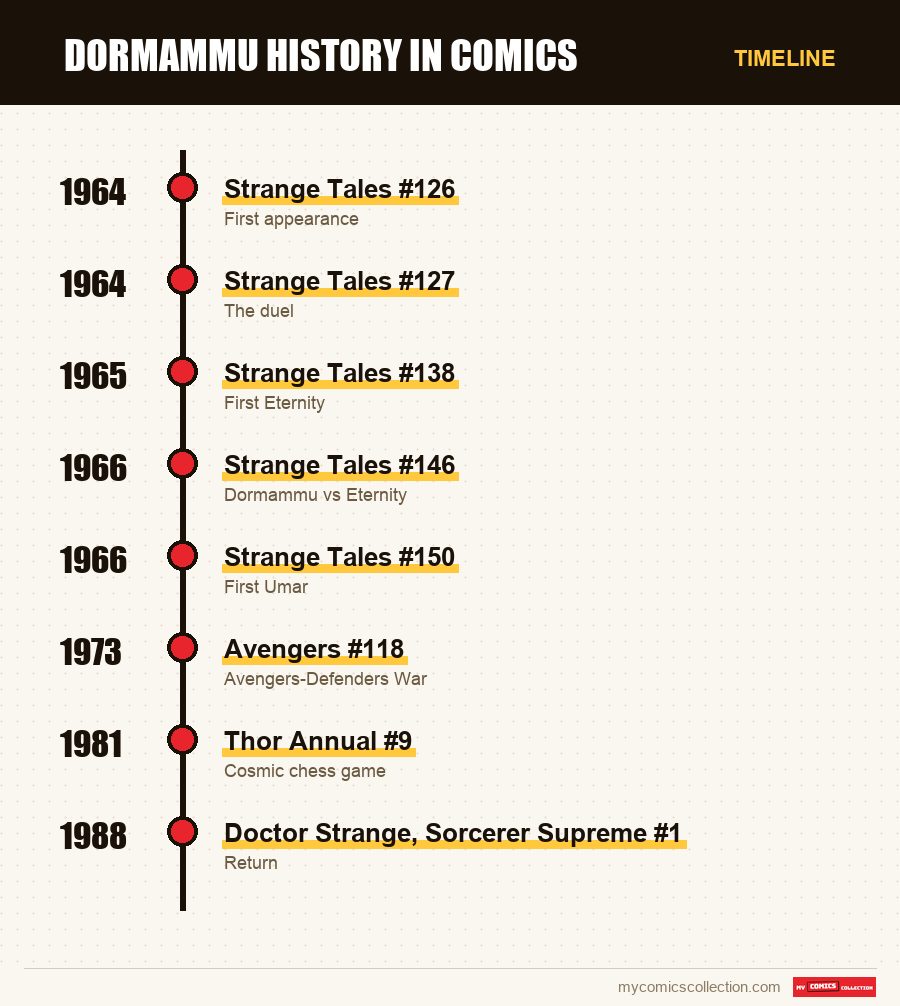
What sets Dormammu apart from many other Marvel villains of the same generation is that his legend is not based on a handful of isolated appearances but on a continuous series. After Strange Tales #126-127, which poses the inaugural confrontation, the character returns in force in a major arc running from Strange Tales #131 to #146 (April 1965 to July 1966), i.e. fifteen consecutive issues devoted largely to the conflict between Doctor Strange and the lord of the Dark Dimension. It is one of the very first examples, in the history of American superhero comics, of a serial plot spread over so many months without a systematic return to the “complete story in one issue” format.
Strange Tales #150 (November 1966) then brings an important mythological development: it is in this issue that the nature of Faltine of Dormammu and Umar is explained, definitively anchoring the character in his own cosmogony rather than in a simple status of generic demon. This mythological foundation will become the basis on which later scriptwriters will construct his appearances.
From Avengers-Defenders War to cosmic crossovers
In the 1970s, Dormammu left the sole framework of Doctor Strange to establish himself as a threat across the entire Marvel shared universe. The crossover Avengers #115-118 / Defenders #8-11 (1973), known as "Avengers-Defenders War", saw him join forces with Loki in a plan to conquer Earth: an association which well illustrates how the Marvel editorial of the seventies began to build bridges between its different series and to make Dormammu an actor in major inter-title events, and no longer just an antagonist confined to Doctor Strange.
Thor Annual #9 (1981) features him in a cosmic chess game against Odin, a tale that highlights the extent to which the writers already treated him as a peer of the Norse gods in terms of narrative power. Later, the start of the ongoing series Doctor Strange, Sorcerer Supreme (#1-2, 1988-1989) explored a possession scenario in which Dormammu attempted to directly take over Stephen Strange's body, renewing the threat he posed just as the character of Doctor Strange was going through a significant editorial overhaul in the late 1980s.
These successive arcs explain why collectors who are interested in Dormammu do not limit themselves to Strange Tales #126: possessing the complete history of the character requires following his evolution through several decades and several titles, which makes him a subject of collection that is both rich and demanding.
The impact of adaptations on ratings: Dormammu in cinema and in other media
Before its film adaptation, Dormammu already had an established presence in animation and video games, which helped maintain its notoriety among a wider audience than just comic book readers. He appears in Spider-Man: The Animated Series (voiced by Ed Gilbert), The Super Hero Squad Show (voiced by Robert Englund), Ultimate Spider-Man (voiced by Phil LaMarr), and Marvel Disk Wars: The Avengers (voiced by Neil Kaplan). On the video game side, he is a playable character in Marvel vs. Capcom 3 and Ultimate Marvel vs. Capcom 3, appears as a boss and playable character in Lego Marvel Super Heroes, and is on the roster of Marvel Contest of Champions.
The most significant turning point for the character's notoriety, however, remains his presence in Doctor Strange (2016), released in theaters on November 4, 2016 and played by Benedict Cumberbatch in the title role. The film grossed $677.8 million at the worldwide box office for a budget estimated between $165 and $236.6 million depending on sources, a success which exposed the character to an audience much wider than that of comic book readers. Notable fact: it is Cumberbatch himself who plays Dormammu, without being credited in the credits. The actor proposed this idea to director Scott Derrickson, believing that a Dormammu conceived as a "horrific" reflection of Stephen Strange would be more effective on screen than a simple monster. Cumberbatch provided the reference motion-capture performance for the character's flamboyant face, and his voice was then mixed with that of another uncredited British actor with a particularly deep voice to achieve Dormammu's final timbre; actor Tony Todd had also recorded an alternative version of the voice, ultimately discarded during editing.
In terms of collecting, this type of media exposure has a documented effect on interest in the original comics: Marvel film releases typically generate a surge in research and purchases for the first appearances of the characters concerned, Strange Tales #126 included, without this necessarily resulting in a lasting surge in prices: the effect is generally more visible in volume of transactions than in absolute value record for this specific issue, unlike much rarer keys from the Silver Age.
It should also be noted that Dormammu has never been the central character of a solo series: his presence in the comics always remains relative to that of a hero who confronts him, most often Doctor Strange. This position as a recurring antagonist rather than an autonomous star explains why the collection market around him is structured less in a hunt for a single "grail" than in a progressive accumulation of arc numbers: where a title character concentrates most of his collection value on his number #1, Dormammu spreads his collector interest over the entire duration of the 1964-1966 arc, which makes him a subject particularly suited to a collection built over time rather than a single purchase.
Collecting this series?
Track what you own, what you are missing and what your collection is worth. 7 day trial.
Start my trial →Spotting and evaluating a Strange Tales #126: points of vigilance
Strange Tales #126 is a 1964 comic that is relatively commercially available in average condition (VG to FN), making it an accessible Silver Age key compared to other major early releases of the same decade. Its rating, on the other hand, rises sharply as soon as you reach the high grades, where copies become much rarer: a classic phenomenon for comics before 1970, whose pulp paper and reading habits of the time (comics folded, stacked, exchanged between readers) reduced survival in close to new condition.
A particularly documented copy illustrates this rarity in high grade: the “Bowling Green Pedigree” copy of Strange Tales #126, certified CGC NM 9.2 with blank pages, coming from a pedigree collection recognized in the auction market and regularly cited as one of the best known copies of this issue. Pedigree copies (that is, from well-preserved and documented historical collections) generally benefit from a premium on the market compared to a copy of equivalent grade with no known provenance.
Specific grading criteria to watch out for
As with any Silver Age comic, several points deserve particular attention before purchasing:
- The Kirby cover: Look for corner creases, yellowing, and the red ink sheen characteristic of mid-1960s Marvel covers, a common point of dot loss in grading.
- The central binding (spine): On a 36-page stapled comic from 1964, spine cracks and rusty staples are common and directly impact the grade.
- The whiteness of the pages: the mentions “white pages” or “off-white to white” strongly influence the value; the pulp paper of the period yellows naturally, so a still clear pagination is a real marker of conservation quality.
- Undeclared restorations: on an issue of this age, systematically check the CGC label (Universal vs Restored) rather than relying solely on the photos, especially for copies sold outside specialized platforms.
- The distinction between the two stories of the issue: keep in mind that this is a two-story issue (Human Torch and Doctor Strange); it is not an issue entirely devoted to the Sorcerer Supreme, which partly explains why its print run and distribution followed the editorial logic of an anthology rather than a solo title.
Buying guide: how to approach Strange Tales #126 as a collection
- First, set a realistic grade goal: a GD to VG copy is an affordable entry into the Silver Age and allows you to own Dormammu's origin story without aiming for the high end.
- If your goal is a certified copy, systematically favor CGC or PSA copies rather than “raw” (uncertified) copies for this issue, given the risk of undeclared restoration on a comic over sixty years old.
- Always compare several recent sales before setting your budget: the rating of Strange Tales #126 varies significantly depending on the presence or absence of the “white pages” mention at the same grade.
- Keep an eye out for pedigree examples (Bowling Green or other documented collections) if you are aiming for the very high grade: they often represent the best quality-provenance ratio available on the market.
- Remember that this issue contains two distinct stories: make sure, on the scans or photos, that the entirety of both stories (Human Torch and Doctor Strange) is present and complete.
- To track the evolution of the rating over time without multiplying manual searches, use an estimator based on actual eBay sales rather than a fixed list price.
- If you collect several issues of the Dormammu arc (Strange Tales #126 to #150), consider centralizing the monitoring of your collection with a dedicated application rather than a spreadsheet: this makes it easier to follow the progression from grade to grade over the entire arc.
For collectors who build a collection around several issues linked to the same narrative arc, structuring the follow-up quickly becomes essential: this is the kind of task that the collection management application simplifies, by centralizing the grades, the acquisition dates and the evolution of the estimated value number by number.
Key issues to know
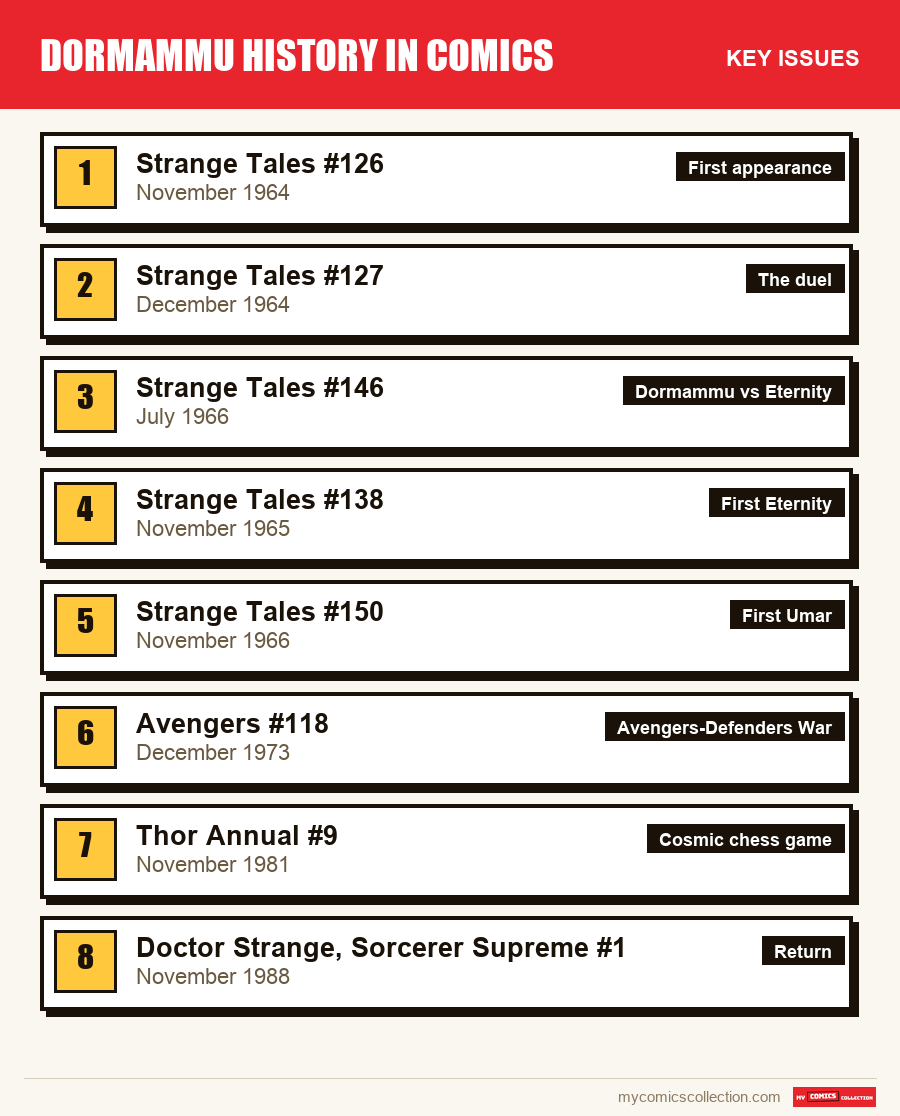
Strange Tales #126
In Stan Lee and Steve Ditko's Doctor Strange story, the Sorcerer Supreme enters the Dark Dimension and faces its ruler, Dormammu. The issue also introduces Clea, still unnamed, Strange's future partner.
Strange Tales #127
During the duel between Strange and Dormammu, the spell holding back the Mindless Ones, introduced in this issue, breaks. Strange helps his foe contain them and Dormammu, bound by the debt, pledges not to invade Earth's dimension.
Strange Tales #146
Climax of the long serial: Dormammu challenges Eternity, the embodiment of the universe, and is seemingly destroyed. The same issue finally gives Clea her name.
Strange Tales #138
In the middle of the long saga pitting Strange against Dormammu and Baron Mordo, the hero meets Eternity, the cosmic entity embodying the universe. It becomes the arbiter of the arc's final duel.
Strange Tales #150
The issue introduces Umar, Dormammu's sister and Clea's mother, who takes up the threat in the Dark Dimension. It enriches the character's family mythology and that of the Faltine.
Avengers #118
Conclusion of Steve Englehart's Avengers and Defenders crossover: using the Evil Eye, Dormammu, allied with Loki, begins merging the Dark Dimension with Earth. It is his first attempt to invade our dimension since his pledge.
Thor Annual #9
Chris Claremont shows Odin locked in a chess game with Dormammu, its stakes affecting Lord Chaos and Master Order. Thor, manipulated by Umar, nearly tips everything over: Dormammu is treated as the gods' equal.
Doctor Strange, Sorcerer Supreme #1
Peter B. Gillis and Richard Case give Strange a new ongoing series, which opens with the return of Dormammu, believed destroyed years earlier. The character reclaims his place as the Sorcerer Supreme's great foe.