Clea first appears, unnamed, in Strange Tales #126 (November 1964), created by Stan Lee and Steve Ditko as jailer and then ally of Doctor Strange against Dormammu. You will have to wait Strange Tales #146 (July 1966) for her to finally be named. Disciple then mystical wife of Stephen Strange, she becomes queen of the Dark Dimension before inheriting the title of Witch Supreme in 2021-2022 in the series Strange by Jed MacKay. The founding issues (Strange Tales #126 and #146) remain the most sought-after pieces by Silver Age Marvel collectors.
Few supporting characters in the Marvel Universe have had such a long and bumpy editorial trajectory as Clea. Introduced in the mid-1960s as a simple captive silhouette in the cosmic setting of Doctor Strange, it took her nearly twenty months to receive a name, several decades to obtain a last name, and nearly sixty years to finally land the title role in a series that bears her direct influence. In the meantime, she goes through almost all the major narrative cycles of the original Sorcerer Supreme: recurring love interest, rival of her own mother, ruler of the Dark Dimension, mystical wife of Stephen Strange, then, after the latter's death, his legitimate replacement at the top of the Marvel magical hierarchy.
This long history explains why Clea occupies a special place among comic book collectors: it owes its popularity not to an isolated media peak, but to an accumulation of narrative milestones spread over six decades, from the Silver Age to the post-MCU era. This article retraces this complete chronology, sheds light on the issues that really matter to a collector and takes stock of the real effect that its appearance had in Doctor Strange in the Multiverse of Madness on the interest in the original comics.
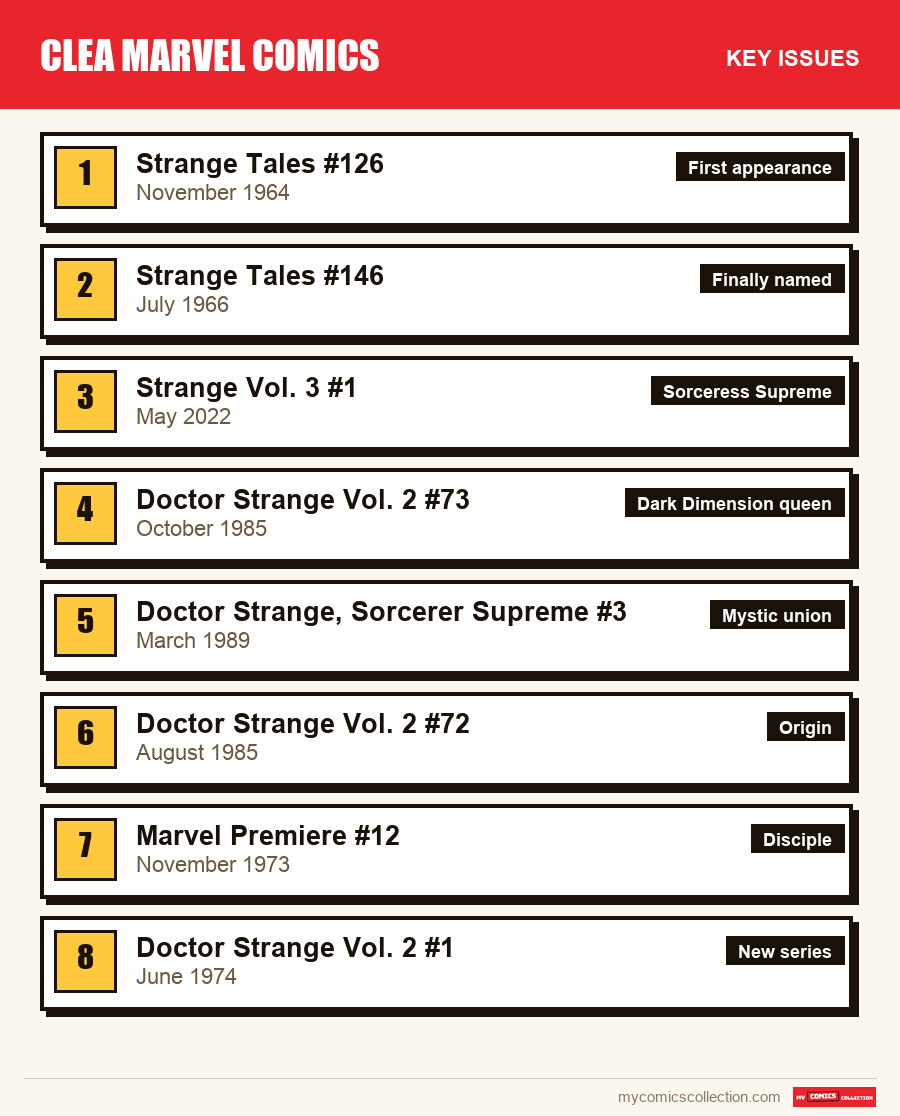
Birth of a character: Clea in the Lee/Ditko era (1964-1966)
In November 1964, Stan Lee and Steve Ditko completed one of the anthology series' most ambitious arcs Strange Tales: the very first confrontation between Doctor Strange and Dormammu, tyrannical lord of the Dark Dimension. In Strange Tales #126, a silver-haired female character appears in the background, presented as a captive of the despot. She has neither name nor history of her own: she serves above all as a dramatic foil, a human face at the heart of a cosmic clash between two magical powers. However, this is the very first appearance of Clea, and the issue also marks the debut of Dormammu himself, making it today one of the most hotly contested Silver Age comics of the entire Ditko period on the title.
Lee's choice not to immediately name the character was not insignificant for the time: anthological series like Strange Tales operated at an intense production pace, with arcs completed in a few pages and secondary characters often treated as renewable elements of scenery. The young woman, however, reappears throughout the following episodes, always associated with the fate of the Dark Dimension, which already betrays a more lasting storyline intention than a simple extra. You have to wait Strange Tales #146, published in July 1966, so that Dennis O'Neil and Steve Ditko finally named her Clea: a name that has since remained inseparable from the mythology of Doctor Strange. Between these two issues, almost two years of monthly publication have passed, a rare duration for a character destined to become a pillar of the franchise.
This delay has a direct consequence on the way in which collectors prioritize these issues today: Strange Tales #126 retains the status of first appearance in the strict sense, while #146 is valued as the number of the first named appearance, a distinction found for several Marvel characters introduced anonymously before being formally identified. Both issues are therefore sought after, but for different reasons, and an informed buyer must know which of these two keys corresponds to the use he wants to make of it: to complete a complete Doctor Strange collection, or to possess the very first graphic trace of the character.
From silent captive to disciple of Doctor Strange
In the episodes following her first appearance, Clea's status evolves rapidly. At first a simple hostage of Dormammu's regime, she gradually takes a stand against her jailer and finds herself punished for this betrayal. This storyline shift, the secondary character who chooses side against his own ruling family, becomes one of the most reused narrative engines in his editorial history, returning in varied forms at each major stage of his life: against Dormammu in the 1960s, against Umar in the following decades, then against the very legacy of Stephen Strange in the 2020s.
The Ancient One, Stephen Strange's mentor, intervenes to protect her by placing her in an isolated dimensional pocket, safe from Dormammu's reprisals. It is Strange himself who later frees her from this exile and returns her to Earth: a seminal gesture that seals their bond and begins the mentoring relationship that will structure decades of stories. Clea then becomes Strange's student, learning the mystical arts under his direct tutelage, a teacher-student dynamic that gradually develops into a romantic relationship over the course of the 1970s and 1980s.
This status of disciple is important to understand the rest of the character's trajectory: unlike other superhero love interests confined to a passive role, Clea acquires from this period her own magical autonomy, independent of that of Strange. This autonomy will become central much later, when the publishing industry decides to make her a heroine in her own right rather than a simple supporting role in the mythology of the Sorcerer Supreme.
Umar, Orini, Dormammu: the explosive genealogy of the Dark Dimension
Clea's strength as a character is largely due to her genealogy, built in small steps over several decades. She is revealed to be the daughter of Orini, a disciple of Dormammu who once ruled the Dark Dimension, and of Umar: an even more decisive figure, since she is Dormammu's own sister. Clea is therefore, through her mother, the direct niece of Doctor Strange's greatest recurring enemy, which makes her a central genetic and political piece in the balance of power of the Dark Dimension.
This lineage does not stop with the ruling family of the Dark Dimension: Clea and her mother are also descended from the Faltine, a race of extradimensional energy beings whose human appearance is only a form of adaptation. It is this ancestry which explains the quasi-immortal nature of the character, she retains the appearance of a woman of around twenty years old while her existence is counted in centuries, as well as her ability to generate mystical energy herself rather than simply channeling it, unlike the majority of human sorcerers in the Marvel universe, Stephen Strange included.
This complex family architecture allows the writers to generate conflicts over several generations: Clea against Dormammu, Clea against Umar, then, later, Clea managing the political heritage of this same family once installed on the throne of the Dark Dimension. Few Marvel characters benefit from such a directly exploitable family tree dramatically, which partly explains the character's editorial longevity despite decades without a series to his name.
The Flames of the Regency: Clea becomes sovereign
The most significant turning point in Clea's career before the 2020s came when she led a rebellion against the powers that be in the Dark Dimension. During this arc, she discovers the truth about her parentage with Umar and confronts her own mother in direct magical combat. The victory is accompanied by a striking mystical phenomenon: the Flames of Regency manifest on his head, symbol and source of power sufficient to banish both Umar and Orini from the Dark Dimension.
This sequence permanently establishes Clea as the legitimate sovereign of the Dark Dimension, a political status which distinguishes her from almost all of the female characters in the Doctor Strange universe at that time: she does not reign by proxy or by marriage, but by direct magical conquest over her own lineage. The screenwriters of the following decades will regularly return to this status of leader, making her navigate between her responsibilities as sovereign and her attachment to Stephen Strange on Earth: a balance never completely stable, since Clea chooses several times to stay in the Dark Dimension to defend her people rather than follow Strange.
The mystical marriage with Stephen Strange
Clea and Stephen Strange's relationship reaches a major milestone in the series Doctor Strange, Sorcerer Supreme, launched in 1988. From issue 3 of this series, the two characters exchange vows according to the rites of the Dark Dimension rather than according to a classic earthly ceremony. Rather than a traditional marriage, the union takes the form of a mystical ritual: the two lovers each accept one of the “Two Rings That Are One”, a magical object which materializes their bond more than it contractualizes it in the earthly legal sense.
This form of union (mystical, not recognized by terrestrial authorities, but perfectly valid according to the laws of the Dark Dimension) is revealing of the way in which Marvel has always treated the Clea/Strange relationship: never completely stabilized, never reducible to a simple couple of superheroes, but constantly torn between two worlds that the two characters must each govern or protect in their own way. The return of Dormammu, shortly after, pushes Clea to stay in the Dark Dimension at the head of the resistance while Strange returns to Earth, a pattern of separation which will return several times in the following decades and which fuels a good part of the dramatic tension of the couple.
Editorially, it should also be noted that we must wait Strange vol. 3 #1, cover-dated May 2022, to see the character formally referred to as "Clea Strange": more than fifty-seven years after her first silent appearance in Strange Tales #126. This editorial slowness in establishing a complete identity, including last name, clearly illustrates the character's long secondary status in the Marvel hierarchy, before the spectacular rebalancing of the 2020s.
From Strange's Shadow to Witch Supreme: the turning point 2021-2022
The most radical change in status in Clea's publishing history comes with the event "Death of Doctor Strange" (2021). Stephen Strange dies during this storyline and, in a gesture that symbolically closes six decades of mentor-student relationship and then mystical union, bequeaths his title of Sorcerer Supreme to Clea. This transfer of power is not just a temporary storyline gimmick: it leads directly to the launch of a new monthly series, Strange, written by Jed MacKay with art by Marcelo Ferreira, Don Ho and Roberto Poggi, the first issue of which appears on March 2, 2022.
In this series, Clea inherits not only the title but also the entire magical arsenal of Stephen Strange, while mourning the man she seeks to bring back to life. The series met with notable critical reception from its first issue: several industry observers highlighted the way in which Jed MacKay's writing finally gave Clea a narrative voice of her own, sharp and distinct from that of Strange, far from the simple role of love interest which had long characterized the character. On the commercial level, Strange #1 ranked 7th among the best-selling comics for the month of March 2022 according to distribution figures from Diamond Comic Distributors: a notable performance for a title carried by a character previously considered secondary in the Marvel hierarchy.
This editorial repositioning permanently transforms the reading that collectors make of Clea's entire bibliography: the Silver Age issues (Strange Tales #126 and #146) are no longer just curiosities for Ditko-era purists, but the original milestones of a character now entitled to her own series with the rank of Witch Supreme of the Marvel universe: a status that no other female character of the Dark Dimension has ever achieved in continuity main.
Collecting this series?
Track what you own, what you are missing and what your collection is worth. 7 day trial.
Start my trial →The impact of adaptations on the rating
The general public discovers Clea on screen in May 2022, in the post-credits scene of Doctor Strange in the Multiverse of Madness, where she is played by Charlize Theron. The sequence, brief but striking, shows the character (white hair, characteristic purple costume) intercept Stephen Strange in a Manhattan street to tell him that his use of the multiverse has caused a dangerous incursion between universes, before opening an energy blade revealing the Dark Dimension. This appearance, timed a few months before the launch of the series Strange in comics, creates a rare alignment between the cinematic calendar and the editorial calendar: the general public discovers the name "Clea" in cinema almost at the time that Marvel Comics officially makes her a Witch Supreme on paper.
This type of synchronization has a measurable, although generally temporary, effect on the demand for original comics: the first appearances of a character just revealed in the cinema traditionally see their search and sales intensify in the weeks following the release of the film, before a gradual decline once the media novelty has died down. For Strange Tales #126, this phenomenon adds to an already solid rating independent of the MCU, driven by the double interest of the issue: first appearance of Clea and first appearance of Dormammu in the same issue, which makes it a piece already sought after by two distinct categories of Doctor Strange collectors.
At mid to high grades, a CGC certified copy around 8.0 with white to off-white pages commonly trades in the several hundred dollar range, with higher grades (9.0 and above) becoming significantly rarer to find on the market due to the manufacturing and handling standards typical of Silver Age comics-a booklet stapled and printed on cheap paper in 1964 was simply not designed to survive sixty years at very high grade. Strange Tales #146, less contested because it lacks the first appearance of Dormammu, generally trades at more accessible levels in the middle grades, which makes it a realistic entry point for a collector who wants to own the first named appearance of the character without aiming for the most expensive piece in his bibliography.
Unlike characters whose popularity explodes then suddenly falls after a single cinematic appearance, Clea benefits from a broad editorial base (six decades of presence, an ongoing status of Witch Supreme in current continuity) which limits the risk of a collapse in demand once the MCU effect has dissipated. This is a factor to take into account for any collector who thinks in the medium term rather than on the sole momentum of a theatrical release.
Collection benchmarks: the key numbers to know
Strange Tales #126 (November 1964)
The founding number. First, unnamed appearance of Clea, and first appearance of Dormammu. It is the most sought-after piece in the character's bibliography, and one of the most stable Silver Age keys in the entire Doctor Strange catalog, regardless of variations in popularity of the character himself.
Strange Tales #146 (July 1966)
The issue where Dennis O'Neil and Steve Ditko finally name the character "Clea", after almost two years of anonymous appearances. Less expensive than #126 but essential for any collection focused on the exact origins of the character.
Doctor Strange, Sorcerer Supreme #3 (1989)
The number of the mystical union between Clea and Stephen Strange, sealed by the exchange of the “Two Rings That Are One”. A key piece for collectors who follow the couple's complete romantic arc rather than just the Dark Dimension lineage.
Strange #1 (March 2022, Jed MacKay / Marcelo Ferreira)
The issue that establishes Clea as a Witch Supreme in her own right, in her own monthly series. Ranked the 7th best-selling comic of the month according to Diamond Comic Distributors upon its release, it marks the character's true editorial tipping point, a few weeks before his first appearance in the cinema.
Buying guide
- Clearly distinguish the purpose of the purchase before choosing a number: Strange Tales #126 for the very first appearance (unnamed) and the Clea/Dormammu double interest, or #146 for the first appearance under the name “Clea”: the two respond to different collection logics and do not have the same rating.
- Systematically check the certification (CGC or equivalent) on Silver Age issues like #126 and #146: at this age, the condition of the pages (white, off-white to white, cream) strongly influences the perceived value, much more than on recent comics.
- Be wary of uncertified examples sold as “high grade” without proof: on a 1964 or 1966 issue, the price gap between an optimistic self-assessment and an actual CGC grade can be considerable.
- For a more limited budget, favor medium grades (Very Good to Fine) of #146, which remain readable and collectible without reaching the price levels of very high grades of #126.
- Do not neglect Doctor Strange, Sorcerer Supreme #3 and Strange vol. 3 #1: less publicized than the Silver Age issues, they nevertheless complete two essential narrative milestones (the mystical marriage, the fixing of the full name) often forgotten by buyers who focus only on the “first appearance”.
- For a recent and accessible entry point, Strange #1 (2022) remains the easiest issue to find in very high grade, since it is a modern publication with a large initial circulation.
- Before any purchase, compare several recent real sales rather than a single displayed price: Silver Age comics markets are subject to significant variations depending on the origin and quality of the certification.
- Keep a precise inventory of your Doctor Strange/Clea collection, with grade, date of purchase and provenance, to follow the evolution of the price over time: this is exactly what our collection management application.
The key issues to know
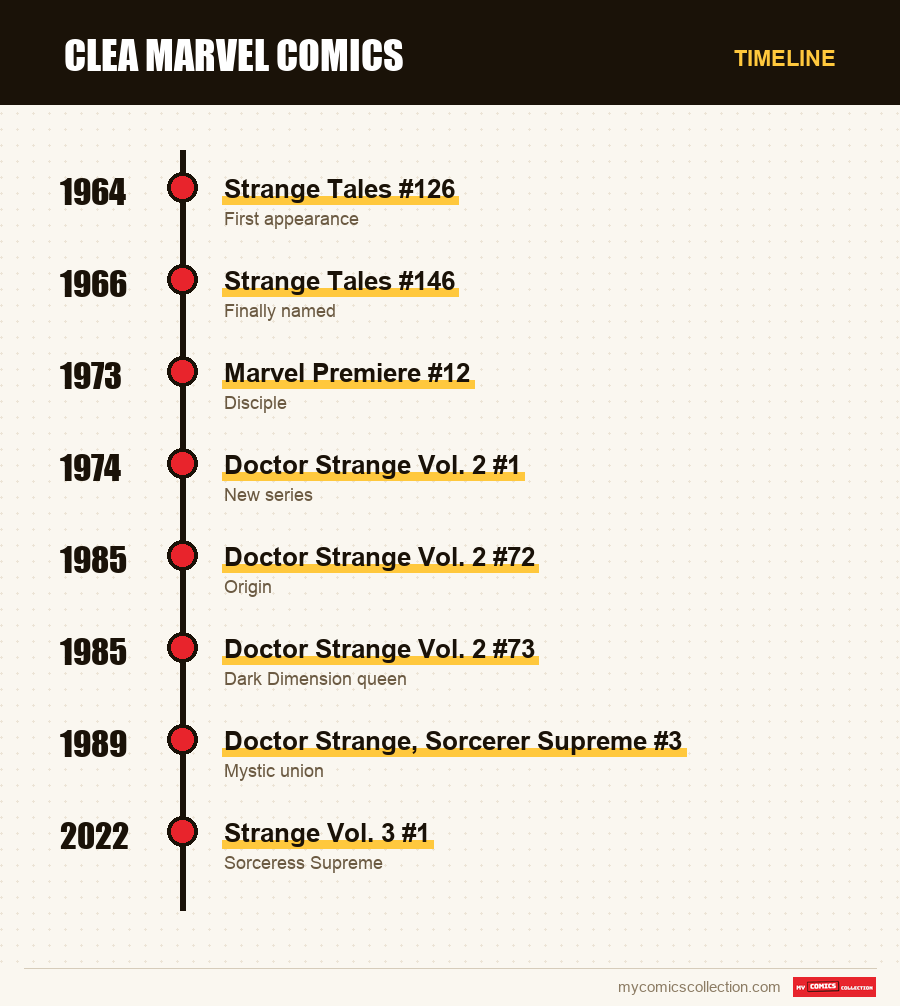
Strange Tales #126
In "The Domain of the Dread Dormammu!", Stan Lee and Steve Ditko introduce a still-unnamed white-haired young woman who helps Doctor Strange in the Dark Dimension. The same story marks Dormammu's first appearance. A double Silver Age key, it is the character's centerpiece.
Strange Tales #146
Nearly two years after her debut, the character finally gets her name, Clea, in a story written by Dennis O'Neil and Steve Ditko. This issue is also the last Doctor Strange story drawn by Ditko. A second key, more affordable than #126.
Strange Vol. 3 #1
On sale from March 2, 2022, this first issue by Jed MacKay and Marcelo Ferreira makes Clea the new Sorceress Supreme after Stephen Strange's death. Haunted by her restored memories, she seeks to bring him back from the dead. The character's true turning point.
Doctor Strange Vol. 2 #73
The conclusion of Clea's revolt, by Roger Stern and Paul Smith: thanks to a ruse, she faces her mother Umar in a duel and wins. She becomes ruler of the Dark Dimension. A status she would hold for years.
Doctor Strange, Sorcerer Supreme #3
Peter Gillis and Richard Case unite Clea and Stephen Strange through a Dark Dimension rite: each wears one of the "Two Rings That Are One", bound for eternity. It is not a marriage in the earthly sense, but it seals the couple for decades. A milestone in the character's romantic arc.
Doctor Strange Vol. 2 #72
In "Secret Origin", Roger Stern and Paul Smith show Clea leading the Dark Dimension rebels, backed by Doctor Strange, and confronting her father Orini in private. The issue revisits her origins and her link to Umar. It sets up the victory in #73.
Marvel Premiere #12
Steve Englehart and Frank Brunner show Clea and Wong finding Doctor Strange after the Ancient One's passing: Strange is now Sorcerer Supreme. It is in this context that he makes Clea his official disciple in the mystic arts. The start of the couple's long mentor and student relationship.
Doctor Strange Vol. 2 #1
Englehart and Brunner continue their work in the Sorcerer Supreme's new series: at the Sanctum Sanctorum, Clea shows Strange the rituals she has been learning. The issue puts the duo at the heart of the title for the whole decade. A milestone of the period when Clea grows alongside Strange.