Guardians of the Galaxy Vol. 2 (2017), directed by James Gunn, deepens the tape by revealing Star-Lord's father: Ego the Living Planet , appeared in Thor #132 (1966) by Stan Lee and Jack Kirby. The film also introduces Mantis , born in Avengers #112 (1973). Great freedom: in the comics, Peter Quill's father is not Ego but Emperor J'son of Spartax. The film preserves the family spirit of the team but reinvents this connection. Detailed comparison, film versus comics.
After the surprise success of the first part, Guardians of the Galaxy Vol. 2 focuses on the intimate: the quest for the origins of Star-Lord and the links that unite this family of broken arms. James Gunn draws on ancient cosmic characters while granting himself one of the most striking liberties in the saga on the question of authorship. Source-by-source decryption.
As in each article in the series, only verified information (distribution, dates, numbers, creators) is stated; the comparative analysis is ours, without reproducing dialogue or protected images.
Title : Guardians of the Galaxy Vol. 2 (2017)
Director: James Gunn
Actors: Chris Pratt (Star-Lord), Zoe Saldana (Gamora), Dave Bautista (Drax), Vin Diesel (voice of Groot), Bradley Cooper (voice of Rocket), Kurt Russell (Ego), Pom Klementieff (Mantis), Michael Rooker (Yondu)
Exit : May 5, 2017 (United States)
Studio: Marvel Studios
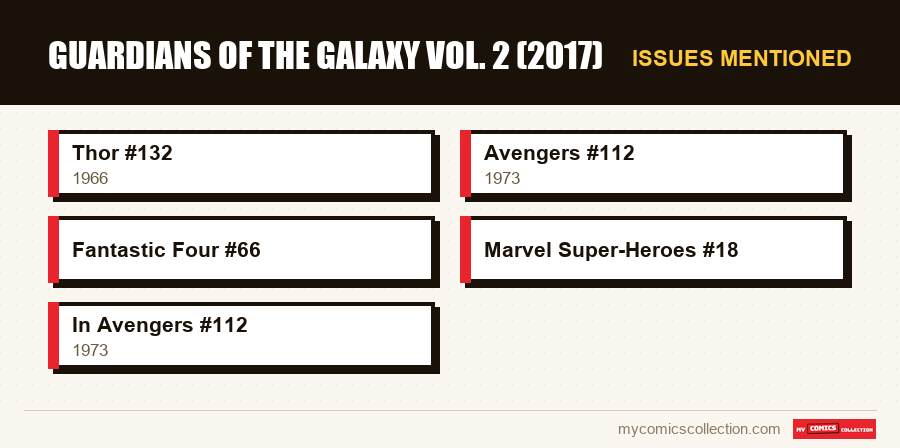
Thor #132 (1966): 1st appearance of Ego the Living Planet (Lee & Kirby)
Avengers #112 (1973): 1st appearance of Mantis (Englehart & Heck)
Guardians Team (2008): Abnett & Lanning
I'm from Spartax: Star-Lord's real father in the comics
- Ego the Living Planet, cosmic entity taken from a 1966 Thor.
- Mantis, the empath with strange perceptions, from Avengers #112.
- La blended family of the Guardians, emotional heart of the modern series.
- The decor cosmic populated by extraterrestrial entities and peoples.
- The character of Yondu, veteran of the original 1969 team.
- Star-Lord's father: in the comics, it's Emperor J'son of Spartax, not Ego.
- Ego becomes a parent: the Living Planet has no connection with Quill in the comics.
- Mantis sees its story simplified: its complex arcs from the comics are discarded.
- Yondu, a member of the 1969 team in the comics, becomes a pest with a big heart.
- Le your, family comedy and emotion, remains a signature of James Gunn.
Thor #132 (1966): Ego the Living Planet
The film's central revelation, Star-Lord's father is a sentient planet, relies on a character drawn from a completely different corner of the Marvel Universe. Ego the Living Planet appears in Thor #132 (September 1966), creation of Stan Lee and Jack Kirby: a gigantic cosmic entity, an entire world with a mind and a face. The film faithfully takes up this dizzying idea (a being on a planetary scale, both astonishing and terrifying) and embodies it brilliantly. It's a great example of how cinema will draw an obscure figure from Kirby's archives to make him the pivot of an intimate story.
The great freedom, on the other hand, is to make Ego the biological father of Peter Quill. In the comics, no filiation link unites the Living Planet and Star-Lord: the film invents this link to give his quest for origins a cosmic and tragic resonance. The contrast between the disproportionate scale of Ego and the intimacy of the father-son relationship is the strength of the story.
Avengers #112 (1973): Mantis joins the gang
The film introduces Mantis, an empath capable of perceiving the emotions of others. The character was born in Avengers #112 (June 1973), created by Steve Englehart and Don Heck, with a rich and complex history over the decades, mixing martial arts, mysticism and cosmic destiny. The film considerably simplifies this past to make her an innocent in the service of Ego, whose naivety and sincerity bring a new color to the team. Its emotional function-revealing the truth of feelings that others conceal-admirably serves a film centered on family ties.
J'son from Spartax: the hidden father
The question of Star-Lord's paternity perfectly illustrates the film's method. In the comics, Peter Quill's father is J'son, emperor of the Spartax empire, a political character woven into Marvel's galactic intrigues. The film completely dismisses this figure in favor of Ego, considered more spectacular and more loaded with meaning for a story about identity. This choice shows that the adaptation does not seek genealogical fidelity, but the best possible story: by making the father a narcissistic planet-god, the film offers Star-Lord a dilemma of much greater significance than a simple dynastic quarrel.
The characters, from paper to screen
- Ego: Faithful to his nature as a living Planet (Thor #132), but promoted to the rank of father of Star-Lord, an unprecedented bond.
- Mantis: Empath from Avengers #112, with a radically simplified story.
- Yondu: Veteran of the 1969 team, reinvented as a big-hearted pest and surrogate father figure.
- Star Lord: His quest for identity takes on a cosmic dimension via the invented link with Ego.
- Gamora and Nebula: Thanos' adopted daughters, whose sibling rivalry deepens.
Collecting this series?
Track what you own, what you are missing and what your collection is worth. 7 day trial.
Start my trial →Yondu and the legacy of the 1969 team
The film gives a central place to Yondu, whose destiny turns the story upside down. In the comics, Yondu Udonta is a founding member of the original Guardians team, which appeared in 1969, playing in the distant future. The film recovers the character, the blue archer with the whistling arrow, but reinvents him as the leader of Ravagers and true father of Peter Quill's heart. This shift, already started in the first part, culminates here: Yondu becomes the embodiment of the film's main idea, that true family is not that of blood. By transforming a 1969 veteran into a moving father figure, the film illustrates its total freedom from continuity.
Where to start reading
To rediscover the spirit of the film, the series by Abnett and Lanning (2008) remains the best gateway to the modern team. Those curious about Ego should go back to Thor #132 (1966) to discover the Living Planet in its original context, alongside Thor. Mantis is discovered in the Avengers of the 1970s (from Avengers #112). Finally, to understand the true genealogy of Star-Lord, the stories featuring J'son and the Spartax empire offer insight into the character as the comics conceived him. From 1966 to 2008, this journey covers the film's scattered sources.
The Sovereigns and the Promise of Adam Warlock
The film enriches its cosmic setting with the Sovereigns, a golden and haughty people created for the occasion but nourished by Marvel's space mythology. Above all, he slips in at the end of the story the announcement of a major character: Adam Warlock. This emblematic figure of cosmic sagas first appears in comics under the name "Him" in Fantastic Four #66-67 (1967), before becoming Adam Warlock, an artificial being in search of meaning, central hero of Jim Starlin's great epics around Thanos and the Infinity Stones. By teasing it, the film weaves an additional thread towards the cosmic clashes to come and pays homage to an essential part of Marvel science fiction. For the reader, it is an invitation to explore one of the most fascinating and philosophical characters in the catalog.
This anchoring in cosmic tradition is not insignificant: the Guardians are, in the comics as in the cinema, the heirs of Starlin's great space sagas. By summoning the Sovereigns and Adam Warlock, the film confirms its place as a gateway to this vast territory, where Thanos hovers and the promise of a confrontation on the scale of the universe.
Chronology of comics to know
- 1966: Thor #132: first appearance of Ego the Living Planet.
- 1969: Marvel Super-Heroes #18: first Guardians team (with Yondu).
- 1973: Avengers #112: First appearance of Mantis.
- 2008: relaunches Abnett & Lanning: the modern line-up of the film.
Collection side: what numbers to aim for after the film
The vol. 2 highlights two notable keys. Thor #132 (Ego's first appearance) is a sought-after Silver Age number from the Lee-Kirby duo, whose interest soared with Ego's central role on screen. Avengers #112 (first appearance of Mantis) is an affordable Bronze Age key and directly related to the film. For fans of the team, the Abnett and Lanning collections remain the best reading-to-budget ratio. These targets cover various price ranges, from prestigious issues to accessible comics. As always, condition and gradation determine value; relying on recent real sales is strongly recommended before any purchase. One point deserves attention: Thor #132 is also an issue signed by Lee and Kirby at the height of their collaboration, which gives it artistic value beyond just the first appearance of Ego. As for those curious about Adam Warlock, teased at the end of the film, they can target Fantastic Four #66-67 (1967), his very first appearance under the name "Him", a cosmic key increasingly sought after as the character gains visibility.
Its place in the saga and for the collector
Where the first installment introduced the gang, Vol. 2 explores its soul, deepening family bonds and setting major emotional milestones. For the collector, the film extends the effect of the first: it shines the spotlight on cosmic characters who have long been confidential, transforming Thor #132 and Avengers #112 into sought-after targets. It's a new illustration of the power of cinema on the market: a character as improbable as a living planet, drawn by Kirby in 1966, suddenly becomes a coveted number again. Beyond speculation, the film invites us to explore the most imaginative corners of Marvel's cosmic catalog, where ideas of crazy audacity lie dormant. In this way, the Guardians saga remains one of the most fertile for those who like to unearth forgotten treasures, these numbers long relegated to the bottom of the bins and suddenly propelled to the rank of keys sought after by the magic of a successful adaptation.
The verdict: emotion before genealogy
- Loyalty: Ego, Mantis and the team's family spirit are faithfully taken from the comics.
- Freedoms: Ego promoted to father of Star-Lord (in place of J'son), the story of Mantis simplified, Yondu reinvented.
- Collectible numbers: Thor #132 (Ego) and Avengers #112 (Mantis).
Guardians of the Galaxy Vol. 2 confirms James Gunn's method: favoring emotion over literal fidelity. By making a planet-god the father of its hero, the film takes total liberty with the genealogy of comics, but gains a rare dramatic power. For both the reader and the collector, it is a new door open to Marvel's cosmic treasures, from Ego to Mantis. By transforming a dark entity imagined by Kirby in 1966 into the beating heart of a story about fatherhood, the film once again demonstrates that the value of a character does not lie in his initial notoriety, but in the story we choose to make him carry: a lesson that the Guardians saga has continued to brilliantly illustrate. From the Living Planet to the empath Mantis, each character serves as a reminder that the darkest corners of the Marvel catalog sometimes hold the most beautiful stories to tell.
Frequently asked questions
Ego the Living Planet first appears in Thor #132 (1966), created by Stan Lee and Jack Kirby. The film takes the cosmic entity but makes it Star-Lord's father, a link that does not exist in the comics.
J'son, Emperor of the Spartax Empire. The film rejects it in favor of Ego, considered more spectacular and more loaded with meaning for a story about the identity of Peter Quill.
In Avengers #112 (1973), created by Steve Englehart and Don Heck. The film greatly simplifies her complex story to make her an innocent empath serving Ego.
Yes, but from the original team that appeared in 1969, very different. The film reinvents him as the leader of Ravagers and a surrogate father figure for Star-Lord.
Thor #132 (first appearance of Ego) on the Silver Age side, and Avengers #112 (first appearance of Mantis) on the Bronze Age side, more accessible and directly linked to the film.
Does the film make you want to collect Guardians? Estimate the value for free of your issues (Thor #132, Avengers #112…) with our tool based on current eBay listings.