Guardians of the Galaxy Vol. 3 (2023), directed by James Gunn, tells the origin of Rocket and faces the Supreme Evolutionary , mad scientist born in Thor #134 (1966) by Stan Lee and Jack Kirby. The film also introduces Adam Warlock (appeared as "Him" in Fantastic Four #66-67, 1967). It retains the team's spirit and the Evolutionary's obsession with perfection, but rewrites Rocket's past. Detailed comparison, film versus comics.
Conclusion of James Gunn's trilogy, Vol. 3 offers the soundtrack's most moving farewell, centering on Rocket's painful origins. The film draws on a little-known Kirby character to create a terrifying antagonist. Source-by-source decryption.
As in each article in the series, only verified information (distribution, dates, numbers, creators) is stated; the comparative analysis is ours, without reproducing dialogue or protected images.
Title : Guardians of the Galaxy Vol. 3 (2023)
Director: James Gunn
Actors: Chris Pratt (Star-Lord), Bradley Cooper (voice of Rocket), Zoe Saldana (Gamora), Chukwudi Iwuji (Supreme Evolutionary), Will Poulter (Adam Warlock), Karen Gillan (Nebula)
Exit : May 5, 2023 (United States)
Studio: Marvel Studios
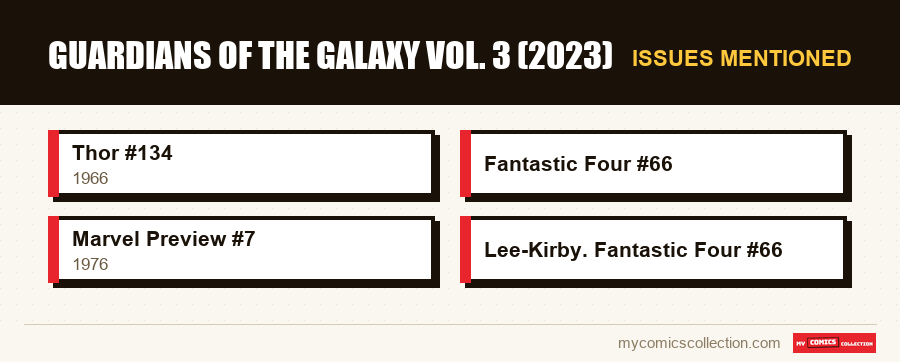
Thor #134 (1966): First appearance of the Supreme Evolutionary (Lee & Kirby)
Marvel Preview #7 (1976):Rocket Raccoon's first appearance
Fantastic Four #66-67 (1967): Adam Warlock (“Him”)
Counter-Earth & Wundagore: the mythology of the Evolutionary
- L'Supreme Evolutionary and his obsession with creating a perfect species.
- His animal experiments, the origin of hybrid creatures.
- Rocket, genetically modified and overarmed raccoon.
- Adam Warlock, an artificial being in search of its nature.
- La blended family of the Guardians, the emotional heart of the trilogy.
- The origin of Rocket is rewritten: in the comics, he comes from the planet Halfworld, not the Evolutionary.
- The Evolutionary is made more cruel and sadistic than in the comics.
- Adam Warlock is reinvented as an immature being in the service of the Sovereigns.
- La Counter-Earth and Wundagore are rearranged for the story.
- Le your, mixing emotion and comedy, remains a signature of James Gunn.
Thor #134 (1966): The Supreme Evolutionary
The film's antagonist, the Supreme Evolutionary, is a Kirby character as old as he is little-known. He appears in Thor #134 (1966), created by Stan Lee and Jack Kirby: a scientist obsessed with evolution, holed up on Mount Wundagore, who seeks to create a perfect species. His experiments give rise to the "New Men", animal-human hybrids, and he establishes Counter-Earth, a twin planet destined to become a paradise. The film faithfully preserves this insane obsession with perfection, the creation of hybrid creatures and the mythology of Counter-Earth. Chukwudi Iwuji plays a chilling Evolutionary, whose quest for perfection justifies the worst atrocities. The film, however, makes him significantly more cruel and sadistic than in the comics, where the character oscillates more between genius and madness than between genius and pure villainy.
It's a striking example of how cinema will exhume an obscure figure from the Kirby archives to make him a central antagonist. By linking this Evolutionary to the origin of Rocket, the film anchors its big bad in the most intimate drama of the gang.
Marvel Preview #7 (1976): Rocket and his rewritten past
The emotional heart of the film is Rocket's origin. The character was born in Marvel Preview #7 (1976), created by Bill Mantlo and Keith Giffen: in the comics, Rocket comes from the planet Halfworld, in the Keystone Quadrant, a world where guardian robots have created evolved animals to watch over patients. The film completely rewrites this origin: Rocket is the tortured creation of the Supreme Evolutionary, a modified animal among others, marked by the loss of his experimental friends. This rereading, much darker and more poignant than the source, makes Rocket the most tragic character in the trilogy, and gives the film its exceptional emotional charge. Rocket's painful past becomes the real subject of the story.
Adam Warlock, reinvented as an immature being
The film introduces Adam Warlock, an iconic figure in Marvel's cosmic sagas. The character first appears under the name "Him" in Fantastic Four #66-67 (1967), before becoming Adam Warlock, an artificial being in search of meaning, central hero of Jim Starlin's great epics. The film reinvents him as an immature and impulsive creature, barely born, in the service of the Sovereigns: far from the cosmic and philosophical messiah of the comics. This rereading, which favors humor, has divided, but preserves the essential: Adam Warlock is an artificial being seeking his place. The film lays the foundations of a character destined to evolve, faithful to his nature as a creature in the making.
The characters, from paper to screen
- Rocket: His origin is rewritten around the Evolutionary, making the character much more tragic than in the comics.
- The Supreme Evolutionary: True to his obsession with perfection (Thor #134), made more cruel.
- Adam Warlock: Reinvented as an immature being, far from the cosmic messiah of the comics.
- Star Lord and Gamora: Their relationship, complicated by temporal variations, extends the trilogy.
- Nebula and Mantis: Full members of the blended family.
Collecting this series?
Track what you own, what you are missing and what your collection is worth. 7 day trial.
Start my trial →Rocket, the secret heart of the trilogy
By devoting his final part to the origin of Rocket, James Gunn reveals what was, from the beginning, the secret heart of the trilogy. The cynical and snarling raccoon of the first films hid a deep wound: that of a creature shaped by pain, deprived of his childhood and his friends. The film fully exploits the contrast between the character's comedic appearance and the seriousness of his story, creating one of the most emotional arcs of the entire saga. This unexpected depth, grafted onto a character who seemed to be nothing more than a comic spring, illustrates the capacity of cinema to reinvent and enrich its sources. Rocket, a simple curiosity from 1970s comics, becomes on screen a universal tragic figure, about mourning, survival and chosen family.
This rewriting demonstrates a constant of the trilogy: favoring emotion over literal fidelity. By overturning Rocket's origin, the film takes total liberty with the comics, but gains a dramatic power that the lighter source did not have. It is the accepted challenge of the entire Guardians saga, carried out here to its most successful conclusion, and proof that an adaptation can reinvent its source without ever betraying it in spirit.
Farewell to a trilogy
The vol. 3 is also and above all a farewell: that of James Gunn to the characters he shaped over nearly a decade. This dimension of goodbye permeates the entire film, which takes the time to conclude each arc, to resolve each relationship, to prepare for the dispersion of the family. This awareness of the end, rare in a saga accustomed to infinite sequels, gives the film a particular gravity and sincerity. The Guardians, brought together by chance in the first part, separate here having each found their place and their healing. This complete journey, from initial chaos to rediscovered peace, makes the trilogy one of the most accomplished arcs of the entire saga.
This overall coherence distinguishes Guardians: where many franchises accumulate episodes without direction, Gunn's trilogy tells a single story, with a beginning, a middle and an end. The vol. 3, by closing this loop on the origin of Rocket, the most mysterious member of the gang, elegantly completes the story. For the spectator as for the reader, it is the demonstration that an adaptation can have its own author's vision, coherent and personal, while drawing from the vast reservoir of comics. Les Gardiens de cinéma will remain as a success of writing as much as of spectacle.
Where to start reading
To rediscover the spirit of the film, the series by Abnett and Lanning (2008) remains the reference on the modern team. Those curious about the Supreme Evolutionary will find him in Thor #134 (1966) and in the stories related to Wundagore and Counter-Earth. For Rocket, Marvel Preview #7 (1976) offers his Halfworld origin, very different from the film. Finally, Jim Starlin's sagas around Adam Warlock shed light on this major cosmic character. From 1966 to 2008, this journey covers the scattered sources of a film that draws on several decades of Marvel science fiction, from Kirby's great cosmic frescoes to the team's modern reworkings.
Chronology of comics to know
- 1966: Thor #134: First appearance of the Supreme Evolutionary.
- 1967: Fantastic Four #66-67: Adam Warlock (“Him”).
- 1976: Marvel Preview #7: First appearance of Rocket Raccoon.
- 2008: relaunches Abnett & Lanning: the modern line-up of the Guardians.
Collection side: what numbers to aim for after the film
The vol. 3 highlights various keys. Marvel Preview #7 (Rocket's first appearance) is a logical target, whose popularity has increased with the character's central role. Thor #134 (first appearance of the Supreme Evolutionary) is a sought-after Silver Age issue, by Lee-Kirby. Fantastic Four #66-67 (Adam Warlock) will appeal to cosmic enthusiasts. These numbers cover various budgets. As always, condition and gradation determine value; relying on real recent sales is strongly recommended. Thor #134 is a great opportunity to own a little-known but major creation from the Lee-Kirby duo, at a price still much lower than that of the most famous first appearances of the same period.
Its place in the saga and for the collector
The vol. 3 concludes one of the most beloved trilogies in the saga, on a rare emotional note. For the collector, the film has revived interest in the Supreme Evolutionary and Adam Warlock, two long-secret cosmic figures, as well as in the origin of Rocket. This film once again illustrates the power of cinema to rediscover forgotten treasures: Thor #134, Kirby's little-known creation, gains new recognition. Beyond speculation, it invites us to explore the most imaginative corners of Marvel's cosmic catalog, where concepts of crazy audacity lie dormant: a scientist who creates worlds, an artificial being in search of meaning. By upending Rocket's origin, the Guardians trilogy ends as it began: by proving that the most unlikely characters can carry the deepest stories.
The verdict: emotion at the top
- Loyalty: the Supreme Evolutionary and his obsession, Rocket and Adam Warlock come from the comics.
- Freedoms: Rocket's origin rewritten (Evolutionary instead of Halfworld), an immature Adam Warlock.
- Collectible numbers: Marvel Preview #7 (Rocket), Thor #134 (The Evolutionary), Fantastic Four #66-67 (Adam Warlock).
The vol. 3 concludes the Guardians trilogy by revealing Rocket's secret heart, in a story of rare emotion. Faithful to the obsession with the Supreme Evolutionary while freely rewriting the origin of the raccoon, the film takes the gamble of emotion over fidelity. For both reader and collector, it is an invitation to explore Marvel's cosmic treasures, from Kirby to Starlin. By closing his trilogy on emotion rather than spectacle, James Gunn signs one of the most successful conclusions of the saga, and proves that an adaptation can have the coherence and sensitivity of a true work of authorship.
Frequently asked questions
The Supreme Evolutionary appears in Thor #134 (1966), created by Stan Lee and Jack Kirby. He is a scientist obsessed with the creation of a perfect species, at the origin of the “New Men” and Counter-Earth.
No: in the comics (Marvel Preview #7, 1976), Rocket comes from the planet Halfworld. The film completely rewrites his past by making it arise from the experiences of the Supreme Evolutionary, a much more tragic version.
An artificial being appearing as "Him" in Fantastic Four #66-67 (1967), central hero of Jim Starlin's cosmic sagas. The film reinvents him as an immature creature in the service of the Sovereigns.
Because it reveals the painful origin of Rocket, a hitherto comic character. The contrast between his snarling raccoon appearance and the seriousness of his story creates one of the most poignant arcs in the saga.
Marvel Preview #7 (first appearance of Rocket) and Thor #134 (first appearance of the Supreme Evolutionary, signed Lee-Kirby) are the main targets.
Does the film make you want to collect Guardians? Estimate the value for free of your issues (Marvel Preview #7, Thor #134…) with our tool based on current eBay listings.