Avengers: Endgame (2019), directed by Anthony and Joe Russo, concludes the Infinity saga that began with “The Infinity Gauntlet” (1991) by Jim Starlin. His “time heist” is an invention of the film, but several cult moments come from the comics: Captain America lifts Mjolnir as in Thor #390 (1988), and the Professor Hulk is taken from Peter David's run. The film retains the outcome, Thanos' defeat, while completely reinventing the path to get there. Detailed comparison, film versus comics.
The culmination of more than twenty films, Endgame takes on a unique challenge: concluding a decade of stories by undoing the catastrophe of Infinity War. The Russo brothers do not adapt a specific story, but assemble scattered elements from the comics into an entirely new structure, time travel. Let's see what the film owes to its sources and what it invents.
As in each article in the series, only verified information (distribution, dates, numbers, creators) is stated; the comparative analysis is ours, without reproducing dialogue or protected images.
Title : Avengers: Endgame (2019)
Directors: Anthony and Joe Russo
Actors: Robert Downey Jr., Chris Evans, Chris Hemsworth, Scarlett Johansson, Mark Ruffalo, Jeremy Renner, Josh Brolin (Thanos), Karen Gillan (Nebula)
Exit : April 26, 2019 (United States)
Studio: Marvel Studios
“The Infinity Gauntlet”(1991): Jim Starlin, The Defeat of Thanos
Thor #390 (1988): Captain America lifts Mjolnir
Run by Peter David: Professor Hulk (intelligence + strength)
Iron Man #55 (1973): 1st appearance of Thanos (Jim Starlin)
- La final defeat of Thanos and undoing his snap.
- Captain America worthy of Mjolnir, moment taken from Thor #390.
- Le Professor Hulk, a fusion of Banner's intelligence and the Hulk's strength.
- The size tragic and sacrificial sagas of Jim Starlin.
- The role of Nebula, rebellious daughter of Thanos.
- The Time Heist is an invention of the film, absent from the comic.
- The five year leap and collective mourning have no direct equivalent.
- The death of Iron Man to save the universe is unique to the film.
- Adam Warlock, architect of victory in the comic, is completely absent.
- The movie loop of personal bows (Stark, Rogers) rather than following the cosmic plot.
A faithful outcome, an invented path
Endgame is a direct sequel to Infinity War, which repairs the catastrophe. Basically, it remains faithful to the outcome of “The Infinity Gauntlet” (1991) by Jim Starlin: Thanos, once all-powerful, ends up defeated, and his great massacre is canceled. But the path to get there is completely reinvented. Where the comic had the heroes triumph thanks to a cosmic struggle led by Adam Warlock and a betrayal within Thanos's allies, the film imagines a “temporal heist”: the survivors go back in time to recover the Infinity Stones before Thanos obtains them. This structure, without equivalent in the comics, owes its origin to the concept of the Quantum Realm introduced in the Ant-Man saga.
This choice illustrates the Endgame method: retaining the emotional charge and outcome of Marvel's great cosmic stories, but building an original scenario tailor-made to complete the arcs of the cinema's characters. The film is less an adaptation than a conclusion, nourished by comics but autonomous.
Thor #390 (1988): Captain America worthy of Mjolnir
One of the film's most acclaimed moments, Captain America lifting Thor's hammer, comes straight from the comics. In Thor #390 (1988), during Walt Simonson's run, Steve Rogers first proves himself worthy of Mjolnir and briefly wields it in battle. For more than twenty-five years, no character except Thor had achieved this: this gesture made Cap an exceptional being. The film takes up the idea in a climactic moment of bravura, rewarding longtime readers who can recognize the reference. It's a great example of how Endgame draws on specific moments from the comic to create its own emotional peaks.
Professor Hulk and Peter David's run
The Hulk from Endgame, which combines the intelligence of Bruce Banner and the body of the green giant, is taken directly from the comics. This version, nicknamed "Professor Hulk," originated in Peter David's monumental run on Incredible Hulk, which in the early 1990s merged the character's multiple personalities into a single, balanced entity. The film takes up this idea of a Hulk reconciled with himself, having made peace between man and monster. It's an elegant way to evolve a character who, in previous films, was torn apart by his duality, and a new homage to a comic book run considered definitive.
The characters, from paper to screen
- Iron Man: His final sacrifice to save the universe is unique to the film, but true to the spirit of a hero defined by responsibility.
- Captain America: Worthy of Mjolnir (Thor #390), he concludes his arc by transmitting his shield.
- Hulk: Became Professor Hulk, taken from Peter David's run.
- Thanos: Defeated as in the comic, but at the end of a completely reorganized confrontation.
- Nebula: Daughter of Thanos, whose rebellion plays a central role, faithful to the comics.
Collecting this series?
Track what you own, what you are missing and what your collection is worth. 7 day trial.
Start my trial →The Russo brothers and the art of the conclusion
Concluding a saga of this magnitude required an unprecedented exercise: satisfying expectations accumulated over ten years while offering a coherent ending to dozens of characters. The Russo brothers choose the intimate: rather than following the cosmic intrigue of the comics, they complete the personal trajectories, in particular those of Iron Man and Captain America, the two pillars of the saga. The time heist becomes a pretext for a nostalgic tour through previous films, celebrating a decade of stories. This approach, very far from the letter of the comics, nevertheless respects their spirit: Starlin's great sagas have always mixed cosmic issues and personal dramas. Endgame pushes the cursor towards emotion, with resounding success.
Five years of mourning: a bold choice
One of the strongest decisions in the film, with no direct equivalent in the comics, is the five-year jump after the disaster of Infinity War. The world is not frozen there waiting for a solution: it is trying to survive the trauma, between support groups, mourning and collapse. This unprecedented temporality gives the film a rare gravity for a superhero blockbuster, by showing the heroes themselves broken, unable to get back up. Clint Barton, in particular, descends into violence under the identity of Ronin: a mantle that the character actually takes on in the comics of the 2000s, where several figures have worn it. This darkness, assumed, prepares the hope for the second part and makes the final victory all the more cathartic.
This bias illustrates the maturity of the film: rather than rushing towards the resolution, it takes the time to explore the defeat and its human consequences. It is an approach faithful, in spirit, to the great sagas of comics, where significant events leave lasting scars on the characters. By daring to show defeated and bereaved heroes, Endgame gives real weight to the issue, far from the conventions of the genre. This psychological dimension, carried by actors involved for ten years, largely explains the considerable emotional impact of the film on the public, who had followed these characters for a decade and shared, in a certain way, their mourning.
Where to start reading
The reference reading remains “The Infinity Gauntlet” (1991) by Jim Starlin, George Pérez and Ron Lim, whose Endgame concludes the intrigue initiated by Infinity War. We can continue with its sequel, “Infinity Gauntlet: Aftermath” and “Warlock and the Infinity Watch”, which explore the consequences of Thanos’ defeat. For Professor Hulk, Peter David's run on Incredible Hulk (1990s) is essential. Finally, Thor #390 (1988) offers the cult moment of Captain America and the hammer. From 1988 to 1991, this journey covers the sources of the film's greatest moments.
Chronology of comics to know
- 1973: Iron Man #55: First appearance of Thanos.
- 1988: Thor #390: Captain America lifts Mjolnir.
- 1990-1991: “The Thanos Quest” and “The Infinity Gauntlet”.
- 1990s: run by Peter David: Professor Hulk.
Collection side: what numbers to aim for after the film
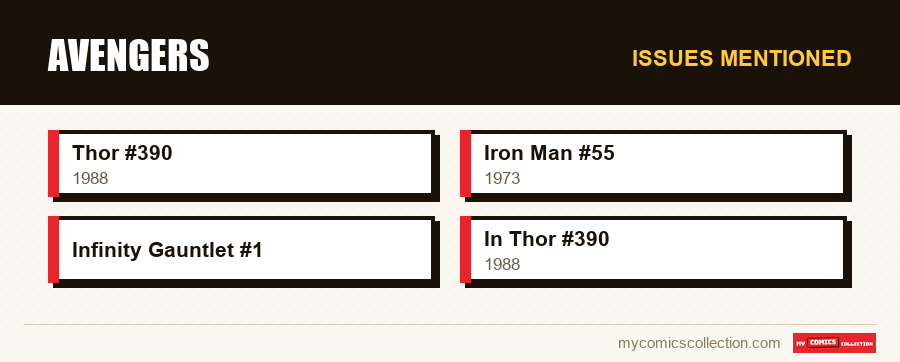
Endgame revives interest in several keys. Iron Man #55 (first appearance of Thanos) is the centerpiece, one of the most sought after Bronze Age keys. Thor #390 (Captain America worthy of Mjolnir) is a Copper Age number that has become very popular thanks to the film, the moment of which is faithfully reproduced on screen. The Infinity Gauntlet #1 (1991) remains an accessible and iconic modern number. These targets span varying budgets, from the Bronze Age to the 1990s. As always, condition and grading determine value; relying on recent real sales is strongly recommended before any purchase. Thor #390 is a great example of an issue whose value jumped after a single movie scene, rewarding collectors who knew the reference well before it was put on screen.
Its place in the saga and for the collector
Endgame is the climax of the saga, the film which closes ten years of stories and two decades of waiting. Its impact on the collectible market has been considerable: Thor #390, long confidential, saw its value explode as soon as the film was released, wonderfully illustrating the power of a single scene on the price of a comic. Iron Man #55 and the Thanos-related issues continued their rise. This film demonstrates that knowledge of comics can guide the informed collector: recognizing the reference to Thor #390 before anyone else was like anticipating an outbreak. Beyond speculation, Endgame invites us to discover the great sagas of Jim Starlin and the run of Peter David, two comic book peaks from which the film draws to compose its most memorable moments.
The verdict: a conclusion fueled by comics
- Loyalty: the defeat of Thanos, Cap worthy of Mjolnir and Professor Hulk come from the comics.
- Freedoms: the time heist, the five year jump, the death of Iron Man and the absence of Adam Warlock.
- Collectible numbers: Iron Man #55 (Thanos), Thor #390 (Cap and Mjolnir), The Infinity Gauntlet #1.
Endgame does not adapt a story: it concludes a saga by drawing, here and there, from the great moments of the comics. By resuming Thanos' defeat, Cap's gesture with Mjolnir and Professor Hulk, while inventing its own path, the film honors its sources without submitting to them. For reader and collector alike, it opens the door to Marvel's cosmic heights, and to issues whose popularity was transformed by a single scene. Endgame will remain as the ultimate demonstration of what superhero cinema can accomplish when it draws on decades of comics: not a slavish adaptation, but a celebration, an outcome which rewards both the general public and readers capable of recognizing, at the turn of a shot, the homage paid to a cult issue.
Frequently asked questions
He concludes the plot of “The Infinity Gauntlet” (1991) by Jim Starlin, but invents the time heist. Several moments come from the comics: Cap and Mjolnir (Thor #390, 1988), Professor Hulk (run by Peter David).
No, the time heist is an invention of the film, made possible by the Quantum Realm from the Ant-Man saga. In the comic, Thanos' defeat involves a cosmic struggle led by Adam Warlock.
Yes: in Thor #390 (1988), Steve Rogers proves for the first time that he is worthy of the hammer and wields it in battle. The film takes up this cult moment.
A version of the character combining Banner's intelligence and the Hulk's strength, born in Peter David's run on Incredible Hulk (1990s), which merged the hero's personalities.
Iron Man #55 (Thanos' first appearance) is the centerpiece. Thor #390 (Captain America worthy of Mjolnir) saw its rating jump thanks to the film, while remaining more accessible.
Does the film make you want to collect? Estimate the value for free of your issues (Iron Man #55, Thor #390…) with our tool based on current eBay listings.