
Groot first appears in Tales to Astonish #13 (November 1960), created by Stan Lee, Larry Lieber and Jack Kirby as a silent alien monster from "Planet X". Forgotten for nearly fifty years, the character was reborn in 2008 in Annihilation: Conquest before becoming a mainstay of Guardians of the Galaxy, then a global star thanks to the 2014 Marvel Studios film and series I Am Groot on Disney+.
There are few Marvel characters whose editorial trajectory is as unique as that of Groot. Where most superheroes are born with a stable identity that is refined over the decades, Groot began his career in 1960 as a simple creature from “monster comics”, a genre then in decline at Atlas Comics (the former name of Marvel), before almost completely disappearing from the editorial radar for almost five decades. His return, orchestrated in the mid-2000s as part of a cosmic event little known to the general public, transformed him into a full-fledged member of the Guardians of the Galaxy, then into a true cultural phenomenon once brought to the screen by Marvel Studios.
This two-part story, the Silver Age monster and the contemporary hero, explains why Groot occupies a special place in collections: his original keys belong to the most sought-after Silver Age on the market, while his modern appearances (2007-2014) form a second wave of collecting driven by cinematic success. Understanding this dual temporality is essential for any collector who wishes to invest intelligently in the character, whether it is tracking down a period example or a modern key linked to the Guardians.
In this article, we retrace the complete editorial history of Groot: his creation by the Lee/Lieber/Kirby team, his long editorial sleep, his cosmic resurrection, his integration into the modern Guardians of the Galaxy, then the shock wave caused by the audiovisual adaptations on the rating of his founding comics.
Groot, child of the Silver Age and monster comics
Before becoming a superhero, Groot was first a monster. At the turn of the 1950s and 1960s, Atlas Comics, which would become Marvel Comics a few months later, published a multitude of anthology titles featuring gigantic creatures from distant worlds: Journey Into Mystery , Strange Tales or even Tales to Astonish. It is in this last title, in issue 13 dated November 1960 (on sale in June 1960), that Groot makes his very first appearance in a story entitled "I Challenged... Groot!" The Monster from Planet X! ".
The screenplay is by Larry Lieber, Stan Lee's brother, with sketches by Jack Kirby inked by Dick Ayers, with coloring by Stan Goldberg and lettering by Ray Holloway; Stan Lee serves as editor. The story, just seven pages long, features Groot posing as the monarch of Planet X, who has come to Earth to capture an entire small town to bring back home for scientific study. The character is then depicted as a giant humanoid tree, capable of controlling other trees telekinetically and impervious to conventional human weapons.
The final twist of this typical monster story of the era remained famous among Silver Age readers: it is a scientist, Leslie Evans, who manages to neutralize Groot not by force, but thanks to termites specially bred in the laboratory, capable of devouring the interior of his woody structure. The story closes with a twist that will become a habit of the house: Groot survives this defeat and finds himself imprisoned in the collection of monsters of Taneleer Tivan, aka the Collector: a character who will also remain lastingly linked to the Marvel cosmic universe.
An anthology title, not yet a shared universe
It is important to place this story in its editorial context: in 1960, the Marvel shared universe as we know it did not yet exist. The Fantastic Four, the cornerstone of modern Marvel, did not begin until November 1961. Tales to Astonish #13 therefore belongs to an era where each monster story was independent, without continuity or intention to build a recurring character. Groot was actually just one creature among dozens of others (Fin Fang Foom, Gorgilla, Rommbu) published in this type of title to occupy the reader while waiting for the explosion of the superheroic genre which would follow the following year.
It is precisely this status of “disposable guest star” which makes today Tales to Astonish #13 so sought after: no one in 1960 could have guessed that this monster with minimalist dialogue would become sixty years later one of the most recognizable faces of superhero cinema. The comic is now ranked 24th on Overstreet's list of the 50 most sought-after Silver Age comics, alongside titles that were much more famous at the time of their publication.
A long editorial absence, punctuated by cosmic apparitions
After this first story, Groot does not completely disappear from the Marvel pages, but he profoundly changes his status. He becomes a reusable character within the Collector's collection, appearing occasionally as a simple element of cosmic decor in stories featuring characters like the Silver Surfer or the Avengers, without ever finding a central story role. For nearly five decades, Groot has remained a nostalgic wink reserved for the most loyal readers of the Atlas of Origins material, rather than a story-driven character.
This long crossing of the editorial desert has a direct consequence on the collecting market: unlike characters exploited continuously, each decade of which produces its share of secondary keys, Groot offers almost no notable appearance between 1960 and the mid-2000s. The collector who targets the history of Groot must therefore deal with an editorial void of several decades, which mechanically concentrates collector's interest on a very limited number of issues.
This phenomenon is not specific to Groot: it concerns a large part of the cosmic casting created by Atlas then Marvel at the turn of the 1960s, a breeding ground of occasional monsters and aliens that the screenwriters have regularly reactivated over the decades to populate the Collector's gallery or serve as foil to more established heroes. What sets Groot apart from the rest is that he ended up being extracted from this collective anonymity to become the starting point of an entire team, while almost all of his monstrous contemporaries remained confined to the rank of recurring extras, without ever achieving the status of main character.
Cosmic Rebirth: Annihilation: Conquest and the birth of the modern Guardians
The decisive turning point came in the mid-2000s, when Marvel relaunched its entire cosmic sector through a series of mega-events: Annihilation (2006), then Annihilation: Conquest (2007-2008). It's in the mini-series Annihilation: Conquest: Star-Lord, written by Keith Giffen with art by Timothy Green II, Peter Quill (Star-Lord) first crosses paths with Rocket Raccoon and Groot in a setup that directly foreshadows the team that would later become the Guardians of the Galaxy of cinema.
This improbable meeting (a human mercenary, an armed to the teeth raccoon and a telepathic alien tree) gives birth, in the pages of Annihilation: Conquest #6 (June 2008), to the official formation of a new team. This is truly taking off with the launch of Guardians of the Galaxy volume 2 #1 in July 2008, written by Dan Abnett and Andy Lanning with art by Paul Pelletier. This founding issue brings together the full lineup for the first time: Star-Lord, Rocket Raccoon, Groot, Gamora, Drax the Destroyer, Adam Warlock and Phyla-Vell (aka Quasar), joined by Mantis. It is this iteration of the team, carried by the pens of Abnett and Lanning for almost three years, which will serve as a direct scriptural basis for the 2014 film adaptation.
For the collection, this editorial diptych: the mini-series Annihilation: Conquest: Star-Lord for the very first meeting, then Guardians of the Galaxy vol. 2 #1 for the official formation of the team: constitutes the second wave of Groot keys, much more recent and much more accessible than the 1960 issue, but just as structuring for understanding the character as we know him today.
The Bendis era and the launch of Volume 3 (2013)
In 2013, in the wake of the critical success of the Abnett/Lanning period, Marvel entrusted Brian Michael Bendis with the launch of an all-new Guardians of the Galaxy volume 3, with Steve McNiven drawing the first issue. This relaunch, designed in advance of the release of the film scheduled for the following summer, is accompanied by a particularly dynamic variant cover strategy, notably the now famous “Baby” variant by Skottie Young featuring child versions of the team members, including Groot. This period also marks the closer integration of Groot within the main cast of the Guardians in contemporary editorial continuity, with a development of his relationship with Rocket Raccoon which will become central to the character's identity.
The impact of adaptations on the rating
Nothing transformed Groot's collectible value quite like his time in cinema. The movie Guardians of the Galaxy, directed by James Gunn and released in the summer of 2014, introduces Groot to the general public via the voice of Vin Diesel: who only utters three words in the entire feature film: “I am Groot”. The film was a colossal success: $333.7 million in revenue in North America and around $439.6 million internationally, for a worldwide total of around $773.3 million, making it the biggest superhero success of 2014.
This global exposure had an immediate and measurable effect on the old comic market. The demand for Tales to Astonish #13, until then an issue appreciated only by Silver Age specialists, exploded with a much wider audience of collectors, movie buffs as well as comic book readers. As a documented example, a CGC 9.2 graded example sold for more than $80,000 at auction in 2017, a price level that illustrates the extent to which this little seven-page monster tale, initially intended as a simple editorial stopgap, has become one of the most sought-after Silver Age keys on the market.
The final sequence of the first film, where Groot sacrifices himself to protect his teammates before being reborn as a dancing sapling ("Baby Groot"), also created a whole new visual icon, exploited in Guardians of the Galaxy Vol. 2 (2017) then in Guardians of the Galaxy Vol. 3 (2023). Editorially, this popularity directly inspired the launch of a solo series, Groot (2015), written by Jeff Loveness and drawn by Brian Kesinger, which follows the escapades of a teenage Groot and Rocket Raccoon during an eventful interstellar journey over six issues.
More recently, Marvel Studios has extended this dynamic with I Am Groot, a series of animated short films broadcast on Disney+ from August 2022, created and directed by Kirsten Lepore, with photorealistic animation produced by Luma Pictures and still the voice of Vin Diesel. This production, centered on Baby Groot's misadventures between the first two films, confirms that Groot is now an autonomous pillar of Marvel's editorial and audiovisual planning, well beyond his initial role as a simple team member.
The release of Guardians of the Galaxy Vol. 3 in May 2023, which closes the trilogy directed by James Gunn at the cinema, constituted a new point of attention for collectors following the character: this third film, centered on the past of Rocket Raccoon, marks the last appearance of the original formation of the cinematographic casting and closes a cycle started nine years earlier. Each release of this type mechanically triggers a renewed interest in the general press in the paper origins of the characters concerned, with an observable knock-on effect on searches and sales relating to Tales to Astonish #13 as on modern Guardians keys.
Collecting this series?
Track what you own, what you are missing and what your collection is worth. 7 day trial.
Start my trial →Why Groot remains a textbook case for collectors
Groot's journey illustrates a phenomenon that seasoned collectors know well: the value of an old comic book is never fixed at the time of its publication, it is built, or rebuilt, over the decades depending on the character's trajectory in popular culture. In 1960, no one would have bet an extra penny on Tales to Astonish #13 compared to the dozens of other monster stories published the same year. It is precisely the lack of special status at the origin, combined with an unexpected cosmic rebirth and then resounding cinematic success, that has made this issue one of the most sought-after silver age keys today.
This dynamic is reproduced, on a different scale, with modern keys: Annihilation: Conquest: Star-Lord #1 and Guardians of the Galaxy vol. 2 #1 remained second-rate issues for a long time, loved only by readers of cosmic comics, before becoming sought-after items once the film was released. For a collector, understanding this mechanism (obscure origin, editorial resurrection, then validation by a mainstream media) allows one to anticipate which characters or which currently minor teams could experience the same fate in the years to come.
Buying guide: how to collect Groot without making a mistake
Before investing in a copy of Tales to Astonish #13 or in one of the modern keys of the character, some precautions are necessary, specific to the particular nature of this collection.
- Distinguish the two temporalities of the character. A 1960 copy is from the Silver Age (fragile paper, period print, high entry cost even at low grade), while the keys from 2007-2008 (Annihilation: Conquest, Guardians of the Galaxy vol. 2) are modern comics, much more affordable and available at high grade.
- Check the exact attribution of the title. Groot appears in several mini-series of the Annihilation: Conquest saga published in the same period (Star-Lord, Quasar, Wraith): only the Star-Lord mini-series contains his first meeting with Peter Quill and Rocket, do not confuse the titles from the same editorial wave.
- Be wary of reissues and facsimiles for the 1960 issue. On a title as old and sought after as Tales to Astonish #13, undeclared restored covers and facsimiles of interior pages exist; systematically favor a copy encapsulated by a recognized grading service (CGC or equivalent), with the words “restored” clearly indicated if applicable.
- Consider the condition of the original pulp paper. The 1960 Atlas comics have acidic paper that yellows and becomes brittle over time; an ungraded copy kept without special precautions quickly loses flexibility, which must be reflected in the asking price.
- Target Skottie Young variants for the 2013 period. The launch of volume 3 in 2013 increased the number of variant covers; Skottie Young's "Baby" versions have become collector's items in their own right, regardless of the standard issue's editorial key.
- Don't overlook the 2015 solo series. The first issue of Groot (2015) by Jeff Loveness and Brian Kesinger remains an affordable entry point for those wishing to own the first series entirely dedicated to the character.
- Compare several recent sales before purchasing. The prices of Tales to Astonish #13 vary greatly depending on the grade and the context (presence or not of a media peak linked to a new Marvel Studios release); consulting several recent completed transactions remains the best guide before making any offer.
To quickly estimate the current value of a specific copy, whether it's the founding issue from 1960 or a modern key to Guardians of the Galaxy, it is possible to enter the series, issue and condition of the comic to obtain a price range based on actual sales. A collector who tracks his collection over time can also rely on a tracking application to organize his acquisitions and monitor the evolution of their value over time.
Key issues to know
Tales to Astonish #13
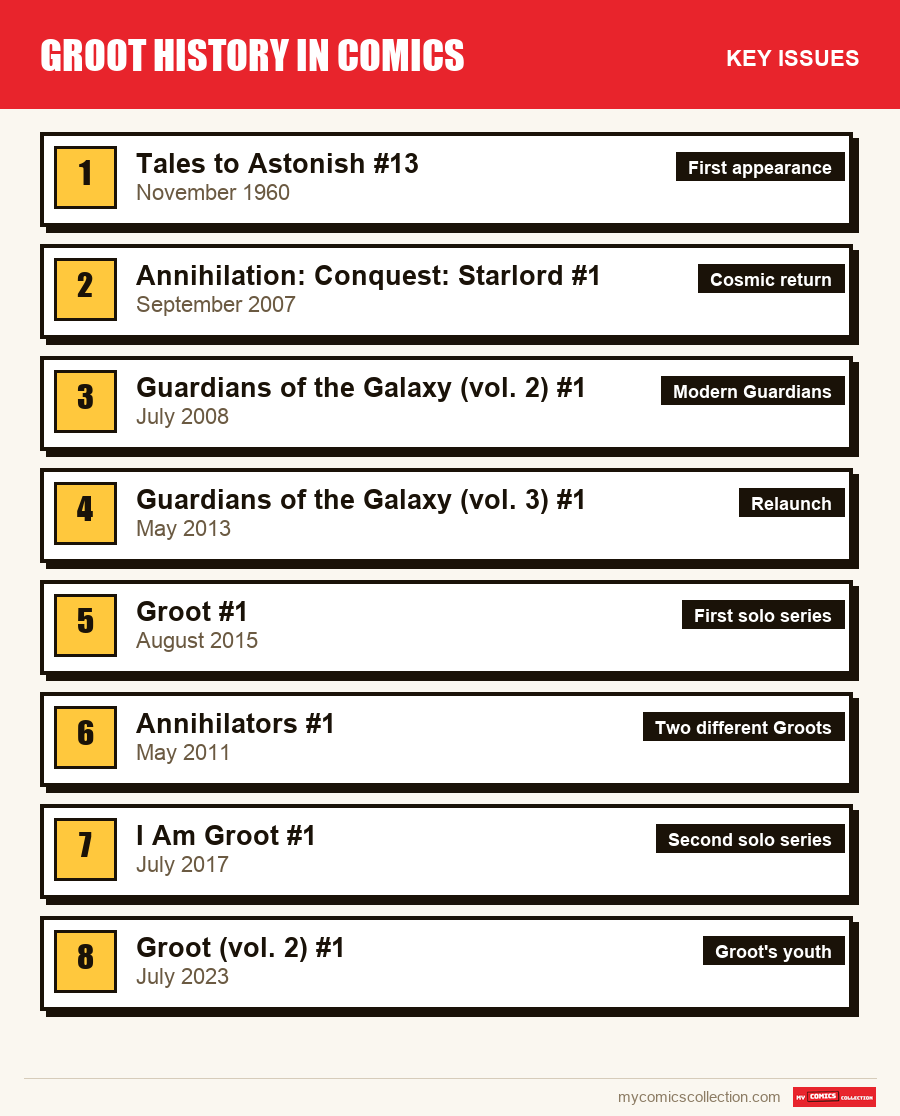
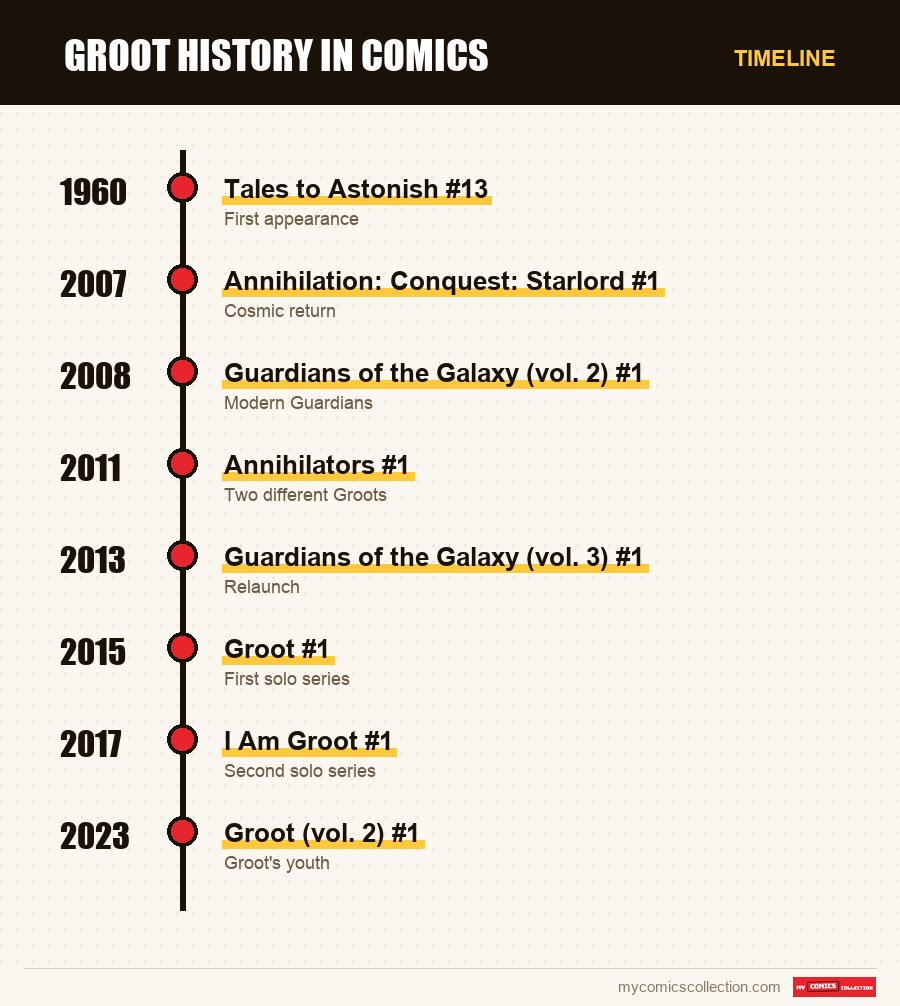
In "I Challenged... Groot! The Monster from Planet X!", a seven-page story by Stan Lee, Larry Lieber and Jack Kirby, a tree monster from Planet X wants to abduct humans. He is defeated by termites: it is Groot's very first appearance.
Annihilation: Conquest: Starlord #1
Keith Giffen and Timothy Green II bring together Star-Lord, Rocket Raccoon and Groot in a special-ops team against the Phalanx. It is the modern Groot's first appearance, and he still speaks normally in this miniseries.
Guardians of the Galaxy (vol. 2) #1
Dan Abnett, Andy Lanning and Paul Pelletier launch the new Guardians of the Galaxy team around Star-Lord. Groot is part of it, even though he is still regrowing from a mere twig.
Guardians of the Galaxy (vol. 3) #1
Brian Michael Bendis and Steve McNiven relaunch the series a year before the film's release, with a lineup that foreshadows the one on screen. The issue opens Groot's mainstream exposure.
Groot #1
Jeff Loveness and Brian Kesinger give the character his first series, a six-issue miniseries following Groot and Rocket Raccoon on an interstellar trip.
Annihilators #1
The Rocket Raccoon and Groot backup story takes Rocket to Planet X. This issue establishes that the Guardians' Groot is a different individual from the 1960 monster, from the same species.
I Am Groot #1
Christopher Hastings and Flaviano Armentaro give Groot a new series under his name, centered on his adventures away from the rest of the Guardians.
Groot (vol. 2) #1
Dan Abnett and Damian Couceiro go back to Groot's youth on his home planet, before the Guardians. Captured by criminals, he is freed by a young Kree soldier, Mar-Vell.