Among The Flash annuals, specials, and one-shots, three titles dominate the collector hierarchy: Flash Annual #1 (1963, Silver Age 80-page giant), Flash: Iron Heights (2001, Geoff Johns & Ethan Van Sciver one-shot with multiple first appearances), and Flash: Rebirth #1 (2009, Barry Allen's return). The biggest Flash crossover, Flashpoint #1 (2011), redefined the entire DC Universe. eBay volume on these out-of-series titles is too thin for a reliable median: values here are drawn from the web (PriceCharting, GoCollect, documented sales).
The Scarlet Speedster's publishing legacy extends far beyond his main title. From the 80-page Giants of the 1960s to the crossovers that rebooted the DC Universe wholesale, Flash has produced out-of-series issues that rank among the most significant comic events of their era. Annuals, prestige-format one-shots, anthology specials, crisis tie-ins: each format has contributed at least one title that serious collectors actively pursue.
This guide sticks to the verifiable: data documented by PriceCharting, GoCollect, and Heritage Auctions, cross-referenced with confirmed publication facts. The MyComicCollection eBay estimator does not cover out-of-catalogue series (annuals, crossovers) with sufficient volume: the signal is too thin on these titles for a reliable median. Where no precise figure is confirmed, it is stated qualitatively rather than invented.
Key Flash annuals and specials at a glance
| Title | Date | Significance | Documented value |
|---|---|---|---|
| Flash Annual #1 | Aug. 1963 | Silver Age 80-page giant; Infantino reprints (Kid Flash, Grodd, Elongated Man) | ~$5,497 (CGC 9.4, PriceCharting 2017); raw low grade below $100 |
| Flash: Speed Force #1 | Nov. 1997 | Anthology one-shot: Mark Waid; Jay Garrick, Jesse Quick, Max Mercury during the Wally West era | eBay volume insufficient: no reliable median |
| Flash: Iron Heights | Oct. 2001 | Prestige one-shot by Geoff Johns & Ethan Van Sciver; 1st Murmur, Fallout, Girder, Double Down, Blacksmith | CGC 9.8 copies actively circulating on eBay; confirmed prices not publicly available |
| Flash: Rebirth #1 | Apr. 2009 | Geoff Johns & Ethan Van Sciver mini; Barry Allen returns; first print sold out on day one | Active eBay market; CGC 9.8 copies in circulation; no official record publicly confirmed |
| Flashpoint #1 | May 2011 | Geoff Johns & Andy Kubert; gateway to the New 52; 1st Thomas Wayne Batman, 1st Element Woman | Active market (CGC 9.8 variants in circulation); recent sale prices not publicly confirmed |
Sources: PriceCharting, GoCollect, worldwide comics database, DC Database Fandom.
Flash Annual #1 (1963): the Silver Age giant
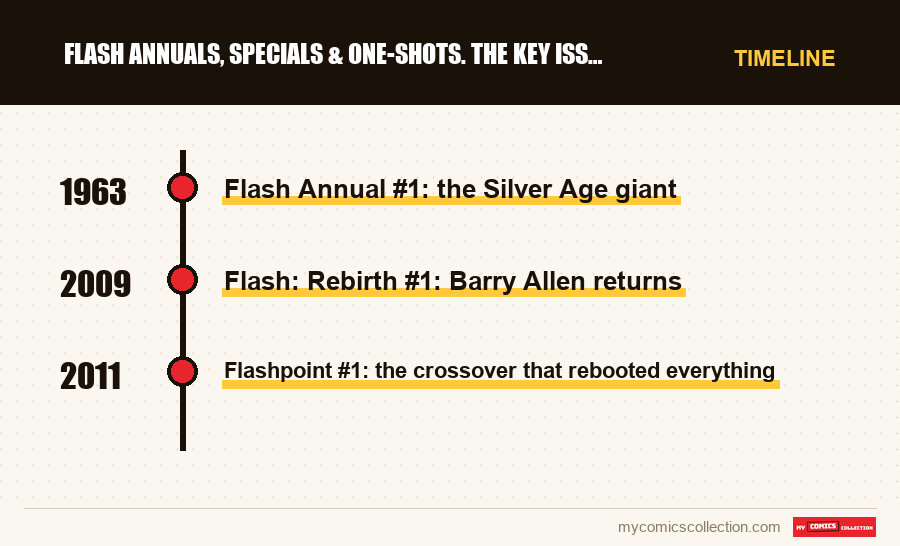
Published in the summer of 1963, Flash Annual #1 is an 80-page giant made up entirely of hand-picked reprints by Carmine Infantino: it collects the origin of Kid Flash (Wally West), early Gorilla Grodd adventures, the first Elongated Man team-up, and a two-page illustrated feature, "How I Draw The Flash," by Infantino himself. The annual also includes a comprehensive index of Flash #105-140 and the Flash-starring Showcase issues: an invaluable editorial document for anyone mapping the Silver Age geography of the character.
On the market, raw low-grade copies remain accessible below $100. A CGC 9.4 copy is documented at approximately $5,497 by PriceCharting (2017 sale). eBay volume on this annual is too thin for our estimator to return a reliable median: it is a scarce title, with demand concentrated in mid-to-high grade.
Flash: Iron Heights (2001): Geoff Johns's founding one-shot
Published in October 2001 in prestige format, Flash: Iron Heights is the one-shot written by Geoff Johns and illustrated by Ethan Van Sciver: their first major collaboration, which foreshadows their work together on Flash: Rebirth eight years later. Set at the high-security Iron Heights Penitentiary, the story introduces five new Rogues in a single issue: Murmur (first appearance), Fallout, Girder, Double Down, and Blacksmith. Johns used this one-shot to lay the foundations for his five-year run on The Flash: effectively the pilot for his entire saga.
For collectors, Iron Heights carries real key-issue weight: the multiple-first-appearance label drives demand in the CGC market. Both CGC 9.6 and 9.8 copies circulate actively on eBay, but no public sale record has been confirmed at the time of writing: check GoCollect or recent auction results for current pricing.
Flash: Rebirth #1 (2009): Barry Allen returns
Published on April 1, 2009, Flash: Rebirth is a six-issue miniseries written by Geoff Johns with art by Ethan Van Sciver. The first issue sold out at Diamond Comic Distributors on the very first day of release, triggering a second printing with a variant cover by April 29, 2009, followed by a third, fourth, and fifth printing: rare early proof of collector demand.
The series formally restores Barry Allen as the Flash following his cameo return in Final Crisis (2008). Johns's central revelation, that Barry Allen is himself the origin of the Speed Force, became a cornerstone of all subsequent Flash mythology. The villain driving the plot is Professor Zoom (Eobard Thawne), who has created a "negative Speed Force" to corrupt the heroic speedster family. The miniseries leads directly into Flashpoint (2011) and the New 52. The first printing of issue #1 is the collector's target; CGC 9.8 copies are actively traded on the secondary market.
Flashpoint #1 (2011): the crossover that rebooted everything
Flashpoint is a five-issue miniseries published from May to August 2011 , written by Geoff Johns and pencilled by Andy Kubert. The event's scope is exceptional: sixty-one issues in total: the core series, sixteen three-issue miniseries, and multiple one-shots, all launching in June 2011. The premise: Barry Allen wakes in an altered timeline where Superman never existed, the Justice League never formed, Thomas Wayne operates as Batman, Cyborg is the world's primary hero, and Amazons and Atlanteans have devastated Europe.
Flashpoint #1 marks the first appearance of Thomas Wayne as Batman and the first appearance of Element Woman. Above all, the event serves as the direct bridge to DC's cancellation of all its existing titles and the simultaneous launch of 52 new series in September 2011: the New 52, the most radical DC reboot since Crisis on Infinite Earths. Thomas Wayne's resonance with readers proved durable enough that Johns revisited the character in Flashpoint Beyond (2022, co-written by Johns, Jeremy Adams, and Tim Sheridan). CGC 9.8 copies of issue #1, including SDCC variants, are actively traded; no officially documented sale record has been found at time of writing.
Other specials worth knowing
Beyond those four anchors, several other out-of-series Flash publications deserve attention depending on which era you collect. Flash: Speed Force #1 (November 1997) is a one-shot anthology by Mark Waid, Brian Augustyn, and John Byrne, gathering stories around Jay Garrick, Jesse Quick, and Max Mercury at the height of the Wally West creative era. Flash: Secret Files & Origins #3 (2001), written by Geoff Johns with art by Scott Kolins, contains the first appearance of Hunter Zolomon, the criminologist who would later become the villain Zoom: a quiet key for Geoff Johns run collectors. The Flash: Secret Files and Origins 2010 one-shot (Geoff Johns, Francis Manapul & Scott Kolins) bridges the gap between Rebirth and the relaunched ongoing series. Finally, Flash #0 (October 1994, Mark Waid & Mike Wieringo), a Zero Hour crossover tie-in, offers an intimate account of Wally West's identity as the Flash: an issue Waid completists hunt to round out his defining run.
Do you own a Flash annual or special? Get a free valuation with our tool based on real eBay sales to find its low, median, and high value.
Frequently asked questions
Four titles dominate: Flash Annual #1 (1963), Flash: Iron Heights (2001), Flash: Rebirth #1 (2009) and Flashpoint #1 (2011). Every format, from annual to crossover, has produced at least one issue collectors covet.
It is an 80 Page Giant from August 1963 made up of reprints chosen by Carmine Infantino: the origin of Kid Flash, Gorilla Grodd's first adventures and the first meeting with Elongated Man. It also includes a feature where Infantino explains how he draws Flash.
This October 2001 prestige one-shot, written by Geoff Johns and drawn by Ethan Van Sciver, introduces five new Rogues: Murmur, Fallout, Girder, Double Down and Blacksmith. That multiple first appearance status gives it its key value.
Published on April 1, 2009, it marks the return of Barry Allen as the title Flash. It sold out on the first day of distribution, which led to a second printing under a variant cover as early as April 29, 2009.
This miniseries from May to August 2011, by Geoff Johns and Andy Kubert, contains the first appearance of Thomas Wayne Batman and of Element Woman. It leads straight into the launch of the New 52 in September 2011.