The best entry point into The Flash depends on the era that interests you: Flash Comics #1 (1940, Jay Garrick) for the Golden Age, Showcase #4 (1956, Barry Allen) for the Silver Age, Flash vol.2 #62 (1992, "Born to Run") to discover Wally West with Mark Waid, or Flash: Rebirth (2009, Geoff Johns) for the modern Barry Allen. Each era stands on its own: there is no need to read everything in order.
The Flash is one of the very few DC characters to have appeared continuously across every major era of comics, changing identity each time: Jay Garrick in the Golden Age (1940), Barry Allen in the Silver Age (1956), and Wally West from 1986 onwards. Each carried the winged helmet and left a lasting mark on the mythology of the Fastest Man Alive. The character also launched the Silver Age of comics in 1956 with Showcase #4: an editorial break that inspired Marvel and transformed the entire industry.
This reading guide is editorial, not commercial: it lists the most important runs and issues in chronological order, with creators and narrative stakes for each era. Prices are mentioned only when they come from documented sales; Silver Age issues show near-zero eBay volume through our estimator: auction records are the only reliable benchmark available.
Golden Age: Jay Garrick and the origins (1940-1951)
Flash Comics #1 (January 1940) is the absolute starting point: Gardner Fox (writer) and Harry Lampert (artist) create Jay Garrick, a college chemistry student who accidentally inhales hard-water vapours during a lab experiment and gains superhuman speed. The issue also introduces Hawkman and Johnny Thunder: a classic Golden Age anthology. The series ran for 104 issues before being discontinued in 1949. The value of this issue is reserved for the most committed collectors: the sole CGC NM+ 9.6 copy (Mile High pedigree) sold for $450,000 at Heritage Auctions in 2010: one of the few Golden Age DC million-dollar books. Low-grade copies trade in the thousands of dollars.
For today's readers, Golden Age Flash is accessible through the DC Archives hardcovers or DC's recent facsimile editions. Continuity is light, stories are short and self-contained: ideal for a curious read without commitment.
Silver Age: Barry Allen relaunches everything (1956-1985)
In October 1956, Showcase #4 reinvented the character from scratch. Barry Allen, a police scientist, is struck by lightning and drenched in lab chemicals: he becomes the new Flash. Written by Robert Kanigher (and John Broome), with art by Carmine Infantino, this issue is considered the official starting gun of the Silver Age of American comics. A CGC 9.6 copy sold for $900,000 at Heritage Auctions in January 2024: a record for a Silver Age DC comic. The ongoing series launched with The Flash #105 in 1959 (continuing the numbering from the Golden Age Flash Comics, which had ended at #104).
The key Silver Age issues in the ongoing series:
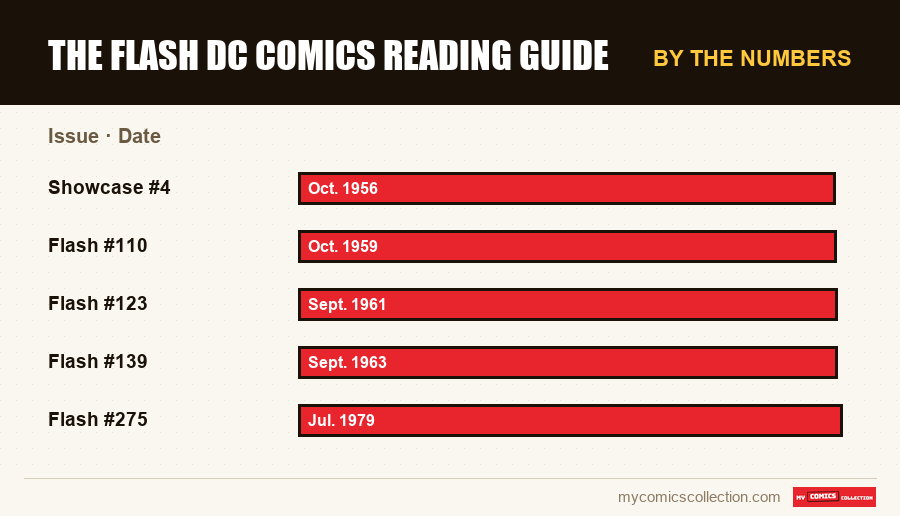
| Issue | Date | Creators | Significance |
|---|---|---|---|
| Showcase #4 | Oct. 1956 | Kanigher / Infantino | 1st appearance of Barry Allen / Silver Age Flash |
| Flash #110 | Oct. 1959 | John Broome / Carmine Infantino | 1st appearance of Kid Flash (Wally West) + 1st Weather Wizard |
| Flash #123 | Sept. 1961 | Gardner Fox / Carmine Infantino | "Flash of Two Worlds": 1st DC multiverse, Jay Garrick returns |
| Flash #139 | Sept. 1963 | John Broome / Carmine Infantino | 1st appearance of the Reverse-Flash / Professor Zoom (Eobard Thawne) |
| Flash #275 | Jul. 1979 | Cary Bates / Alex Saviuk | Death of Iris West |
Collector's note: eBay volume is negligible for these issues through our estimator: Heritage Auctions records are the only available reference.
Flash #123 (September 1961, "Flash of Two Worlds", Gardner Fox / Carmine Infantino) deserves its own mention: it is the founding issue of the DC multiverse. Barry Allen finds himself on a parallel Earth (Earth-Two) where Jay Garrick is a real person rather than a fictional character, and the two Flashes team up. The multiverse concept you know from DC films today, and from Flashpoint: traces directly back to this 12-page story.
The Barry Allen saga concludes with Crisis on Infinite Earths #8 (November 1985): Barry sacrifices himself to save the universe. A death that would remain official for 23 years.
Modern Age I: Wally West takes the mantle (1987-2000)
From 1986, Wally West, the former Kid Flash, takes on the costume during Crisis on Infinite Earths. His solo series launches in June 1987 with Flash vol.2 #1, written by Mike Baron and drawn by Jackson Guice. The first 61 issues establish a less certain, more human Wally than Barry ever was.
The run that turns Wally West into a legend begins with Mark Waid at #62 (1992). "Born to Run" (#62-65) is a retelling of Wally's origin, structured as a Year One story: why did he always want to be the Flash, and why does he feel like an impostor in that role? Waid then invents the Speed Force: the dimension of pure kinetic energy from which every DC speedster draws their power. Introduced across issues #91-100, this narrative concept has since become the cosmological backbone of every Flash story. The Waid run extends to #163 (2000) with a one-year hiatus, and remains the definitive Wally West reading experience. Recommended entry point for new readers: the Flash by Mark Waid Omnibus Vol. 1 (issues #62-91).
Modern Age II: Geoff Johns and the Rogues (2000-2005)
Geoff Johns takes over the series at #164 (2000) and steers it through #225 (2005), with Scott Kolins and later Howard Porter on art. His main contribution: a systematic reinvention of the villains. Captain Cold, Mirror Master, Captain Boomerang: Johns gives them psychology, motivation, and group cohesion. The Rogues become the most distinctive villain gallery in all of DC.
His most cited arc is "The Secret of Barry Allen" (#201-209), which weaves revelations about Barry's past into Wally's present-day continuity. To begin with Johns: Flash by Geoff Johns Book One (#164-191) is the right entry point, with the Rogues firing on all cylinders and Scott Kolins's kinetic artwork at its best.
Flash: Rebirth and Barry Allen's return (2009-2011)
Flash: Rebirth (April 2009: January 2010) is a six-issue miniseries written by Geoff Johns with art by Ethan Van Sciver. Barry Allen returns from the dead: he had reappeared briefly in Final Crisis #2 (2008), and must relearn how to live in a world that moved on without him. Van Sciver's artwork is monumental in scale; the first issue sold out on its first day at comic shops and went through five successive printings. This is the most natural entry point for readers who want Barry Allen without the Silver Age back-catalogue.
The miniseries also establishes the modern lore of the Reverse-Flash (Eobard Thawne as primary antagonist) and leads directly into the next major event.
Flashpoint: the event that changed DC (2011)
Flashpoint (May-August 2011) is a five-issue miniseries written by Geoff Johns and drawn by Andy Kubert. Barry Allen wakes up in an alternate reality where Thomas Wayne is Batman, Atlantis and Themyscira are at war, and Superman never existed. The event, triggered by Barry's own manipulation of the timeline, resets DC continuity and opens directly into the New 52 (2011). Completely self-contained, Flashpoint requires no prior knowledge of DC continuity to work as a standalone story. The tie-in miniseries are optional.
If you can read only one Flash event to understand the character's narrative importance in DC history, this is the one.
After Flashpoint: New 52, Rebirth and Williamson (2011-2020)
The New 52 relaunched The Flash in 2011 with Barry Allen as the solo lead, written and drawn by Francis Manapul and Brian Buccellato: a visually distinctive, award-winning run with an unusually lush colour palette. The DC Rebirth era (2016) handed the series to Joshua Williamson for roughly fifty issues: all the speedsters return (Wally West, Bart Allen, Jay Garrick), Flash War (#46-51) pits Barry and Wally against each other in a philosophical conflict over the Speed Force, and Year One (#70-75) retells Barry's origin. An excellent entry point for the post-2016 Flash.
The adaptations: TV series and film
The CW series The Flash (2014-2023) starring Grant Gustin ran for 9 seasons and 184 episodes. It draws heavily on the Johns run (the Rogues, Eobard Thawne as the Season 1 big bad) and the Waid run (the Speed Force). It remains the most accessible introduction to the character for non-comics readers. The Flash film (2023) with Ezra Miller grossed $271.4 million worldwide against a reported $200 million production budget: a disappointing result for a film troubled by off-screen controversies.
Do you own Flash comics? Get a free valuation with our tool based on real eBay sales to find the low, median, and high price for each issue.
Frequently asked questions
It depends on the era that draws you: Flash Comics #1 (1940) for the Golden Age, Showcase #4 (1956) for the Silver Age, Flash vol.2 #62 (1992) for Wally West with Mark Waid, or Flash: Rebirth (2009) for the modern Barry Allen. Each era works on its own, so there is no need to read everything in order.
Jay Garrick in the Golden Age (1940), Barry Allen in the Silver Age (1956) and Wally West from 1986. Each wore the winged mask and left a lasting mark on the character's mythology.
Because "Flash of Two Worlds" (September 1961, Gardner Fox and Carmine Infantino) is the founding issue of the DC multiverse. Barry Allen meets Jay Garrick on a parallel Earth there, and the concept traces directly back to this 12-page story.
No. Flashpoint (May to August 2011, Geoff Johns and Andy Kubert) is a 5-issue miniseries that can be read entirely on its own, and its tie-ins are optional. It resets DC continuity and directly opens the New 52.
Yes, it is the best introduction for non-readers. The Flash series (2014-2023), starring Grant Gustin, draws largely on Geoff Johns's run (the Rogues, Eobard Thawne) and Mark Waid's (the Speed Force).