The most sought-after Bronze Age key in The Flash is #275 (July 1979), which marks the death of Iris West Allen: later revealed as the work of Professor Zoom. That tragic storyline set in motion the final years of Barry Allen's run, leading to his murder trial and his sacrifice in Crisis on Infinite Earths #8 (1985). eBay volume is insufficient for a reliable median on these issues: documented auction results and qualitative data are the appropriate reference here.
The Bronze Age of The Flash runs roughly from the early 1970s through the end of vol.1 in 1985 (issue #350). This is the Cary Bates era: he wrote the series uninterrupted from #209 (1971) to #350 (1985), a fourteen-year tenure. Pencilling duties passed through Irv Novick (dominant in the 1970s), Alex Saviuk, Don Heck, and a late return by Carmine Infantino for the trial arc. The tone darkened: Barry Allen's personal stakes grew heavier, the Rogues became more menacing, and storylines tackled themes, including drugs and domestic violence, that Silver Age comics had never touched.
This guide sticks to the verifiable: our eBay estimator returns zero active listings for every Bronze Age Flash issue tested (#250, #270, #275, #300, #323, #324): volume is too thin to produce usable medians. Qualitative data and the rare documented auction results from Heritage Auctions serve as the benchmark. No precise figure is cited without a documented source.
Bronze Age Flash key issues (1970s-1985)
eBay volume is insufficient for all issues tested. The data below comes from Heritage Auctions, Key Collector Comics, and DC Database.
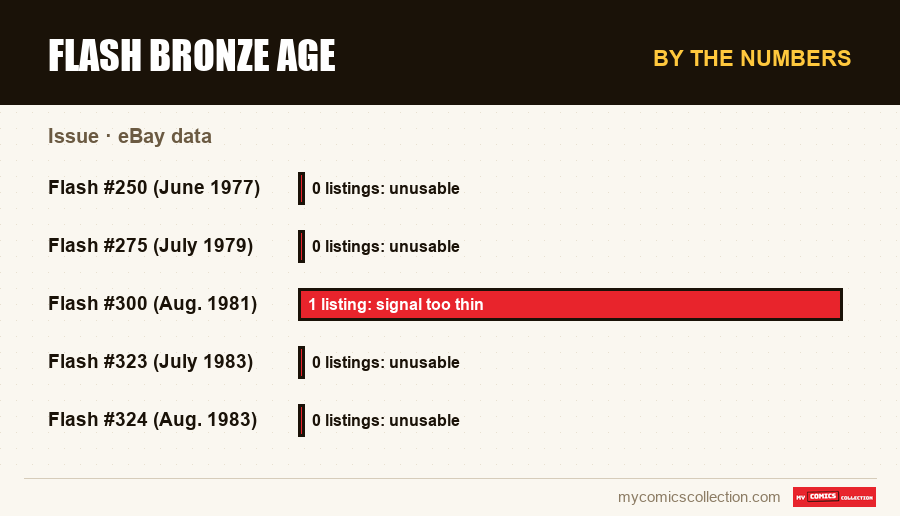
| Issue | Significance | eBay data | Documented data |
|---|---|---|---|
| Flash #250 (June 1977) | 1st appearance of the Golden Glider | 0 listings: unusable | Raw low-grade copies active on eBay under $50 |
| Flash #275 (July 1979) | Death of Iris West Allen | 0 listings: unusable | CGC 9.6 sold for $131 (2009, Heritage); 9.8 catalogued at Heritage |
| Flash #300 (Aug. 1981) | Giant anniversary issue (80 pages) | 1 listing: signal too thin | Not publicly documented |
| Flash #323 (July 1983) | Start of Barry Allen's murder trial | 0 listings: unusable | Not publicly documented |
| Flash #324 (Aug. 1983) | Flash kills the Reverse-Flash (death of Thawne) | 0 listings: unusable | Not publicly documented |
Sources: Heritage Auctions, Key Collector Comics, DC Database / Fandom.
Flash #275: the death of Iris West Allen
Published in July 1979, written by Cary Bates with art by Alex Saviuk and Don Heck, The Flash #275 is the most collected Bronze Age issue in the series. The story actually begins as early as #270: Barry and Iris attend a costume party that ends in tragedy. Iris Allen is murdered, and suspicion initially falls on a character named Clive Yorkin. The truth emerges gradually: it was Professor Zoom (Eobard Thawne, the Reverse-Flash from the 25th century) who committed the murder, driven by obsessive jealousy. The full arc from #270 to #284 was collected by DC in a 2021 hardcover, The Flash: The Death of Iris West.
In value terms, the Bronze Age Flash market remains modest compared to Silver Age grails. Heritage Auctions has catalogued a CGC 9.8 copy and records a CGC 9.6 selling for $131 in 2009. Raw low-grade copies appear on eBay under $50 based on active listings, though our estimator returns no aggregated data. This issue is collected primarily for its narrative weight and its place in DC continuity rather than speculative investment.
Flash #250: first appearance of the Golden Glider
Published in June 1977, The Flash #250 introduces Lisa Snart, the Golden Glider: younger sister of Captain Cold. Created by Cary Bates and artist Irv Novick, she is a championship figure skater and the secret student and lover of the Top (a Flash villain who died in battle). Seeking revenge for her mentor's death, she adopts an orange skater's costume and enchanted skates capable of generating their own ice trail. The Golden Glider quickly became one of the most distinctive members of the Rogues Gallery, and her profile has grown further thanks to television adaptations.
The issue is catalogued as a first-appearance key by Key Collector Comics and DC Database. Our estimator returns no consolidated eBay data for this issue. Active eBay listings show raw VG/FN copies in the range of a few dollars to around $30, with no reliable median to cite.
Flash #324 and the trial of Barry Allen
The other defining Bronze Age arc opens with #323 (July 1983): Barry Allen learns that Reverse-Flash has escaped and is plotting again. The pivotal issue is #324 (August 1983, written by Cary Bates, pencilled by Carmine Infantino): on his own wedding day, Barry is forced to intervene, and in his desperate rush to save his fiancee Fiona Webb, he accidentally breaks Eobard Thawne's neck. Flash is subsequently charged with manslaughter. The trial of Barry Allen dominates issues #323 through #350, consuming the entire remainder of the vol.1 run, until Barry steps into Crisis on Infinite Earths #8 and sacrifices himself to save the universe (1985).
These trial-arc issues (#323-350) remain widely accessible at modest prices for the vast majority of copies: the Bronze Age Flash market is largely affordable. No high-grade auction records have been publicly documented for these issues.
The Rogues in the Bronze Age
The 1970s also saw the Rogues Gallery cemented and expanded. Silver Age classics: Captain Cold (1st app. Flash #114, 1960), Mirror Master (#105, 1959), Heat Wave (#140, 1963), Captain Boomerang (#117, 1960): return regularly under Cary Bates's pen. Issue #256 (1977) is even titled "The Rogues Gallery!", assembling several of them in a single adventure. It is in this context that the Golden Glider (#250) joined the roster, bringing a new feminine dimension to the villains' lineup. The CW television series starring Grant Gustin (2014-2023, nine seasons) and the 2023 film with Ezra Miller ($271 million worldwide gross) have raised the profile of these characters significantly: though they have boosted collector interest most in the Silver Age first appearances rather than Bronze Age reappearances.
Own a Flash comic from the 1970s? Get a free valuation with our tool based on real eBay sales to find its low, median, and high value.
Frequently asked questions
The Flash #275 (July 1979), which marks the death of Iris West Allen, written by Cary Bates and drawn by Alex Saviuk and Don Heck. The story actually begins as early as #270, at a costume party that turns tragic.
From the early 1970s to the end of the vol. 1 series in 1985, with issue #350. Cary Bates wrote it without interruption from #209 (1971) to #350, fourteen years.
Lisa Snart, the younger sister of Captain Cold, in The Flash #250 (June 1977). Created by Cary Bates and Irv Novick, she is a top-level figure skater and a secret former pupil of the Top.
#323 (July 1983) opens the arc, and #324 (August 1983, Cary Bates and Carmine Infantino) is the turning point: Flash kills the Reverse-Flash. The trial issues run from #323 to #350.
The market remains modest compared to Silver Age grails, and the great majority of the trial issues remain accessible. However, sales volume is too low to establish reliable medians: always check recent sales before buying.