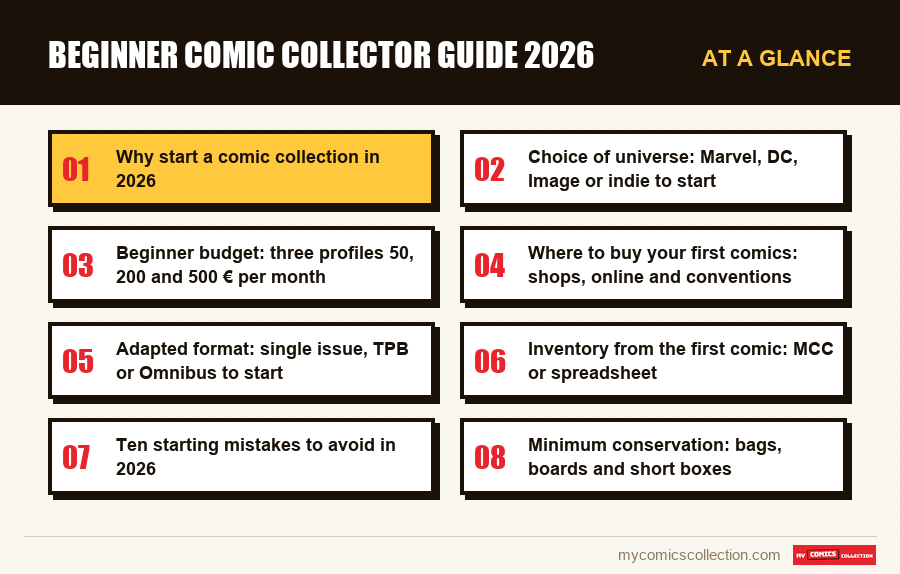
The beginning 2026 comic collector starts with €50 to €200/month, chooses a universe (Marvel, DC, Image), favors TPB and Omnibus before single issues, stores in a short box with acid-free bags/boards, and inventories each comic from the first purchase in MyComicsCollection or a spreadsheet. Three mistakes to avoid: buying everything at once, neglecting inventory, underestimating conservation.
Starting a comic collection in 2026 has never been easier on paper. Marvel, DC, Image, Boom! Studios and a dozen independent publishers publish more than 80 new titles in original language every week, translated into French with a lag of 3 to 18 months by Panini Comics, Urban Comics, Delcourt and HiComics. The Amazon, BDFugue and Cultura platforms, along with specialized retailers, offer prices that are often lower than physical bookstores. For a beginner, the offer is so wide that it becomes the first trap: without a method, you spend €800 in six months without having built a coherent collection or an inventory system.
This pillar guide summarizes the fundamentals of the beginner collector for 2026: where to start, how to choose a Marvel/DC/Image/indie universe, what monthly budget according to your profile (50, 200 or 500 €), which formats to favor (single issue, TPB, Omnibus, Absolute), where to buy new and used, how to store and preserve from the first comic, and above all how to avoid the ten mistakes which ruin 80% of beginner collections. The approach is pragmatic: no unnecessary jargon, verifiable price ranges on Pulps Comics, Amazon France and Le Bon Coin, and clear trade-offs between reading pleasure and heritage logic.
The final objective can be summed up in one sentence: build in twelve months a collection of 80 to 150 comics that you read, understand, store correctly and know how to find on demand. Not a mountain of boxes stacked in an attic. The secret lies in taking inventory from the first comic, keeping minimum bags/boards, and a disciplined monthly budget. All the serious collectors you meet at a convention will tell you: what distinguishes the frustrated beginner from the progressing beginner is the organizational method applied from the start, not the budget committed.
Why start a comic collection in 2026
Three reasons make 2026 favorable for starting. First reason, the translated catalog offering has never been so broad: Panini Comics publishes around 380 albums per year in French (Marvel, DC, Image, IDW), Urban Comics around 220 (DC, Vertigo, BOOM!, indie), Delcourt around 90 (Star Wars, Marvel kids, US manga), HiComics around 60 (indie, Skybound, Aftershock). This density means that a beginner will find in VF almost all of the cult series in TPB or Omnibus, without having to attack the original version immediately. Second reason, VF prices remain under control: a Panini TPB costs €14 to €18, a Marvel Deluxe €24 to €32, an Omnibus €75 to €120, an Urban DC Essentiels €16 to €19. Compare with a classic Franco-Belgian comic at €16-25 per volume.
Third reason, the French collecting community has never been so active. The Facebook groups (Collectionneurs Comics France, Comics VF Echange, Marvel France Collectionneurs) will have more than 90,000 members in 2026, compared to 25,000 in 2018. Dedicated conventions such as Paris Comics Expo, Lyon Comic Expo or Comic Con Paris exceed 50,000 annual visitors combined. Specialized podcasts (Comics Outcast, Comics Avenger, Capes & Crooks) accumulate more than 2 million listens per year. For a beginner, this ecosystem offers entry points to ask questions, exchange, resell duplicates and learn the codes of the industry without paying a mentor.
Beyond the offer and the community, the 2026 heritage context remains favorable. THE used comics are circulating at reasonable prices on Le Bon Coin, Vinted and eBay France: a 2-year-old Panini TPB straight out of the press can be found at €7-10 instead of €16 new, a used Omnibus at €50-70 instead of €95-120. VO Marvel/DC single issues from 2018-2023 sell for €2 to €4 per unit in lots of 20-50 on eBay, compared to €4-6 per new unit. A beginner equipped with a reading plan can build a library of 60 albums in 8 months for less than €600, which is equivalent to an equivalent Franco-Belgian comics collection.
There remains a less quantifiable but real argument: narrative depth. The monthly single issue format, 90 years old, has generated arcs of 50 to 200 issues on characters like Spider-Man, Batman, Daredevil or Saga. Reading in TPB or Omnibus allows you to absorb these long sagas without breaking the rhythm. The comics medium offers something that no classic European comic book equals in 2026: the possibility of a chronological reading over several decades of the same character. The collector is not just a buyer, he is a reader who builds his corpus.
Choice of universe: Marvel, DC, Image or indie to start
The beginner's first strategic decision concerns the universe. Choosing three universes at the same time leads to dispersion: 30 Marvel albums, 30 DC, 30 Image read half-heartedly, with little coherence. The recommended method is to choose a main universe which will represent 70% of the budget, and a secondary universe for 20%, leaving 10% for one-off discoveries. This distribution makes it possible to build real expertise in the main areas while maintaining cultural openness. For details of entry routes by universe, consult Marvel comics for starters, DC comics for starters et comics Image to start.
Marvel is suitable for beginners who want a rich and continuous universe, with characters known via the MCU in the cinema. The advantage: Panini Comics has structured its “Marvel Must-Have” (€35 for a large luxury format) and “Marvel Origins” (€15) collections which guide the neophyte through 60 founding albums. The Spider-Man (Brand New Day, Big Time, Spencer), Daredevil (Bendis, Brubaker, Waid, Zdarsky), X-Men (Hickman, Duggan, Gillen) sagas are available in complete VF. The disadvantage: Marvel continuity is dense, with crossovers every 18 months (Secret Wars, Civil War, House of M, Avengers vs. X-Men) which require you to buy side albums to understand.
DC is suitable for the beginner who enjoys standalone arcs and authorial visions. Urban Comics has structured a very readable editorial policy: the "DC Essentials" collection (€16-19) brings together the classics (Year One, Long Halloween, Killing Joke, Dark Knight Returns), "DC Renaissance" covers New 52 and Rebirth in TPB, "Urban Comics DC Limited" brings together Black Label and the author's graphic novels. The DC Universe lends itself well to entries by author: Frank Miller, Alan Moore, Grant Morrison, Tom King, Scott Snyder, Greg Rucka. The advantage is that you can read King's Batman without having read Batman before. The disadvantage: less tight continuity, therefore less cumulative pleasure for those who like the big fresco.
Image and indie are suitable for beginners who favor well-rounded stories and strong authors. Image edits Saga, The Walking Dead, Invincible, Paper Girls, Monstress, East of West, Black Magick, Sex Criminals: series of 40 to 150 issues with a beginning, a middle and an end. The advantage: no shared continuity, each series operates independently, you can read and finish, then move on to something else. Delcourt, HiComics and Glénat also publish part of the US indie (Skybound, Aftershock, IDW, BOOM!). The disadvantage: TPB unit prices a little higher (€16-22) and more difficult to resell than Marvel/DC on the secondary market.
For a beginner who is hesitant, the most profitable choice in 2026 is often: primary Marvel (because the VF offer is the widest and the most stable resale value), secondary DC (because Urban publishes very well and the classics appreciate over time), and one or two Image albums tested in TPB to open the palate. This distribution limits budgetary dispersion while providing exposure to the three pillars of the market.
Beginner budget: three profiles 50, 200 and 500 € per month
The monthly budget determines the nature and speed of building your collection. Three typical profiles cover 95% of beginner situations. Profile 1, budget 50 €/month (600 €/year). At this level, the purchase of single issue VO is excluded: too expensive in the end (€4-6 per unit for 6-7 issues read in 30 minutes). The winning strategy is 100% second-hand TPB and pocket VF collections such as “Marvel Origins” or “Marvel Saga” at €8-12 per volume. With €50/month, the beginner reads 4 to 6 albums and builds up a collection of 50-70 coherent albums in 12 months. Ideal for discovering Marvel or DC without financial risk. For a detailed annual framework, see the annual collector budget 2026.
Profile 2, budget €200/month (€2,400/year). This is the level of the serious collector. The recommended distribution: €100 in new TPB and Omnibus VF (5-7 albums), €60 in monthly VO single issues (10-15 issues on current series such as Spider-Man, Batman, Saga), €40 in second-hand albums and conservation material (bags, boards, boxes). At this level, the beginner can follow 2-3 monthly VO series as a pull list at a specialized comic shop, read the new VF releases and build up a retro background. In 12 months, the collection reached 120-180 albums and around 80-120 single issues, which corresponds to €1,800-2,200 of catalog value.
Profile 3, budget €500/month (€6,000/year). This is the passionate collector level, often reached after 18-24 months of commitment. The typical distribution: €200 in monthly VO single issues (35-50 issues, i.e. 4-6 followed series), €150 in TPB and high-end VF Omnibus (Marvel Deluxe, Urban DC Black Label, Absolute DC at €75-90), €80 in second-hand vintage albums (Lug, Arédit, Strange, Special Strange years 1970-1980), €40 in variant covers and key issues, €30 for professional conservation equipment (Mylar bags, acid-free long boxes, binders). At this level, we build a heritage fund with an investment logic CGC on 2 to 5 key issues per year.
Three principles run through the three profiles. First principle, protect the budget. Set a monthly ceiling and don't exceed it, even when an opportunity falls through. Better to miss a deal than start the spiral of overshooting. Second principle, reserve 20% for conservation equipment and inventory for the first six months. Buying 30 albums without bags/boards or boxes guarantees accelerated degradation and therefore a loss of value. Third principle, keep 10% for the annual convention and comic book exchanges: Paris Comics Expo, Lyon Comic Expo, Angoulême have the best opportunities of the year for vintage VF and second-hand VO single issues in large lots.
Where to buy your first comics: shops, online and conventions
The beginner has four main purchasing channels, each with its advantages and pitfalls. First channel, physical comic shops. In France, around 95 specialized comics stores will operate in 2026, between major-city specialized retailers and around fifty regional independents. Advantage: personalized advice, opening of pull list for VO single issues, sorted copies, no unpleasant surprises. Disadvantage: full price (-0 to 5% discount depending on shop), limited stock on retro and vintage VF. For Paris, see comic shops Paris 2026 top 10.
Second channel, general online platforms. Amazon France, Cultura, BDFugue, Fnac. Advantage: prices often 5 to 15% lower than the physical store, fast delivery, large VF catalog. Disadvantage: no advice, sometimes misleading illustration photos, sometimes poor condition for TPBs stored in warehouses. Beginner strategy: Amazon for new TPB and Omnibus VF, Cultura for free store collections, BDFugue for specific BD customer service. Always check the reviews and the publication date before purchasing: a Marvel Deluxe TPB may have 3 successive editions with slightly different contents.
Third channel, platforms specializing in single issues VO, whether French or US-based specialized retailers. Advantage: preorder price -10 to -40% on new used vehicles, access to variants, automated pull list subscription. Disadvantage: delays of 3-6 weeks for USA orders, shipping costs and import VAT. For beginners, start in France via a specialized retailer with a pull list of 3 VO series maximum, without breaking the bank on variant covers. Savings occur beyond 10 series followed, not before.
Fourth channel, second-hand and vintage. Le Bon Coin, Vinted, eBay France, flea markets, garage sales, conventions. Advantage: price 30 to 70% cheaper than new, vintage VF from the 1970s-1990s available, lots of 20-100 single issues between €20 and €100. Disadvantage: sorting effort, variable condition, risk of stuck or yellowed pages, amateur sellers who overprice. The method: Le Bon Coin alerts on keywords ("TPB Marvel", "Omnibus Marvel", "Strange Lug", "Special Strange Lug"), systematic verification of the condition via high-resolution photos, negotiation at 70-80% of the displayed price if the seller has not provided detailed photos. See the complete guide used comics: checklist 2026.
Adapted format: single issue, TPB or Omnibus to start
The format determines the reading experience, the budget involved and the logistics of storage. Three major formats structure the 2026 offer. Format 1, the single issue (or floppy): monthly issue of 22-32 pages, sold for €4-6 in original version or €4-8 in French newsstands. Advantage: we follow the series in real time, we participate in the adventure, we collect the variant covers, we resell the key issues more easily. Disadvantage: unfavorable price/reading time ratio (€4 for 25 minutes of reading), significant storage logistics (a single issue = a bag + a board), risk of interrupted series in progress.
Format 2, the TPB (Trade Paperback) or soft collection: compiles 4-6 single issues in a paperback volume of 100-150 pages, sold for €14-22. This is the king format for beginners. Advantage: ultimately lower price than the single issue (€3-4 per episode compared to €4-6), continuous reading of an arc, vertical storage in a library, easy resale. Disadvantage: release with a 4-8 month delay on single issues, less valuable for resale than key issues, variable binding quality depending on the publisher. For 90% of beginners, the TPB constitutes the pivotal format for the first two years.
Format 3, the Omnibus, Absolute or complete luxury: large format bound 25 x 32 cm, 600-1200 pages, sold for €75-150 in French (Marvel Omnibus, Marvel Deluxe XL, Urban DC Absolute, Urban DC Black Label). Advantage: compiles 20-50 from a major arc in a single volume, quality paper, rigid binding, heritage value. Disadvantage: high price, bulky, not suitable for current series (published 3-8 years after the original release). For the beginner, aim for an Omnibus every 3-4 months maximum, on a reference arc such as Daredevil by Frank Miller, X-Men by Claremont/Byrne, Batman by Snyder/Capullo, Saga 1-9 by BKV/Staples.
The optimal format strategy for a beginner 12 months: 70% TPB new and used (building up the fund), 20% Omnibus once a quarter on reference arcs (heritage quality), 10% single issues VO to follow one or two current series and learn comic shop culture. This distribution balances pleasure, budget and heritage. Above all, it avoids the classic mistake of the beginner who accumulates 200 unread single issues VO in a box, because he bought them as an opportunity without a reading plan.
Inventory from the first comic: MCC or spreadsheet
Inventory is the reflex that 70% of beginners neglect and 100% of serious collectors practice. Starting an inventory at comic #1 takes 30 seconds per entry. Starting an inventory at comic #200 takes 6-12 hours, and no one ever does it. The result: collections of 400 albums whose owner no longer knows what he owns, buys duplicate TPBs he already has, does not know how to estimate the overall value or insure correctly. Two main tools structure the inventory starting in 2026: MyComicsCollection (MCC) and the spreadsheet (Excel, Google Sheets, Numbers). For the detailed comparison, see catalog comics online: app vs spreadsheet.
MyComicsCollection (MCC), accessible on mycomicscollection.com and iOS/Android mobile application, is the most complete tool for the French market. Advantage: database already populated with 250,000+ VF albums (Panini, Urban, Delcourt, Lug, Arédit, Semic), search by ISBN, barcode scanning, automatic indicative rating, management of duplicates, CSV export that opens in Excel, and a PDF insurance report. The service starts with a 7-day free trial, then moves to a monthly or annual subscription priced by country (see pricing). For the complete user guide, see MCC complete guide. The beginner has every interest in choosing MCC for the VF cover, which far exceeds League of Comic Geeks or ComicBookRealm for the French catalog.
The spreadsheet remains a valid option for those who like total flexibility and want to avoid the monthly subscription. Recommended structure: columns Number, Title, Publisher, Format (TPB/Omnibus/single issue), Acquisition date, Price paid, Condition (NM/VF/FN/VG/G/F), Place of purchase, Storage location (box/shelf), Reading note (0-10), Free notes. For an effective bulk inventory on an existing undocumented collection, see the method inventory 1000 comics in 90 minutes. The spreadsheet is worth more than 500 entries if you are comfortable with Excel, otherwise MCC remains faster.
Whichever option you choose, six rules apply. First rule, grab each comic the same day of purchase. Second rule, photograph the cover and the spine for state archive. Third rule, note the exact price paid, shipping costs included, because this is the basis for calculating the long-term capital gain. Fourth rule, assign a physical location (Box 1, Shelf 3, File B) and write it in the notes of the tool. Fifth rule, save a CSV export of your MCC collection or your spreadsheet every month on a cloud (Drive, iCloud, Dropbox). Sixth rule, make an annual PDF export for home insurance, with total catalog value.
Ten starting mistakes to avoid in 2026
Beginner errors follow patterns documented on the Comicbook.com forums, Reddit r/comicbookcollecting and French Facebook groups for 15 years. For details of the 10 most expensive traps, consult comics beginner error: avoid 10 traps. Mistake 1, buying everything at the same time on three Marvel/DC/Image universes. Result: scattered collection, interrupted readings, frustration. Method: choose a main universe for 70% of the budget. Mistake 2, neglecting inventory the first six months. Result: we no longer know what we have, duplicates, loss of insurance. Method: MCC or spreadsheet from the first comic.
Error 3, buying VO single issues without a reading plan. Result: 50 booklets of unfollowed series, half-read, unsaleable. Method: pull list of 2-3 series maximum the first year. Mistake 4, neglecting bags/boards for single issues. Result: horns, yellowing, loss of value. Method: one bag + one acid-free board for each single issue, upon purchase. See protects comics acid-free vs classic. Mistake 5, storing comics in a cellar, attic or basement. Result: humidity, mold, sticky paper. Method: dry room, 18-22°C, 40-55% humidity.
Error 6, buying second-hand without checking the condition via photos. Result: glued pages, tears, broken spines not reported. Method: request a minimum of 4 photos (front, back, edge, pages 30-40) before purchasing on Le Bon Coin and Vinted. Mistake 7, paying too much for variant covers in speculation. Result: we buy a variant for €25 which sells for €8 two years later. Method: variant purchase for pleasure only, never for pure speculation unless reference artist (Mike Mignola, Stanley "Artgerm" Lau, Adam Hughes, Alex Ross). Error 8, mixing VF Panini and VO Marvel comics in the same box. Result: different formats which distort each other. Method: dedicated boxes by format (TPB separated from single issues separated from Omnibus).
Mistake 9, forgetting to keep a wishlist. Result: impulse purchases, disappointment, duplicates. Method: wishlist kept in MCC or spreadsheet, monthly update, purchases validated against the list. Mistake 10, refusing to learn the market quote. Result: we resell a Saga #1 (Image 2012) for €5 on Vinted while it is worth €40 in NM. Method: consult Pulps Comics, eBay sold listings and GoCollect monthly on the series we collect. For a free estimate of your collection, dedicated services exist.
An eleventh, more subtle error deserves mention: underestimating the emotional dimension of the collection. Many beginners start in “investment” mode, calculate potential capital gains, read little and accumulate. Result: no pleasure, abandonment after 18 months, hasty resale at 60% of the purchase price. Collecting comics is above all cultural and pleasure: if you don't read, you are not a collector, you are a hoarder. All profiles that last 5 years and beyond actually read their comics, talk about them, recommend them to those around them.
Collecting this series?
Track what you own, what you are missing and what your collection is worth. 7 day trial.
Start my trial →Minimum conservation: bags, boards and short boxes
Conservation is the technical basis of the collector. Without suitable equipment, a new single issue VO loses 30 to 50% of its value in 18 months. The basic equipment comes down to three elements: bags, boards, boxes (or binders). Bags: transparent plastic pouches which wrap each single issue or TPB. Two main qualities in 2026, classic polypropylene (lifespan 2-4 years, €0.10-0.15 each, current/silver/golden formats depending on dimensions) and archive grade Mylar (lifespan 25-50 years, €0.80-1.40 each, recommended for key issues and vintages). The beginner uses polypropylene for 95% of his collection and Mylar for the 5% of key issues.
Boards: rigid acid-free cardboards slipped behind the comic in the bag, to stiffen and protect from creases. Two types: standard white board (0.10-0.15 € each, lifespan 5-8 years) and acid-free archive grade board (0.18-0.25 € each, lifespan 25-50 years). For details, see protects comics acid-free vs classic difference. Golden rule: every new single issue VO receives a bag + an acid-free board as soon as it leaves the shop, without exception. Material cost per comic: €0.25-0.40. This investment protects a booklet which can be worth €4 to €600 depending on market developments.
Boxes: mass packaging for single issues and certain TPBs. Three main formats in 2026. Short Box, 38 x 19 x 30 cm, capacity 150-200 single issues bagged, price €14-22. Long Box, 73 x 19 x 30 cm, capacity 300-400 single issues bagged, price €22-32. BCW Drawer Box, stackable drawer format, 90 x 19 x 30 cm, price €28-38. For a beginner, aim for 2 short boxes the first year (300 single issues) and move on to long boxes beyond 600 issues. The TPB and Omnibus are stored in a vertical bookcase, not in a box.
Three environmental rules complete the material. First rule, temperature 16-22°C stable. No sudden day/night or summer/winter variations that cause the paper to work. Second rule, humidity 40-55%. Above 60%, risk of mold and stuck pages. Below 30%, cracking paper. A digital hygrometer costs €12-18 on Amazon. Third rule, no direct light. Solar UV and halogen cause covers to yellow in 3-6 months. Store in north room or with curtains closed. These three rules radically transform the longevity of a collection to 10-20 years.
Local and Online Community: Where to Join
Joining the collector community multiplies the sources of learning, opens up good deals and facilitates exchanges. The French comics 2026 community is structured on four layers. Layer 1, Facebook groups. The most active: Collectors Comics France (28,000 members), Comics VF Exchange and Sale (22,000), Marvel France Collectors (18,000), DC Comics France (14,000), Image Comics France Communauté (9,000), Comics VO Purchases Sales Exchanges (24,000). Advantage: free advice, price alerts, sales between members, warm general mood. Disadvantage: a lot of noise, uneven moderation, occasional scams on the marketplace.
Layer 2, forums and dedicated platforms. Forumcomics.fr (the historic French-speaking forum, 35,000 members, archives 2003+), Reddit r/comicbookcollecting (180,000 members, English-speaking), League of Comic Geeks (English-speaking comics social network), ComicBookRealm. Advantage: quality of discussion superior to Facebook groups, searchable archives, in-depth expertise on vintage and key issues. Disadvantage: less day-to-day activity, less spontaneity in exchanges. For the beginner, reading the forumcomics.fr archive on their favorite series is a massive time saver.
Layer 3, comic shops and local associations. Beyond the shop, some cities have comics/comics associations (Marseille Comics Club, Toulouse BD Festival, Bordeaux Comics Café, Lyon Comic Circle) which organize monthly meetings, flash sales and joint reading sessions. Advantage: physical contact, possibility of inspecting comics before purchase, informal mentoring. The shop remains the natural hub: spending 30 minutes a week at a specialized comic shop, interacting with sellers and regulars, means learning 10 times faster than on the internet.
Layer 4, BD conventions and exchanges. Paris Comics Expo (50,000 visitors), Lyon Comic Expo (35,000), Comic Con Paris (40,000), Angoulême (mid-January, comics segment present), Brussels BD Festival, Toulouse Geek Convention. Advantage: the lowest prices of the year on retro, second-hand single issues VO in lots, author dedications, direct meeting with other collectors. The beginner who attends 1-2 conventions per year makes a qualitative leap in his collection by purchasing 30-50 comics at once at negotiated prices, rather than purchasing 30 comics spread over 6 months online. Preparing a written wishlist before the convention avoids compulsive purchases.
First year roadmap for the beginner collector
A structured roadmap avoids budgetary and cognitive dispersion. Here is the twelve-month plan recommended for a beginner €200/month. Month 1, start-up. Choose a main universe (Marvel, DC or Image). Buy 3 reference TPB (eg Daredevil Born Again, Batman Year One, Saga vol. 1). Open a MyComicsCollection account. Buy 100 bags + 100 acid-free boards + 1 short box. Total cost: €180-200. Reading: 3 albums played. Learn the CGC state grid (NM, VF, FN, VG, G, F).
Months 2-3, exploration. Buy 6-8 additional TPB by varying the arcs and authors on the main universe. Test an Omnibus if budget allows. Visiting a local comic shop for the first time. Follow 5 Facebook groups and 1 forum. MCC inventory systematically updated. Total cumulative cost: €400-450. Collection: 15-18 albums. Reading: 12-15 albums played.
Months 4-6, structuring. Start a pull list of 2 monthly VO or VF series at the comic shop (for example Amazing Spider-Man + Saga, or Batman + Invincible). Continue 5-6 TPB/month. First second-hand purchase on Le Bon Coin (a lot of 10-20 TPB at €80-120). Open a second short box for single issues. Total: €1,000-1,200. Collection: 50-65 albums + 12-18 single issues. Reading: 40-50 albums played.
Months 7-9, upmarket. First Omnibus VF (for example Marvel Omnibus Daredevil by Miller at €95). First second-hand key issue VO purchase (Saga #1 at €25-35, or Walking Dead #1 reprint at €18-22). First convention of the year (Paris Comics Expo or Lyon Comic Expo). Prepare a written wishlist beforehand. Total: €1,700-2,000. Collection: 90-115 albums + 35-50 single issues. Reading: 80-100 albums played.
Months 10-12, consolidation. Audit of the collection. Identify the series you really like and the ones you neglect. Resell 10-15 unread albums to recover €100-150 to reinvest. Update full MCC inventory, export PDF for home insurance. Prepare the year 2 roadmap with adjustment of the monthly budget according to feelings. Final total: €2,200-2,500. Collection: 130-160 albums + 60-90 single issues. Playback: 110-140 albums played. Estimated catalog value: €2,600-3,200.
This roadmap is not fixed. A beginner at €50/month divides the volumes by 4 (collection 35-45 albums at the end of year 1). A beginner at €500/month multiplies by 2.5 (collection 300-400 albums and 200+ single issues at the end of year 1). Children aged 7-14 who are starting their comic collection follow a simplified roadmap at €25/month for pocket collections, detailed in comics for children 7-14 years old: guide. THE women collectors 2026 also have a dedicated roadmap with suggestions for suitable series and insight into the growing female community. Whatever the profile, what counts is regularity and method, not absolute volume.
Summary article: the successful beginner
The beginning comic collector who lasts and progresses in 2026 shares five characteristics. First, it chose a main universe and devoted 70% of its budget to it. Second, it inventories each comic upon purchase in MyComicsCollection or a spreadsheet. Third, bag/board/box it upon receipt, without leaving single issues "flat" on the table. Fourth, he reads what he buys, at a rate of 60 to 80% of the monthly flow. Fifth, he participates in at least one community (Facebook group, forum, comic shop, convention) to share and learn. The beginner who ticks these five boxes reaches in 18 months a level of collection that is coherent, readable, preserved and valuable. Anyone who neglects two or more stagnates or gives up before 24 months.
The French 2026 framework remains favorable to entry into the hobby: rich VF offer, active community, controlled prices, complete ecosystem of conservation equipment and inventory tools. The pitfalls exist (dispersion, lack of inventory, neglected conservation, hasty speculation on variants), but are all avoidable with a little method. This pillar guide covers the fundamentals; specialist guides linked at the opening and throughout the text delve deeper into each dimension. There comic collection on this site provides access to the product catalog. There free estimate allows beginners who are already committed to know the value of their first acquisitions and to calibrate their next budget with full knowledge of the facts.
FAQ: Beginner comic collector
What is the minimum budget to start a comic collection in 2026?
The realistic minimum threshold is €50/month (€600/year), allowing 4-6 second-hand TPBs or 3-4 new TPBs per month. At this budget, we build in 12 months a collection of 50-70 coherent albums, sufficient for a serious discovery of Marvel, DC or Image. Below €50/month, the collection remains very slow to build (15-20 albums per year) and motivation crumbles. The €200/month level constitutes the sweet spot for the serious collector, with pull lists, new TPBs, quarterly Omnibuses and professional conservation equipment. Beyond 500 €/month, we enter the passionate profile with heritage dimension and key issues CGC logic. Regardless of the budget, setting aside 20% for conservation equipment and inventory for the first six months is non-negotiable.
Marvel or DC: which universe to choose to start?
Marvel is suitable for beginners who like dense continuity, long sagas and the universe known via the MCU. The VF Panini offer is very structured (Marvel Must-Have, Marvel Origins, Marvel Deluxe, Marvel Omnibus) and covers 60 accessible founding albums. DC is suitable for the beginner who prefers self-contained arcs and author's visions, with the readable editorial policy of Urban Comics (DC Essentials, DC Renaissance, DC Black Label). For those who are hesitant, the optimal 2026 strategy often consists of choosing Marvel as the main universe (70% of the budget) because the VF offer is broader and the resale value more stable, and keeping DC as a secondary universe (20%) for the classics. Image and indie enter as opening universes, 10% of the budget. This distribution avoids the dispersion of the beginner who starts on three universes in parallel.
Should you buy single issues VO or TPB to start?
For 90% of beginners, the TPB constitutes the pivotal format for the first two years. Advantages: price per episode lower than the single issue (3-4 € compared to 4-6 €), continuous reading of a complete arc, vertical storage in the library, easier resale. The single issue VO has its place from the second year to follow 2-3 ongoing series in the monthly rhythm, participate in comic shop culture and collect targeted variants or key issues. The pull list of 2-3 VO series maximum in the first year avoids chaotic accumulation. The Omnibus (€75-150) occurs at the rate of one per quarter on reference arcs (Daredevil by Miller, X-Men by Claremont, Batman by Snyder). The optimal beginner format strategy: 70% TPB, 20% Omnibus, 10% single issues VO.
How to store your comics when you're starting out?
The basic equipment comes down to three elements per single issue: a polypropylene bag (0.10-0.15 €), an acid-free board (0.15-0.25 €) and a short or long box depending on volume. The TPB and Omnibus can be stored in a vertical bookcase, upright format, without bag. The storage room must respect three rules: stable temperature 16-22°C, humidity 40-55% (digital hygrometer €12-18 at Amazon), no direct light (UV solar and halogen yellow in 3-6 months). No cellar, no attic, no basement. For 5% of the collection (value VO key issues), use archive grade Mylar bags (0.80-1.40 €) which guarantee conservation for 25-50 years. This investment protects a booklet which can increase in value by 200 to 600% over 5-10 years.
What tools should you use to inventory your comics collection?
Two main tools structure the inventory starting in 2026. MyComicsCollection (MCC) on mycomicscollection.com and in the app for iPhone, iPad and Android, 7-day free trial, then a monthly or annual subscription priced by country (see pricing). Advantages: database 250,000+ VF albums (Panini, Urban, Delcourt, Lug, Arédit, Semic), search by ISBN, barcode scanning, automatic indicative rating, duplicate management, CSV export that opens in Excel, PDF report for home insurance. It is the recommended tool for the French market. The spreadsheet (Excel, Google Sheets, Numbers) remains a valid alternative for those who want total flexibility without a subscription: columns Title, Publisher, Format, Acquisition date, Price paid, State, Location, Reading note. Whatever the tool, six rules: enter each comic on the day of purchase, photograph the cover and spine, note the exact price paid, assign a physical location, save monthly to the cloud, export annually in PDF for insurance.