The comics market in France will be worth around 180 million euros in 2026, driven by 320,000 active collectors, 45 specialized shops and 12 major conventions. Buying, selling, declaring, conserving, organizing your collection requires a clear method: this pillar summarizes the complete framework for 2026 with calendar conventions, specific taxation, regional climate and MCC tools adapted to the demanding French collector.
The comic collector in France operates in a mature but fragmented ecosystem. Between the Franco-Belgian comic book culture, the heritage of Lug and Semic editions, the massive arrival of Panini Comics since 1996 and the rise of Urban Comics since 2012 for DC, the hexagonal playing field mixes US imports at customs, VF translations of variable quality, regional conventions and active secondary markets on Leboncoin, eBay France and CataWiki. Understanding this structure conditions each purchase or sale decision: an American Marvel comic purchased in New York costs 4.99 USD, its VF Panini equivalent comes out at 4.90 EUR, but the difference in valuation on resale shifts depending on the condition, the rarity of the French edition and the channel chosen.
This pillar guide covers the nine dimensions of the collector's profession in mainland France and DROM-COM: size and demographics of the market in 2026, physical and online purchasing methods with US import, sale between individuals and associated taxation, calendar of major conventions from Paris to Marseille, Discord community and regional clubs, collector's rights in terms of inheritance and insurance, conservation adapted to the French climate which varies from the humid Atlantic to the dry South, digital tools with focus on MyComicsCollection, typical beginner's errors and roadmap strategic over four years to build a coherent and financially healthy collection.
The objective is not encyclopedic exhaustiveness but operational relevance: in each section, the collector finds figures dated 2026, precise references to shops, conventions, platforms and administrative procedures, and links to complementary guides from MyComicsCollection which delve deeper into each subject. The pillar works like a road map. Satellite articles act as a detailed zoom. Together, they cover the complete journey of the French collector, from the first Spider-Man Panini purchased on newsstands to the heritage collection of 5,000 titles listed with a notary with a view to transmission.
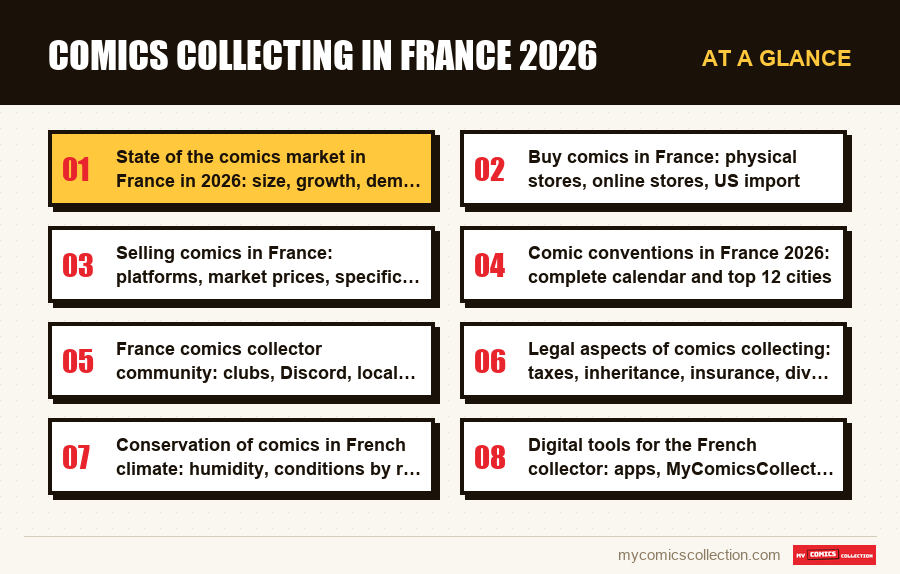
State of the comics market in France in 2026: size, growth, demographics
The French comics market represents in 2026 publisher turnover estimated at 180 million euros, growing by 7.3% over twelve months according to cross-referenced data from GfK Livres, Syndicat National de l'Édition and secondary market observations. This progression can be explained by three converging factors: the continued release of Marvel and DC films and series which fuels general public interest, the editorial maturity of Urban Comics and Panini with quality completes, and the rebound of the secondary market after the 2023-2024 correction which followed the post-Covid speculative bubble.
Demographically, there are around 320,000 active collectors in mainland France, defined as regular buyers of at least six comics per year. The age distribution shows a dominance of 25-44 year olds at 58%, followed by 45-64 year olds at 24%, 18-24 year olds at 13% and over 65 year olds at 5%. Gender parity is increasing: 72% men versus 28% women in 2026, compared to 85% and 15% five years ago. The arrival of new readers can be explained by the rise of series like Saga, Monstress, Paper Girls and the increased visibility of Marvel and DC heroines in cinema adaptations.
Geographically, Île-de-France concentrates 31% of active collectors, followed by Auvergne-Rhône-Alpes at 14%, Hauts-de-France at 9%, Nouvelle-Aquitaine at 8% and PACA at 7%. This distribution generally follows the demographic density but with an over-representation in Paris linked to the concentration of specialized shops, conventions and well-stocked media libraries. Overseas territories have around 8,000 active collectors, with more complex import logistics and prices often increased by 15 to 25% on VF editions compared to mainland France.
The average annual basket of a French collector stands at 680 euros in 2026, compared to 540 euros in 2022. This inflation reflects both the rise in publisher prices: a Panini Marvel increased from 4.20 to 4.90 euros between 2022 and 2026, and the expansion of the catalog with the multiplication of completes, omnibuses and high-margin deluxe editions. Expenditure is broken down between 58% in VF, 22% in imported VO, 12% in the secondary market and 8% in goodies and associated merchandising. The CGC and CBCS graded comics segment remains a minority in France but is growing: the number of French collectors with at least one graded comic is estimated at 12,000, compared to 4,500 in 2020.
Publishers structure the market around four dominant poles. Panini Comics France holds approximately 48% of the market thanks to its Marvel licenses and its Image, Boom! catalog. Studios and Dynamite. Urban Comics, owned by the Média-Participations group since 2012, controls 27% with DC exclusivity in France and Vertigo, Black Label and selected indie licenses. Delcourt Comics weighs 11% with Star Wars, IDW and several franchise licenses. Glénat Comics, Komics Initiative, Hi Comics, Ankama and Black River share the remaining 14% on indie niches, American manga and specific licenses.
This editorial concentration has a concrete consequence: for an exhaustive collector on a Marvel character, 95% of the follow-up goes through Panini, which simplifies prospecting but exposes the risk of discontinuation of the series, publishing delays or questionable editorial cuts. Tracking publications via free estimate MyComicsCollection and publisher calendars allow you to anticipate releases and plan the monthly budget.
Buy comics in France: physical stores, online stores, US import
The purchase of comics in France is organized around three complementary channels: the physical specialized bookstore, French e-commerce and direct import from the United States or the United Kingdom. Each channel presents a distinct profile of prices, deadlines, risks and benefits, and the experienced collector combines the three according to the type of purchase: recent VF single issue, retro VF complete, current VO single, old key comic with strong heritage potential.
On the physical side, France has 45 dedicated comic bookstores in 2026, concentrated in Paris (15 shops), Lyon (4), Marseille (3), Bordeaux (3), Lille (3), Toulouse (2), Nantes (2) and the balance distributed between Strasbourg, Rennes, Montpellier, Nice, Dijon, Tours, Rouen and several medium-sized cities. In Paris, the references are several specialized bookstores spread across the Latin Quarter, Saint-Honoré, the Marais and the 11th arrondissement. The complete details of Parisian shops verified in 2026 appear in the top 10 Paris verified.
In Lyon, several specialized bookstores around Bellecour, the Vieux-Lyon and rue Mercière form the historic square. THE collector's guide Lyon 2026 details schedules, specialties and take-back policy for each. In Marseille, specialized retailers around the cours Belsunce, rue Saint-Ferréol and rue Sainte cover current and old needs. Physical shops offer three structural advantages: expert advice on the editorial consistency of a current series, access to second-hand stock that is often rotating and of variable but sometimes exceptional quality, and a monthly reservation system which secures the monitoring of current series without interruption.
On the French e-commerce side, six players dominate. Amazon.fr concentrates general public volumes with short delivery times and regular prices but little collector service. Cultura offers a large catalog with free store collection. Fnac.com targets a similar audience with an interesting Member program on omnibuses. Several specialized retailers operate e-commerce sites aligned with their physical expertise, with stock sometimes higher than the store. For new VF, the price differences between these channels rarely exceed 10%, the arbitration is made on after-sales service, stock availability and protective packaging, the latter point being critical on hardcover editions sensitive to transport shocks.
Import from the United States is primarily through specialized retailers shipping internationally. The economic calculation remains advantageous on bulk orders above 200 USD, despite the French VAT at 5.5% on the book and the VAT at 20% on goodies, plus customs clearance costs and the DHL or FedEx commission. On an order of 300 USD of single issues VO, the total cost delivered in France generally reaches 380 to 410 EUR depending on the carrier, i.e. a competitive unit cost compared to the VO price in French shops which includes an importer margin of 30 to 50%.
The secondary market between individuals goes through Leboncoin for lots and complete collections at low prices, eBay France for high-value single issues with authentication system, CataWiki for auctions on heritage items, and more marginally through specialized Facebook groups and dedicated Discords. The purchasing methodology on these channels is developed in the guide buy and sell comics France which covers authenticity verification, grading, negotiation and payment security.
Selling comics in France: platforms, market prices, specific taxes
The sale of comics in France meets often little-known tax rules which can transform a lucrative transaction into an unpleasant tax surprise. Before discussing sales platforms and techniques, the collector must clarify his status: individual occasionally selling personal goods, individual making repeated capital gains on collectible goods, or commercial activity falling under the micro-entrepreneur regime or VAT. The border between these three statuses is tenuous and has been the subject of increasing controls since the DAC7 directive entered into force in France on January 1, 2024.
For the occasional sale of personal property, typically the collector who parts with part of his collection accumulated over 15 years, article 150 UA of the General Tax Code provides a total exemption from capital gains tax for goods whose sale price is less than or equal to 5,000 euros per lot. Beyond that, the capital gain is taxed at 36.2% (19% + 17.2% social security contributions), with a reduction of 5% per year of ownership beyond the second, i.e. total exemption after 22 years of ownership. The complete guide to the taxation of the sale of comics by an individual details the concrete cases and the declarative procedure.
On the platform side, the 2026 hierarchy is thus established for the French seller. For medium-value single issues (50 to 500 EUR), eBay France remains the benchmark with an auction system and seller commission of 11.5% plus 0.35 EUR per transaction. For heritage items above 500 EUR, CataWiki imposes a higher commission of 12.5% but offers international visibility and internal expertise which reassures the buyer. For lots and complete collections in person, Leboncoin remains free of charge with direct negotiation. For the demanding collector market, Whatnot has established itself as a new benchmark in live streamed sales with commissions around 8%.
Sale via Heritage Auctions, ComicLink or ComicConnect in the United States becomes possible for key comics graded CGC 9.4 and above whose value exceeds 2,000 USD. The logistics of international shipping from France requires a specialized broker to avoid customs disappointments upon return. THE comparison of CGC France 2026 brokers details the options, prices and deadlines of the main intermediaries active on the French market.
Since 2024, the DAC7 declaration has required platforms (eBay, Leboncoin, Vinted, Whatnot, CataWiki) to transmit to the French tax administration the annual income of sellers exceeding 2,000 EUR or 30 transactions per year. This transmission does not mean automatic imposition but triggers targeted controls. Collectors exceeding these thresholds must keep a traceable file: documented acquisition price, proof of purchase, calculation of capital gains per sale, and possible declaration in form 2048-M for capital gains on collectible goods. Maintaining a structured inventory via MyComicsCollection considerably simplifies the production of these supporting documents in the event of an inspection.
On the market price side, the 2026 references for French sellers generally follow the GoCollect and GPAnalysis grids adjusted for the EUR/USD exchange and a logistical discount of 5 to 10% compared to the American market for ungraded comics, and a zero discount or even a premium for certain rare graded pieces whose rarity in Europe creates a greater local demand effect. The preliminary estimate via the free estimation tool and consulting the latest comparable sales on Heritage and ComicConnect constitute the two preliminary steps to any serious sale.
Comic conventions in France 2026: complete calendar and top 12 cities
The calendar of comic conventions in France 2026 includes twelve major meetings which structure the collector's year and offer the best opportunities for purchasing, meeting authors, on-site grading and direct negotiation with specialist dealers. The hierarchy of these events evolves year after year with competition between general festivals and dedicated pop culture conventions.
The Angoulême International Comics Festival opens the season at the end of January with 200,000 visitors and an expanded comics program each year thanks to the Panini, Urban Comics, Delcourt stands and several specialized American galleries present for the English-speaking version. Comic Con Paris is traditionally held in October at the Grande Halle de la Villette with 90,000 visitors and a strong presence of American publishers, CGC and CBCS graders on site, and leading guest authors. The Paris Comics Expo in May at Espace Champerret specifically targets collectors with 8,000 visitors and stands dedicated to the secondary market.
The Lyon BD Festival in June attracts 40,000 visitors with a growing comics section. Comic Con Toulouse in April brings together 35,000 visitors with international guests. Trolls and Legends in Mons, Belgium, 30 minutes from Lille, attracts 25,000 fantasy and comic fans every May. Made in Asia in Brussels in March completes the Northern European agenda. The Japan Expo in Villepinte at the beginning of July, despite its dominant manga orientation, welcomes a growing American comics sector with 250,000 visitors accumulated over four days.
The FACTS in Ghent in October and the Geek Touch Lyon in April offer regional alternatives appreciated for their conviviality. The Mang'Azur in Toulon in March and the Pop Culture Festival in Marseille in November cover the south. The Geekopolis in Paris in November targets the pop culture niche with an interesting comic scene. Comic Con Atlanta has no direct equivalent in France but the Brussels Comic Con and Belgian Comic Strip Festival conventions play this role for French-speaking collectors from the north.
For the collector, the arbitration between these events concerns four criteria: the quality of the dealers present with vintage stock and rare keys, the presence of official CGC and CBCS graders for direct submissions, the signing program with reasonable accessibility to the artists, and the cost-benefit ratio of the trip including accommodation, transport and forecast purchasing budget. A Comic Con Paris weekend for a collector from Lyon typically represents 400 to 600 EUR in opportunity cost before purchases, which justifies rigorous preparation of the hunting list and budgets by category.
The convention season also remains a privileged time to meet the local community, identify traveling comic shops that complement the regional offering, and test independent French publishers like Hi Comics, Komics Initiative or Black River who often bring limited and signed editions to conventions. Building loyalty with a few merchants met at conventions creates relationships that continue throughout the year with priority sales and preferential offers on arrivals.
France comics collector community: clubs, Discord, local events
The French community of comics collectors is organized in 2026 around three parallel ecosystems: regional physical clubs heirs to French associative culture, Discord servers which have replaced the declining forums since 2020, and Facebook groups which maintain residual activity despite generational migration to other platforms. Understanding these channels conditions access to market information, purchase and sale opportunities between enthusiasts and the sharing of expertise on the specialized subjects of gradation, restoration and conservation.
As for physical clubs, the Association of French Comics Collectors (ACCF) based in Paris has 1,200 members and organizes four annual meetings in the capital with guests, exhibitions of heritage pieces and exchange exchanges. The Cercle Lyonnais des Amateurs de Comics brings together 350 members and holds monthly meetings in a partner café in the 2nd arrondissement. The Collectif Comics Méditerranée in Marseille brings together 280 members with quarterly meetings between Marseille, Aix and Nice. More modest but active, clubs exist in Lille, Bordeaux, Toulouse, Nantes, Rennes, Strasbourg and Montpellier with a few dozen to a hundred members each.
The Discord ecosystem now dominates daily exchange. The Comics France Communauté server has 18,000 members with channels by publisher, by character, by activity (gradation, sale, conservation) and a mature moderation system. ComicsFR brings together 8,500 members with a secondary market and trading orientation. Spider-Verse France focuses 3,200 Spider-Man fans with channels specializing in Panini variants and French editorial history. Several specialized servers cover Batman, X-Men, indies and American manga themes.
On the Facebook side, the Comics France Achat Vente Échange (24,000 members), Comics VF Collection (15,000) and Marvel France Officiel (12,000) groups remain active despite a declining quality of exchange. Facebook groups remain useful for direct sales between individuals without platform fees, but the degraded user experience and uneven moderation push serious collectors towards Discord and dedicated marketplaces.
Physical community meetings are organized at several levels. Regional exchanges (in Paris once a quarter, Lyon twice a year, Marseille in spring and fall) offer the opportunity to trade duplicates, sell coins without platform fees and negotiate face to face with merchants. Thematic evenings organized by certain shops (debates on publisher announcements, tastings around a new series, screenings of Marvel or DC films) create a precious local fabric for the isolated collector.
For the women collectors in 2026, specific initiatives are emerging with dedicated Discord servers, occasional single-sex meetings in Paris and Lyon and growing representation in the moderation of general communities. THE collectors children 7-14 years old find in certain clubs educational activities carried out by volunteers, in connection with municipal media libraries which have been developing comic collections since 2018.
Legal aspects of comics collecting: taxes, inheritance, insurance, divorce
The legal status of the comic collection under French law deserves particular attention because it crosses several branches: tax law on capital gains and VAT, civil law on property and joint ownership, inheritance law on transmission, insurance law on risk coverage and family law on sharing in the event of divorce. The serious collector benefits from anticipating these subjects rather than experiencing them at the moment of the triggering event.
On the tax side, the collection is legally movable property. Capital gains from occasional transfers benefit from the regime of article 150 UA already detailed, with exemption below EUR 5,000 per lot and progressive reduction beyond that. For collections valued above 100,000 EUR, the IFI does not apply because movable property is not included in the real estate wealth tax base. On the other hand, the valuation of the collection at the estate can generate significant rights beyond the legal allowances, particularly in the absence of organized transmission of the living.
The inheritance transfer follows the general regime for movable property with two main options for the far-sighted collector. A simple donation allows all or part of the collection to be passed on to a child or heir with a reduction of EUR 100,000 per parent and per child, renewable every 15 years. The legacy by will makes it possible to designate a specific beneficiary with, in the event of family disagreement, the risk of reinstatement in the available portion if the legacy harms the reserved heirs. The detailed inventory via MyComicsCollection facilitates contradictory valuation and avoids family disputes over the estimate.
On the insurance side, the standard home contract covers movable property up to a ceiling generally located between 30,000 and 80,000 EUR depending on the contract, with a fixed valuation which does not reflect the real value of a heritage collection. For collections beyond this threshold, two insurers dominate the French market: Axa with its Objects of Valuables contract and Hiscox with its Collections contract. THEcomparison Axa vs Hiscox 2026details the guarantees, exclusions, prices and declaration procedures. The annual quotation of the collection with high resolution photos, CGC certificates and preserved invoices constitutes the prerequisite for any serious treatment in the event of a disaster.
Divorce under legal community regime raises the question of sharing the collection accumulated during the marriage. French jurisprudence distinguishes comics purchased before marriage or received by donation and inheritance, non-shareable personal property, from comics acquired during the marriage with common funds, subject to sharing in half unless amicably agreed. The traceability of acquisitions via dated inventory and preserved invoices becomes critical here to defend the status of heritage pieces as proper property.
The collector's legal protection also requires declaration to the town hall for works relating to heritage within the meaning of the 1992 law on cultural property, although this qualification is rare for American comics of the 20th century. Registering an inventory with photos with an auctioneer can strengthen traceability in the event of theft, and certain high-end insurance policies require this formality above a certain value threshold.
Collecting this series?
Track what you own, what you are missing and what your collection is worth. 7 day trial.
Start my trial →Conservation of comics in French climate: humidity, conditions by region
The conservation of comics in mainland France raises specific challenges linked to the climatic diversity of the territory. Between Breton humidity, Mediterranean drought, continental thermal amplitudes and Parisian urban pollution, the collector must adapt his storage strategy to his local environment to sustainably preserve the quality of his pieces. American conservation standards, calibrated on dry climates like Arizona or stable temperate climates like coastal California, do not apply directly to the French context.
The scientific reference for the conservation of acid or neutral paper that constitutes modern comics sets three key parameters. Temperature between 16 and 21 degrees Celsius, ideally stable around 18. Relative humidity between 30% and 50%, ideally around 40%. Absence of direct light, particularly UV rays which degrade pigments and weaken cellulose. The simultaneous respect of these three parameters conditions the longevity of the collection over several decades without restoration intervention.
In an oceanic climate (Brittany, Normandy, Pays de la Loire, coastal New Aquitaine) the average outdoor humidity oscillates between 75% and 90% with problematic winter peaks. Standard living rooms generally do not drop below 60% relative humidity in winter, which creates a risk of curling of roofing, proliferation of mold on unprotected rooms and accelerated oxidation of metal staples. The solution involves the use of dehumidifiers or dry boxes with regularly regenerated silica gel, and storage in a central room less exposed to variations.
In the Mediterranean climate (PACA, coastal Occitanie, Corsica) the opposite challenge presents itself with prolonged summer drought and indoor temperatures which can exceed 28 degrees in the absence of air conditioning. Deterioration manifests itself through weakening of the covers, dulling of the colors on the exposed parts and weakening of the paper which becomes brittle when folded. Storage in a north room on a low floor remains the most accessible compromise, supplemented by a humidifier during periods of prolonged heatwave to prevent a drop below 25% relative humidity.
In a continental climate (Grand Est, Burgundy-Franche-Comté, Auvergne-Rhône-Alpes excluding the coast) the annual thermal amplitudes between cold winters and hot summers create significant material stress. Uninsulated attics and garages should absolutely be avoided. A temperate interior room, ideally with wall inertia like a stone room, offers the most relevant natural stability. THE detailed conservation guide delves into techniques by material type and investment level.
The conservation equipment is organized into three levels. Accessible level with standard Mylar sleeves at 0.15 EUR each and acid-free backing boards at 0.12 EUR each, storage in short BCW boxes or Drawer Boxes for 25 EUR per box of 200 comics. Intermediate level with Mylites 2 mil sleeves at 0.35 EUR, full-back boards at 0.22 EUR and Comic-Care polypropylene boxes at 45 EUR. Heritage level with CGC encapsulation at 30 to 80 USD per piece depending on the declared value, storage in a dedicated air-conditioned cabinet and annual photographic inventory with traced hygrothermal measurements.
Digital tools for the French collector: apps, MyComicsCollection, spreadsheet
The digital organization of the collection determines both its comfort of daily use and its valorization for resale or transmission. In 2026, the French collector has the choice between four families of tools: dedicated mobile applications like Comics Manager, specialized web platforms like MyComicsCollection, homemade Excel or Google Sheets spreadsheets, and complex databases like Airtable or Notion configured to measure. Each approach has a distinct feature profile, learning curve, and sustainability profile.
Comics Manager historically dominates the mobile market with an internal database of more than 2 million referenced comics, barcode scanning for rapid addition, daily-updated valuation and cloud synchronization. THE complete guide Comics Manager 2026 details features, prices and limits. Comics Price Guide and Key Collector Comics complete the US mobile offering with specific guidance on key comics and market valuation. CLZ Comics offers a multi-media approach with synchronized iOS, Android and desktop applications.
MyComicsCollection is positioned in 2026 as the French-speaking reference with Panini, Urban Comics and Delcourt native VF catalog, support for French hardcover and omnibus editions, valuation in euros, and a purchase history (price paid, date) that helps when you need to work out a capital gain, plus a PDF insurance report with a verifiable report number. There free estimate page allows you to test the platform without obligation with comparative valuation based on current eBay listings.
The spreadsheet approach retains supporters for its complete flexibility, its independence from a third-party publisher and its zero cost. A well-structured Google Sheets with columns for title, number, publisher VF and VO, year, condition, acquisition price, acquisition date, estimated market price and physical location meets the needs of 60% of collectors. THE comparison app vs spreadsheet details the practical trade-offs between the two approaches depending on the size of the collection and the level of analytical requirements.
For collections of more than 2,000 pieces with advanced analytical dimensions (tracking of latent added value, profitability analysis by publisher or by character, 24-month budget projections) the evolution to a configured Airtable or Notion base offers greater analytical power than general public applications. The initial time investment of 15 to 25 hours of configuration pays off over time for demanding analytical collectors. The connection with MyComicsCollection via CSV export allows you to combine the richness of the reference catalog with the analytical flexibility of a personalized tool.
Le collector's annual budget 2026 and the monthly routine goals budget stats propose operational frameworks for the use of digital tools to manage the collection as a structured asset. The regularity of monitoring (typically a monthly session of 60 to 90 minutes for entering acquisitions, updating valuations and budgetary assessment) distinguishes well-managed collections from accumulated accumulations which are discovered during succession.
Typical French beginner mistakes to avoid
The comics beginner in France generally goes through the same pitfalls, identified over the years by sellers and the community. Anticipating them saves two to three years of learning curve and several hundred euros in ill-advised purchases. These errors are grouped into five main families: purchase timing errors, channel errors, conservation errors, inventory management errors and strategic collection creation errors.
The first common mistake is the compulsive purchase on newsstands or on Amazon of the first ten issues of a Marvel or DC series without checking French editorial consistency. Panini and Urban Comics divide the American runs according to their own commercial logic with arcs often grouped differently from the original US edition. The beginner who buys issue 1 of Marvel Comics France Spider-Man on newsstands thinks he is following a series that is just beginning, while he is taking in progress an arc dependent on previous events published in separate integrals. Prior consultation of the chronological guides avoids this structural confusion.
Second error, the early mixing of VF and VO languages without a clear strategy. The beginner who starts Batman in VF Urban Comics, then switches to three VO issues at Pulp's Comics out of curiosity, then returns to VF but on a complete which overlaps the VO single issues, quickly finds himself with an incoherent collection difficult to complete and resell. The simple rule is to choose one language per series and stick to it unless you decide to switch completely.
Third mistake, underinvestment in conservation. The beginner stores his comics in a pile on a shelf exposed to light, or worse in the attic or cellar. The first signs of deterioration appear at six months and become irreversible at 18 months. The initial investment of 80 to 150 EUR in sleeves, backboards and boxes adapted for the first 200 comics represents a clear saving compared to the loss of value on a poorly preserved collection. This subject is central and detailed in the conservation guide already cited.
Fourth mistake, the lack of inventory from the start. The beginner thinks he can memorize his emerging collection and postpones the entry, telling himself that he will start with 500 pieces. At 500 pieces, retroactive seizure becomes a dissuasive 20 to 30 hour project, which is often never undertaken. Data entry via MyComicsCollection or a simple spreadsheet takes 30 seconds per acquisition and guarantees a traceable, recoverable and transferable collection.
Fifth error, strategic dispersion. The beginner buys by feeling without defining collection axes. Three months later, he has 80 comics spread over 25 different series, without any coherence or depth. The resulting collection is difficult to resell, has no heritage value and is unsatisfying to handle. The early definition of two to four axes (for example Spider-Man Marvel Now in VF, Batman Urban Comics in VF, Indies Image in VO) structures the acquisitions and makes it possible to build a valuable coherence.
These five errors frequently occur in beginners who start without a guide. Consulting the Marvel and DC guides to get started:Marvel for starters et DC to start: allows the methodological foundations to be laid before the first significant acquisition.
Comics collector roadmap France 2026-2030: 4 years of structured progression
Building a significant comic collection is planned over several years. The following roadmap proposal is aimed at the French collector starting in 2026 with an annual budget of 800 to 1,500 EUR, i.e. the intermediate profile representative of the majority of active collectors. The principles remain transposable to higher budgets with adjustment of levels and thematic depth.
Year 2026: Foundations phase. Definition of two to four collection axes. Acquisition of conservation tools for 200 EUR, implementation of the MyComicsCollection inventory or spreadsheet, first convention visit to meet the community and identify two physical reference shops. Acquisitions targeted at 80 to 120 comics with a mix of new VF Panini or Urban Comics and second-hand quality. No CGC grading at this stage, no US import unless precisely sourced strategic part. Target for the end of 2026, a coherent collection of 80 to 120 inventoried pieces, properly preserved and estimated between 1,200 and 2,000 EUR.
Year 2027: Consolidation phase. Deepening the defined axes with acquisition of complete arcs and first key integrals. First trip to a national convention such as Comic Con Paris or Lyon BD Festival with a dedicated purchasing budget of 200 to 400 EUR. First US group import if relevant on an indie series not available in French. Mid-year evaluation of the coherence of the axes with possible adjustment. First CGC grading on a key comic identified if potential value exceeds 300 USD post-grading. Objective end of 2027, collection of 250 to 350 pieces, valuation 3,500 to 5,000 EUR, two to three structured axes.
Year 2028: Upmarket phase. Acquisition of heritage pieces on the chosen axes, identification of key Silver Age or Bronze Age comics accessible in the 200 to 600 EUR range. Dedicated insurance subscription if valuation exceeds 8,000 EUR. Attendance at two to three annual conventions with prepared purchasing strategy. Community network development with local club membership or active Discord participation. Target end of 2028, collection 400 to 550 pieces, valuation 7,000 to 10,000 EUR, first CGC graded comic of significant value.
Year 2029: Expertise phase. Specialization pushed on an axis with ambition of relative completeness: for example complete Amazing Spider-Man Volume 1 issues 200 to 300 in original version graded 9.0 and above. Sale of off-axis elements to finance strategic acquisitions. Implementation of the complete assets file for insurance and transmission. First participation in a CataWiki auction on the buyer side. Objective end of 2029, collection 500 to 700 pieces, valuation 12,000 to 18,000 EUR, flagship axis close to completeness.
Year 2030: Heritage phase. Mature collection with complete or almost complete flagship axis, significant valuation, legal file and insurance in place. The collector enters the fine-tuning phase with qualitative arbitrations: replacement of average pieces by higher gradings, completion of priority variants, possible early transmission via donation to children. Possible participation in Heritage sales on the seller's side on surplus parts. Target for the end of 2030, a signature heritage collection with a strong identity, impeccable record and controlled liquidity.
This roadmap assumes a regularity of effort that goes beyond simple financial capacity: a weekly hour of market monitoring, a monthly inventory and review session, two to four conventions per year, and regular reading of the MyComicsCollection specialized guides. The methodological discipline distinguishes collections that last and gain value from accumulations that crumble. Monitoring of key issues comics and regular use of MyComicsCollection inventory constitute the two operational tools which structure this progression over four years.
FAQ: Comic collector France 2026
How many comics constitute a serious collection in France in 2026?
There is no absolute threshold but the French community considers that a collection becomes significant beyond 300 pieces inventoried and preserved correctly. The heritage threshold with insurance and transmission issues is generally above 1,000 pieces and 8,000 EUR of valuation, a level reached on average after three to four years of regular collecting with an annual budget around 1,000 EUR.
Should you declare your occasional comic book sales for taxes?
For an individual occasionally selling personal goods, the exemption applies up to EUR 5,000 per lot sold. Beyond this or in the event of repeated transactions exceeding 2,000 EUR per year on the same platform, the DAC7 declaration is triggered automatically and the collector must be able to justify the acquisition price and calculate a possible capital gain. Traceability via MyComicsCollection inventory considerably facilitates this process in the event of a tax audit.
Is it better to collect in VF or VO in France in 2026?
The choice depends on three criteria: linguistic mastery for reading comfort, heritage enhancement for resale where the original version maintains a structural advantage on rare key pieces, and accessibility of purchase where the Panini or Urban Comics VF offers kiosk or shop availability with local after-sales service. The pragmatic rule consists of favoring the VF for current reading series and the VO for heritage pieces identified as an area of investment.
What insurance should I choose for a comic collection in France?
Under 30,000 EUR valuation, the multi-risk home contract with valuable movable property extension is generally sufficient. Beyond that, the Axa Valuables contract and the Hiscox Collections contract dominate the French market with specific coverage. The choice between the two depends on the declaration methods, the guarantee exclusions and the annual rate which oscillates between 0.4% and 0.8% of the declared value depending on the options and the excess retained.
How to start a comic collection in France with a modest budget?
With a budget of 50 to 80 EUR monthly, the startup favors a single VF axis, for example Spider-Man Panini or Batman Urban Comics, supplemented by opportunistic purchases on Leboncoin for low-priced lots. The initial investment in sleeves and backboards of around 80 EUR secures the conservation of the first pieces. Inventory discipline from the first acquisition and patience over 12 to 18 months make it possible to build a coherent base of 60 to 100 pieces which forms the basis of sustainable progress.
Related articles
- Buying and selling comics in France: complete guide
- Comics shops Paris 2026: top 10 verified
- Comics collector Lyon: guide 2026
- Marvel comics for beginners: complete guide
- DC Comics for Beginners: Complete Guide
- Comics Manager: complete guide 2026
- Annual comics collector budget 2026
- Monthly collector routine: objectives, budget, stats