Before buying a secondhand comic in 2026, run through 10 checkpoints: CGC or CBCS authentication via the official lookup, high-resolution front-and-back scans, consistency between the stated grade and visible defects, 90-day eBay sold median price, seller feedback above 99%, account age over 12 months, Top Rated Seller badge, correct newsstand or direct edition identification, no undisclosed restoration, and a minimum 14-day return policy.
The secondhand comics market has tripled in volume between 2020 and 2026, driven by eBay, Catawiki, Delcampe, Leboncoin, comic conventions, and specialized Facebook groups. That expansion draws in new buyers, but it also attracts opportunistic sellers: reproductions of vintage keys, doctored slabs, undisclosed restorations, blurry photos that hide creases and stains, prices inflated 30 to 50% above market median. According to surveys on Comicartfans and CGC Boards forums, the average unprepared buyer loses between $300 and $500 on their first year of secondhand purchases. A methodical checklist cuts that risk by more than 80%.
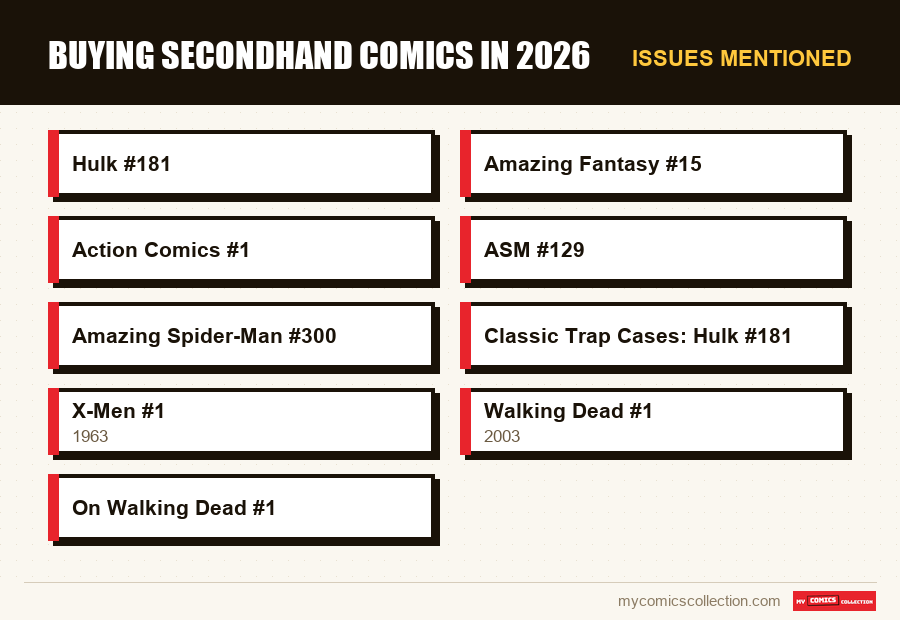
This guide compiles the 10 checks to run systematically before any secondhand comic purchase in 2026: whether it's a CGC slab at $4,000 or a raw Bronze Age book at $80. The method applies on eBay, in private Facebook sales, at comic cons, and in Catawiki auctions. It covers cross-referenced authentication via the official CGC and CBCS lookups, critical reading of listing photos, comparison against recent sold data, seller reputation auditing, and a rundown of the classic trap cases (Hulk #181 fake newsstand, Amazing Fantasy #15 Italian reprint, Action Comics #1 reproduction, ASM #129 trim). For a broader overview of buying and selling, check out the general guide on buying and selling comics.
The 10-Point Checklist: Your Reference Framework
The checklist runs in a specific order: from the most decisive criteria to the least. The goal is to quickly eliminate sketchy listings and focus your analysis time on serious pieces. Budget 8 to 15 minutes per listing for comics above $200, and 3 to 5 minutes for anything below that. The first filter covers stated condition and photo consistency, the second covers the comic's actual identity (edition, reprint, fake), the third covers price, and the fourth covers the seller.
Point 1: Stated Condition. Verify that the listed grade corresponds to a single, specific level (9.4, or Very Fine, or VF/NM). Reject vague ranges like "great overall condition" or "like new" without a grade. On a slab, read the grade to the tenth on the label photo. On a raw copy, require a self-assessment like "I'd estimate 7.5-8.0" with visual justification.
Point 2: High-Resolution Scans. Require at least four photos: full front, full back, spine, and a close-up of the top-right corner. Minimum acceptable resolution is 1,200 pixels wide. Below that threshold, defects (creases, micro-tears, water stains, color breaks) become invisible. A serious professional seller always provides these four angles; their absence is a red flag.
Point 3: Grade vs. Photos Consistency. Compare the stated grade to what the photos actually show. A comic listed as "9.6" with a visible crease at normal zoom is being over-graded. The grade vs. price guide details the defect grid by level.
Point 4: Slab Authentication. For a CGC or CBCS slab, require the certification number (10 digits for CGC, a different format for CBCS) and run it through the official CGC lookup. Any mismatch is a dealbreaker.
Point 5: Comic Identity. Verify the comic is not a reprint, a facsimile, or a Marvel Legacy or DC Facsimile Edition being sold at original-issue prices. Read the indicia (bottom of the first interior page) to confirm the publication date and publisher.
Point 6: Newsstand vs. Direct Edition. On comics from 1977 to 2013, distinguish newsstand (visible UPC barcode) from direct edition (publisher logo in the box). The newsstand commands a 30 to 200% premium on certain issues, but many listings confuse or misrepresent the two. See the Hulk #181 case at the end of this article.
Point 7: Disclosed Restoration. Explicitly ask whether the comic has been pressed, cleaned, or restored (color touch, piece replacement, tear seal). On CGC slabs, a Purple Label signals restoration and carries a massive value penalty. The Purple Label guide quantifies that penalty.
Point 8: Market Median Price. Compare the asking price to the median of eBay sold listings over the past 90 days for the same issue, same grade, same edition. A premium of more than 15% above the median without justification (documented signature, pedigree, exceptional quality within the grade) is a warning sign.
Point 9: Seller Reputation. Feedback above 99% on eBay, account age of at least 12 months, Top Rated Seller badge, documented comics sales history. For private Facebook or Craigslist sales, ask for verifiable references.
Point 10: Return Policy. Require a minimum 14-day return window with a full refund. Refuse "as-is, no returns" on anything over $100. Serious sellers always accept returns: their reputation depends on it.
Authentication: CGC Logo, Label, Official Lookup
Authenticating a certified slab is the most decisive step in the checklist. A well-made fake CGC slab can fool an experienced collector from photos alone, but it will fail every time against the official lookup. CGC offers a free verification service that cross-references the certification number, title, issue, grade, and encapsulation date. The CGC lookup is accessible from any browser and takes about 20 seconds per slab. CBCS offers an equivalent on its own site, with the same mechanics.
A CGC certification number contains 10 digits, often formatted as XXXX-XXX-XXX. It's printed on the interior label of the slab, below the title. In the listing photos, the number must be legible without destructive zooming. If the seller obscures or blurs the number, that's a red flag: an honest seller has no reason to hide this information since the lookup is already public.
The verification cross-references four data points: number, exact title (Amazing Spider-Man vs. Spider-Man: watch for variants), issue number, and grade. Any discrepancy between what the lookup shows and what the listing claims reveals either a seller error (rare) or a fraud attempt using a legitimate number recycled onto a fake. Classic scenario: a fake slab reuses the certification number of a genuine CGC 9.8 Amazing Spider-Man #300 to sell a counterfeit 9.8 of the same issue. The lookup confirms the certification, but the fake label photo shows subtly different typography, imprecise edge sealing, or a slightly off-color label. Cross-referencing the lookup with a sharp label photo lets you catch this overlap.
Beyond the lookup, certain physical markers help with authentication: the molded CGC logo on the side of the case (raised texture), the quality of the edge sealing (an amateur fake leaves glue marks or uneven edges), the presence of the two-part interior label (main label plus security strip), and the exact label color by type (Universal blue, Signature yellow, Restored purple, Qualified green, Conservation cyan). For spotting comic fakes and reproductions, a dedicated guide lists the detailed markers by era and publisher.
Extra vigilance is warranted on slabs sold outside of CGC or Heritage auctions: private Facebook sales, Discord, parallel markets. These channels are the most exposed to fakes because the seller isn't staking a platform's reputation. On eBay, a validated CGC lookup combined with a seller feedback history of 500+ positive transactions in the comics category provides reasonable assurance of authenticity. In informal markets, additionally requesting a video of the slab being handled (slow rotation, back view, back under raking light to reveal the polymer grain) further reduces risk.
Actual Condition vs. Listed Condition: Reading High-Resolution Photos
The gap between the stated grade and the grade actually observable in photos is the number-one source of disputes in raw secondhand purchases. A seller can list a comic as "Near Mint" when it's really a 7.5 or 8.0. For a buyer, knowing how to read high-resolution photos is just as valuable as knowing key issues. Four mandatory angles: full front in even lighting, full back, spine in raking light to reveal rolls and stress lines, and at least one close-up corner shot.
On the front cover, look first for structural defects: blunted corners, creasing, color touch (visible retouching under raking light), staining, and tanning (peripheral yellowing). A Bronze Age comic from 1970 to 1985 will naturally show slight tanning on non-acid-free pulp, but pronounced tanning pulls the grade below 8.0. The back cover is often neglected by sellers, which is exactly where sticker residue, color touch, or pen markings that don't appear on the front tend to hide.
The spine is the most grade-critical component for high grades. On a comic listed at 9.4 or 9.6, the spine must be perfectly straight: no roll, no color break (color loss at fold lines), no tick (micro-tear). The spine photo must be taken in raking light at a 30 to 45 degree angle to surface any irregularities. A spine photo taken straight-on and flat will always hide defects. If the seller doesn't provide this view, ask for it explicitly before buying.
On corners, require a close-up of at least one corner (ideally all four). A "9.6" corner has a sharp point, no blunting, no micro-crease, no incipient tear. Under raking light, a perfect corner reflects evenly; a damaged corner shows a matte zone at the tip. This corner shot is the ultimate test for grades of 9.4 and above. Above 9.6, serious sellers often provide a macro photo taken from 2 to 4 inches away from the corner.
Water stains and foxing (water staining, foxing) are the most expensive defects to correct and the most penalizing. A visible water stain drops a comic below 6.0, and even a faint trace on the cover costs 1 to 2 points. Foxing (scattered brown spots) is typical of comics stored in damp conditions and heavily affects Golden and Silver Age books stored in Europe between 1960 and 1990. On European-origin copies, moderate foxing is almost the norm: don't confuse natural patina with severe defect, but do adjust the grade accordingly (rarely above 6.5 with foxing present).
Finally, be wary of recently "pressed" comics. Professional pressing temporarily removes creases and straightens the spine, but it doesn't eliminate color breaks, tears, or stains. A pressed comic without disclosure can misrepresent the visual grade; factor in that upon CGC regrading, certain defects will resurface. The raw vs. graded comparison breaks down the economic trade-offs between the two formats.
Market Price vs. Asking Price: eBay Sold Data and 90-Day Medians
Price checking requires one discipline above all else: never compare to an asking price, always compare to actual sales (sold price). On eBay, the "Sold" filter over a rolling 90-day window gives access to the most recent completed transactions, with the final price, date, and usually photos. This dataset is the most liquid reference on the global secondary market. Building the median from 8 to 15 recent transactions neutralizes outliers (a botched sale at a deep discount, an auction driven up by an emotional bidder).
The standard method runs in four steps. First, identify the comic precisely: title, issue, edition (newsstand or direct), any variant (cover A, B, 1:25 ratio, etc.). Second, select sales of the exact same grade: to the tenth for slabs (9.4 = 9.4, not 9.2 or 9.6). For raw copies, accept a broader range (VF, VF/NM, NM) and adjust the median manually up or down. Third, calculate the median (not the average, which is sensitive to outliers). Fourth, compare the asking price: if the premium is under 15% above the median, the offer is reasonable; if higher, require justification (documented signature, pedigree, exceptional top-of-grade quality).
Beyond eBay, three other sources feed the grid. GoCollect aggregates eBay sales and adds ComicLink data; the site is freemium and useful for comics above $200. GPAnalysis (subscription) offers the most complete data for vintage books above $1,000. Heritage Auctions publishes its auction results in a freely searchable database: useful for premium pieces, but the Heritage buyer profile pushes prices 5 to 15% above eBay. For comics destined for sale in non-US markets, Catawiki and Delcampe provide a more locally relevant benchmark than the US market.
Watch for several classic biases. Best Offer eBay sales don't display the final negotiated price: the crossed-out price remains the starting ask, while the actual deal may be 15 to 25% lower. To calibrate correctly, cross-reference with auction sales (which display the true final price). Listings marked "make offer" or "price negotiable" are not sales: don't include them in your median.
An announcement or hype effect can temporarily distort the median. On keys tied to film or TV releases (MCU/DCU announcements, casting news, trailers), prices can spike 30 to 80% over 4 to 12 weeks, then fall back. Buying at the peak of a hype bubble is the most costly mistake on the 2020-2026 secondary market. Systematically cross-referencing the 30-day, 90-day, and 12-month medians lets you detect a bubble: if the 90-day figure is 40% above the 12-month figure, the market is running hot and caution is warranted. For tax implications on reselling a secondhand comic, consult the resale tax guide.
Seller: Feedback, Account Age, Badges, References
Seller reputation is the fourth layer of protection after authentication, photos, and price. On eBay, four metrics intersect: positive feedback percentage, total review count, account age, and Top Rated Seller badge. The minimum acceptable threshold for a comic above $100 is 99% positive feedback on at least 200 total reviews, with an account open for more than 24 months. For transactions above $1,000, require 99.5% and 500 reviews.
The eBay Top Rated Seller badge guarantees a track record: fewer than 0.3% disputes, sales documented over 12+ months, tracked shipping. This status is a solid filter for certified comic purchases. The eBay buyer protection program covers the buyer on authenticity and item condition, provided you open a dispute within 30 days of receiving the item. The eBay buyer protection guide for comics details buyer-side remedies.
Reading recent negative feedback (1 to 12 months) often reveals systemic issues: inflated grading, shipping delays, refusal of returns. Filtering reviews by the comics category eliminates noise (a multi-category seller may have excellent electronics ratings but poor comics ratings). A seller who responds to criticism courteously and fixes problems is generally more trustworthy than one who is silent or aggressive.
For private Facebook, Discord, Reddit r/comicswap, or in-person convention sales, verification is more complex. Ask for references: three names of verifiable previous buyers, or portable feedback (an associated eBay account, a Comicartfans profile, presence on a recognized forum). Cross-referencing the Facebook profile with a real LinkedIn or Instagram account adds an identity authentication layer. A seller who refuses these checks without explanation on a transaction above $200 is one to avoid.
Specialized comics retailers apply their own quality filters, which considerably reduces risk compared to a private sale, and the level of guarantee can vary noticeably from one retailer to another. On Heritage and ComicConnect auctions, authentication is built into the house: residual risk is very low, but buyer's premiums (15 to 25%) increase the total cost. The ComicConnect vs Heritage comparison details the fee structures.
At comic cons (San Diego Comic-Con, New York Comic Con, regional shows), trust is built in person: physical examination of the comic, negotiation, immediate payment. Professional exhibitors put their reputation on the line. Asking for a detailed receipt noting the grade, exact edition, and any restoration documents the transaction and simplifies any future dispute. To catalog acquisitions and track provenance history, a dedicated tool like a comics manager keeps your collection organized over the long haul.
Classic Trap Cases: Hulk #181, Amazing Fantasy #15, Action Comics #1
Certain comics account for a disproportionate share of secondary market fraud on their own. Knowing them cold saves hundreds of dollars and speeds up detection. Below are the six most common trap cases on both domestic and international marketplaces in 2025-2026.
Hulk #181 fake newsstand. First full appearance of Wolverine (1974), this is one of the most coveted Bronze Age issues. On this specific issue, the market distinguishes two variants: the Mark Jewelers Insert (a promotional insert found in certain copies, commanding a 20 to 40% premium) and Type 1A vs. 1B (minor printing differences). Many listings claim to offer a newsstand copy when in fact the entire US print run of this era is newsstand by default: the direct edition didn't exist at Marvel until 1979. The scam involves charging an unjustified "newsstand" premium. Always verify the publication year and the actual nature of the variant before buying.
Amazing Fantasy #15 Italian or Mexican reprint. First appearance of Spider-Man (August 1962), this issue ranges from $70,000 to $5 million depending on grade. Italian reprints (Editoriale Corno, 1970s), Mexican (Editorial Novaro), Brazilian, and Indian editions circulate at a fraction of the original's price. In dubious listings, some sellers present a reprint as a "rare collector's edition." The indicia (bottom of the interior first page) immediately gives away the reprint: foreign publisher, different language, different date. The cover may look nearly identical, but the paper (quality, slightly different dimensions) and printing (coarser screen on reprints) are enough for a trained eye.
Action Comics #1 reproduction. First appearance of Superman (June 1938): the absolute holy grail (record sale: $9.12 million in 2025). Reproductions are everywhere: Famous First Edition (DC, 1974), cardboard facsimile 1992, recent amateur reproductions. No authentic copy ever changes hands outside Heritage or ComicConnect auctions with CGC authentication. An Action Comics #1 offered at $5,000 or $50,000 on eBay without a CGC slab is without exception a reproduction. The originals market is far too tight for a copy to circulate in informal private sales.
X-Men #1 (1963) non-witnessed Stan Lee signature. Post-death Stan Lee signatures (after 2018) circulate on comics without CGC witnessed documentation. Without a yellow CGC Signature Series label or a yellow CBCS Verified Signature label with provenance documentation, the signature has no market value and is almost certainly fake. An X-Men #1 with a Stan Lee signature for under $4,000 without an SS label is a clear red flag.
ASM #129 trim. First appearance of the Punisher (1974), highly sought-after in high grade. Some copies have been trimmed (edges cut to remove defects) in ways that can appear invisible to the eye. CGC almost always detects trimming and will either assign an Apparent grade or refuse to grade the book outright. On the raw market, a trimmed ASM #129 gets resold as an original; detection requires measuring the book precisely (a standard Bronze Age comic is 7.0" × 10.5"; a trim loses 1 to 3mm on one or two sides). For a raw copy above $1,000, get it authenticated before purchase.
Walking Dead #1 (2003) second print and facsimile. On Walking Dead #1, the first print (March 2003) is worth $2,000 to $4,500 in 9.8, while the second print (May 2003, "Tony Moore variant") is worth $250 to $600. Some sellers list a second print while simply mentioning "1st" and "Walking Dead #1." The indicia always reveals the edition: "First Printing: March 2003" for the first print, "Second Printing" for the second. The Walking Dead #1 facsimile (official Image reprint from 2023, cover price $1) also circulates; the cover carries a "Facsimile Edition" stamp and the indicia mentions 2023. To identify all these variants, the comics fakes and reproductions guide lists the detailed markers.
When in doubt about a valuable book, requesting a free appraisal before buying prevents a costly mistake. To catalog the collection afterward and track value over time, the comics section of the site offers a structured entry point by series and character.
FAQ: Buying Secondhand Comics in 2026
How do I verify that a CGC slab is authentic before buying on eBay?
Verification runs in three steps. First, locate the 10-digit certification number on the interior label of the slab: it should be visible in the listing photos (if it's masked or blurred, walk away from the transaction). Second, enter that number into the official CGC lookup, available for free on the CGC website: the result must display exactly the title, issue, grade, label type, and encapsulation date matching the listing. Any discrepancy is a dealbreaker. Third, examine the physical details in the photos: quality of the edge sealing, label typography, exact label color by type (blue for Universal, yellow for Signature, purple for Restored, green for Qualified, cyan for Conservation), and the molded CGC logo on the case. For transactions above $1,000, requesting a video of the slab being handled (slow rotation, back view, raking light on the polymer) further reduces fake risk.
What is an acceptable median price for a secondhand comic in 2026?
The reference point is the median of eBay sold listings over a rolling 90-day window for the same issue, same grade to the tenth, and same edition (newsstand or direct). Building the median from at least 8 recent transactions neutralizes outliers. An asking price up to 15% above that median is generally acceptable, especially for a top-of-grade slab, a comic with a documented signature, a pedigree copy (Mile High, Edgar Church, etc.), or an unusually fresh example within the grade. Beyond 15%, require a specific justification. Cross-referencing eBay with GoCollect, Heritage Auctions, and for local comparisons Catawiki and Delcampe gives a robust price range. Watch out for hype bubbles: if the 90-day median exceeds the 12-month median by 40%, the market is running hot (film announcement, series casting) and the price may fall back within 4 to 12 weeks.
Should I buy a raw comic or a CGC-graded comic when starting out in the secondhand market?
For beginners, raw is more budget-friendly but exposes you to grade misjudgment risk: a novice buyer may pay for an "estimated 9.4" that comes back as an 8.0 from a professional grader. A CGC or CBCS slab costs a 25 to 60% premium over the same raw issue and grade, but nearly eliminates grade and authentication risk. For a beginner spending under $200 per book, raw copies from eBay Top Rated Sellers with high-resolution photos remain the learning path: mistakes are cheaper and help you calibrate your eye. Above $500 per book, shifting to certified slabs is almost always the safer call. The raw vs. graded investment 2026 comparison details the economic trade-offs by resale time horizon.
What recourse do I have if a secondhand comic I received doesn't match the listing?
On eBay, the buyer protection program covers non-conformities (actual condition below the stated grade, questionable authenticity, item different from the description) provided you open a dispute within 30 days of receiving the item. Document everything methodically: high-resolution photos taken immediately upon unboxing, comparison against the listing photos, precise measurements if trimming is suspected. PayPal Buyer Protection offers a second layer, with 180 days to file a claim. For private Facebook, Discord, or convention sales, recourse is limited to negotiation, which is exactly why extra caution is warranted on those channels. For transactions above $500 between private individuals, formalizing a sale agreement with a 14-day return clause and a detailed grade description significantly limits disputes. Keep all proof of communication (messages, listing screenshots) for at least 24 months.
What's the strategy for avoiding paying for a nonexistent newsstand variant or a reprint at original prices?
Three systematic reflexes. First, verify the actual publication year of the newsstand variant: no Marvel comic pre-1979 or DC comic pre-1977 has a direct edition: the entire print run was newsstand by default, so charging a newsstand premium on those issues is either ignorance or bad faith. Second, on comics from 1979 to 2013, identify the UPC barcode (newsstand, variable premium depending on issue and grade) versus the boxed publisher logo (direct edition, standard) before any purchase; on Bronze and Copper Age keys, the newsstand premium can reach 30 to 200%, which motivates deceptive presentations. Third, on foreign editions (Italian, Mexican, Brazilian, French from the 1970s-1980s), always read the indicia (bottom of the interior first page) which names the local publisher, local date, and language: a foreign reprint of Amazing Fantasy #15 or Action Comics #1 may look visually similar to the original, but the indicia always reveals what the copy actually is. When in doubt, cross-reference with the comics catalog or request a free appraisal before the transaction.