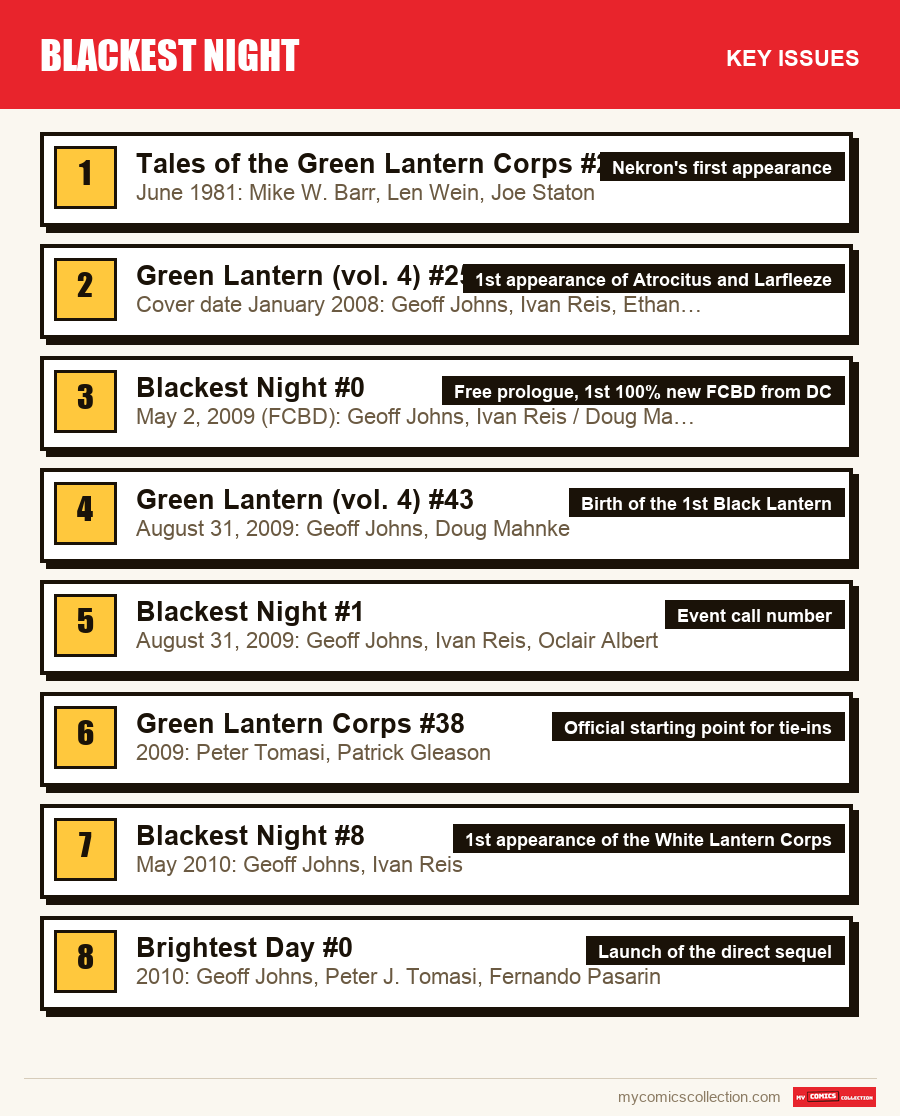
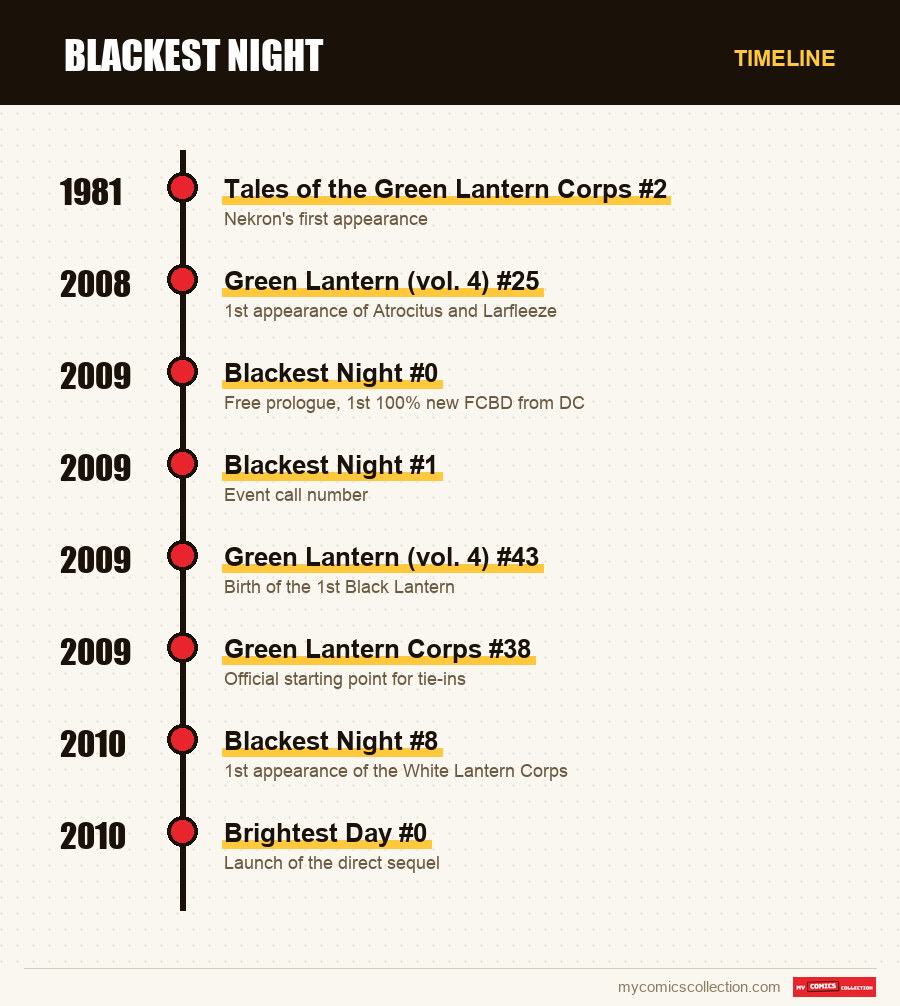
The key comics of Blackest Night revolve around three layers: the origins (Green Lantern #25 with the first appearance of Atrocitus and the Red Lanterns, Tales of the Green Lantern Corps #2 with the very first appearance of Nekron in 1981), the triggering of the event (Green Lantern #43 and the birth of the first Black Lantern, Blackest Night #0 as a free prelude, then Blackest Night #1 in August 2009) and its conclusion (Blackest Night #8 with the appearance of the White Lantern Corps, then Brightest Day #0 which opens the sequel). Blackest Night #1 remains the most sought after issue in 9.8, with a rating hovering around $260 and a CGC census of only a few hundred copies at this grade.
Few DC events have had such a lasting impact on readers' imaginations as Blackest Night. Published between 2009 and 2010, this crossover imagined by Geoff Johns and drawn by Ivan Reis brought out of the earth, literally, dozens of dead heroes and villains, transformed into Black Lanterns in the service of a cosmic entity named Nekron. The idea was not new: it drew on decades of Green Lantern continuity, but its execution, its unapologetic darkness and its scale (more than 60 tie-in titles) made it a milestone in the late Bronze Age of modern DC publishing.
For a collector, Blackest Night poses a classic problem of big crossovers: where to start, and especially where to stop? Between the main mini-series, the tie-ins in Green Lantern and Green Lantern Corps, the nine derivative mini-series (Titans, Batman, Superman, Wonder Woman, Flash, Tales of the Corps...) and the much older roots of the character of Nekron, the temptation is great to buy everything. This guide isolates the issues that really matter-those that carry a first appearance, a major narrative turning point, or a proven rarity-and leaves out the filler.
Blackest Night: context and genesis of a cult event
The story of Blackest Night begins well before 2009. Geoff Johns has been patiently building his "emotional spectrum" since his arrival on Green Lantern in 2005: Sinestro Corps War introduced the yellow fear in 2007, then Green Lantern (vol. 4) #25, published at the end of December 2007 with a cover date of January 2008, gave rise to the red rage by introducing Atrocitus and the Red Lanterns. It is in this same arc, “Rage of the Red Lanterns”, that the prophecy of the Blackest Night appears, revealed to Hal Jordan by the former Guardian Ganthet: the common thread that will hold the entire saga together for two years.
The narrative mechanics of the event are based on a simple and terrifying principle: the Guard named Scar, a corrupt Guardian, shapes the first black ring and sends it to wake William Hand, Black Hand, after the latter murdered his family and killed himself. This moment, located in Green Lantern #43 (August 31, 2009), officially serves as a prologue to the event: it is the birth of the very first Black Lantern, the entity who will then reanimate dozens of dead people from the DC universe, from the Flash to the Titans via the Justice Society.
The general public launch took place the same day with Blackest Night #1, written by Geoff Johns and drawn by Ivan Reis and Oclair Albert, with Ethan Van Sciver as reinforcement. The main miniseries has eight monthly issues, preceded by a free prologue distributed during Free Comic Book Day on May 2, 2009: Blackest Night #0, the first entirely new title that DC has ever designed specifically for Operation FCBD. The event closes in May 2010 with Blackest Night #8, before opening directly to the sequel, Brightest Day, which resurrects twelve dead characters in a flash of white light.
To put Nekron in a broader perspective: the character was not born with Blackest Night. His first appearance dates back to Tales of the Green Lantern Corps #2, in June 1981, under the pen of Mike W. Barr and Len Wein, with Joe Staton drawing. A comic from the Bronze Age that remained anecdotal for a long time, and which the 2009 event suddenly brought back into the spotlight.
Tales of the Green Lantern Corps #2
This is the real starting point, almost thirty years before the event. This Bronze Age anthology issue introduced Nekron, Lord of the Dead, long before Geoff Johns made him the central antagonist of Blackest Night. Long considered a simple back-of-the-box comic, it experienced a clear revaluation from the announcement of the event in 2008-2009, a classic pattern for the first “dormant” appearances suddenly reactivated by a film or a major saga.
Green Lantern (vol. 4) #25
The number that ignites the powder. “Rage of the Red Lanterns” introduces in the same episode Atrocitus, future leader of the Red Lantern Corps, and Larfleeze (Agent Orange), two figures who will weigh heavily throughout the War of Light and then in Blackest Night. It is also here that Ganthet reveals to Hal Jordan the prophecy that gives its name to the event. A pivotal issue for anyone who wants to go back to the sources of the story rather than just the main mini-series.
Blackest Night #0
Distributed only during Free Comic Book Day 2009, this issue zero is the very first entirely original title that DC has produced for Operation FCBD, rather than a simple promotional reissue. It lays down the final pieces before the launch of the regular series: it is a complete narrative entry point, but also a “ghost” comic of the resale market since it has never been sold on newsstands or in bookstores at full price.
Green Lantern (vol. 4) #43
The official Blackest Night prologue. It is in this issue that Guardian Scar fashions the very first Black Ring and revives William Hand, Black Hand, after his suicide, making him the first Black Lantern in the DC Universe and Nekron's gateway to the world of the living. Released on the same day as Blackest Night #1, this issue is often overlooked by collectors who rush straight to the main mini-series, despite it being the true first appearance of the Black Lantern concept.
Blackest Night #1
The reference number of the entire saga. 52 pages for $3.99 at launch, with Ethan Van Sciver as drawing backup and four distinct variants listed, including the 1:25 by Ethan Van Sciver and a 1:250 sketch by Ivan Reis. This is the number that every DC event collector from the 2000s owns or is looking for, and the one that structures the rating of the entire series: its liquidity makes it a good indicator of the health of the modern DC comics market.
Green Lantern Corps #38
Alongside Green Lantern #43, this issue marks the start of the Green Lantern Corps tie-in which accompanies the entire main miniseries until #46. Tomasi and Gleason develop deaths and resurrections specific to the Corps, particularly around secondary characters from the intergalactic corps, with a direct impact on the mini-series Blackest Night: Tales of the Corps. A standalone issue for readers who want to follow the event in its entirety rather than just the spine.
Blackest Night #8
The finale of the main miniseries. Nekron separates Sinestro from the white entity that has just emerged, before Hal Jordan in turn merges with her to confront the lord of the dead. It is in this issue that the White Lantern Corps and the White Power Battery appear for the first time, elements which will structure the entire editorial suite of Green Lantern until War of the Green Lanterns. A concluding issue which, in itself, carries a first major appearance: often underrated compared to #1.
Brightest Day #0
The immediate narrative bridge after Blackest Night #8. Twelve characters: including Aquaman, Martian Manhunter, Firestorm, Hawkman and Hawkgirl: are brought back to life by a white light bursting from the center of the Earth, without knowing why they were chosen. This issue zero launches the bimonthly Brightest Day series (24 issues, 2010-2011) and directly relaunches the editorial careers of Aquaman and Firestorm, two characters who would experience major solo runs in the following decade.
Collecting this series?
Track what you own, what you are missing and what your collection is worth. 7 day trial.
Start my trial →The impact of adaptations on the rating
Blackest Night never had a real film or television adaptation until recently, which has long limited the exposure of the event to the general public compared to sagas like Infinity Gauntlet on the Marvel side. The situation changes with the arrival of the DC Universe piloted by James Gunn: the HBO series Lanterns, centered on Hal Jordan and a new recruit, John Stewart, investigating a murder which leads them to an "ancient horror" on earth, is widely interpreted by the specialized press as a gateway to Blackest Night in the filmed universe. James Gunn himself indicated that Lanterns was "really important in setting up" the rest of the DCU.
Notable item for collectors: actor Garret Dillahunt plays a character named William Macon, widely suspected of concealing the identity of Black Hand: Nekron's mortal anchor in the comics. If this lead is confirmed on screen, it would reflect directly on the rating of Green Lantern #43, the real first appearance of the character as a Black Lantern, and on Green Lantern (vol. 4) #25, where Atrocitus and the roots of the War of Light appear. This pattern has already been verified elsewhere in the industry: a first appearance considered secondary for fifteen years can see its demand take off in a few months as soon as a series or film confirms its adaptation.
For a collector following this issue closely, the best strategy remains the same as for any character ahead of a potential adaptation: secure the first appearance numbers in the correct grade before the official announcement, rather than after a price spike that is difficult to anticipate. The release schedule for Lanterns has not yet been precisely set, which leaves a window for patient buyers: without certainty, of course, that the plot confirms the link with Nekron and Blackest Night as the press is now predicting.
Buying guide
- Distinguish first appearance and call number. Blackest Night #1 is the best-known issue, but Green Lantern #43 bears the real first appearance of the concept of Black Lantern, and Green Lantern #25 that of Atrocitus: it is often these "satellite" issues which offer the best rarity/price ratio.
- Don't overlook Tales of the Green Lantern Corps #2. It's a Bronze Age comic, therefore more fragile and less abundant in high grades than the 2009 releases: favor intermediate grades if the budget does not allow a 9.6-9.8, rather than relying solely on the raw market without certification.
- Always check the grade before purchasing a CGC number. For a 2009-2010 event, the difference in rating between a 9.6 and a 9.8 can be significant; our article on the difference between CGC 9 and 9.8 details precisely what justifies the price difference.
- Beware of misleading variations. Blackest Night #1 has at least four versions (first printing, 1:25 Van Sciver variant, 1:250 Ivan Reis sketch variant, Diamond Retailer Summit variant): the price displayed varies greatly depending on the version, make sure the ad clearly specifies which one is offered.
- Don't overlook the free prologue. Blackest Night #0 was never sold on newsstands, making it a more difficult issue to locate in very good condition than its status as a "mere promotional prologue" would suggest.
- Always compare against recent actual sales. Price guides evolve slowly; an estimate based on eBay sales from recent weeks better reflects current demand than a range frozen for several months.
- Catalog your collection as you go. With over 60 event-related titles, it's easy to lose track of what you already own: our collection management application allows you to track each number, its rank and its origin.