
La tier list Aquaman 2026 prioritizes key DC issues according to the rarity/demand/spec ratio: Tier S (More Fun Comics #73 1941, Adventure Comics #260 1959, Showcase #30 1961, Aquaman Vol 1 #1 1962) between €8,000 and €280,000, Tier A (Adventure #229, Aquaman #18 Mera, Aquaman #29 Ocean Master, Aquaman Vol 5 #2 Peter David hand bite) between €400 and €12,000, Tier B sleepers (More Fun #84, Aquaman #11 Aqualad, Showcase #100, Aquaman Vol 6 #0) between €80 and €1,800, Tier C spec calls DCU James Gunn and Lost Kingdom between €40 and €400.
Build a Portfolio Aquaman in 2026 without a tier list, it's moving blindly on a catalog that covers eighty-five editorial years from the backup story of More Fun Comics #73 (November 1941) to the Jackson Hyde runs and the DCU 2026 relaunches announced by James Gunn. The tier list method, applied to Aquaman, is based on measurable criteria: the first appearance of a character identified as structuring for the DC canon, the census CGC rarity in high grade on Golden Age and Silver Age survivors, the liquidity on the secondary market (Heritage Auctions, ComicConnect, documented sales 2024-2026), and the spec linked to the DCU reboot. This grid avoids two classic errors on Aquaman: confusing the late Golden Age editions (More Fun #84 and above) with the real FA of November 1941, and buying Aquaman Vol 1 #1 (January-February 1962) at the price of a real blue-chip without realizing that the Silver Age edition allowed better survival than Action Comics #1 or Detective Comics #27.
This hub covers the tier list methodology applied to Aquaman, the details of each tier (S/A/B/C) with dates, creators and rating ranges validated by Heritage 2024-2026 sales, allocation strategies for four budget profiles, technical pitfalls specific to Golden Age DC (restored copies, More Fun Comics earliest issue poorly dated, multiple Aquaman #1 depending on volumes), and a monitoring grid for the 2026-2030 cycle conditioned by the DCU reset. To situate this tier list in the overall DC universe, consult our pillar comics DC universe guide pillar, and for chronological context, the Aquaman story in comics.
Aquaman tier list methodology: 5 weighted criteria
The Aquaman 2026 tier list is based on five weighted criteria, applied number by number. First criterion, the first appearance of a major character in the Atlantean canon. This FA status triggers most of the sustainable speculative premium because it is unique and inscribed in the editorial chronology. More Fun Comics #73 (November 1941) concentrates the Aquaman FA as an eight-page backup, signed by Mort Weisinger on the screenplay and Paul Norris on the drawing. Adventure Comics #260 (May 1959) offers the first Silver Age origin story by Robert Bernstein and Ramona Fradon, which will remain canonical until the Crisis on Infinite Earths reboot of 1985. Aquaman #18 (November-December 1964) introduces Mera, Aquaman #29 (September-October 1966) introduces Ocean Master. Each FA documented by CGC and recognized by Heritage secures a sustainable rating floor.
Second criterion, the rarity census CGC in high grade. On Golden Age DC, the census is the determining factor: More Fun Comics #73 displays less than five hundred copies graded all grades combined, including less than fifteen copies above CGC 6.0. At this level of absolute scarcity, the market values availability more than initial mintage. On Silver Age (Adventure #260, Aquaman Vol 1 #1, Aquaman #11, #18, #29), the census remains thin compared to equivalent Marvel titles: DC Silver Age sleeps under the collector's radar for two decades, which creates an arbitrage opportunity that is still active in 2026. To understand this mechanic applied to DC titles, see our analysis of the first Aquaman series.
Third criterion, the DCU tie-in James Gunn. The DCU reset announced for 2025-2027 (Aquaman repositioned as Jackson Hyde then return Arthur Curry according to hypotheses) creates massive general public demand for keys from the character. The rule of thumb on DC since Man of Steel 2013: a film announcement triggers +30 to +70% on the key figures from the character concerned in the six to nine months post-trailer, with a partial fallout after commercial release. Aquaman and the Lost Kingdom (2023) demonstrated that commercial disappointment produces a consolidation of ratings rather than a lasting drop in Tier S and A. Fourth criterion, belonging to a run signature: Weisinger/Norris Golden Age, Bernstein/Fradon Silver Age origin, Jack Miller/Nick Cardy Aquaman Vol 1 (1962-1971), Peter David Aquaman Vol 5 (1994-1998) with the emblematic amputation at number 2. Fifth criterion, the status of modern key: issues after 1994 with FA of a character or structuring narrative reversal (Aquaman Vol 5 #2 hand bite by Peter David).
Each ranked number receives a weighted score on these five criteria, which positions it in one of the four thirds. The placement is not fixed: a Tier B sleepers can move to Tier A after a major DCU announcement, and a Tier C to Tier B after confirmation of a casting. The Aquaman 2026 tier list reflects the state of the market in the first half of 2026, validated by Heritage Auctions sales January-May 2026 and the CGC census stopped in April 2026. For the context of editorial developments, also read our guide key issues Aquaman Bronze Age.
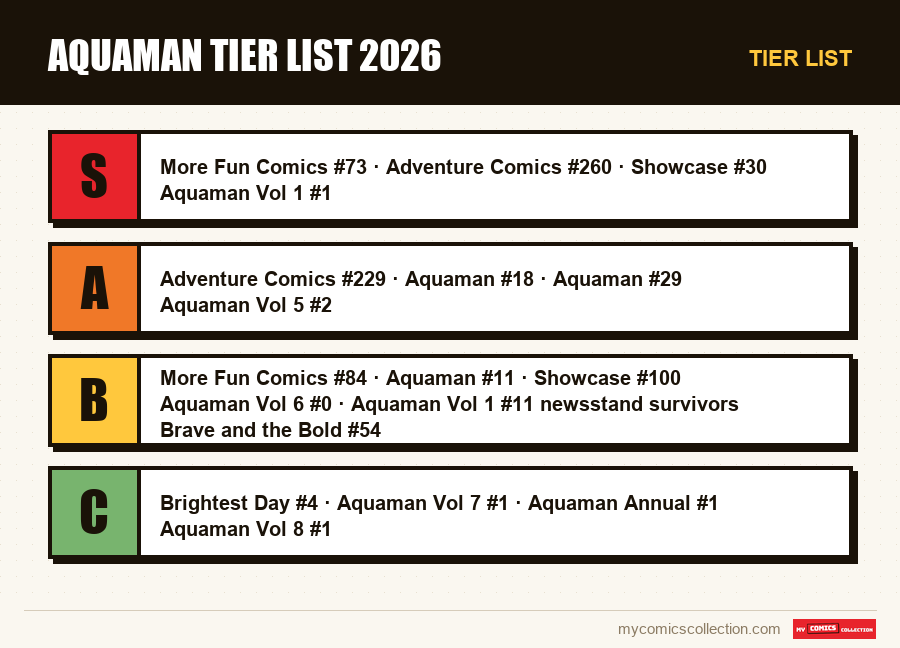
Tier S: Blue-chip Aquaman (€8,000 to €280,000)
Le Tier S brings together four numbers at the confluence of all the criteria: major FA, run signature, recurring DCU request, documented census rarity. These issues constitute the absolute foundation of any blue-chip Aquaman portfolio. They have never experienced a lasting decline over fifteen years and their rating increases on average by 7 to 11% per year in high grade CGC, with marked acceleration in 2018-2019 (release of the film Aquaman by James Wan) and stabilization 2023-2024 (post-Lost Kingdom consolidation).
More Fun Comics #73 (cover dated November 1941, newsstand release September 1941), screenplay by Mort Weisinger, drawings by Paul Norris, contains the FA of Aquaman as an eight-page backup, as well as the FA of Green Arrow and Speedy in the same edition (exceptional triple FA configuration on Golden Age DC). Estimated circulation of between 350,000 and 400,000 copies but minimal survival: the number of existing copies in collector's condition is estimated at less than five hundred. Rating 2026: CGC 3.0 between €18,000 and €25,000, CGC 4.5 around €45,000, CGC 6.0 between €90,000 and €130,000, CGC 7.0 around €160,000, CGC 8.0 and above extremely rare and negotiated over-the-counter beyond of €250,000. Documented record sale 2024 at Heritage Auctions: a CGC 6.0 White Pages copy sold for $250,000 including fees. For auctions, see our Aquaman record price file at auction.
Adventure Comics #260 (May 1959), screenplay Robert Bernstein, drawings Ramona Fradon, contains the Silver Age origin of Aquaman, the first structured version of the Atlantean backstory (son of Atlanna and Tom Curry) which will remain canonical until Crisis on Infinite Earths in 1985. Estimated circulation of 400,000 copies. Rating 2026: CGC 4.0 around €1,200, CGC 6.0 between €2,800 and €3,500, CGC 7.5 around €6,000, CGC 8.5 around €12,000, CGC 9.0 between €18,000 and €24,000, CGC 9.4 rare and negotiated above €35,000. The issue benefits from Silver Age DC institutional demand which maintains high liquidity even at high grade. For the Bronze Age context of Aquaman, also see our Aquaman annuals and specials guide.
Showcase #30 (January-February 1961), screenplay Robert Bernstein, drawings Ramona Fradon, Aquaman's first solo tryout in the Showcase series (anthology of early DC appearances which launched The Flash in 1956 and Green Lantern in 1959). Estimated circulation of 380,000 copies. Rating 2026: CGC 4.5 between €800 and €1,100, CGC 6.5 around €2,200, CGC 8.0 between €4,500 and €5,800, CGC 9.0 around €9,500, CGC 9.4 between €16,000 and €22,000. The “first solo tryout” status places this issue just before the ongoing series and constitutes a structuring collector acquisition objective. The issue still suffers from moderate exposure compared to Showcase #4 (Flash) or Showcase #22 (Green Lantern), which maintains real upside.
Aquaman Vol 1 #1 (January-February 1962), script Jack Miller, drawings Nick Cardy, first issue of the ongoing Aquaman series, founder of the 1962-1971 Cardy run considered the definitive Silver Age creative sequence. Estimated circulation of 350,000 copies. Rating 2026: CGC 5.0 between €600 and €900, CGC 7.0 around €2,200, CGC 8.0 between €3,500 and €4,800, CGC 9.0 around €9,000, CGC 9.4 between €16,000 and €22,000, CGC 9.6 around €35 000 € and above in the event of an exceptional census discovery. The issue experienced a marked revaluation in 2018-2019 then 2023 thanks to the cinema exhibition, and remains the natural entry point for an ongoing series collector. Details in our analysis of the first Aquaman series.
Tier A: Solid Aquaman 2026 (€400 to €12,000)
Le Tier A brings together major FAs whose rating increases regularly without reaching the absolute rarity of Tier S. These numbers constitute the heart of an average portfolio and offer an optimal liquidity/appreciation ratio for an intermediate budget €2,000 to €25,000.
Adventure Comics #229 (October 1956), published by DC, marks the beginning of the recurring Silver Age phase of Aquaman in Adventure Comics (the character appears in backup from this issue until the transition to a solo title). Estimated circulation of 420,000 copies. Rating 2026: CGC 4.5 around €350, CGC 6.0 between €700 and €900, CGC 7.5 around €1,500, CGC 8.5 around €3,200, CGC 9.0 between €5,000 and €7,000, CGC 9.4 above €12,000 in case of census thin. This issue is undervalued by the general public market but identified by Silver Age analysts as a benchmark sleeper: it is the editorial shift which places Aquaman in the logic of a recurring series after the late Golden Age trough. For the context of transition between eras, see our Aquaman crossovers guide.
Aquaman #18 (November-December 1964), Jack Miller on screenplay and Nick Cardy on drawing, contains the FA of Mera, future wife of Aquaman and central character of the Atlantean canon up to modern Geoff Johns runs and DCEU cinema. Estimated circulation of 280,000 copies. Rating 2026: CGC 6.0 around €350, CGC 7.5 between €700 and €900, CGC 8.5 around €1,800, CGC 9.0 around €3,200, CGC 9.4 between €6,500 and €9,000, CGC 9.6 above €14,000. The Mera FA experienced a strong revaluation 2018-2019 (Amber Heard DCEU role) then a consolidation 2022-2024. DCU prospect James Gunn (recast likely) creates second spec window in 2026-2027. See our analysis of the impact of cinema adaptations on the Aquaman market.
Aquaman #29 (September-October 1966), Bob Haney on screenplay and Nick Cardy on drawing, contains the FA of Ocean Master (Orm Marius, half-brother of Aquaman), signature antagonist of the franchise and character exploited in Aquaman 2018 (played by Patrick Wilson) then Lost Kingdom 2023. Estimated circulation of 260,000 copies. Rating 2026: CGC 6.0 around €280, CGC 7.5 between €550 and €750, CGC 8.5 around €1,400, CGC 9.0 around €2,800, CGC 9.4 between €5,500 and €8,000, CGC 9.6 above €12,000. Ocean Master remains the main DCU antagonist candidate for future projects, which keeps the spec active on this issue despite already capitalized cinema exposure.
Aquaman Vol 5 #2 (March 1994), screenplay Peter David, drawings Martin Egeland, contains Peter David's emblematic hand bite: Aquaman has his left hand devoured by piranhas in the Time and Tide arc, a major narrative transformation which repositions him as an amputee warrior with a prosthetic harpoon throughout the 1990s. Estimated circulation of 180,000 copies (figures declining post-Image bust). Rating 2026: CGC 9.0 around €80, CGC 9.4 between €180 and €260, CGC 9.6 around €400, CGC 9.8 between €800 and €1,200. The issue experienced an explosion in 2018-2019 (9.8 rating multiplied by five between 2017 and 2019) then a stabilization, and remains an accessible Modern Age sleeper with upside DCU possible.
Tier B: Emerging Aquaman Sleepers (€80 to €1,800)
Le Tier B brings together sleepers identified by their low relative exposure with regard to their narrative potential or their census rarity. These numbers offer the most relevant perspectives of appreciation on the 2026-2028 cycle but require a careful reading of the census and DCU news.
More Fun Comics #84 (October 1942), Mort Weisinger on screenplay and Louis Cazeneuve on drawing, contains an early Aquaman appearance considered by some collectors as a secondary Golden Age key issue (direct succession of the origin established in More Fun #73). Estimated circulation of 320,000 copies but minimal survival: less than one hundred and fifty copies in the CGC census, all notes combined. Rating 2026: CGC 4.0 between €800 and €1,100, CGC 5.5 around €1,600, CGC 7.0 around €3,200, CGC 8.0 between €5,500 and €7,500. The census rarity and narrative proximity to More Fun #73 make it a Golden Age sleeper that deserves patient accumulation for intermediate budgets who cannot access #73 directly.
Aquaman #11 (September-October 1963), Jack Miller on screenplay and Nick Cardy on drawing, contains the FA of Aqualad named Garth, first Atlantean sidekick and future founding member of the Teen Titans in 1964 in The Brave and the Bold #54. Estimated circulation of 300,000 copies. Rating 2026: CGC 6.0 around €250, CGC 7.5 between €480 and €650, CGC 8.5 around €1,200, CGC 9.0 around €2,200, CGC 9.4 between €4,500 and €6,500. The long-term spec is based on the possible introduction of Aqualad/Garth in a live action DCU Teen Titans project, a scenario mentioned in the Gunn-Safran roadmaps but not confirmed as of May 2026. For the DC sidekicks context, see our complete guide Aquaman collection.
Showcase #100 (May 1978), cover by Joe Staton, anthology celebrating the hundredth issue of Showcase with multi-character presence including Aquaman among the heroes represented. Estimated circulation of 200,000 copies, Bronze Age. Rating 2026: CGC 8.0 around €80, CGC 9.0 between €180 and €250, CGC 9.4 around €400, CGC 9.6 around €700, CGC 9.8 between €1,500 and €2,200. The issue is a Bronze Age sleeper that combines full Showcase collector interest and Aquaman presence, underexposed on the secondary market. Further details in our guide Bronze Age key issues Aquaman.
Aquaman Vol 6 #0 (October 1994), screenplay Peter David, drawings Martin Egeland, special Zero Hour issue which establishes the creative peak of the Peter David run after the hand bite: new visual identity long-haired warrior Atlante with prosthetic harpoon, prelude to the 1994-1998 phase considered as the definitive Modern Age sequence. Estimated circulation of 200,000 copies. Rating 2026: CGC 9.0 around €60, CGC 9.4 between €120 and €180, CGC 9.6 around €280, CGC 9.8 between €500 and €800. Sleeper Modern Age with strong DCU upside if the Gunn artistic direction is inspired by the Peter David aesthetic. For full editorial context, read our historical analysis of the first Aquaman series.
Complete Tier B with attention to Aquaman Vol 1 #11 newsstand survivors and at Brave and the Bold #54 (June-July 1964, FA Teen Titans with Aqualad as a founding member), often classified in the Teen Titans franchise but constituting a major secondary Aquaman key issue: CGC 8.0 around €1,500, CGC 9.0 between €3,500 and €4,500. For misleading editions and reprints, see our Aquaman fakes and reprints guide.
Tier C: Spec calls Aquaman 2026-2027 (€40 to €400)
Le Tier C brings together spec calls validated by recent signals: DCU announcements, rumored castings, editorial runs in preparation at DC. These numbers offer the highest risk/reward ratios, with the risk of stagnation if the spec does not materialize, and the potential for doubling or tripling if confirmed.
The main Aquaman 2026-2027 spec call is based on the reset DCU James Gunn. Three scenarios are being considered by speculation analysts: recasting Arthur Curry after the departure of Jason Momoa from the Aquaman DCEU, transition to Jackson Hyde (black Aqualad introduced in Brightest Day #4 in June 2010, his FA is an extreme sleeper in CGC 9.8 under €100), or return of Mera in lead role with complete recasting. The key issues to accumulate: Brightest Day #4 (June 2010) FA Jackson Hyde, CGC 9.8 between €80 and €140, sleeper conviction if Aqualad noir becomes the new DCU direction. Aquaman Vol 7 #1 (November 2011, New 52 Geoff Johns/Ivan Reis), CGC 9.8 between €60 and €100, long-term sleeper on the canonical modern era.
The fallout of Aquaman and the Lost Kingdom (2023, directed by James Wan, commercial performance below expectations) produced two contradictory effects: consolidation of Tier S and A (blue-chips did not fall), and compression of ratings on secondary modern keys linked to specific characters in the film. This compression creates buying opportunities on the 2010-2018 modern keys which have lost 20 to 35% from their 2018-2019 peak and offer an interesting entry point if the DCU Aquaman returns in force in 2027-2028. For pre and post-film arbitrations, see our guide impact of adaptations on the Aquaman market.
Complete Tier C with Aquaman Annual #1 (1990, FA Land Minor Cosmic Aquaman) at high grade, the Tales of the Teen Titans with Aqualad (1984-1985 NTT), and the Aquaman Vol 8 #1 (2016 Rebirth Dan Abnett), all accessible under €100 in CGC 9.8. For the 2026-2027 cross-character spec calls, read our folder spec keys 2027 Marvel DC movies series. To compare with the Superman methodology, see our tier list Superman key issues 2026.
Collecting this series?
Track what you own, what you are missing and what your collection is worth. 7 day trial.
Start my trial →Strategy by budget: 1K€, 5K€, 25K€, 100K€ and more
The optimal allocation depends on the total budget and time horizon. Four profiles emerge from the 2026 portfolio analyzes published by GoCollect and Heritage on Aquaman specifically.
Budget €1,000: concentration on two Tier A and one Tier B, for example Adventure #260 CGC 4.0 around €1,200 (already above the budget: alternative to grade Aquaman #18 CGC 5.5 around €250 + Aquaman #29 CGC 6.0 around €280 + Aquaman Vol 5 #2 CGC 9.6 around €400). This allocation offers exposure to Mera, Ocean Master and modern key Peter David, three characters exhibited at DCU 2026-2028. The classic mistake to avoid: buying a copy of Aquaman Vol 1 #1 CGC 3.5 at €800 (low grade, low liquidity, limited upside) rather than three high grade sleepers.
Budget €5,000: Tier A core and Tier B exposure, for example Adventure #260 CGC 5.0 around €1,800, Aquaman Vol 1 #1 CGC 6.0 around €1,400, Aquaman #18 CGC 7.5 around €800, Aquaman #29 CGC 7.5 around €700. This allocation combines the Silver Age origin, the first ongoing issue, the FA Mera and the FA Ocean Master, the founding quartet of any serious Aquaman collection. For purchase arbitrations at auction on these grades, see our file ComicConnect Heritage auction purchasing strategy.
Budget €25,000: pivot to a medium Tier S grade + Tier A diversification. Typical configuration: Showcase #30 CGC 7.0 around €3,500, Aquaman Vol 1 #1 CGC 8.5 around €6,500, Adventure #260 CGC 7.5 around €6,000, Aquaman #18 CGC 9.0 around €3,200, Aquaman #29 CGC 8.5 around €1,400 €, plus a reserve of €4,000 for accumulable Tier C modern keys. Or five concentrated positions with guaranteed Heritage liquidity and full exposure to signature characters.
Budget €100,000 and more: blue-chip Tier S base + complete Silver Age runs. More Fun Comics #73 CGC 4.0 between €35,000 and €45,000 if available (rare), Adventure #260 CGC 8.5 around €12,000, Showcase #30 CGC 9.0 around €9,500, Aquaman Vol 1 #1 CGC 9.0 around €9,000, plus a 30% cash envelope for Heritage and auction opportunities ComicConnect. At this level, also provide high-grade Tier A positions (Aquaman #18 CGC 9.4, Aquaman #29 CGC 9.4) which act as exposure to signature characters with high liquidity. OUR investment update 2027 pillar strategy details the Marvel/DC weighting trade-offs at this budget level.
Pitfalls to avoid: More Fun vs Adventure earliest, multiple Aquaman #1
First trap, confusion More Fun Comics #73 vs Adventure Comics #260 earlier. More Fun Comics #73 (November 1941) is the true FA of Aquaman, an eight-page backup signed Weisinger/Norris. Adventure Comics #260 (May 1959) is the Silver Age origin, the first structured retelling of the Atlantean backstory. Some eBay sellers and general markets present Adventure #260 as the "first Aquaman origin" without specifying that the Golden Age FA existed eighteen years earlier, which can mislead beginning collectors about the relative price. Rule: More Fun #73 is the absolute objective (FA Golden Age, census rarity, triple FA with Green Arrow and Speedy), Adventure #260 is the Silver Age objective (canonical origin). The two are complementary, never substitutable. To verify Golden Age authenticity, see our Aquaman fakes and reprints guide.
Second trap, the multiple Aquaman #1 depending on the volumes. The franchise has eight main volumes: Aquaman Vol 1 (1962-1971), Vol 2 (1986 limited series Neal Pozner), Vol 3 (1989 limited series Robert Loren Fleming), Vol 4 (1991-1992 mini-series Shaun McLaughlin), Vol 5 (1994-1998 Peter David), Vol 6 (Sword of Atlantis 2006-2007), Vol 7 (2011-2016 New 52 Geoff Johns), Vol 8 (2016-2021 Rebirth Dan Abnett then Kelly Sue DeConnick). The only Vol 1 #1 (January-February 1962) is the key issue Silver Age. Vol 2 to Vol 8 #1 are numbers without rarity, accessible in CGC 9.8 under €100 except Vol 5 #1 (odds 9.8 around €150-250) and Vol 7 #1 (odds 9.8 around €60-100). Classic mistake: paying €500 for Vol 5 #1 or Vol 7 #1 thinking you were buying the “first Aquaman”. Always check the cover, date and creator. For the full timeline, read our editorial history of Aquaman in comics.
Third trap, the restored copies Golden Age. On More Fun Comics #73 and More Fun #84, the temptation for restorers is strong because the bonus for increasing the grade economically justifies a restoration (color touch, tear seal, piece replacement). CGC marks these copies with a purple label called “purple label” and a discount of 40 to 70% compared to the equivalent unrestored grade. On More Fun #73, a CGC 6.0 purple copy will be worth around €35,000 to €50,000 compared to €90,000 to €130,000 for a Universal blue. The difference is massive: systematically check the CGC label color (blue = Universal unrestored, green = Qualified isolated defect, purple = Restored, yellow = Signature Series). A purple copy for a blue price is the classic scam on Golden Age DC. For the detection of fraudulent slabs, consult our guide fakes CGC slabs.
Fourth trap, bad positioning High Grade vs Mid Grade CGC on Silver Age DC. On Aquaman Vol 1 #1, the gap 9.0 to 9.4 exceeds 1 to 2.5 (€9,000 against €16,000 to €22,000) and the liquidity of 9.4 remains correct but limited to Heritage and ComicConnect: for an intermediate budget, 9.0 often offers a better risk/return ratio. On Adventure #260, the spread 7.5 to 8.5 is 1 to 2 (€6,000 versus €12,000) with greater liquidity on 7.5. Silver Age DC rule of thumb: under 200 CGC 9.0 copies and more in the census, prioritize the high grade; above 500 copies 9.0 and above, the intermediate grade 7.5-8.5 offers better ratio. For CGC fees and grading services, see our third-party guide CGC services and prices.
Fifth trap, the raw books high grade ungraded. Buying an ungraded Aquaman Vol 1 #1 “NM minus” at €8,000 out of confidence means exposing yourself to a real grade CGC 7.0 or worse after CGC pressing. Rule: for any purchase over €1,000 on Aquaman, require either a Universal blue CGC slab, or a discount including the risk of downgrade (30% minimum). The tool free estimate integrates these discounts into the practical valuation of your collection. For complete inventory, view our catalog comics and the list of key issues comics.
Monitoring of the Aquaman 2026-2030 portfolio: DCU reset and Gunn roadmap
An Aquaman portfolio is tracked with a position file updated quarterly, indicating for each number: CGC grade, certification number, purchase price, purchase date, current GoCollect rating, Heritage rating last comparable sale. This inventory discipline makes it possible to measure actual performance and identify positions to be reallocated. A comic that has not gained 5% in two years despite active demand for the character signals either a bad edition (raw vs CGC) or an illiquid grade (CGC 8.5 on an issue where the market prefers 8.0 or 9.0).
The James Gunn 2026-2028 DCU calendar determines Aquaman demand peaks. No firm Aquaman DCU announcement has been released as of May 2026, but the Gunn-Safran roadmaps point to an Aquaman or Aqualad project for the Chapter Two phase (2028-2029). A trailer announcement would automatically boost demand for More Fun #73, Adventure #260, Showcase #30, Aquaman Vol 1 #1 (Tier S) and trigger a second spec window on Aquaman #18 Mera, Aquaman #29 Ocean Master, Aquaman #11 Aqualad. The Jackson Hyde spec (Brightest Day #4) is based on the hypothesis of a repositioning Aquaman noir in line with the inclusive Gunn direction observed on Superman 2025 and Supergirl 2026. To anticipate these cycles, see our file comics investment update 2027 strategy pillar.
The tool Comics Manager allows this monitoring to be centralized with CSV exports for capital gains taxation in France (professional BIC regime if regular activity, movable property regime if occasional assets, threshold of €5,000 per transfer). Inventory discipline is particularly critical on Golden Age DC where sales are spaced out (More Fun #73 sees fewer than five documented sales per year above CGC 5.0) and where the latest Heritage comp is often the only valid price reference.
Horizon 2030: the Aquaman tier list should see three major movements. First, the move of Brightest Day #4 (FA Jackson Hyde) to Tier B confirmed if the Black Aqualad introduction to the DCU materializes. Secondly, the consolidation of Tier S ratings on a new plateau, with More Fun Comics #73 CGC 6.0 potentially around €200,000 to €250,000 if the Golden Age DC bullish cycle continues (parallel with Action Comics #1 and Detective Comics #27 whose ratings tripled over the decade 2015-2025). Third, the possible move to Tier A of modern keys Peter David (Aquaman Vol 5 #2, Aquaman Vol 6 #0) if the DCU artistic direction is inspired by the long-haired warrior aesthetic. For additional DC cross-title context, see our tier list Superman key issues 2026 which details the sister methodology.
FAQ: Tier list Aquaman 2026
What are the 4 Tier S Aquaman numbers in 2026?
More Fun Comics #73 (November 1941, FA Aquaman backup eight pages Weisinger/Norris, triple FA with Green Arrow and Speedy), Adventure Comics #260 (May 1959, Silver Age origin Bernstein/Fradon), Showcase #30 (January-February 1961, first solo tryout) and Aquaman Vol 1 #1 (January-February 1962, first issue ongoing series Miller/Cardy). The four combine major FA or first solo, run signature, recurring DCU request and documented Golden Age or Silver Age census rarity. 2026 rating between €8,000 in medium grade Silver Age and $250,000 for More Fun #73 CGC 6.0.
What is the minimum budget to start an Aquaman Tier S wallet?
€500 already allows you to acquire an Aquaman Vol 1 #1 in CGC 5.0 or a Showcase #30 in CGC 4.5, entry level in Tier S. For a diversified Tier S exhibition (two issues), allow €2,500 to €4,000 with an Aquaman Vol 1 #1 CGC 7.0 and an Adventure #260 CGC 5.0. To access More Fun Comics #73, the budget starts around €18,000 for low grade (CGC 3.0) and €35,000 for medium grade (CGC 4.5).
Adventure Comics #260 or More Fun Comics #73 to boot?
It all depends on the budget. Adventure Comics #260 (May 1959) is the canonical Silver Age origin, accessible from €1,200 in CGC 4.0, ideal for an intermediate budget. More Fun Comics #73 (November 1941) is the real FA Golden Age but entry starts at €18,000 in CGC 3.0. Recommended strategy: start with Adventure #260 and Aquaman Vol 1 #1 in accessible Silver Age, aim for More Fun #73 in the long term with a dedicated budget of €25,000 and more. Never confuse the two: More Fun #73 is the absolute FA, Adventure #260 is the Silver Age origin which will remain canonical until Crisis on Infinite Earths 1985.
Should you buy CGC 9.4 or intermediate grade on Silver Age Aquaman?
Silver Age DC Aquaman rule of thumb: under 200 CGC 9.0 copies and more in the census, prioritize the high grade. Above 500 copies 9.0 and above, the intermediate grade 7.5 to 8.5 offers a better risk/return ratio. On Aquaman Vol 1 #1 (thin 9.0 census), the 9.0 or 9.4 remains the conviction buy. On Adventure #260 and Aquaman #18 Mera, 8.0 to 8.5 is more efficient. Always check the price ratio between adjacent grades: a difference less than 2 favors the higher grade, a difference greater than 3 favors the lower grade.
How to avoid restored copies on More Fun Comics #73?
Systematically check the CGC label color: blue Universal (unrestored) is the goal, purple Restored involves a discount of 40 to 70%. Confirm the certification number on the CGC website (verify.cgccomics.com), compare the photo displayed with the slab received. On More Fun #73 specifically, restored copies (color touch or piece replacement) are common in CGC 6.0 to 7.0: a purple copy at a blue price signals a scam. Heritage Auctions and ComicConnect strictly filter these differentiations in their lot descriptions, which justifies the confidence premium on premium auctions.