Wonder Woman (2017) Patty Jenkins , with Gal Gadot, adapts the Amazon born in All Star Comics #8 (1941) by William Moulton Marston and Harry G. Peter. The film covers Themyscira, the Amazons, the origin of Diana and her enemy Ares, transposing the action during the First World War. Faithful to the heroic spirit of the character, he modernizes the context. Here is the detailed comparison, film versus comics.
The first major film dedicated to a superheroine, Wonder Woman brings to the screen one of DC's greatest icons. It draws on more than seventy-five years of mythology. Source-by-source decryption.
As in each article in this series, only verified information (creators, distribution, dates, comic numbers) is stated; the comparative analysis is ours, without reproducing dialogue or protected images.
Title : Wonder Woman (2017)
Director: Patty Jenkins
Actors: Gal Gadot (Diana / Wonder Woman), Chris Pine (Steve Trevor), Robin Wright, Connie Nielsen
Exit : June 2017
Studio: Warner Bros.
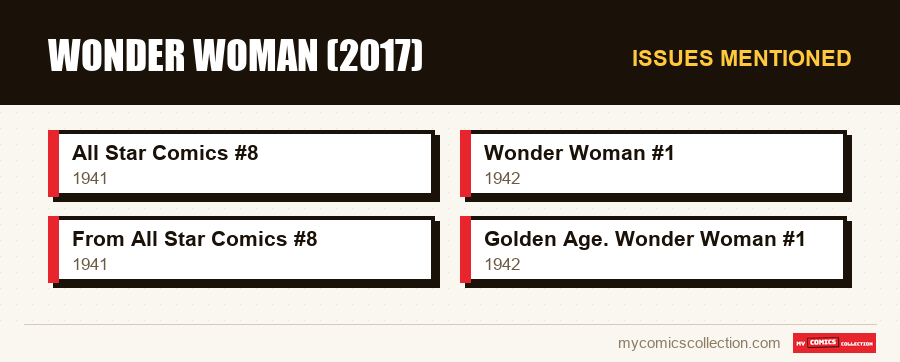
All Star Comics #8 (1941): Wonder Woman's first appearance
Themyscira and the Amazons: the paradise island
Ares: the god of war, enemy of Diana
Steve Trevor: the American pilot, ally of Diana
- Diana, Amazon princess of Themyscira.
- THE Amazons and their hidden island paradise.
- Steve Trevor, the pilot who takes him into the world of men.
- Ares, the god of war, mythological enemy.
- Her equipment: the lasso of truth, the bracelets, the sword.
- The action is transposed during the World War I.
- L'origin of Diana (daughter of Zeus) follows a modern version.
- The plot and human antagonists are original.
- The story condenses the mythology for the format.
- Some details of the pantheon are simplified.
All Star Comics #8 (1941): the birth of Wonder Woman
Wonder Woman appears in All Star Comics #8 (1941), created by psychologist William Moulton Marston and artist Harry G. Peter. Diana, princess of the Amazons, was born on the hidden paradise island of Themyscira, populated only by warrior women descended from Greek myths. When American pilot Steve Trevor crashes on the island, Diana leaves her home to accompany him into the world of men, becoming Wonder Woman, champion of peace, justice and love. Boasting superhuman strength, the lasso of truth, indestructible bracelets, and a deep connection to Greek mythology, she is one of DC's greatest icons and a major feminist symbol since the 1940s.
The film faithfully captures the essence of this myth: Diana, Themyscira, the Amazons, Steve Trevor, the iconic equipment, the fight for peace. Gal Gadot plays a Wonder Woman who is both powerful and imbued with idealism, faithful to the spirit of the character. The film is based on modern rereadings of the origin, in particular that which makes Diana the daughter of Zeus. The main freedom lies in the context: where the original story takes place during the Second World War, the film transposes the action during the First World War, providing a strong historical framework for Diana's discovery of the world of men. This modernization serves the film's scope on war and humanity.
Themyscira, the Amazons and the origin of Diana
The film devotes its opening to Themyscira and the Amazons, faithful to the mythology of the character. The paradise island, hidden from the world of men, is home to a society of warrior women, guardians of a divine heritage and dedicated to protecting humanity from Ares, the god of war. Diana grew up there, trained in combat despite the reluctance of her mother, Queen Hippolyte. This Amazon origin, anchored in Greek mythology, is at the heart of Wonder Woman's identity. The film brings her to the screen with breadth, offering a luminous and utopian counterpoint to the war-ravaged world of men that Diana will discover.
The film follows a modern version of Diana's origin, presenting her as the daughter of Zeus, a retelling introduced in contemporary comics. This divine filiation reinforces its mythological dimension and its role in the fight against Ares. The film, however, simplifies certain details of the Greek pantheon for the clarity of the story. This immersion in Themyscira and Amazon mythology is one of the film's great successes, anchoring the character in his rich heritage. For the reader, it is an invitation to discover the mythology of Wonder Woman in the comics, where Themyscira, the Amazons and the Greek gods nourish stories of remarkable depth and richness, mixing superheroism and ancient mythology.
Ares and the fight for humanity
The film pits Diana against Ares, the god of war, her mythological enemy in the comics. Ares embodies the violence and hatred that corrupts humanity, and Diana, champion of peace, is destined to confront it. The film takes up this fundamental opposition, situating it during the First World War, a conflict which perfectly embodies the war madness against which Wonder Woman fights. Diana, convinced that Ares is responsible for the war, sets out to defeat him to free humanity from his influence. This quest, faithful to the spirit of the character, structures the story and gives it its mythological dimension.
The film explores a central theme of Wonder Woman: the nature of humanity, capable of the worst as well as the best. As Diana discovers the horrors of war, she must confront a complex truth: evil comes not only from Ares, but also from the hearts of men. This reflection on violence, redemption and hope, faithful to the humanist spirit of the character, gives the film its depth. Wonder Woman is not a warrior thirsty for battle, but a champion of love and compassion, who chooses to believe in humanity despite its darkness. For the reader, this dimension reminds us of what makes the character great: an ideal of peace and justice, forcefully embodied by the film.
Collecting this series?
Track what you own, what you are missing and what your collection is worth. 7 day trial.
Start my trial →The characters, from paper to screen
- Diana/Wonder Woman: Amazon Princess Champion of Peace, faithful to All Star Comics #8.
- Steve Trevor: American pilot who takes Diana into the world of men, faithful to her role.
- Ares: The god of war, mythological enemy of Diana.
- Hippolyte: Queen of the Amazons and mother of Diana.
- The Amazons: The warrior women of Themyscira, guardians of humanity.
A milestone for cinema heroines
Wonder Woman occupies a special place in the history of superhero cinema: it is the first major successful film dedicated to a superheroine, directed by a woman, Patty Jenkins. This long-awaited milestone marked an important step in the representation of heroines on screen. By proving that a film starring a superheroine could achieve immense critical and commercial success, Wonder Woman paved the way for greater diversity in the genre. This historical dimension, added to the quality of the film, has made it a symbol of emancipation, in line with the character's feminist heritage since 1941.
This symbolic significance is faithful to the essence of Wonder Woman, conceived from the outset as a model of female empowerment by William Moulton Marston. By portraying a powerful, idealistic and humane heroine, the film honors this heritage. Diana is not defined by a man or by a secondary role, but by her values and her fight. For the reader, the film is an invitation to discover the rich history of Wonder Woman in the comics, where the character has carried progressive ideals for more than seven decades. By bringing this icon to the screen with strength and fidelity, Wonder Woman recalls the importance of a character who has always embodied peace, justice and equality.
The success that relaunched DC
Wonder Woman marked a turning point for the DC Cinematic Universe. After several films with a dark tone and divisive reception, he gave the studio its first major unanimous critical success, proving that a more luminous and sincere approach could work. The film, carried by the idealism of the character and the inspired direction of Patty Jenkins, restored confidence in DC's ability to bring its heroes to the screen. This triumph had a lasting impact, influencing the direction of the saga and demonstrating the appeal of a more optimistic tone, true to the heroic spirit of the comics.
This success illustrates the importance of remaining true to the essence of a character. Wonder Woman, conceived from the outset as a figure of hope, peace and equality, did not lend itself well to cynical treatment. By embracing his idealism and his humanist dimension, the film captured what makes him great. For the reader, this success is an invitation to discover the rich history of the Amazon in comics, where it has carried progressive values for more than seven decades. Wonder Woman served as a reminder that DC heroes shine brightest when they embody hope and nobility, not just darkness. This film will remain as a milestone, both for the representation of heroines and for the rebirth of the DC universe.
Where to start reading
To extend the film, All Star Comics #8 (1941) features the first appearance of Wonder Woman. “Wonder Woman: Gods and Mortals” (1987) by George Pérez modernizes its origins and mythology. “Wonder Woman: The Hiketeia” (2002) and recent runs explore the character in depth. This journey covers the sources of a film faithful to the spirit of the Amazon.
Chronology of comics to know
- 1941: All Star Comics #8: Wonder Woman's first appearance.
- 1987: “Wonder Woman: Gods and Mortals” (George Pérez): the modern rereading.
- Years 2000-2010: Recent runs delve deeper into the character and his mythology.
Collection side: what numbers to aim for after the film
Wonder Woman points to major keys. All Star Comics #8 (1941, first appearance of Wonder Woman) is a highly sought-after and valuable Golden Age grail. Wonder Woman #1 (1942) is another essential key to the character. George Pérez's run (1987) offers more accessible targets to discover the modern version. These numbers cover budgets ranging from inaccessible to reasonable. As always, condition and gradation determine value; relying on real recent sales is strongly recommended.
Its place in the saga and for the collector
Wonder Woman brought one of DC's greatest icons to the screen, marking a milestone for female heroes in cinema. For the collector, it magnified the aura of All Star Comics #8, holy grail of the Golden Age. It illustrates the effect of adaptations on the market. Beyond speculation, the film invites you to discover the rich mythology of Wonder Woman in the comics, from the founding story of 1941 to modern rereadings. By playing a powerful and idealistic heroine, faithful to her feminist heritage, he honors a character who has always embodied peace and justice.
The verdict: a faithful and iconic Amazon
- Loyalty: Diana, Themyscira, the Amazons, Steve Trevor, Ares and the iconic equipment come from the comics.
- Freedoms: action during World War I, modern origin (daughter of Zeus), original human antagonists, condensed mythology.
- Collectible numbers: All Star Comics #8 (Wonder Woman), Wonder Woman #1 (1942), George Pérez's run.
Wonder Woman brings DC's Amazon to the screen with fidelity to her heroic and humanist spirit, transposing her origins during the First World War. Faithful to Themyscira, the Amazons and Ares, the film modernizes the context and marks a milestone for heroines in cinema. For the reader as well as the collector, it is an invitation to discover All Star Comics #8.
Frequently asked questions
From All Star Comics #8 (1941), created by William Moulton Marston and Harry G. Peter. Amazon princess of Themyscira, Diana becomes Wonder Woman, champion of peace and justice. The film faithfully reproduces its origin and its spirit.
It is a transposition of the film: in the original comics, the action takes place during the Second World War. The film chooses the First to provide a strong historical framework for the discovery of the world of men and reflection on war.
The Greek god of war, mythological enemy of Wonder Woman in the comics. He embodies the violence and hatred that corrupts humanity. Diana, champion of peace, is destined to confront him, an opposition faithfully taken up by the film.
The film follows a modern rereading of the comics making Diana the daughter of Zeus, which reinforces her divine dimension. In the classic version, she was shaped from clay and animated by the gods. The two origins coexist in the character's mythology.
All Star Comics #8 (1941, premiere of Wonder Woman) is a holy grail of the Golden Age. Wonder Woman #1 (1942) is another major key. George Pérez's run (1987) is an accessible modern target.
Does the film make you want to collect? Estimate the value for free of your issues (All Star Comics #8…) with our tool based on current eBay listings.