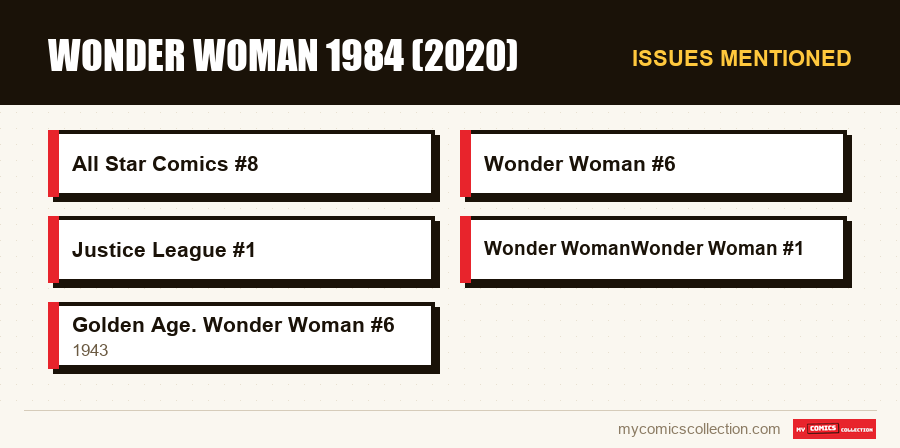
Wonder Woman 1984 (2020) Patty Jenkins , with Gal Gadot, continues the adventures of the Amazon (All Star Comics #8, 1941) in the 1980s, facing Cheetah (Wonder Woman #6, 1943) and Maxwell Lord (Justice League #1, 1987). The film takes up these emblematic enemies and Diana's idealism, but invents a plot around a wishing stone. Here is the detailed comparison, film versus comics.
A highly anticipated sequel to the 2017 hit, Wonder Woman 1984 transports the Amazon to 1980s America. It draws on the character's gallery of enemies. Source-by-source decryption.
As in each article in this series, only verified information (creators, distribution, dates, comic numbers) is stated; the comparative analysis is ours, without reproducing dialogue or protected images.
Title : Wonder Woman 1984 (2020)
Director: Patty Jenkins
Actors: Gal Gadot (Diana), Chris Pine (Steve Trevor), Kristen Wiig (Cheetah), Pedro Pascal (Maxwell Lord)
Exit : December 2020
Studio: Warner Bros.
All Star Comics #8 (1941):Wonder Woman's first appearance
Wonder Woman #6 (1943): Cheetah's first appearance
Justice League #1 (1987): 1st appearance of Maxwell Lord
The Eagle's golden armor: iconic equipment
- Diana and her idealism, champion of the truth.
- Cheetah (Barbara Minerva), the feline enemy.
- Maxwell Lord, the power-hungry manipulator.
- Le lasso of truth and iconic equipment.
- L'golden armor of the Eagle, from the comics.
- The plot (the wishing stone) is original.
- Le return of Steve Trevor is an invented spring.
- Maxwell Lord sees his powers reinvented.
- The tone, more fanciful, evokes the 1980s.
- Some origins are reorganized.
Wonder Woman, champion of truth
Wonder Woman 1984 continues the story of Diana, the Amazon born in All Star Comics #8 (1941), created by William Moulton Marston and Harry G. Peter. The film finds her in the 1980s, now settled in the world of men while continuing her fight for truth and justice. Faithful to the spirit of the character, the film foregrounds his idealism, his compassion and his connection to the truth, embodied by the golden lasso which compels anyone not to lie. Gal Gadot returns to the role that established her, carrying the luminous idealism of the Amazon, in contrast to the materialistic and greedy world of the 1980s that the film depicts.
The film anchors its story in the theme of truth, central to Wonder Woman. In an era marked by excess, lies and the frantic quest for desires, Diana defends authenticity and truth against illusions. This moral dimension, faithful to the spirit of the character conceived by Marston as a model of virtue, structures the story. The film also introduces the golden Eagle armor, legendary equipment from the comics, giving Wonder Woman a spectacular appearance. This fidelity to the idealism and iconography of the character places the film in the continuity of the success of 2017, despite a more fanciful plot.
Cheetah, the feline enemy
The film introduces Cheetah, one of Wonder Woman's greatest enemies. The character first appears in Wonder Woman #6 (1943) in the guise of Priscilla Rich, before the modern version, Barbara Minerva, was created in the 1980s. The film adapts this version: Barbara Minerva, a self-effacing and self-conscious scientist, envious of Diana, who wishes to be like her before transforming, through a wish, into a formidable feline creature. Kristen Wiig embodies this trajectory, from shy woman to predator, faithful to the tragic dimension of the character, whose metamorphosis is born from a desire for power and recognition.
This rereading of Cheetah preserves the essence of the character: envy, the transformation into a feline creature, the opposition to Diana. Barbara Minerva, in the comics and in the film, embodies the dark side of desire, a counterpoint to the idealism of Wonder Woman. The film exploits this duality, making Cheetah the reverse reflection of Diana: where the Amazon defends truth and altruism, Barbara succumbs to envy and selfishness. This thematic opposition enriches the story. For the reader, Cheetah is an invitation to discover Wonder Woman's gallery of enemies in the comics, where this feline rival occupies a special place, embodying the temptations and flaws that the Amazon, champion of virtue, must face.
Maxwell Lord and the theme of desire
The film also pits Diana against Maxwell Lord, who appeared in Justice League #1 (1987). In the comics, Lord is a manipulative businessman with mind control powers whose machinations have marked the DC Universe. The film reinvents him as a power-hungry crook who seizes a magical wish-granting stone, transforming himself into the embodiment of that power. Pedro Pascal embodies this character consumed by ambition and the desire for success, in an America of the 1980s obsessed by materialism. Maxwell Lord becomes the vehicle for the central theme of the film: the way desires, once granted without limit, lead to chaos.
This rereading, if it moves away from the specific character of the comics, retains the nature of an ambitious manipulator. The film uses Maxwell Lord and the Wishing Stone to explore a moral idea: that every desire has a price, and the frantic pursuit of our wishes, without regard for the consequences, corrupts the world. This dimension, specific to the film, resonates with the idealism of Wonder Woman, who advocates truth and acceptance rather than illusion. For the reader, Maxwell Lord is an invitation to discover his version in the comics, where his machinations and his mind control have given rise to significant stories in the DC universe. The film offers a thematic rereading, serving its purpose on desire and truth.
Collecting this series?
Track what you own, what you are missing and what your collection is worth. 7 day trial.
Start my trial →The characters, from paper to screen
- Diana/Wonder Woman: Champion of the truth, faithful to her idealism, in the 1980s.
- Cheetah (Barbara Minerva): Envious scientist transformed into a feline creature, faithful to the modern version of the comics.
- Maxwell Lord: Greedy manipulator, reinvented around the wishing stone.
- Steve Trevor: Back by a magic spring, addition of the film.
- The Eagle's golden armor: Iconic equipment from the comics.
A more fanciful and divisive sequel
Wonder Woman 1984 adopts a more whimsical and colorful tone than its predecessor, in line with the exuberant aesthetic of the 1980s. By introducing a magical wish-granting stone and the improbable return of Steve Trevor, the film takes on a more fantastical and dreamlike dimension, moving away from the historical realism of the first part. This approach, as well as certain scriptwriting choices, divided critics and the public, more mixed than for the 2017 film. The film nevertheless remains carried by the idealism of its heroine and by a moral message on truth and desire, faithful to the spirit of the character.
This divisive reception illustrates the challenges of a highly anticipated sequel. By taking the risk of a more fanciful tone and a plot centered on a magical artifact, the film deviates from the formula that made the first one successful. However, he retains what makes Wonder Woman great: her idealism, her compassion, her faith in humanity. For the reader, Wonder Woman 1984 is an invitation to discover the richness of the character in the comics, where Cheetah and Maxwell Lord are among her notable adversaries. Despite its faults, the film reminds us that the Amazon embodies, above all, an ideal of truth and virtue, the heart of a character conceived as a model since 1941.
A sequel in a particular context
Wonder Woman 1984 was released in an unprecedented context, marked by upheavals in the film industry, which affected its career and its reception. Highly anticipated after the triumph of the first film, it was unable to benefit from the same conditions, and its more mixed reception must be placed in this particular context. The film nonetheless remains an ambitious work, which takes the risk of a more fanciful tone and a moral message based on truth and desire, faithful to the idealism of the character. This audacity, if it was divisive, testifies to a desire not to simply reproduce the formula of the first part.
This contrasting reception does not diminish the public's attachment to Wonder Woman, one of DC's most beloved heroines. The character, driven by idealism and compassion, retains a particular aura, that of a symbol of truth and justice. For the reader, this film is an invitation to discover the richness of the Amazon in the comics, where its ideals and its enemies (Cheetah, Maxwell Lord) nourish stories of great depth. Despite its imperfections, Wonder Woman 1984 recalls what makes the character great: her unwavering faith in humanity and her defense of the truth, timeless values inherited from her creation in 1941 by William Moulton Marston.
Where to start reading
To extend the film, All Star Comics #8 (1941) features Wonder Woman, and Wonder Woman #6 (1943) the first version of Cheetah. George Pérez's "Wonder Woman: Gods and Mortals" (1987) introduces the modern Cheetah (Barbara Minerva). Justice League #1 (1987) features Maxwell Lord. This journey covers the source material for a film rooted in the 1980s.
Chronology of comics to know
- 1941: All Star Comics #8: Wonder Woman's first appearance.
- 1943: Wonder Woman #6: the first appearance of Cheetah (Priscilla Rich).
- 1987: Justice League #1: the first appearance of Maxwell Lord.
Collection side: what numbers to aim for after the film
Wonder Woman 1984 points to varied keys. All Star Comics #8 (1941, premiere of Wonder Woman) is a holy grail of the Golden Age. Wonder Woman #6 (1943, Cheetah premiere) is a sought-after key. Justice League #1 (1987, first by Maxwell Lord) is an accessible modern target. George Pérez's run, which introduced the modern Cheetah, offers other avenues. These numbers cover various budgets. As always, condition and gradation determine value; relying on real recent sales is strongly recommended.
Its place in the saga and for the collector
Wonder Woman 1984 continued the Amazon's adventures in the 1980s, introducing Cheetah and Maxwell Lord, despite mixed reception. For the collector, it reignited interest in Wonder Woman #6 (Cheetah) and Justice League #1 (Maxwell Lord). It illustrates the effect of adaptations on the market. Beyond speculation, the film invites you to discover Wonder Woman's gallery of enemies in the comics. By retaining the idealism of the character despite a more fanciful plot, he reminds us that the Amazon has embodied, since 1941, an ideal of truth and virtue.
The verdict: an idealistic and fanciful sequel
- Loyalty: the idealism of Diana, Cheetah (Barbara Minerva), Maxwell Lord, the lasso of truth and the golden armor come from the comics.
- Freedoms: the wishing stone plot, the return of Steve Trevor, the reimagined powers of Maxwell Lord, the whimsical tone.
- Collectible numbers: All Star Comics #8 (Wonder Woman), Wonder Woman #6 (Cheetah), Justice League #1 (Maxwell Lord).
Wonder Woman 1984 continues the adventures of the Amazon in the 1980s, facing Cheetah and Maxwell Lord, around the theme of desire and truth. Faithful to the idealism of Diana and her iconic enemies but adopting a more fanciful tone, the film was divisive. For both the reader and the collector, it is an invitation to discover Wonder Woman #6 and Justice League #1.
Frequently asked questions
One of Wonder Woman's greatest enemies, first appearing in Wonder Woman #6 (1943). The film adapts the modern version, Barbara Minerva, an envious scientist transformed into a feline creature. Kristen Wiig embodies this tragic trajectory.
A manipulator who appeared in Justice League #1 (1987), a businessman with mind control powers in the comics. The film reinvents him as a greedy conman who grabs a wishing stone, embodying the theme of limitless desire.
It's a spring invented for the film: Steve Trevor, who died in the first part, returns through the power of the wishing stone. This improbable return serves the theme of desire and its price, central to the story.
For its more fanciful tone and its plot centered on a magical stone, which depart from the historical realism of the first film. It does, however, retain Wonder Woman's idealism and a moral message about truth and desire.
All Star Comics #8 (1941, Wonder Woman) is a holy grail of the Golden Age. Wonder Woman #6 (1943, Cheetah) is a sought-after key, and Justice League #1 (1987, Maxwell Lord) an accessible modern target.
Does the film make you want to collect? Estimate the value for free of your issues (All Star Comics #8, Wonder Woman #6…) with our tool based on current eBay listings.