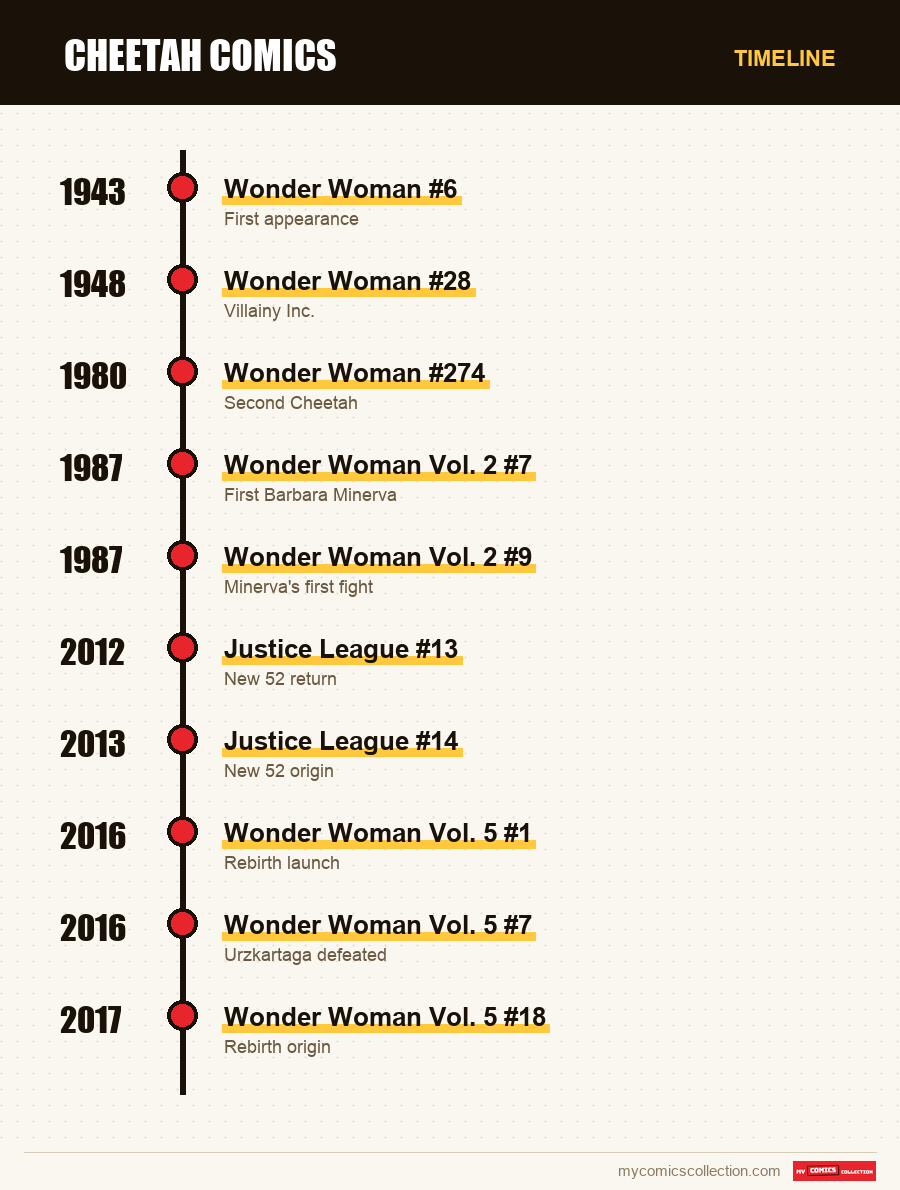
Cheetah first appears in Wonder Woman #6 (Fall 1943), created by William Moulton Marston and H.G. Peter as socialite Priscilla Rich. Three different women will then wear the costume: Deborah Domaine in 1980, then especially Barbara Ann Minerva, appeared in Wonder Woman vol. 2 #7 (August 1987) under the pen of Len Wein and the pencil of George Pérez, which remains the reference version today: the one embodied by Kristen Wiig in Wonder Woman 1984. The founding comic from 1943 is a rare Golden Age piece, with a CGC census of barely 75 to 80 copies listed across all gradations.
There are few DC villains who embody the notion of the reverse mirror of the hero as well as Cheetah. Where Wonder Woman is diplomatic, generous and driven by compassion, Cheetah is jealousy, appetite and predatory instinct. It's no coincidence that several comic book historians call her "Diana Prince's Joker": she is not only a physical threat, she is the toxic version of everything Wonder Woman refuses to become.
This duality explains why the character has survived eighty years of chaotic continuity, dozens of editorial reboots, and countless secret identity changes: without ever losing his place as the Amazon's number one nemesis. For a collector, Cheetah poses an interesting textbook case: unlike many forgotten Golden Age villains, each of its major reappearances (1980, 1987, 2011, 2016, 2020) has generated its own peak of interest on the second-hand market.
In this file, we retrace the complete editorial history of the character: his three main incarnations, the arcs that mattered, and what this means in concrete terms when we seek to understand the value of an issue bearing his name.
Priscilla Rich, the first Cheetah of the Golden Age era (1943)
Cheetah is born in Wonder Woman #6, cover-dated Fall 1943 and created by William Moulton Marston (creator of Wonder Woman) and illustrator H.G. Peter. At that time, the series was not even a year old and Marston was already looking for an antagonist capable of physically competing with his heroine: something rare at the time, when most villains in superhero comics were male.
The first Cheetah is called Priscilla Rich, a wealthy New York socialite consumed by an inferiority complex and what the script of the time describes as a personality split in two. The trigger is almost Freudian Golden Age theater: during a charity event, Priscilla finds herself totally eclipsed by Wonder Woman, then fails to discreetly assassinate her during an escape act that she organizes herself. Consumed by humiliation, she takes refuge in her room, collapses in front of her makeup mirror and sees the reflection of a woman dressed as a cheetah appear, who orders her to make a costume from a cheetah skin rug lying around her mansion. Priscilla's second personality (cruel, athletic, with sharp claws capable of cutting steel) then takes over.
In terms of powers, this first Cheetah remains anchored in the Golden Age register: no supernatural superpower, but an Olympic physical condition, a mastery of close combat and acrobatics, and claws as a signature weapon: a visual gimmick which will become the trademark of the character for the following eighty years, whatever the identity behind the mask.
Priscilla Rich then had several notable confrontations with Wonder Woman during the 1940s: she trapped her by accusing her of a theft she did not commit, kidnapped a young girl with psychic powers named Gail to extort military secrets from her in the middle of the Second World War, then stole Hippolyte's magic belt during a competition on Paradise Island: a crucial object since it determines the strength of Wonder Woman herself. She finally joins the group of villains Villainy Inc., which appeared in Wonder Woman #28 (1948), alongside other recurring antagonists of the series. This original Priscilla Rich would eventually retire from the supervillain life and settle into a mansion in northern Maryland; her trajectory would end tragically after Crisis on Infinite Earths, when she was killed by the later version of the character, Barbara Minerva.
Deborah Domaine: The Transitional Cheetah (1980)
Between the original Priscilla Rich and the version that would definitively establish itself, DC introduced a second Cheetah in Wonder Woman #274, published in December 1980. It is Deborah Domaine, introduced as the niece of Priscilla Rich. The plot twist is notable for the time: Deborah is not an antagonist at the start. She is an environmental activist, sincere ally of Wonder Woman, before agents of the terrorist organization Kobra capture her, torture her and mentally condition her so that she in turn takes on the identity of Cheetah.
This iteration remains short in continuity. Deborah appeared alongside the Secret Society of Super-Villains, but her run was interrupted by the major editorial cleanup of Crisis on Infinite Earths in 1985-1986, then definitively abandoned after the New 52 relaunch of 2011. For a collector, Wonder Woman #274 remains a niche piece: it has real historical value as the first appearance of Deborah Domaine, but it never achieved the notoriety or demand of the other two milestones in the lineage Cheetah.
Barbara Ann Minerva: the modern Cheetah and its archaeological origin (1987)
The character's definitive turning point came with the relaunch of Wonder Woman by George Pérez in 1987, in the wake of Crisis on Infinite Earths. In Wonder Woman vol. 2 #7 (August 1987), scripted by Len Wein with Pérez drawing (inking by Bruce Patterson, colors by Tatjana Wood), DC introduced Dr. Barbara Ann Minerva, a British archaeologist and heiress from Nottinghamshire.
This version breaks radically with the Freudian psychology of the 1940s: Minerva is not a jealous worldly rival, but an intellectual obsessed with scientific proof of the existence of ancient deities. During an expedition to Africa in search of a mythical guardian tribe linked to the cheetah, she undergoes a transformation ritual involving a potion made from human blood and berries and leaves from the plant god Urzkartaga. The price to pay is an almost matrimonial pact with this plant divinity: Minerva literally becomes the wife of Urzkartaga, condemned to a painful transformation into human form but to bloodthirsty euphoria in her cheetah form.
In terms of abilities, this Cheetah radically changes scale compared to its predecessors: superhuman strength, agility and speed described by some screenwriters as almost limitless, claws capable of cutting Kryptonian skin: therefore of injuring Superman himself -, and a bite capable of transmitting Cheetah's curse to other characters. The character also retains the intelligence of her alter ego: two doctorates, fifteen spoken languages, an erudition which clearly distinguishes her from the thick brutes of the classic supervillain bestiary. The counterpart remains dark: Minerva constantly fights against a cannibalistic impulse and a thirst for blood which almost brings her closer to a Gothic horror figure more than a simple costumed rival.
The character then goes through several major editorial rereadings. During the arc One Year Later (2006), the magician Circe offers her the ability to voluntarily control her transformations while retaining her Cheetah physiology, and she even gains the ability to command three real cheetahs. With the relaunch New 52 in 2011 (Justice League #13-14, 2012-2013, written by Geoff Johns and drawn by Tony S. Daniel), its origin is completely rewritten: Minerva becomes possessed by the “Goddess of the Hunt” after having cut herself with an Amazon dagger, linking her powers to an ancestral tradition of the Sun tribe which had been transmitted from host to host for centuries. Then, in the era DC Rebirth (as of 2016), continuity returns to a version closer to the 1987 origin: Minerva discovers archaeological proof of the existence of the Amazons during an excavation in Ukraine, finances an African expedition thanks to the industrialist Veronica Cale, in reality in the service of the sons of Ares, and finds herself unable to escape her "marriage" to Urzkartaga despite Wonder Woman's attempts to prevent her.
Sebastian Ballesteros, the only male Cheetah
Little-known detail of the character's mythology: during the post-One Year Later, a man briefly held the title Cheetah. Sebastian Ballesteros, Argentine tycoon and agent (as well as lover) of Circe, convinces Urzkartaga that the previous Cheetahs have failed in their mission and temporarily gains the powers of the plant god, depriving Minerva of her transformation. The episode remains anecdotal in overall continuity but illustrates the mythological flexibility that the writers have built around Urzkartaga over the decades: Barbara will eventually regain the upper hand and recover her powers after briefly hosting the force of a Fury, Tisiphone.
The impact of adaptations on the rating
Cheetah has long been absent from the big screen: a shame for the sworn enemy of one of the three founding icons of DC alongside Superman and Batman. This absence changed in 2020 with Wonder Woman 1984, directed by Patty Jenkins, in which Kristen Wiig plays Barbara Minerva. The film freely adapts the genesis of the character: Minerva is first a self-effacing and mistreated colleague of Diana Prince, before a magical artifact, the Dreamstone, grants her her wish to be "like Diana", triggering a progressive transformation towards arrogance, superpower and, ultimately, the bloodthirstiness characteristic of the character in the comics.
This type of cinematic exposure has a measurable and recurring effect on the golden age and bronze age comic book market: each release of a film dedicated to a villain previously confidential to the general public generates renewed research and attention for his first appearances in comics. We've seen it with other DC and Marvel antagonists brought to screen for the first time. For Cheetah, the two milestones naturally involved are Wonder Woman #6 (1943, Priscilla Rich) and Wonder Woman vol. 2 #7 (1987, Barbara Minerva): the latter explicitly being the version adapted by Kristen Wiig. The high-end grading market has also benefited from this: recently certified PSA 9.8 copies of Wonder Woman #7 (1987) continue to circulate among collectors specializing in Wonder Woman villains, a sign that the demand for almost new copies of this “first appearance of Minerva” remains active several years after the film's release.
Beyond cinema, Cheetah has enjoyed an almost uninterrupted presence in animation and video games since the 1970s, which partly explains her disproportionate notoriety compared to other golden age villains who have fallen into oblivion: she appears in Super Friends (in the guise of Priscilla Rich), in the DC animated universe of the 1990s-2000s (Barbara Minerva, voiced by Sheryl Lee Ralph, integrated to Lex Luthor's Injustice Gang then to Grodd's Secret Society), in Batman: The Brave and the Bold (Priscilla Rich, voiced by Morena Baccarin), in the two versions of DC Super Hero Girls (2015 then 2019), in Harley Quinn and Kite Man: Hell Yeah!, as well as in several DC animated feature films where she appears within the Legion of Evil or Villainy Inc. until her death in Justice League Dark: Apokolips War. On the video game side, she is a notable playable character in Injustice 2 and in several Lego DC titles, which maintains constant recognition among a younger audience, often a gateway to collecting paper comics.
Collecting this series?
Track what you own, what you are missing and what your collection is worth. 7 day trial.
Start my trial →Buying guide: what to check before buying a Cheetah comic
Buying a comic featuring Cheetah, whether from the golden age of the 1940s or a more recent issue, requires a different method depending on the era in question. Here are the essential points to watch out for:
- Identify the correct “first appearance”. There are three distinct first appearances that should not be confused: Wonder Woman #6 (1943, Priscilla Rich), Wonder Woman #274 (1980, Deborah Domaine), and Wonder Woman vol. 2 #7 (1987, Barbara Ann Minerva). A sloppy seller may describe an issue as "1st Cheetah" without specifying that it is actually a reappearance or secondary version of the character.
- Check restoration on golden age numbers. Wonder Woman #6 dates from 1943: at this level of age, restoration (cover retouching, spine repair, page replacement) is frequent and must be explicitly declared on the CGC or CBCS label. An “Apparent” copy with light restoration sells for significantly less than an unrestored universal copy at the same level of visual preservation.
- Compare censuses before bidding. The CGC census for Wonder Woman #6 lists approximately 75 to 80 graded copies of all grades: a very low volume which justifies significant price differences between an average grade and a high-end copy. Before purchasing, check the number of examples graded in the grade that interests you and in higher grades: this indicates the relative rarity of your future piece.
- Don't neglect the interior pages. On a golden age like Wonder Woman #6, the color of the pages (white, cream to white, or yellowed) strongly influences the value, sometimes more than the numerical rating itself at equivalent grade.
- Favor Wonder Woman vol. 2 #7 for a more accessible budget. If the golden age of 1943 is beyond your budget, the first appearance of Barbara Minerva (1987) remains the most recognizable version of the character: that of the film Wonder Woman 1984 - and is circulating at much more affordable prices, including in very high conservation.
- Be wary of exaggerated “key issues”. Many later issues featuring Cheetah are sold as "key issue" even though they are neither a first appearance nor a major plot turning point (change of origin, death, definitive transformation). Always check what the issue actually adds to the character's continuity before paying a premium.
- Use actual sales data rather than a fixed list price. Overstreet values evolve slowly from one edition to another, while the second-hand market reacts in real time to the release of films, series or video games. Cross-referencing several recent sales remains the most reliable method.
To quickly estimate the value of an item you own or are considering purchasing, the free estimate of the site calculates a low, median and high range based on the most current eBay listings for the series, number and condition entered. And if you already manage several issues related to Wonder Woman and her villains, the collection management application allows you to centralize your copies, track their rating over time and organize your collection by character or narrative arc.
Key issues to know
Wonder Woman #6
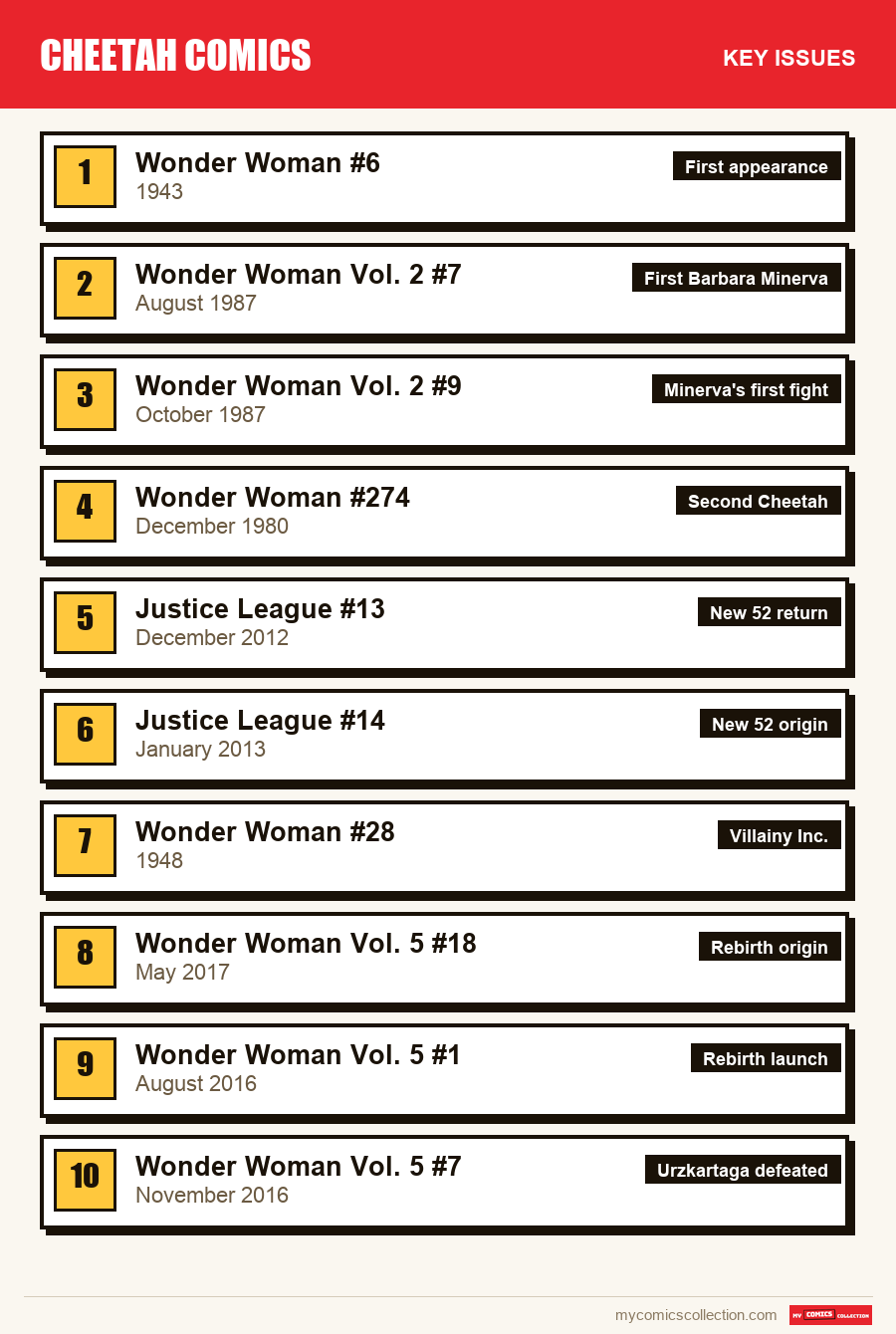
Cover-dated Fall 1943, this issue written by William Moulton Marston and drawn by Harry G. Peter introduces the first Cheetah, socialite Priscilla Rich, in "Wonder Woman and the Cheetah". It marks the birth of the Amazon's great rival and is a Golden Age book that is hard to find in good condition.
Wonder Woman Vol. 2 #7
In the post-Crisis relaunch, Len Wein and George Pérez, with inks by Bruce Patterson, introduce Dr. Barbara Ann Minerva, a British archaeologist willing to do anything to get her hands on Wonder Woman's lasso. She has been the definitive Cheetah ever since, the version Kristen Wiig plays in Wonder Woman 1984.
Wonder Woman Vol. 2 #9
In "Blood of the Cheetah", Wein and Pérez show Barbara Minerva performing the ritual that turns her into the Cheetah, then hunting Wonder Woman. The lasso has already forced her to admit her intentions, and the fight only ends when Julia Kapatelis shoots the creature. It is the first real clash between the two women.
Wonder Woman #274
Gerry Conway, José Delbo and Dave Hunt introduce Deborah Domaine, an environmental activist and the niece of Priscilla Rich, who dies in this very issue. Kidnapped by Kobra, Debbi is brainwashed into becoming the second Cheetah. The issue therefore covers both the end of the first Cheetah and the origin of the next.
Justice League #13
Geoff Johns and Tony S. Daniel open "The Secret of the Cheetah": Wonder Woman confronts the Cheetah in Central Park, and we learn that Barbara Minerva was her first friend in Man's World. Her bite even turns Superman into a cheetah-man. It is the first major story of the New 52 Cheetah.
Justice League #14
Johns and Daniel's follow-up reveals the character's new origin: a tribe in the Congo has hosted the spirit of the Goddess of the Hunt for centuries, and an ancient knife, the Godslayer, made Barbara Minerva its host. The League also learns that "Barbara Minerva" is only an alias.
Wonder Woman #28
In "Villainy, Incorporated", again by Marston and Peter, Priscilla Rich joins six other Wonder Woman foes around Eviless to form Villainy Inc. It is one of the very first supervillain teams in comics history.
Wonder Woman Vol. 5 #18
Part two of Godwatch, by Greg Rucka and Bilquis Evely: Barbara Minerva sets off on an expedition in search of the god Urzkartaga, secretly funded by Veronica Cale, despite Diana's warnings. Here the DC Rebirth era retells her origin, leading to her forced "marriage" to the plant god.
Wonder Woman Vol. 5 #1
Greg Rucka and Liam Sharp open The Lies arc with Wonder Woman crossing the jungle in search of the Cheetah, hoping she will help her find her way back to Themyscira. This first issue puts the bond between the two women at the heart of the Rebirth series.
Wonder Woman Vol. 5 #7
In this chapter of The Lies, Wonder Woman and the Cheetah face Urzkartaga, who promises his "bride" her freedom if she kills Diana. Barbara resists, and the lasso, held by the women the god kept captive, lets them banish him. Freed, Barbara regains her human form in the following issues.