
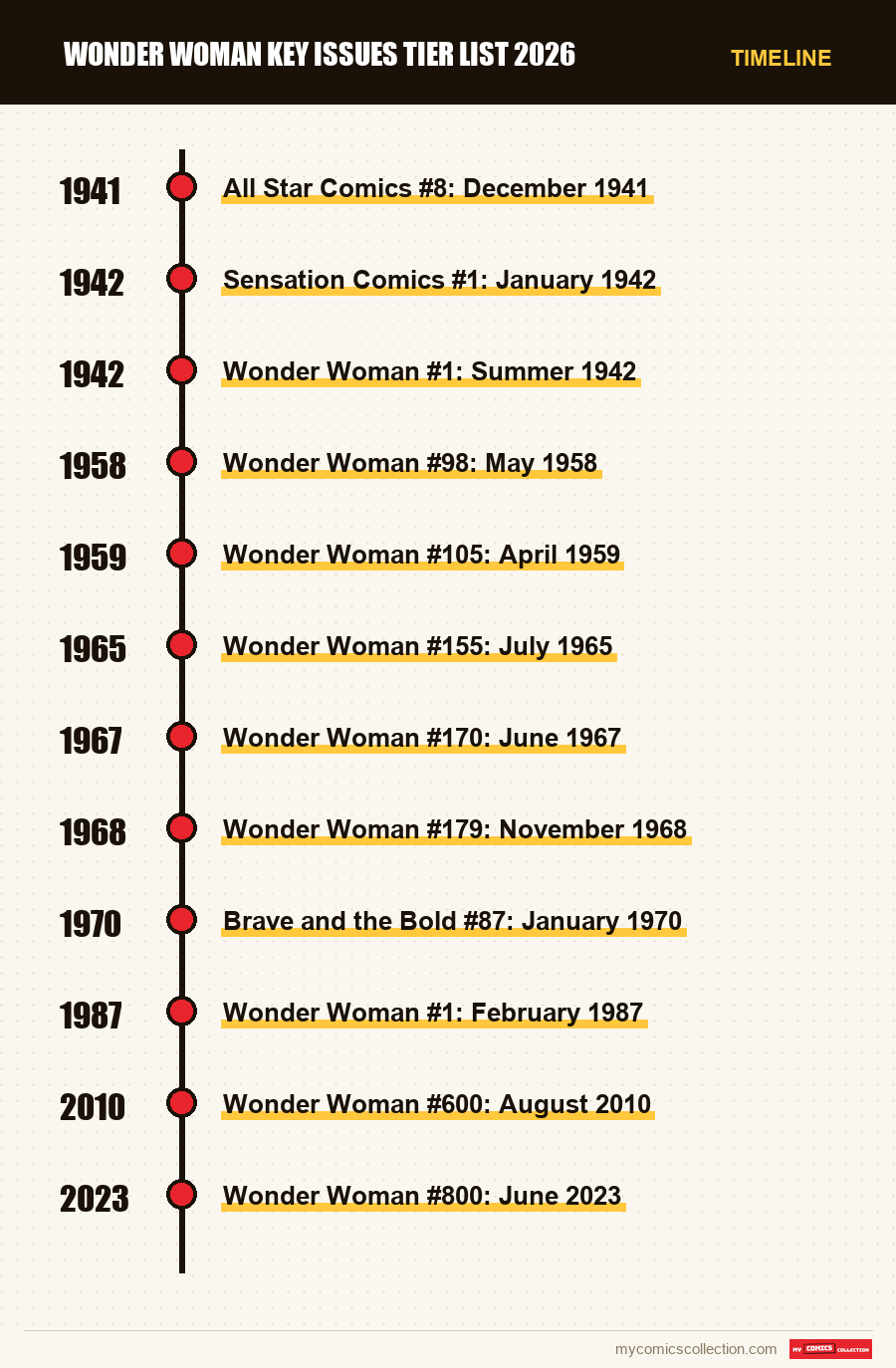
The 2026 tier list of Wonder Woman key issues prioritizes the numbers by valuation potential and historical importance. Tier S blue-chip: All Star Comics #8 (December 1941, first Wonder Woman appearance by William Moulton Marston and Harry G. Peter), Sensation Comics #1 (January 1942, first solo cover), Wonder Woman #1 (summer 1942, launch of own series), Wonder Woman #105 (April 1959, first Silver Age Wonder Girl). Tier A: Wonder Woman #98 (May 1958, start of the Silver Age under Robert Kanigher), Wonder Woman #179 (November 1968, mod era Mike Sekowsky), Wonder Woman #1 (February 1987, George Pérez post-Crisis relaunch), Wonder Woman #600 (August 2010, run J. Michael Straczynski). Tier B sleepers: Wonder Woman #155 (July 1965, Diana Prince ID arc), Brave and the Bold #87 (January 1970, Neal Adams cover), Wonder Woman #170 (June 1967, end of the Golden Age editorial era), Wonder Woman #800 (June 2023, Yara Flor Wonder Girl). Tier C paris 2026-2027: HBO DCU Paradise Lost spinoffs, Wonder Woman 1984 lingering halo.
Building a cohesive Wonder Woman collection in 2026 requires special discipline. The franchise is one of the oldest at DC Comics, spanning eight decades of editorial continuity, digital relaunches and cosmetic reboots, with a catalog where four different issues entitled Wonder Woman #1 and several parallel series coexist (Wonder Woman, Sensation Comics, All Star Comics, Comic Cavalcade). Without rigorous prioritization, the collector disperses his budget on reprints or minor relaunches while the Golden Age blue-chips continue to appreciate out of reach.
Ce guide tier list Wonder Woman 2026 classifies major key issues into four tiers (S, A, B, C) according to three weighting axes: narrative historical importance, documented market performance over five rolling years and probability of DCU James Gunn catalyst in the 2026-2030 window. Each issue is documented with exact publication date, creative team and price range by CGC grade. The objective: to allow the French-speaking collector to build a budgeted purchasing strategy, without wasting a euro on the pitfalls specific to the Wonder Woman catalog (confusion between All Star Comics #8 and Sensation #1 as first appearance, multiplicity of Wonder Woman #1, misleading DC Special reprints).
Wonder Woman 2026 tier list methodology
A useful tier list does not simply align the numbers in order of eBay rating: it prioritizes according to a coherent investment and collection thesis. For Wonder Woman in 2026, three methodological axes structure the classification and reflect the specificity of the franchise.
Tier S/A/B/C classification criteria
- Narrative historical significance (40%): first structuring appearances (Diana Prince, Wonder Girl, Cheetah, Circe), founding events (Marston origin, Pérez relaunch 1987, Rucka run 2003-2006), canonical runs cited by academic criticism and university bibliographies.
- Market performance 5 years (35%): CGC price trend documented on GoCollect, Heritage Auctions, ComicConnect between 2021 and 2026. The Wonder Woman franchise experienced a massive re-rating post-Wonder Woman (Patty Jenkins, 2017) then a stabilization after Wonder Woman 1984 (2020).
- Probability of DCU catalyst 2026-2030 (25%): proximity of the character with the James Gunn announcements for the DCU Chapter One Gods and Monsters, presence in the confirmed HBO Paradise Lost project, traction of verifiable rumors on The Cosmic Circus, Murphy's Multiverse and The Direct.
Definition of third parties
- Tier S: blue-chip: central numbers, globally recognized value, no risk of historical downgrading. These are the defensive assets of the collection. If you could only own four Wonder Women, these would be them.
- Tier A: fundamentals: historically critical issues with solid performance but without the absolute status of Tier S. Make up the backbone of a serious collection spanning Silver Age, Bronze Age and Modern Age.
- Tier B: sleepers with conviction: numbers undervalued in view of their significance, with catalyst identified at 12-36 months (HBO Paradise Lost release, Tom King 2023+ run, spin-off secondary characters).
- Tier C: speculative bets: numbers with a strong thesis but dependent on uncertain future events (DCU casting announcements, series project confirmations). Limited budget allocation recommended.
Voluntary out-of-scope
This tier list does not exhaustively classify the Wonder Woman annuals, the DC event crossovers (Crisis on Infinite Earths, Infinite Crisis, Final Crisis) nor the modern post-2015 variants which have lost any lasting speculative premium. For the market for DC Special and Famous First Edition C-26 reprints, see beginner's guide to DC comics before any purchase of issues before 1970 from unverified eBay.
Tier S: the central Wonder Woman blue-chips
Four issues absolutely dominate the Wonder Woman catalog and constitute the defensive core of any serious collection. They combine absolute rarity in high grade, indisputable historical importance and maximum liquidity on major auction markets (Heritage Auctions, ComicConnect, ComicLink). These are the central assets to be prioritized, even if it means extending the acquisition time.
All Star Comics #8: December 1941 (William Moulton Marston / Harry G. Peter)
The absolute founding number. Published by All-American Publications (a group affiliated with National Periodical, future DC Comics) in December 1941, All Star Comics #8 contains a nine-page back-up story titled Introducing Wonder Woman, written by William Moulton Marston under the pseudonym Charles Moulton and drawn by Harry G. Peter. This introductory story introduces Diana, Amazon princess of Themyscira, who rescues pilot Steve Trevor stranded on the island and decides to accompany him into the outside world to fight the Axis. The issue's cover is dedicated to the Justice Society of America and does not show Wonder Woman: which in no way detracts from the character's status as the character's canonical first appearance.
- CGC 9.0: public sales 2024-2026 between €1,200,000 and €1,800,000. Census CGC 9.0 less than 5 known copies.
- CGC 7.0: €280,000 to €420,000. Median grade of institutional collectors.
- CGC 6.0: €150,000 to €220,000.
- CGC 4.0: €55,000 to €85,000. Entry point for serious collecting.
- CGC 2.0: €18,000 to €28,000. The minimum acceptable to preserve blue-chip status.
- CGC 1.0 / 1.5: €9,000 to €15,000.
5-year trend: +240% between 2021 and 2026 in CGC 4.0, with a post-Wonder Woman (2017) acceleration which has never reversed. No market correction greater than 15% documented in 36-month rolling windows since 2015. It is the most expensive issue of the franchise and one of DC Comics' most expensive, just behind Action Comics #1 (1938) and Detective Comics #27 (1939). L'investment strategy analysis 2027 recalls that this is a museum quality asset, comparable to the Golden Age Marvel Comics #1 blue-chips.
Sensation Comics #1: January 1942 (William Moulton Marston / Harry G. Peter)
The first Wonder Woman solo cover. Published by All-American Publications in January 1942 (barely a month after All Star Comics #8), Sensation Comics #1 inaugurated the first regular series featuring Wonder Woman as a cover star. Marston and Peter pick up the origin and expand on the arc of Diana's arrival in Washington, where she adopts the identity of Diana Prince to stay close to the injured Steve Trevor. The issue also contains Wildcat back-up story (Ted Grant). Sensation Comics is paradoxically often confused with All Star #8 by first-time buyers: it is the first cover, not the first appearance.
- CGC 9.0: €380,000 to €550,000. Census limited to less than 10 copies.
- CGC 7.0: €95,000 to €145,000.
- CGC 6.0: €55,000 to €80,000.
- CGC 4.0: €22,000 to €34,000.
- CGC 2.0: €8,500 to €13,000.
- CGC 1.0 / 1.5: €4,500 to €7,500.
5-year trend: +180% in CGC 4.0, with a recent plateau which could represent a tactical entry window for institutional budgets. The issue remains the obligatory second pillar of any ambitious Wonder Woman collection and systematically appears in the blue-chip DC Golden Age rankings published by Overstreet and CGC Census.
Wonder Woman #1: Summer 1942 (William Moulton Marston / Harry G. Peter)
The launch of the own series. Published summer 1942 (cover dated Summer 1942, effective release May-June), Wonder Woman #1 inaugurates the regular solo title which will remain in continuous publication until 1986 then will be relaunched several times. Marston and Peter detail Diana's extended origin on Themyscira, introduce Hippolyta to her queen mother (see story of Hippolyta in comics) and establish the complete Amazon mythology. The issue contains four distinct stories forming a true origin arc of sixty-four pages.
- CGC 9.0: €320,000 to €480,000.
- CGC 7.0: €78,000 to €120,000.
- CGC 6.0: €45,000 to €68,000.
- CGC 4.0: €18,000 to €28,000.
- CGC 2.0: €6,500 to €10,500.
- CGC 1.5: €3,800 to €5,800.
5-year trend: +160% in CGC 6.0. The triptych of All Star Comics #8, Sensation #1 and Wonder Woman #1 constitutes the Marston holy trinity: having all three in decent grade (4.0 minimum) places a collection at the global institutional level. For detailed trade-offs between the three, see in-depth guide to key Wonder Woman issues.
Wonder Woman #105: April 1959 (Robert Kanigher / Ross Andru)
First Silver Age appearance of Wonder Girl. Published April 1959 by Robert Kanigher (screenplay) and Ross Andru (art, inking Mike Esposito), Wonder Woman #105 introduced the Silver Age version of Wonder Girl, initially presented as teenage Diana and later retconned as Donna Troy, Diana's adoptive sister or mystical companion. The character will become founder of the Teen Titans (first title 1964) then central pivot of The New Teen Titans (1980+) by Marv Wolfman and George Pérez.
- CGC 9.4: €28,000 to €42,000. Census limited to less than 15 copies.
- GCC 9.2: €12,500 to €18,500.
- CGC 9.0: €6,800 to €10,200.
- CGC 8.0: €2,800 to €4,200.
- CGC 7.0: €1,500 to €2,300.
- CGC 6.0: €850 to €1,250.
5-year trend: +320% in CGC 8.0 between 2021 and 2024, followed by stabilization post-speculation Teen Titans HBO Max. The current window is neutral: no urgency to buy, no signal to sell. Any confirmed Donna Troy live action project would trigger a new bullish wave. The issue also remains relevant for the follow-up of the heirs of the legacy Wonder Woman, see the comparable approach for Superman on Superboy/Superman.
Tier A: solid Wonder Woman fundamentals
Tier A brings together the issues that form the backbone of a serious Wonder Woman collection. They combine documented narrative importance and continued market performance, without achieving absolute Tier S monument status. The budgetary weighting rule suggests that they represent 35 to 45% of the Silver/Bronze Age oriented collector's total allocation, and their acquisition signals the transition from a beginner collection to a structured collection.
Wonder Woman #98: May 1958 (Robert Kanigher / Ross Andru)
Beginning of the Silver Age Wonder Woman. Published in May 1958, Wonder Woman #98 marked the arrival of creative team Robert Kanigher (story), Ross Andru and Mike Esposito (art) who defined the character's Silver Age aesthetic for the following decade. The issue introduces a new origin story, transforming the Marston-Peter mythology into a version compatible with post-1954 Comics Code Authority codes. It's the functional equivalent to Wonder Woman of what Showcase #4 (1956) is to The Flash: the official Silver Age reboot.
- CGC 9.4: €14,500 to €22,000.
- GCC 9.2: €6,500 to €9,800.
- CGC 9.0: €3,200 to €4,800.
- CGC 8.0: €1,400 to €2,100.
- CGC 7.0: €750 to €1,150.
- CGC 6.0: €420 to €640.
5-year trend: +95% in CGC 7.0. Issue under-covered by the speculative retail market but recognized as a cornerstone by institutional collectors who follow DC's editorial development. Combine with Showcase #4 (1956) and Detective Comics #225 (1955) for a beginner's Silver Age collection.
Wonder Woman #179: November 1968 (Mike Sekowsky / Dick Giordano)
Early era Diana Prince mod. Published November 1968 by Mike Sekowsky (screenplay-drawings) and Dick Giordano (inking), Wonder Woman #179 marks one of the most radical editorial turns in the franchise: Diana abandons her Amazon powers, her traditional costumes, and adopts the identity of a mod white-collar fighter, trained in martial arts by I-Ching, a blind mentor inspired by the film The Avengers (Steed and Mrs Peel). This controversial redesign lasted until 1973 (Wonder Woman #204) before returning to classic codes. Gloria Steinem publicly protested this depowerification in Ms. Magazine #1 (1972).
- CGC 9.6: €4,200 to €6,400.
- CGC 9.4: €1,800 to €2,700.
- GCC 9.2: €950 to €1,400.
- CGC 9.0: €520 to €780.
- CGC 8.0: €260 to €390.
5-year trend: +145% in CGC 9.2 between 2021 and 2026. The issue is the subject of an academic re-discovery by women's studies (Columbia University, Smithsonian) who regularly make it a case study on female representation in comics. Buying in grade matching CGC 9.0+ maximizes future resale liquidity. For the historical context of this era, the complete Wonder Woman story in comics details the successive editorial transitions.
Wonder Woman #1: February 1987 (George Pérez / Greg Potter / Len Wein)
The post-Crisis relaunch George Pérez. Published February 1987 by George Pérez (art and co-screenplay), Greg Potter (screenplay) and Len Wein (editor), Wonder Woman #1 (volume 2) inaugurates the new post-Crisis on Infinite Earths Wonder Woman. Pérez completely redefines mythology: Diana is sculpted in clay by Hippolyta and blessed by six Olympian deities, the Amazons are reimagined as an ancient matriarchal society, and the mythological antagonists (Ares, retconned Cheetah, Circe) take on a new epic dimension. This Pérez run (1987-1992, 62 issues) is universally recognized as the character's most relevant modern period and directly inspired the Patty Jenkins films.
- CGC 9.8: €380 to €580.
- CGC 9.6: €140 to €210.
- CGC 9.4: €75 to €115.
- GCC 9.2: €45 to €70.
- Newsstand variant: 15-25% premium on the direct version.
5-year trend: +180% in CGC 9.8 between 2021 and 2026. The issue remains accessible in mid-grade for French-speaking collectors with a modest monthly budget and constitutes an excellent Modern Age entry point. To combine with the story of Cheetah in comics which details the Pérez Barbara Minerva version that appeared in Wonder Woman #7 (1987).
Wonder Woman #600: August 2010 (J. Michael Straczynski / Don Kramer)
The JMS run and anniversary renumbering. Published August 2010, Wonder Woman #600 takes up the historical cumulative numbering (volume 1 + volume 2 + volume 3) and inaugurates J. Michael Straczynski's controversial run which redesigns Diana in a jacket-and-pants suit in an alternate reality where Themyscira has been destroyed. The issue also contains back-up stories by Geoff Johns, Brian Azzarello, Gail Simone and Louise Simonson, forming a true anniversary anthology. The main cover is by Gary Frank with variants Adam Hughes (highly sought after), Phil Jimenez, George Pérez and Greg Horn.
- CGC 9.8 cover Frank: €95 to €145.
- CGC 9.8 Hughes variant: €280 to €420.
- CGC 9.8 Pérez variant: €180 to €270.
- CGC 9.6 cover Frank: €38 to €58.
Number frequently cited in sleeper analyses, because the Hughes variant has long been underrated before a gradual re-rating since 2022. See also the guide pillar comics DC universe for the post-Flashpoint global strategy which erased then partially restored the JMS run.
Tier B: Wonder Woman sleepers to be convinced
Tier B is the favorite playground of informed collectors. The numbers are accessible there, their assessment thesis documented, and the potential/risk ratio favorable. They typically represent 25 to 35% of a diversified Wonder Woman allocation and allow a conviction to materialize without a major budgetary commitment.
Wonder Woman #155: July 1965 (Robert Kanigher / Ross Andru)
The Diana Prince ID arc deepened. Published July 1965 by Robert Kanigher and Ross Andru, Wonder Woman #155 substantially expands on the civilian identity of Diana Prince and her role in American military intelligence in the midst of the Cold War. The issue is a structural sleeper as it documents the narrative transition that would lead three years later to the radical overhaul of Wonder Woman #179. It's also a great barometer of where the Silver Age DC market is going for strongly written supporting characters.
- CGC 9.4: €1,800 to €2,700.
- GCC 9.2: €850 to €1,280.
- CGC 9.0: €450 to €680.
- CGC 8.0: €220 to €330.
- CGC 7.0: €120 to €180.
5-year trend: +85% in CGC 8.0. The issue remains one of the most accessible Silver Age Wonder Woman in high grade and is an excellent entry point for collectors wishing to start with Diana Prince before investing in Tier S.
Brave and the Bold #87: January 1970 (Bob Haney / Neal Adams)
Iconic Neal Adams cover featuring Wonder Woman and Batman. Published January 1970, The Brave and the Bold #87 is a Wonder Woman/Batman team-up written by Bob Haney with a Neal Adams signature cover (an Adams cover on Wonder Woman is rare and valuable). The issue comes just before the editorial shake-up of Wonder Woman #179 and remains one of the few Adams illustrations of the character. Adams covers are collected as a standalone category by Bronze Age enthusiasts and have benefited from constant re-rating since 2015.
- CGC 9.6: €2,400 to €3,600.
- CGC 9.4: €950 to €1,450.
- GCC 9.2: €480 to €720.
- CGC 9.0: €280 to €420.
- CGC 8.0: €140 to €210.
5-year trend: +210% in CGC 9.2. The issue benefits from the double catalyst Wonder Woman / Batman (Adams cover) and remains very liquid on major auction markets. Combine for a collection of Bronze Age team-ups with key issues Batman and the key issues Superman which complete the classic DC trinity.
Wonder Woman #170: June 1967 (Robert Kanigher / Ross Andru)
Editorial end of the Golden Age era compatible. Published June 1967 by Robert Kanigher and Ross Andru, Wonder Woman #170 marked the final iteration of the Kanigher-Andru style before the editorial upheavals that would lead to transitional issues 171-178 and the radical redesign of #179. The issue is undervalued because it represents an editorial boundary invisible to the general public but crucial to serious researchers and collectors.
- CGC 9.4: €1,400 to €2,100.
- GCC 9.2: €680 to €1,020.
- CGC 9.0: €350 to €520.
- CGC 8.0: €180 to €270.
- CGC 7.0: €95 to €145.
5-year trend: +75% in CGC 8.0. Typical sleeper number documented for structured collection without urgency of acquisition. To be monitored as part of a collection key numbers Wonder Woman aiming for Silver Age completeness.
Wonder Woman #800: June 2023 (Tom King / various / Yara Flor arc)
800 anniversary and passing of the Yara Flor torch. Published June 2023, Wonder Woman #800 is a double anthology issue that closes the Becky Cloonan / Michael Conrad run and inaugurates the Tom King run with Daniel Sampere. The issue also contains back-up stories highlighting Yara Flor (modern Wonder Girl, Brazilian heiress introduced in Future State: Wonder Woman 2021), serious candidate for DCU integration James Gunn in the confirmed Paradise Lost series or in a future Wonder Girl project. This is one of the few modern Wonder Woman films with a serious speculative investment case.
- CGC 9.8 cover Sampere: €95 to €145.
- CGC 9.8 variants 1:25: €180 to €280.
- CGC 9.6 cover Sampere: €38 to €58.
- Raw NM: €25 to €45.
Trend since publication: +120% over 18 months for the 1:25 and 1:50 variants. The thesis is entirely based on the DCU announcements. See spec keys 2027 Marvel/DC which details confirmed projects and likely correlations.
Collecting this series?
Track what you own, what you are missing and what your collection is worth. 7 day trial.
Start my trial →Tier C: speculative bets 2026-2027
Tier C concentrates bets with a strong thesis but high uncertainty. Recommended budget allocation: 10-20% of total Wonder Woman budget. Buying multiple copies of the same issue is sometimes relevant if conviction is high and the entry price low, particularly for modern 1:25 and 1:50 variants which can quickly increase in value upon official announcement.
Spec James Gunn Paradise Lost HBO DCU
James Gunn and Peter Safran confirmed in January 2023 the development of Paradise Lost, an HBO Max prequel series set on Themyscira and exploring Amazon political issues before the arrival of Diana. The series is positioned as Amazon Game of Thrones and will directly impact the rating of key issues Amazon mythology and characters Hippolyta, Antiope, Artemis and villains Circe and Cheetah.
- Wonder Woman #7 (July 1987): first appearance Barbara Minerva Cheetah Pérez (post-Crisis). CGC 9.8 at €240-360.
- Wonder Woman #17 (June 1988): first Circe Pérez. CGC 9.8 at €180-280.
- Wonder Woman #90 (September 1994): first modern Artemis. CGC 9.8 at €220-340.
- Wonder Woman #195 (October 2003): start of run Greg Rucka with diplomatic Amazon re-centering. CGC 9.8 at €95-145.
The detailed analysis of the Amazon characters appears in the story of Hippolyta in comics, L'story of Circe in comics and the story of Cheetah in comics which detail the complete first appearances by editorial version.
Wonder Woman 1984 spinoffs and Patty Jenkins trilogy
Wonder Woman 1984 (released December 2020) generated a wave of speculation on key issues associated with Cheetah (Wonder Woman #6 1943, Wonder Woman #7 1987) and Maxwell Lord (Justice League International #1 1987, Countdown to Infinite Crisis 2005). The originally planned Jenkins trilogy was shelved by James Gunn in 2023, but the franchise remains a major cultural asset. Several numbers retain a significant residual upside.
- Wonder Woman #6 (1943): first appearance Cheetah Priscilla Rich. CGC 7.0 at €4,500-6,800. Absolute golden censorship, documentary sleeper.
- Justice League International #1 (May 1987): Modern Maxwell Lord. CGC 9.8 at €120-180.
- Wonder Woman #219 (September 2005): Diana kills Maxwell Lord, Infinite Crisis event. CGC 9.8 at €85-130.
DCU Chapter One build-up numbers Gods and Monsters
James Gunn announced in January 2023 the DCU Chapter One Gods and Monsters including Superman: Legacy (became Superman July 2025), The Authority, Paradise Lost, Booster Gold and several others. Several issues will benefit from direct or indirect Wonder Woman halo effects:
- Wonder Woman: Dead Earth #1 (January 2020): Daniel Warren Johnson, post-apocalyptic aesthetic that could inspire an Elseworld DCU. CGC 9.8 at €65-100.
- Sensation Comics Featuring Wonder Woman #1 (November 2014): modern anthology with multiple creators. CGC 9.8 at €38-58.
- Future State: Wonder Woman #1 (March 2021): first appearance Yara Flor Wonder Girl. CGC 9.8 at €180-280.
- Wonder Girl #1 (August 2021): first solo Yara Flor Wonder Girl. CGC 9.8 at €95-145.
For technical purchasing arbitrations, the investment strategy analysis 2027 offers detailed budget weighting grids by franchise and by catalyst window.
Allocation strategy by collector budget
A tier list only has value when operationalized by a budgetary strategy. Here are three typical profiles adjusted to the Wonder Woman 2026 market, calibrated according to the observed CGC price ranges and documented resale liquidity.
Budget €3,000: the Modern Age heart collection + Silver Age sleeper
- Wonder Woman #1 (1987) CGC 9.8 (€480): Pérez relaunch, Tier A anchorage accessible.
- Wonder Woman #98 (1958) CGC 7.0 (€950): early Silver Age Kanigher, Tier A anchorage.
- Wonder Woman #179 (1968) CGC 9.0 (€650): mod era Sekowsky, Tier A anchor.
- Wonder Woman #105 (1959) CGC 6.0 (€1,050): first Wonder Girl Silver Age, Tier S entry point.
- Wonder Woman #800 (2023) variant 1:25 (€220): Modern Yara Flor, Tier B sleepers.
- Wonder Woman #600 (2010) variant Pérez (€220): birthday, Tier A.
- Reserve €430: window opportunities + targeted Tier C (Wonder Woman #7 1987, FS Wonder Woman #1 variants).
This allocation builds a base representative of the three eras (Silver-Bronze-Modern) while keeping a tactical reserve for the Paradise Lost HBO ads. For buyers in France, see free estimate before any commitment greater than €500 on a raw number.
Budget €15,000: the structured Bronze Age + Tier S light collection
Suggested allocation: 45% Tier S, 35% Tier A, 15% Tier B, 5% Tier C.
- All Star Comics #8 CGC 2.0 (€24,000): out of budget, but target for 3-5 years.
- Sensation Comics #1 CGC 1.5 (€5,800): first solo cover, realistic blue-chip.
- Wonder Woman #1 (1942) CGC 1.5 (€4,500): series launch, Marston triptych complement.
- Wonder Woman #105 CGC 7.0 (€1,800): Wonder Girl, Tier S.
- Wonder Woman #98 CGC 8.0 (€1,700): Complete Silver Age Kanigher.
- Brave and the Bold #87 CGC 9.4 (€1,100): Adams cover.
- Reserve €100- opportunities.
This profile opts to acquire two of the three Marstons in modest grade rather than targeting only one of the three in higher grade: a defensive choice that maximizes historical coverage.
Budget 100,000+ €: the institutional blue-chip portfolio
At this level, the top priority is grade quality and CGC authentication. Buy an All Star Comics #8 CGC 4.0 (€70,000) rather than twenty mid-grade Tier B issues. Resale liquidity is paramount, and the Heritage Auctions / ComicConnect market concentrates its best performances on the higher grades. The 80/20 rule strictly applies: 80% of the budget on the three Marstons, 20% on the selected Silver Age and Bronze Age Adams cover.
For continued arbitration between DC franchises, see guide pillar comics DC universe which details the Wonder Woman / Superman / Batman correlations and the annual rebalancing tactical windows.
Classic pitfalls to avoid in the Wonder Woman franchise
The Wonder Woman collection has specific pitfalls that can erode a well-planned budget. Four families of risks dominate, particularly sensitive for beginner French-speaking buyers faced with a predominantly English-speaking market.
Confusion All Star Comics #8 / Sensation Comics #1
The most classic trap: confusing the first Wonder Woman appearance (All Star Comics #8, December 1941, back-up story without character cover) with the first solo cover (Sensation Comics #1, January 1942, first cover illustration). Dishonest sellers exploit this confusion to oversell Sensation #1 by playing on the ambiguity or to offer a poorly authenticated raw All Star #8 at a Sensation price. Buy exclusively CGC slabbed for these two numbers, systematically check the concordance of the CGC serial number on the official basis, refuse any raw purchase greater than €5,000 without documented third-party authentication.
Multiplicity of Wonder Woman #1
The Wonder Woman franchise has seen numerous volumes: volume 1 (1942-1986), volume 2 Pérez (1987-2006), volume 3 (2006-2011), volume 4 New 52 (2011-2016), volume 5 Rebirth (2016-2020), volume 6 Infinite Frontier (2020-2023), volume 7 Dawn of DC (2023+). This inflation creates multiple numberings (Wonder Woman #1 exists seven times) which traps first-time buyers.
- Always check the year of publication AND the volume before purchasing.
- A Wonder Woman #1 without context means nothing: demand the precise date and publisher (the DC Comics mention is not enough, ask for the copyright).
- The new #1 New 52 (2011) or Rebirth (2016) are only worth a fraction of #1 Pérez 1987, itself a far cry from #1 Marston 1942.
- For the modern collection, see the complete guide Comics Manager which automates the distinction of volumes.
Reprints DC Special and Famous First Edition C-26
DC has published several official reprints of Marston issues, including Famous First Edition C-26 (September 1975, reprint Wonder Woman #1 1942) in 25x33 cm tabloid format. These reprints are sometimes sold as originals to inexperienced buyers. The tabloid format (35.5 x 25.5 cm) is immediately recognizable and does not correspond to the standard Golden Age format. The Famous First Edition C-26 raw VF price remains around €30-60, compared to €4,500+ for a Wonder Woman #1 1942 CGC 1.5.
Overvalued modern variants post-2015
Post-2015 variant covers (1:25, 1:50, 1:100, sketch covers, virgin covers, foil covers) have massively lost their initial speculative premium. 90% of Wonder Woman variants purchased for €100-300 in 2021 now sell for €25-70. Avoid variant ratios as a main strategy and favor pre-2013 live newsstand covers for their documented authentic rarity. The only current exceptions are confirmed rare Stanley Lau Artgerm pre-2018 variants and Jim Lee anniversary covers.
Wonder Woman 2026-2030 Portfolio Tracker
A tier list is not static. The DCU catalysts James Gunn, changes in editorial management at DC Comics (Jim Lee Chief Creative Officer), and the macro-economic cycles of the collecting market cause the ranking to evolve year after year. This is the recommended review method for maintaining a successful Wonder Woman collection over the decade.
Quarterly review cycle
- Q1: previous year report: Heritage Auctions and ComicConnect sales, calculation of progression by issue and by grade. Recalibration of the annual budgetary weighting.
- Q2: analysis of San Diego Comic-Con (July) and DC FanDome equivalent announcements. Updated Tier C targets based on DCU confirmations.
- Q3: monitoring of HBO Max releases and price impact observed D+30, D+90, D+180.
- Q4: end-of-year tax arbitrage, opportunistic sales of positions that have achieved their objectives.
Re-classification indicators
Three signals can justify moving a Tier C number to Tier B, or Tier B to Tier A:
- Official DCU casting announcement James Gunn on the central character of the issue (including Cheetah, Circe, Artemis, Yara Flor).
- Reduction of the CGC 9.8 census below a structural threshold (typically 50 copies in public circulation for moderns, 15 copies for Silver/Bronze).
- Price progression greater than 100% over 18 rolling months with maintenance over 24 months.
Operational monitoring tools
To manage a diversified Wonder Woman portfolio over 30-150 issues, manual tools (Excel, Google Sheets) quickly reach their limits. Dedicated applications like Comics Manager keep daily-updated eBay estimates in one place, to read alongside the CGC census and the DCU announcements calendar. See the complete guide Comics Manager for initial setup and free estimate for rapid individual arbitrations.
Horizon 2027-2030: areas to monitor
Four major theses will probably structure the following decade on the Wonder Woman franchise:
- Paradise Lost HBO Max (2026-2027 window): probable release in 2026 or early 2027. Direct catalyst for Hippolyta, Antiope, Artemis and Amazon antagonists. All the first Amazon volumes (Wonder Woman #7 1987, #17 1988, #90 1994) will benefit from a re-rating.
- Wonder Woman feature film DCU (post-2027): unconfirmed but likely in DCU Chapter Two. Catalyst on the Marston blue-chips and the Pérez relaunch.
- Wonder Girl / Yara Flor project: announced then suspended by Greg Berlanti in 2021. James Gunn has not confirmed the project, but Yara Flor remains a structuring legacy character. Future State: Wonder Woman #1 and Wonder Girl #1 are the associated bets.
- HBO saturation and correction risk: if the DCU rate drops below 2 projects/year between 2027 and 2029, the Wonder Woman market could experience a correction of 15-25% on speculative moderns (Tier C). Marston blue-chips remain insensitive to these cycles.
For collectors wishing to actively track the global market, the overview of referenced comics and the index of key issues comics provide a systematic entry point. For the Wonder Woman franchise specifically, the Wonder Woman character sheet centralizes editorial resources and documented purchasing windows.
Wonder Woman 2026 tier list FAQ
All Star Comics #8 (December 1941, William Moulton Marston and Harry G. Peter) remains the absolute seminal issue, as it contains the first canonical appearance of Wonder Woman in the back-up story Introducing Wonder Woman. If the budget only allows one Tier S acquisition, this is it, ideally in CGC 2.0 minimum (€18,000+) to preserve blue-chip status and institutional resale liquidity. Sensation Comics #1 (January 1942) is the second central choice and offers the character's first solo cover.
All Star Comics #8 (December 1941) is the first canonical appearance of Wonder Woman and remains the absolute number one in the franchise, but Sensation Comics #1 (January 1942) offers the first solo cover and remains more accessible budgetarily (around 30-40% of the price of an All Star #8 in equivalent grade). For a first blue-chip purchase, Sensation Comics #1 CGC 2.0-3.0 maximizes the importance/price ratio. All Star Comics #8 remains a priority for institutional collections with budgets greater than €50,000.
Wonder Woman #1 volume 2 (February 1987, George Pérez) in CGC 9.8 has already grown by +180% over 5 years. The initial speculative gamble is largely consumed, but the issue remains a mandatory Tier A cornerstone for any serious modern collection. Buying today in CGC 9.6 (€140-210) or raw NM (€45-70) remains defensible for long-term conservation, particularly in view of a probable direct adaptation by James Gunn in DCU Chapter Two.
Three strict rules: buy exclusively CGC slabbed copies (or CBCS for constrained budgets) for any issue prior to 1970, systematically check the concordance of the CGC serial number on the official basis, refuse any purchase of raw originals greater than €1,000 without third-party authentication. The reprint Famous First Edition C-26 (September 1975, tabloid format 35.5 x 25.5 cm) is regularly sold fraudulently as the original. The tabloid format is immediately recognizable and the price remains around €30-60 in raw VF, compared to €4,500+ for an original Wonder Woman #1 1942 CGC 1.5.
For All Star Comics #8, Sensation Comics #1 and Wonder Woman #1 1942: CGC 4.0 minimum is the institutional liquidity threshold recognized on Heritage Auctions. Below (1.5-3.5), resale remains possible but with a significant negotiated discount (15-25%). For Wonder Woman #105 (1959) Silver Age: CGC 7.0-8.0 offer the most relevant preservation/price ratio. For Wonder Woman #98 and #179 Late Silver Age: CGC 9.0-9.2 are the sweet spots, with 9.4+ often outperforming the census rarity. For the Pérez 1987 Modern Age relaunch: CGC 9.8 remains the only truly liquid grade.
Related articles
- Wonder Woman Key Issues: In-Depth Guide
- Complete history of Wonder Woman in comics
- Superman tier list key issues 2026
- Batman tier list key issues 2026
- Spec keys 2027 Marvel/DC films and series
Do you own Wonder Woman comics? Estimate the value of your collection for free to know their current rating.