
Hippolyta, Queen of the Amazons and mother of Wonder Woman, is created by William Moulton Marston and Harry G. Peter and first appears in All-Star Comics #8 (published October 21, 1941, cover date December 1941/January 1942), in the story which also introduces his daughter Diana. Renamed, rebutted and reinvented several times for eighty years, she went from the status of a simple tutelary queen to that of Wonder Woman in her own right in the 1990s, then as a biological mother revealed to be the daughter of Zeus in the New 52. Her first appearance, extremely rare, sold for up to $1.62 million in 2022 for a CGC 9.4 copy.
There are few supporting characters in the DC Universe whose editorial history is as checkered as Hippolyta's. Queen of an immortal people, mother of a planetary icon, she has been by turns a distant authority figure, a vengeful warrior, a full-fledged superhero wearing the starry costume herself, a victim of magical corruption, then a goddess. Few female characters from the Golden Age have had such a long narrative trajectory and so reworked by successive screenwriters.
For collectors, Hippolyta occupies a special place: she is inseparable from the very first appearance of Wonder Woman, which makes her founding comic book one of the Holy Grails of the Golden Age, alongside Action Comics #1 and Detective Comics #27. But her story doesn't stop at 1941: it goes through George Pérez's reboot in 1987, the period where she literally became Wonder Woman at the end of the 1990s, then the New 52 and the Infinite Frontier era, each of these periods having generated its own key numbers, today sought after to very different degrees.
This article retraces, era by era, the evolution of the character, its creators, its major narrative arcs and the real impact of audiovisual adaptations on collector demand, before offering a concrete buying guide for those who want to build a coherent collection around the Queen of the Amazons.
Hippolyta in the Golden Age: the creation of a queen (1941-1958)
Hippolyta, spelled “Hippolyte” in the earliest stories, appears for the first time in All-Star Comics #8, published on October 21, 1941 by DC Comics (then All-American Publications), in a story by William Moulton Marston for the screenplay and Harry G. Peter for the drawing. This issue is historic in two ways: it is both the first appearance of the Queen of the Amazons and that of her daughter Diana, who receives her nom de guerre of Wonder Woman from the hands of her mother.
In this founding story, Hippolyta reminds us that no man has the right to set foot on Paradise Island, and even less to stay there: a prohibition that American aviator Steve Trevor, whose crash sets off the entire plot, just transgresses. After the appearance of the goddesses Aphrodite and Athena, who urge the Amazons to send an emissary to fight alongside the Americans against the Axis forces, Hippolyta organizes a big tournament to designate the best fighter on the island. His own daughter, in disguise, takes part and wins. It is Hippolyta who, reluctantly, allows Diana to leave for the United States, provides her with a costume in the colors of the American flag and names her Wonder Woman.
The original mythology, as posed by Marston, gives Hippolyta a dark past: according to this version, Heracles, manipulated by the god Mars, once seduced and then betrayed the queen to steal her magic belt, the source of the Amazons' strength. In retaliation for this humiliation, Hippolyta and her people were said to have been exiled to Paradise Island, where the goddesses granted them immortality as compensation. This plot (seduction, betrayal, exile, immortality) remains the matrix that subsequent screenwriters will take up and rework for decades.
Little known fact to casual readers: Hippolyta herself briefly took on the identity of Wonder Woman as early as the Golden Age, in Sensation Comics #26, foreshadowing by several decades a twist that would become much more important in the late 1990s.
The Silver and Bronze Age: consolidation of the myth (1958-1985)
With the transition to the Silver Age, the character's name is permanently fixed in "Hippolyta" and her appearance evolves: the brunette queen of the Golden Age becomes blonde, an aesthetic modification consistent with the new look given to Diana herself in this period. The screenwriters of the time densified her lineage: Hippolyta became the adoptive mother of Donna Troy, future Wonder Girl, and the biological mother of Nubia, another Amazon shaped in clay: a direct mirror of the genesis of Diana which would become a recurring motif throughout the character's history.
This period, less spectacular editorially than the Golden Age or the Pérez reboot that would follow, especially saw Hippolyta consolidate her role as an omniscient and sometimes manipulative matriarch: several stories from this era show her behind the scenes orchestrating events affecting Diana's life, including the resurrection of Steve Trevor with the sole aim of testing her daughter's loyalty and strength of character. This trait (a queen ready to interfere in Diana's destiny to protect her, even if it means lying or manipulating) will become one of the most constant psychological threads of the character until today.
The redesign of George Pérez (1987): a new genesis
After Crisis on Infinite Earths, DC entrusts George Pérez, associated with Len Wein and Greg Potter, with the difficult task of relaunching Wonder Woman from scratch. The new Wonder Woman vol. 2 #1 (February 1987) completely rewrites the mythology of the Amazons and, with it, that of Hippolyta.
In this version, the Amazons are no longer simple immortal warriors but the reincarnated souls of murdered women throughout history, fused with the clay from the shores of the Aegean Sea to form new bodies. Hippolyta is the first to emerge from the clay and is, as such, designated queen by her sisters. The Greek goddesses endow her with superhuman powers and offer her the Golden Belt of Gaia, an artifact which will become one of the recurring symbols of her authority. It is also in this number that the oracle Menalippe invites Hippolyta, consumed by loneliness, to shape a child in clay: a gesture that the goddesses come to animate to give birth to Diana.
The bow Challenge of the Gods ( Wonder Woman vol. 2 #10-14, November 1987-March 1988) deepens the tormented bond between Hippolyta and Heracles: the story reveals that the Greek hero was transformed into a stone pillar supporting Themyscira, then freed by Diana, before Hippolyta granted him her forgiveness: a notable inversion of the victim/executioner schema posed fifty years earlier by Marston. On the collector's level, Wonder Woman vol. 2 #1 remains today one of the most requested modern issues around the character, as a true birth certificate of post-Crisis continuity, much more accessible in print than the Golden Age issues.
When Hippolyta becomes Wonder Woman (1997-2001)
The most unique period in the character's history begins in the mid-1990s. Wonder Woman vol. 2 #90 (September 1994), Hippolyta, tormented by visions of her daughter's imminent death, secretly manipulates the competition supposed to designate the new Wonder Woman to favor the victory of Artemis rather than that of Diana, going so far as to transfer half of her daughter's powers to her rival to guarantee the outcome of the duel. When Diana dies despite everything and briefly gains the status of goddess of Truth, then Artemis in turn dies in battle, Hippolyta sinks into a deep depression, consumed by the guilt of her manipulation.
It is in this context that she herself takes on, for good this time, the identity of Wonder Woman in Wonder Woman vol. 2 #128 (December 1997). Far from being a simple gimmick, this period lasts several story years: Hippolyta joins the Justice Society of America and travels to the 1940s to fight alongside the original generation of heroes (Wonder Woman vol. 2 #130-133, February-May 1998), formed a relationship with Ted Grant, alias Wildcat, then joined the contemporary Justice League (JLA #18-23, May-October 1998). Diana's return, far from putting an end to the experience, gives rise to a period where mother and daughter share, not without tension, the same heroic title (Wonder Woman vol. 2 #136, August 1998): an extremely rare configuration in superhero comics, where two generations of the same lineage wear the same mask simultaneously.
Death, resurrection and corruption: the 2000s
Hippolyta's sacrifice occurs during the event Our Worlds at War , In Wonder Woman vol. 2 #172 (September 2001): The Queen sacrifices herself near the Aegean Sea to save Earth from the cosmic entity Imperiex, and becomes a spectral guardian alongside her sister Antiope and Diana Rockwell Trevor, the first Wonder Woman of the DC multiverse.
Her resurrection, in 2007, was accompanied by a much darker twist: the witch Circe brought her back to life during the event. Amazons Attack!, but Hippolyta's soul is corrupted by that of Circe herself. A bloodthirsty Hippolyta then leads the Amazons in an invasion of Washington D.C., only to be banished by a figure posing as Athena-later revealed to actually be Granny Goodness, one of Darkseid's servants (Countdown to Final Crisis). Imprisoned on Themyscira, Hippolyta must then face the accusations of four Amazon prisoners, including Alkyoné, who holds her responsible for having "given birth to the Dragon", that is to say Diana herself (Wonder Woman vol. 3 #14-15, January-February 2008).
The run ends on a tragic note: in Wonder Woman vol. 1 #601 (September 2010, continuing the arc Past Imperfect which follows anniversary issue #600), Themyscira is invaded and Hippolyta chooses to smuggle her daughter to the United States before committing suicide rather than surrender to the enemy: one of the darkest sacrifices ever written for the character.
New 52 and Rebirth: the father revealed and the return to basics (2011-2022)
The New 52 reboot of 2011 once again shakes up the very genetics of the character of Diana, and therefore the role of Hippolyta. No more clay animated by goddesses: in Wonder Woman vol. 4 #3 (January 2012), it is revealed that Diana is the biological daughter of Zeus and Hippolyta, a birth hidden for centuries to protect her from Hera's murderous jealousy. When the truth comes out, Hera punishes Hippolyta by turning her into a stone statue and turns the rest of the Amazons into snakes (Wonder Woman vol. 4 #4, February 2012): a punishment of mythological violence rarely matched in modern DC origin stories.
The 2016 DC Rebirth relaunch returns to a continuity closer to the pre-New 52 era: Hippolyta finds her black hair and a more peaceful temperament, particularly in the arc Year One, which takes up the founding motif of the tournament designating the Amazon sent alongside Steve Trevor: Hippolyta is saddened to see her daughter go into exile, while fully supporting her victory. The bow The Lies, the same year, adds an extra layer of mystery by revealing that the Hippolyta and Themyscira that Diana thought she had found were actually illusions.
The Infinite Frontier period (2021-2022) offers Hippolyta one of her most notable roles since the late 1990s: when Diana sacrifices herself to save the multiverse, it is her mother who takes over the costume and seat of Wonder Woman within the Justice League. When Diana returns, the two women serve a time together, before Hippolyta's death triggers the crossover Trial of the Amazons (2022), at the end of which she ascends to the rank of goddess within the pantheon of Olympus: a logical outcome for a character whose entire history is crossed by Greek mythology.
Wonder Woman Historia (2022): the 80th anniversary retcon
To celebrate the character's 80th birthday, screenwriter Kelly Sue DeConnick delivers in 2022, with Wonder Woman History: The Amazons, an ambitious and much more adult retelling of Hippolyta's origins. This version presents her as a former widowed midwife's assistant, having devoted her life to rescuing abandoned infants in the name of Artemis, before founding a new tribe composed largely of young girls saved from death. Faced with aggression from the male gods of Olympus, she negotiates with Zeus himself for the definitive freedom of the Amazons in exchange for their voluntary imprisonment on Themyscira: a bitter bargain which she then bears as a silent mourning. It is in this sorrow that she fashions a girl from clay, blessed by seven goddesses and inhabited by the reincarnated soul of one of the babies she had once saved: she names her Diana.
This rereading, hailed for its assumed darkness and its mythological ambition, shows to what extent the character of Hippolyta continues, more than eight decades after her creation, to serve as a ground for narrative experimentation for the greatest DC screenwriters.
Collecting this series?
Track what you own, what you are missing and what your collection is worth. 7 day trial.
Start my trial →The impact of adaptations on the rating
Unlike characters entirely constructed by the cinema, Hippolyta benefits from a collector's capital which largely predated any live-action adaptation: her very first appearance in All-Star Comics #8 is inseparable from that of Wonder Woman herself, which mechanically makes it one of the most sought-after Golden Age comics on the market, in the same way as the first appearances of Superman or Batman. The market provides numerical proof: a CGC 9.4 graded copy of All-Star Comics #8 sold for $1.62 million at auction in June 2022, shattering the previous record of $936,223 established for this same issue in 2017. The CGC census lists approximately 191 certified copies of all grades, the 9.4 sold in 2022 being, to date, the highest grade known: a rarity which alone explains the scale of these auction.
The arrival of Connie Nielsen in the role of Hippolyta in the cinema, from Wonder Woman (2017, directed by Patty Jenkins), undoubtedly put the character back in the spotlight with the general public. Nielsen reprises the role in Justice League (2017), its long version Zack Snyder's Justice League (2021), then in Wonder Woman 1984 (2020) via a flashback sequence on Themyscira. This cinematic exhibition sustained over nearly a decade has had a measurable effect on collectors' interest in the character's founding comics: the demand for All-Star Comics #8 as for Wonder Woman vol. 2 #1 by George Pérez, which poses the “clay and reincarnation” version closest to that popularized by the 2017 film, has strengthened in the wake of the release of the feature film, a classic phenomenon observed in every major production adapting a character or a comic book mythology.
However, we must clearly distinguish two very different markets. On the one hand, All-Star Comics #8 remains an ultra-rare Golden Age asset, fetching seven figures in the highest gradings, completely out of reach of the average collector. On the other, Wonder Woman vol. 2 #1 (1987) and most of the key issues linked to the era where Hippolyta became Wonder Woman herself (late 1990s) are modern comics, printed in significantly larger runs and therefore much more accessible, which makes them a realistic gateway to building a thematic collection around the character without immediately targeting the Golden Age.
Buying guide
- Systematically check the exact number and year of copyright before any purchase on All-Star Comics #8: given its value, this number is one of the preferred targets for counterfeiting and undeclared restoration; favor a part already CGC or CBCS certified with a clear history of provenance.
- Distinguish the two spellings of the name: “Hippolyta” in the original Golden Age stories, “Hippolyta” from the Silver Age onwards: useful for targeting searches on sales engines and collectible databases without missing relevant issues.
- To prioritize Wonder Woman vol. 2 #1 (1987) as entry-level issue for any collection centered on Hippolyta: it is the story which establishes the modern origin of the character which has remained in continuity the longest, and it remains significantly more affordable than the equivalent Golden Age comics.
- Target Wonder Woman vol. 2 #128 (1997) for collectors interested in the run where Hippolyta becomes Wonder Woman herself: an arc still relatively underrated compared to its narrative importance in the character's mythology.
- Compare several gradations before deciding between a raw copy and a certified copy: for modern issues (1990s-2020s), the rating difference between a raw NM copy and a certified 9.8 copy can be significant; use a price estimator based on actual sales before setting a budget.
- Be wary of reissues and trade paperbacks sold as if they were original comic books, particularly for Wonder Woman History (2022), available both in floppies and in hardcover format: the format strongly influences the long-term resale value.
- Follow the news of DC adaptations involving Hippolyta or Themyscira: each new audiovisual appearance of the character tends historically to increase, at least temporarily, the demand for its founding comics.
To accurately gauge the current price of an issue involving Hippolyta, whether it's an overpriced Golden Age or a more accessible modern issue, the site's valuation tool allows you to compare current eBay listings in seconds rather than relying on a fixed list price. To then organize your collection over the course of acquisitions, the site's comic collection management application allows you to follow the evolution of your portfolio number by issue.
Key issues to know
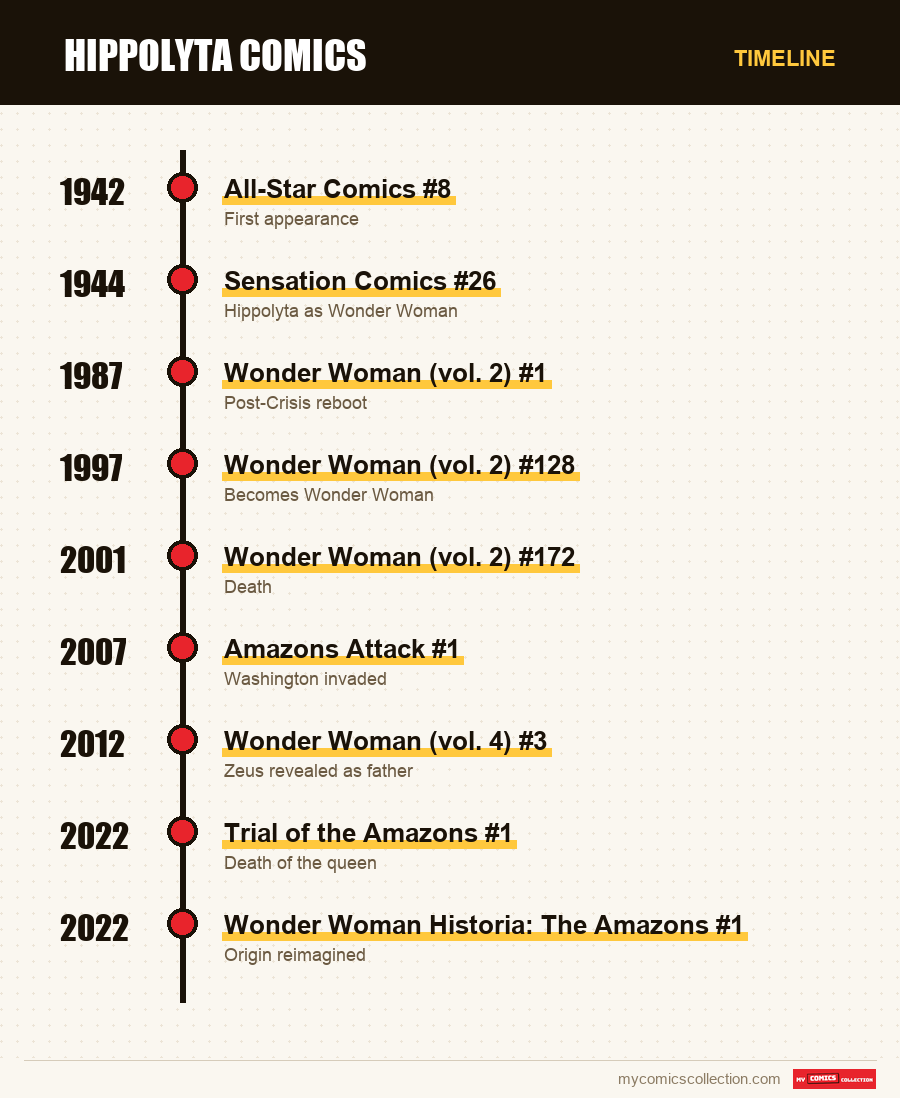
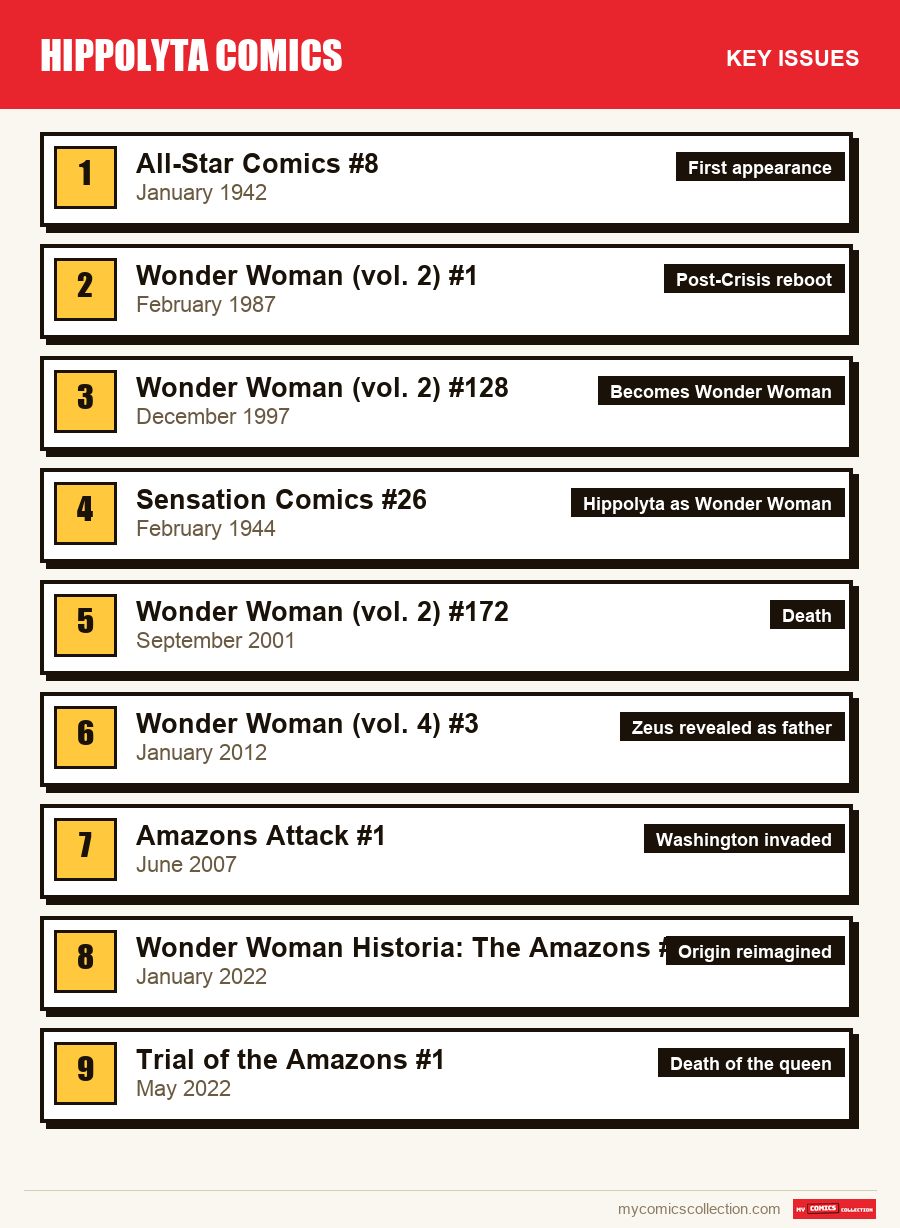
All-Star Comics #8
William Moulton Marston and Harry G. Peter introduce Queen Hippolyte and her daughter Diana. After Steve Trevor arrives on the island, the queen holds a tournament to choose the Amazon who will help America; Diana, masked, wins it despite her mother's ban. The first appearance of both Hippolyta and Wonder Woman, it is one of the great Golden Age keys.
Wonder Woman (vol. 2) #1
George Pérez and Greg Potter rewrite the Amazons' history after Crisis on Infinite Earths. Enslaved by Herakles, Hippolyta and her sisters break free and found Themyscira, where the queen raises Diana. This issue is the first appearance of the modern Hippolyta and the affordable entry point into her collection.
Wonder Woman (vol. 2) #128
Written and drawn by John Byrne, this issue sees Hippolyta take on the role of Wonder Woman while Diana, now the Goddess of Truth, adjusts to her new state. The arc then takes her back to the 1940s, where she spends eight years alongside the first generation of heroes. The key issue of the period when the queen wears the costume.
Sensation Comics #26
In "The Masquerader", Marston and Peter show the queen disguising herself as Wonder Woman to protect her daughter from an accusation foretold by the Magic Sphere. It is the first time Hippolyta takes on the Wonder Woman identity, an idea revisited and expanded in the late 1990s.
Wonder Woman (vol. 2) #172
Written and drawn by Phil Jimenez during the Our Worlds at War event, this issue tells of Hippolyta's death. Still Wonder Woman, the queen takes on Imperiex's probes and sacrifices herself to save the Earth, proving she is worthy of the name. One of the character's great tragic moments.
Wonder Woman (vol. 4) #3
Brian Azzarello and Cliff Chiang upend the myth in the New 52: Hippolyta reveals to Diana that she was not shaped from clay but conceived with Zeus. The long-hidden truth shakes the bond between mother and daughter. A major turning point in modern continuity.
Amazons Attack #1
Will Pfeifer (script) and Pete Woods (art): brought back by the sorceress Circe, Hippolyta sends the Amazon army to attack Washington in defense of her daughter. The queen appears here at her darkest. A key event of the 2000s for the character.
Wonder Woman Historia: The Amazons #1
Kelly Sue DeConnick (script) and Phil Jimenez (art) deliver an ambitious, adult retelling of the Amazons' birth. The first book of this miniseries presents a new version of Hippolyta, at the heart of the clash with the gods of Olympus. A recent milestone for followers of the character.
Trial of the Amazons #1
The first chapter of the crossover opens with Hippolyta's death, which plunges the various Amazon tribes into crisis. The investigation and trial that follow drive the whole saga. The starting point of the latest major chapter devoted to the queen.