
Circe is a witch from Greek mythology adapted into a supervillain by DC Comics. She appears for the first time in Wonder Woman #37 (September-October 1949), created by screenwriter Robert Kanigher and artist Harry G. Peter. Reintroduced into modern continuity by George Pérez and Greg Potter in 1988, she became Diana Prince's most recurring archenemy, capable of shapeshifting her opponents into animals and manipulating magic on a near-divine level. She has since joined James Gunn's television universe via the series Creature Commandos (2024), which revives collector interest in its historical appearances.
Few DC villains can boast of having spanned seven decades of publishing history without ever completely disappearing from the radar. Circe is part of this restricted circle: born at the very end of the 1940s in the pages of Wonder Woman, she experienced slumps, radical reconfigurations of her past, improbable alliances with other DC mythological figures, before once again becoming, from the end of the 1980s, the antagonist most identified with the Amazon. This checkered journey is precisely what makes its history fascinating for a collector: few characters offer so many distinct editorial layers to explore, from post-war pulp to contemporary television production.
This file retraces this entire journey, relying exclusively on verifiable information: publication dates, names of creators, series titles and changes in editorial status. The objective is not to draw up a list of “keys” to acquire at all costs, but to give the reader the necessary benchmarks to understand why certain issues weigh more heavily than others in the character's history, and therefore, potentially, on the collection market.
We will thus see how a mythological witch, initially thought of as an exotic and almost anecdotal threat, ended up becoming one of the pillars of the modern mythology of Wonder Woman, to the point of being chosen by James Gunn to open, in 2024, the new television continuity of the DC Universe.
From Greek mythology to comics: the editorial birth of Circe
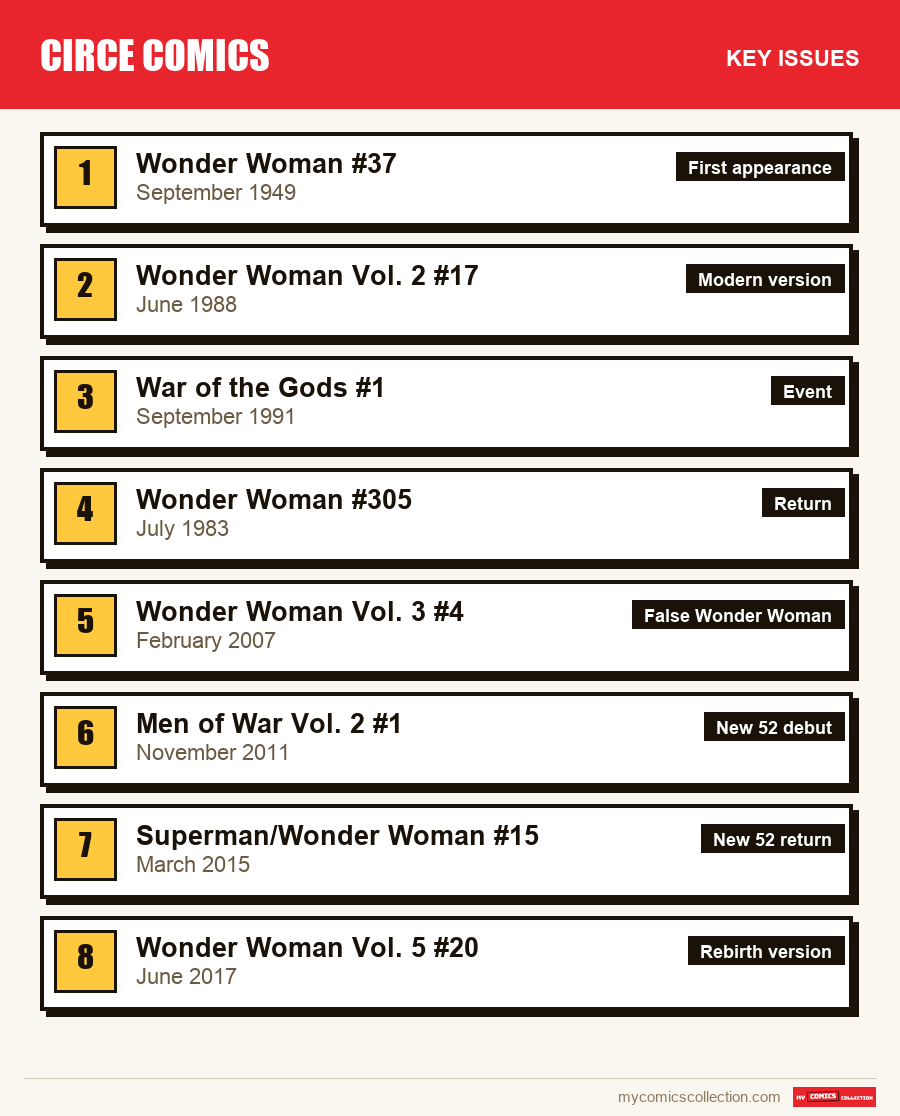
The character of Circe exists well before the comics: she is a figure of Odyssey of Homer, the sorceress from the island of Aea who transforms Odysseus' companions into swine before finally being tamed by the Greek hero. This mythological matrix (the punishing metamorphosis, the isolated island, the confrontation with a protagonist from the sea) is taken up almost unchanged by Robert Kanigher when he introduces it into the universe of Wonder Woman in 1949. In Wonder Woman #37 (issue dated September-October 1949), the fourth story, titled "The Secrets of Circe" features an isolated witch on a distant planet, who lures the crew of Wonder Woman's spaceship to perform a magical formula of animal shapeshifting. Diana herself is temporarily transformed into a doe before managing, after crossing a perilous glass mountain, to recover an antidote, defeat Circe and transfer her to Paradise Island to be "re-educated" there. The drawing of this founding story is by Harry G. Peter, historical artist of the title since its creation in 1941 alongside William Moulton Marston.
What is striking, in hindsight, in this original appearance is the extent to which it contrasts with the image that the character ended up embodying. The Circe of 1949 sports blonde hair and long, flowing red robes-an aesthetic far removed from the austere, brunette witch that would become the visual norm decades later. Above all, nothing in this story suggests that she will one day become THE magical rival of Wonder Woman: at the time, she is only one occasional threat among others in a title which multiplies exotic antagonists.
Half a century of editorial wandering before the consecration
This is where Circe's story takes an unexpected turn for a reader who would discover her today via her recent appearances: after her only confrontation with Wonder Woman in 1949, the character disappeared from the pages of the Amazon for several decades. Bob Haney reused her in February 1962 against the Sea Devils, in Sea Devils #3, with drawings by Russ Heath: an underwater adventure series with no direct connection to Amazonian mythology. During the 1950s and 1960s, Circe became a recurring, but peripheral, figure in the Superman stable: she confronted or manipulated Superman and Supergirl in the pages of Action Comics , of Adventure Comics and of Superman's Girl Friend, Lois Lane, sometimes as an adversary, sometimes in more ambiguous dynamics. In 1959, she also crossed paths with Rip Hunter in Showcase #21, an anthology series which then served as a laboratory for new DC concepts. It was not until 1972, in Justice League of America #102, that she unambiguously reappears as a villainous threat in her own right, confirming a gradual repositioning towards a more clearly antagonistic role.
The so-called Bronze Age period then offered it a more substantial return to its original title: between 1983 and 1985, it returned in Wonder Woman #302 to #313, with an overhaul of his appearance and a notable alliance with Tezcatlipoca, Aztec deity from DC mythology. This period, however, remains transitory: it shortly precedes the major editorial reboot which would permanently redefine the character.
Post-Crisis reinvention: Circe becomes Wonder Woman's sworn enemy
The real turning point comes after Crisis on Infinite Earths, when George Pérez takes over the reins of Wonder Woman from 1987 to deliver a founding rereading that redefines the entirety of Amazonian mythology. It is in this context that in the summer of 1988, Pérez and screenwriter Greg Potter reintroduced Circe no longer as a one-off threat inherited from Greek folklore, but as an immortal witch inscribed at the very heart of modern DC mythology: a figure whose rivalry with the Amazons dates back, in the new continuity, to centuries before Diana's birth. This repositioning is decisive: it makes Circe a “structural” enemy, linked to the very history of Themyscira, and no longer a simple isolated obstacle. This rereading bore editorial fruit a few years later, during the crossover War of the Gods (1991), where Circe plays the role of main antagonist in an event involving the entire DC universe: the ultimate consecration for a character until then considered secondary.
The run of the screenwriter and artist of the time continued to explore the multiple facets of the character throughout the 1990s: a notable plot, spread over issues #78 to #100 of the Wonder Woman volume 2, sees her adopt an infiltrated human identity, that of "Donna Milton", a journalist approaching Diana's entourage to better trap her from the inside: a narrative device which contrasts with the more classic frontal confrontations of her previous incarnations. In 1994, in issues #88 and #89 of this same volume, writer Christopher Priest and artist John Ross offered her a new design, contemporary with the graphic standards of comics of the time. Circe also crosses the following decade via her participation in the event Amazons Attack!, which extends its role as a recurring threat to Themyscira into the 2000s.
New 52 and Rebirth: a character redistributed across the expanded DC universe
The 2011 editorial relaunch, known as the New 52, does not reintroduce Circe directly into the Wonder Woman title: it is in Men of War volume 2 #2, a military war series within the same relaunch, as it resurfaces. This editorial choice, atypical for a character so associated with Diana, illustrates the way in which DC has, during this period, dispersed some of its historical villains across peripheral titles before refocusing them. She then reappears in 2016 in the monthly series Trinity, which brings together Wonder Woman, Superman and Batman. However, it was the Rebirth era, initiated the same year, which offered it its most significant rereading since Pérez: in Wonder Woman volume 5 #20 (June 2017), screenwriter Greg Rucka and artist Bilquis Evely offer a new version of the character, as part of the run which also redefines the origin of Diana herself. Circe continues her journey in the so-called “Pandora Pits” arc, which crosses several titles linked to Trinity volume 2, then appears in the first issue of Justice League Dark & Wonder Woman in October 2018. Even more recently, she appears in issues #4 and #5 of the series Wonder Woman relaunched in 2024, proof that the character has never permanently left the Amazon editorial landscape since its reinvention in the 1980s.
Powers and narrative register: why Circe functions as an antagonist
Abilities-wise, Circe is presented in modern continuity as a near-god level entity: immortality, reality manipulation, matter transfiguration, energy projection, telepathy, telekinesis, and flight are among the powers regularly attributed to her. But it is his signature ability (the transformation of his adversaries into animals, a power directly inherited from its Homeric mythological source) which remains his most identifiable trait from one version of the character to another, from the swine of the Odyssey to the doe of Wonder Woman #37, through the countless variations used in the following decades. This continuity between the Greek myth and the comics is undoubtedly what explains the longevity of the character despite his long periods of absence: unlike other DC villains entirely invented for the page, Circe benefits from a pre-existing, immediately recognizable narrative base, which each screenwriter can reinterpret without having to justify its existence.
Collecting this series?
Track what you own, what you are missing and what your collection is worth. 7 day trial.
Start my trial →The impact of adaptations on the rating
As with many secondary characters who become central, collector interest in Circe largely follows the rhythm of her appearances outside the printed pages. The character was used several times in animation before the current DC Universe cinematic and television era: she appears in the episode "This Little Piggy" of Justice League Unlimited, where she is voiced by Rachel York, then in “Luthor in Paradise” on Justice League Action, with the voice of Laura Post. On the video game side, she appears as a playable character or boss in DC Universe Online, dubbed by Michelle Forbes, as well as in Justice League Heroes: The Flash and Scribblenauts Unmasked: A DC Comics Adventure. The most significant turning point, however, remains recent: in 2024, Circe appears in Creature Commandos, the animated series which officially inaugurates the new DC Universe continuity piloted by James Gunn, where she is voiced by Anya Chalotra (known for her role as Yennefer in The Witcher). Her status as an Amazonian witch capable of traveling to and from Themyscira is not insignificant: Gunn confirmed that these script choices had been thought out in advance of a future film project devoted to Wonder Woman, even though the film was not yet written. In June 2025, James Gunn confirmed that a Wonder Woman film was indeed in development within the DCU, describing it as a "Game of Thrones"-type story centered on Paradise Island: a project whose script was still being written at the time, with no cast or release date announced at this point.
This news is reflected quite directly in the way sellers present the founding copy of the character today. On auction and private sales platforms, several advertisements for Wonder Woman #37 explicitly mention the confirmation of the new DCU film as a selling point, a sign that the market is already anticipating renewed interest in this first appearance. In terms of physical rarity, discussions between collectors on specialized forums report barely three copies rated in a gradation higher than 7.5 on the CGC scale, which places the high gradations of this issue among the most difficult to find from the Wonder Woman production of the immediate post-war period. The advertisements observed for copies in intermediate gradation (around 2.0 to 3.5) are generally in a range of 200 to 400 dollars, while a copy graded 7.5 may have been offered around 700 dollars: amounts which correspond to prices displayed by sellers and not to confirmed sales, and which therefore vary greatly depending on the actual condition of the pages and the possible presence of restoration. More recent issues associated with major reworkings of the character-the 1988 Pérez/Potter reintroduction, the 2017 Rebirth redesign in Wonder Woman vol. 5 #20, or even its appearance in Men of War vol. 2 #2 during the New 52: remain much more accessible, the production of comics during this period being incommensurate with the printings of the Golden Age.
Buying guide
For a collector who wishes to position himself on Circe, a few concrete points of reference allow him to avoid the most common pitfalls, in particular on the founding copy from 1949:
- Systematically check the restoration notice on old copies. Wonder Woman #37 is approaching 80 years of existence: cases of light restoration (spine reinforcement, color retouching) are frequent and must appear clearly on the CGC/CBCS label, with a direct impact on the value compared to an unrestored “universal” example.
- Check the color of the interior pages. For a comic from 1949, the mention “white” or “off-white to white” (OWW) on the gradation label is an important valuation factor; very yellowed or brittle pages indicate more marked aging.
- Favor examples graded by a recognized service rather than “raw” evaluations. Given the documented rarity of the high grades of this issue, a CGC or CBCS certification greatly limits the risk of unpleasant surprises regarding the actual condition of the comic.
- Don't overlook modern entry points. The Pérez/Potter reintroduction of 1988, the Rebirth redesign in Wonder Woman vol. 5 #20, or the New 52 appearance in Men of War vol. 2 #2 offers a gateway to the character's editorial history at a budget much lower than that of Golden Age.
- Anticipate the effect of ongoing adaptations. With the confirmation of a Wonder Woman film within the DCU and the already established presence of Circe in Creature Commandos, the numbers associated with its major rereadings could see their demand evolve as the cinematographic project progresses; following production news remains more reliable than relying on a simple marketing mention on a sales announcement.
- Compare several price sources before purchasing. The differences observed between advertisements for the same grade can be significant; crossing several platforms and focusing on sales made (and not simple listings) gives a more faithful image of the real market.
To organize the monitoring of your collection over the course of these acquisitions, whether it is a fragile Golden Age copy or a more recent issue, the comic collection management application allows you to centralize gradations, purchase dates and rating changes across your entire library.
The key issues to know
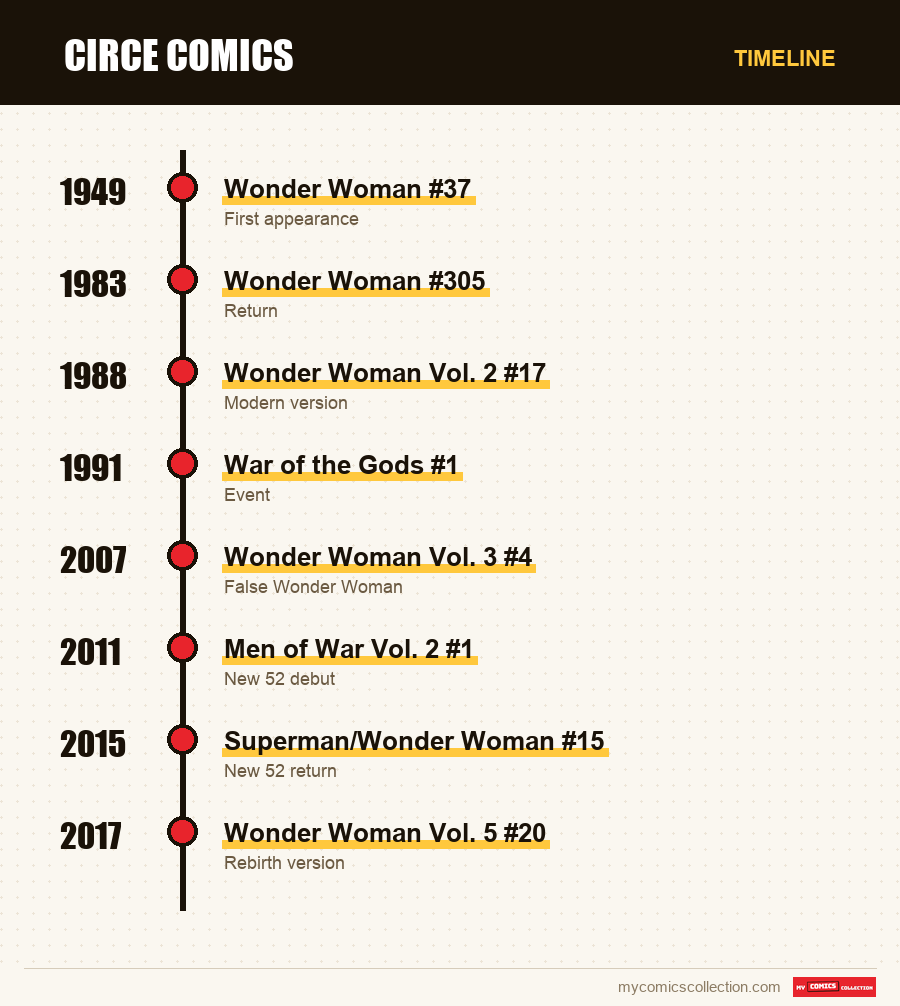
Wonder Woman #37
Robert Kanigher and Harry G. Peter adapt the sorceress of the Odyssey in "The Secrets of Circe", one of the issue's stories. The rocket piloted by Steve Trevor vanishes, and Diana must face this witch who can turn her victims into animals. The character's very first DC appearance.
Wonder Woman Vol. 2 #17
In George Pérez's relaunch, the Circe of the new continuity makes her first, still behind-the-scenes, appearance. The character becomes an immortal witch tied to the very history of the Amazons. The starting point of her status as Diana's major enemy.
War of the Gods #1
George Pérez makes Circe the villain of a DC-wide crossover: to please the goddess Hecate, she weaves a spell meant to destroy Gaea. The resulting upheavals affect Superman, Aquaman, Zatanna and many others. The character's crowning moment.
Wonder Woman #305
Dan Mishkin and Gene Colan bring Circe back into the Amazon's title: she sets man-beasts on Wonder Woman, convinced by a prophecy that they are fated to clash. The character returns to face Diana well before the Pérez relaunch. A Bronze Age milestone.
Wonder Woman Vol. 3 #4
In "Who is Wonder Woman?", by Allan Heinberg and Terry Dodson, Circe has taken on the role of Wonder Woman while Diana and Hercules are stripped of their powers. Diana, as Diana Prince, tries to steal her spellbook. A standout clash of the modern era.
Men of War Vol. 2 #1
During the New 52 relaunch, the Circe of the new continuity first appears as a shadowy figure in this war series by Ivan Brandon and Tom Derenick. Her identity is only revealed in the following issue. A low-key entrance, far from the Wonder Woman title.
Superman/Wonder Woman #15
Peter Tomasi and Doug Mahnke make Circe a threat to the star couple: she recreates Magog with new power and comes to witness the judgment over which of the two heroes should die first. Her creatures serve her schemes. A notable appearance of the New 52 period.
Wonder Woman Vol. 5 #20
The third chapter of "Godwatch", by Greg Rucka and Bilquis Evely: Veronica Cale has Circe summoned, and the witch strikes a deal with her. Through trickery, she gets Diana to use the Lasso on her so she can complete her ritual. The Rebirth take on the character.