Batman v Superman: Dawn of Justice (2016) Zack Snyder pits DC's two biggest icons against each other, drawing inspiration from "The Dark Knight Returns» (1986) by Frank Miller for their confrontation, and features Doomsday and The Death of Superman, Superman #75, 1992. The film also introduces Wonder Woman (All Star Comics #8, 1941). Ambitious but dense, it draws on cult stories. Here is the detailed comparison, film versus comics.
Clash of the titans of the DC pantheon, Batman v Superman confronts the Dark Knight and the Man of Steel. It draws on two of the most famous stories in comics. Source-by-source decryption.
As in each article in this series, only verified information (creators, distribution, dates, comic numbers) is stated; the comparative analysis is ours, without reproducing dialogue or protected images.
Title : Batman v Superman: Dawn of Justice (2016)
Director: Zack Snyder
Actors: Ben Affleck (Batman), Henry Cavill (Superman), Gal Gadot (Wonder Woman), Jesse Eisenberg (Lex Luthor)
Exit : March 2016
Studio: Warner Bros.
“The Dark Knight Returns”(1986): Batman v Superman (Miller)
“The Death of Superman”(Superman #75, 1992): Doomsday
All Star Comics #8 (1941): Wonder Woman's first appearance
Lex Luthor: Superman's archenemy
- L'Batman versus Superman clash (“Dark Knight Returns”).
- Un Aged and armored Batman, suspicious of Superman.
- Doomsday and the death of Superman.
- The introduction of Wonder Woman.
- Lex Luthor, manipulator of the two heroes.
- Lex Luthor is reinvented as an eccentric young genius.
- Doomsday was born from manipulation by Luthor.
- The movie condenses several stories in one dense plot.
- The tone remains dark and serious.
- Batman kill, going backwards from the comics.
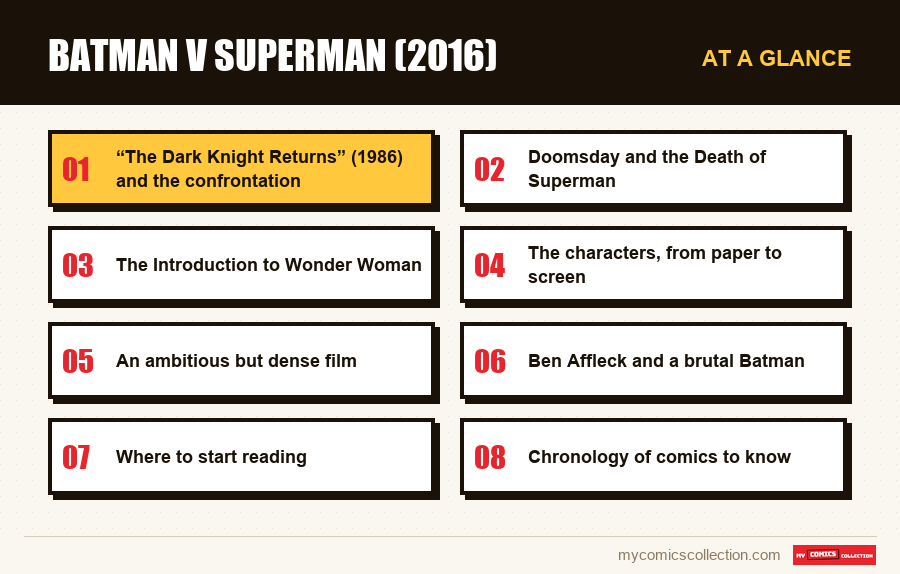
“The Dark Knight Returns” (1986) and the confrontation
The heart of the film is the confrontation between Batman and Superman, directly inspired by “The Dark Knight Returns” (1986), Frank Miller's masterpiece. In this cult tale, an aging Batman comes out of retirement in a dystopian America and confronts Superman, who has become a tool of the government. Their fight, where an armored Batman challenges the Man of Steel, is one of the most famous scenes in comics. The film takes up this configuration: an elderly, armored Batman, suspicious of the uncontrollable power of Superman, whom he considers a threat to humanity. Ben Affleck plays this disillusioned and brutal Dark Knight, marked by years of combat.
The film captures the spirit of “The Dark Knight Returns”: Batman's distrust of a quasi-divine being, the question of absolute power, the clash between two visions of heroism. The fight scene, with Batman in armor facing Superman, pays homage to Miller's iconic image. The film, however, takes liberties: where Miller's story anchored this confrontation in a political dystopia, the film motivates it through the manipulation of Lex Luthor. For the reader, “The Dark Knight Returns” is an invitation to discover one of the absolute pinnacles of comics, whose influence on the entire modern vision of Batman, and on the film, is decisive.
Doomsday and the Death of Superman
The film features Doomsday, the monster responsible for the death of Superman in the comics. “The Death of Superman” (Superman #75, 1992) is one of DC's most memorable stories: Superman faces Doomsday, a Kryptonian creature of devastating strength, in a titanic fight which ends in the death of both adversaries. This event, which shocked readers and made headlines, remains one of the tragic peaks of the DC universe. The film picks up on Doomsday and the death of Superman, culminating in a confrontation where the Man of Steel sacrifices himself to defeat the creature.
The film, however, reinvents the origin of Doomsday. In the comics, the creature is an ancient Kryptonian abomination; in the film, she is born from genetic manipulation by Lex Luthor, from Zod's body. This retelling anchors Doomsday in the film's plot, while moving away from its original mythology. Superman's death, on the other hand, is faithful to the tragic spirit of the 1992 story: the hero's ultimate sacrifice to save the world. For the reader, “The Death of Superman” is an invitation to discover one of the great events in comics, whose cultural impact was immense. The film offers a condensed adaptation, driven by the sacrificial dimension of the character.
The Introduction to Wonder Woman
The film marks Wonder Woman's first cinematic appearance in the modern DC Universe. Diana Prince, aka Wonder Woman, appeared in All Star Comics #8 (1941), created by William Moulton Marston and Harry G. Peter, is one of DC's greatest icons, an Amazon warrior endowed with divine powers. The film introduces her as a mysterious ally who joins Batman and Superman in the final fight against Doomsday. Gal Gadot plays this powerful warrior, whose arrival constitutes one of the highlights of the film. This introduction sets up its own film and the formation of the Justice League.
The appearance of Wonder Woman alongside Batman and Superman brings together on screen the “trinity” of DC, the three founding characters of the publisher. This meeting, dear to readers, marks an important moment in the construction of the DC cinematographic universe. Wonder Woman, long absent from the big screen despite her iconic status, makes a notable entrance. For the reader, it is an invitation to discover the rich mythology of the Amazon in comics, from its founding story of 1941 to modern rereadings. The film, by introducing her, honors one of DC's most important figures and prepares for her development in subsequent productions.
Collecting this series?
Track what you own, what you are missing and what your collection is worth. 7 day trial.
Start my trial →The characters, from paper to screen
- Batman/Bruce Wayne: Aged and distrustful Dark Knight, true to the spirit of “The Dark Knight Returns”.
- Superman/Clark Kent: The Man of Steel, whose sacrifice evokes “The Death of Superman”.
- Wonder Woman / Diana Prince: Amazon warrior, faithful to All Star Comics #8.
- Lex Luthor: Manipulative enemy, reinvented as an eccentric young genius.
- Doomsday: Superman's killer monster, originally reimagined.
An ambitious but dense film
Batman v Superman is a film of great ambition, seeking to bring together several cult stories (the confrontation of “The Dark Knight Returns”, the death of Superman) while building the DC cinematic universe and introducing Wonder Woman. This ambition, however, comes up against a density which has divided critics and the public. By condensing so many elements into one film, the narrative can feel overstuffed, sometimes sacrificing clarity for buildup. The dark and serious tone, in the continuity of Man of Steel, has also been debated, with some seeing it as a betrayal of the luminous spirit of Superman.
This divisive reception illustrates the challenges of such an ambitious film. By wanting to embrace everything (the clash of the titans, the death of Superman, the launch of the League) the film takes the risk of overload. However, it remains a bold attempt to bring major comic book stories to the screen and bring together the DC trinity. For the reader, it is an invitation to discover “The Dark Knight Returns” and “The Death of Superman”, two peaks of comics from which the film is inspired. Batman v Superman recalls the richness of these stories, while illustrating the difficulty of adapting and condensing them into a single coherent work.
Ben Affleck and a brutal Batman
The film introduces a new Batman, played by Ben Affleck, in an aged, disillusioned and particularly brutal version of the Dark Knight. Marked by years of combat and personal losses, this Batman does not hesitate to resort to extreme violence, even to kill, moving away from the moral code that defines the character in the comics. This rereading, inspired by the aging Batman of “The Dark Knight Returns”, offers a darker and more radical vigilante, in line with the serious tone of the DC universe. Ben Affleck delivers a physical and tormented interpretation, praised by part of the public.
This brutal version of Batman has, however, sparked debate, particularly on respect for the refusal to kill, a fundamental principle of the character. By showing a Dark Knight ready to cross this line, the film takes a major liberty, consistent with its dark vision but debated by purists. For the reader, this interpretation recalls the diversity of Batman's faces in the comics, from the disciplined vigilante to the more radical avenger of certain dark stories. Ben Affleck's Batman, marked by weariness and rage, illustrates a side of the character while moving away from his classic ethics. He embodies the bold, and sometimes divisive, choices of a DC universe seeking its own path.
Where to start reading
To extend the film, “The Dark Knight Returns” (1986) by Frank Miller features the Batman/Superman confrontation, and “The Death of Superman” (Superman #75, 1992) recounts the hero's death in the face of Doomsday. All Star Comics #8 (1941) features Wonder Woman. This journey covers the sources of a film which synthesizes several cult stories.
Chronology of comics to know
- 1941: All Star Comics #8: Wonder Woman's first appearance.
- 1986: “The Dark Knight Returns”: Batman faces Superman.
- 1992: “The Death of Superman” (Superman #75): Doomsday kills Superman.
Collection side: what numbers to aim for after the film
Batman v Superman points to varied keys. Superman #75 (1992, “The Death of Superman,” Doomsday) is an iconic and sought-after issue, available in several editions. All Star Comics #8 (1941, premiere of Wonder Woman) is a holy grail of the Golden Age. The collection “The Dark Knight Returns” (1986) is essential reading and an accessible target. These numbers cover budgets ranging from inaccessible to reasonable. As always, condition and gradation determine value; relying on real recent sales is strongly recommended.
Its place in the saga and for the collector
Batman v Superman brought together the DC trinity and adapted several cult stories, despite a divisive reception. For the collector, it reignited interest in Superman #75, "The Dark Knight Returns" and All Star Comics #8. It illustrates the effect of adaptations on the market. Beyond speculation, the film invites us to discover these peaks of the comics, from Miller's confrontation to the death of Superman. By bringing these major stories to the screen and introducing Wonder Woman, it marked an important step in the construction of the DC cinematic universe.
The verdict: an ambitious clash of titans
- Loyalty: the Batman/Superman confrontation, the aged Batman, Doomsday, the death of Superman and Wonder Woman come from the comics.
- Freedoms: Lex Luthor reinvented, Doomsday born from manipulation, the condensation of several stories, a Batman who kills.
- Collectible numbers: Superman #75 (Doomsday), All Star Comics #8 (Wonder Woman), “The Dark Knight Returns.”
Batman v Superman pits DC's two greatest icons against each other, drawing inspiration from "The Dark Knight Returns" and "The Death of Superman," and introduces Wonder Woman. Faithful to the spirit of these cult stories but dense and divisive, the film aims to reunite the DC trinity. For both the reader and the collector, it is an invitation to discover “The Dark Knight Returns” and Superman #75.
Frequently asked questions
From Frank Miller's "The Dark Knight Returns" (1986), where an aging Batman faces Superman. The film uses this configuration (an elderly, armored Dark Knight challenging the Man of Steel) one of the most famous scenes in the comics.
A cult story from 1992 (Superman #75) where Superman dies confronting Doomsday, a devastating Kryptonian creature. The film picks up on Doomsday and the death of Superman, culminating in the hero's sacrifice.
In part: the film takes Superman's killer monster, but reinvents its origin. In the comics, Doomsday is an ancient Kryptonian abomination; in the film, he is born from Lex Luthor's manipulation from Zod's body.
For its density, it condenses several cult stories into a charged plot, and its dark tone, in the continuity of Man of Steel. By wanting to embrace everything, the film takes the risk of overload, despite its ambition.
Superman #75 (1992, “The Death of Superman”) is an iconic issue. All Star Comics #8 (1941, premiere of Wonder Woman) is a holy grail of the Golden Age. “The Dark Knight Returns” is an accessible and unmissable target.
Does the film make you want to collect? Estimate the value for free of your issues (Superman #75, All Star Comics #8…) with our tool based on current eBay listings.