Man of Steel (2013) Zack Snyder , with Henry Cavill, revives Superman (Action Comics #1, 1938) in a realistic origin and pits him against General Zod (Adventure Comics #283, 1961). The film takes up Krypton, the Phantom Zone, Lois Lane and the Kents, while darkening the tone and reinventing certain choices, such as the controversial outcome. Here is the detailed comparison, film versus comics.
A reboot that launches the DC cinematic universe, Man of Steel offers a darker and more realistic vision of the first superhero. It draws on Kryptonian mythology from the comics. Source-by-source decryption.
As in each article in this series, only verified information (creators, distribution, dates, comic numbers) is stated; the comparative analysis is ours, without reproducing dialogue or protected images.
Title : Man of Steel (2013)
Director: Zack Snyder
Actors: Henry Cavill (Superman), Amy Adams (Loïs Lane), Michael Shannon (Zod), Russell Crowe (Jor-El)
Exit : June 2013
Studio: Warner Bros.
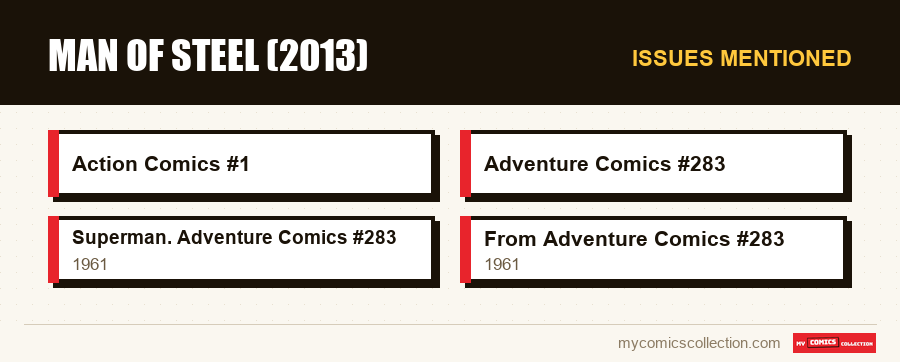
Action Comics #1 (1938): Superman's first appearance
Adventure Comics #283 (1961): 1st appearance of General Zod
Krypton and the Phantom Zone: Kryptonian mythology
“Superman: Birthright”(2003): a rereading of the origins
- The origin kryptonian and the escape from Krypton.
- Jor-El and the Kents, his two fathers.
- Le General Zod and the Ghost Zone.
- Lois Lane and the Daily Planet.
- THE powers from the yellow sun.
- The tone is dark and realistic, far from classicism.
- Superman kills Zod, a controversial departure from its code.
- Le genetic codex Kryptonian is an addition from the film.
- The plot (terraforming) is original.
- Krypton is reinvented visually.
Action Comics #1 (1938) and the Kryptonian origin
Man of Steel revives Superman, the first superhero, appearing in Action Comics #1 (1938), created by Jerry Siegel and Joe Shuster. The film takes up the founding myth: Kal-El, last son of the planet Krypton, sent to Earth as a child by his parents before the destruction of his world, is taken in by the Kents in Kansas. As an adult, he discovers his origins and his destiny, embracing his role as protector under the name Superman. The film extensively develops the Kryptonian side of this origin, showing Krypton, its society, its destruction, as well as Jor-El, Kal-El's biological father. This scale given to Krypton, visually reinvented, is one of the film's striking choices.
The film respects the essence of the myth (the Kryptonian origin, the two fathers (Jor-El and Jonathan Kent), the dual identity, Lois Lane) while reinterpreting it from a darker and more realistic angle. Henry Cavill plays a Superman tormented by the question of his place in the world. The film draws inspiration from modern retellings of the origins, such as "Superman: Birthright" (2003) and "Superman: Secret Origin" (2009), which updated the character for the 21st century. This approach, more serious than the luminous classicism of the 1978 film, seeks to anchor Superman in contemporary realism, at the risk of losing part of the radiant goodness which characterizes the character.
General Zod, Kryptonian enemy
The film pits Superman against General Zod, one of his most iconic enemies, who appeared in Adventure Comics #283 (1961), created by Robert Bernstein and George Papp. A Kryptonian soldier exiled to the Phantom Zone, a prison dimension, before the destruction of Krypton, Zod thus survives his world and seeks to recreate Krypton, even if it means destroying the Earth. The film faithfully takes up this character: the implacable general, the Phantom Zone, the desire to resurrect Krypton. Michael Shannon plays a fanatical and tragic Zod, driven by the duty to save his people at any cost. This opposition between Superman, who chose Earth, and Zod, who wants to save Krypton, structures the film.
The conflict between Superman and Zod poses a central question: what does it mean to belong to two worlds? Superman, raised on Earth but born Kryptonian, must choose between humanity and his heritage. Zod, the last defender of Krypton, embodies the temptation to sacrifice the Earth to resurrect his world. This dilemma, true to the spirit of the character, gives the film its thematic depth. The film, however, adds its own elements, such as the Kryptonian genetic “codex”, the subject of their confrontation. For the reader, Zod is an invitation to discover Kryptonian mythology in comics, where the question of origins and belonging nourishes Superman's great stories.
The death of Zod, a controversial choice
The most debated freedom of the film concerns its outcome: to stop Zod and save innocent people, Superman breaks his neck, killing him. This choice was deeply divided, because it contradicted a fundamental principle of the character in the comics: Superman does not kill. Like Batman, he embodies absolute ethics, refusing to cross the line that would separate him from his enemies. This refusal to kill is at the heart of his identity as a moral model, a figure of hope and goodness. By having Superman kill Zod, the film takes a major departure from this code, justified by the absence of an alternative, but felt by many as a betrayal of the essence of the character.
This controversy illustrates the film's challenge: a darker, more tormented Superman, anchored in an ambiguous moral realism. This bias, consistent with Zack Snyder's vision, moves away from the luminous idealism which characterizes Superman in the comics and in the 1978 film. It reflects an attempt to update the character for a more cynical era, at the risk of distorting him. For the reader, this freedom reminds us of what makes Superman great: not his power, but his unwavering goodness, his refusal to give in to the ease of violence. The film, by freeing itself from this, opens a debate on the very nature of the character, between modernization and loyalty to his ideal.
Collecting this series?
Track what you own, what you are missing and what your collection is worth. 7 day trial.
Start my trial →The characters, from paper to screen
- Superman/Clark Kent: The first superhero, relaunched in a realistic and tormented origin.
- General Zod: Kryptonian enemy wanting to resurrect Krypton, faithful to Adventure Comics #283.
- Lois Lane: Journalist at the Daily Planet, true to his role.
- Jor-El: Biological father of Kal-El, guiding presence of his son.
- The Kents: Clark's adoptive parents, guarantors of his values, in a more serious version.
The launch of a cinematic universe
Man of Steel occupies a special place in the history of DC adaptations: it is the founding film of the DC cinematographic universe, intended to bring together Batman, Superman, Wonder Woman and the other heroes of the publisher, like the success of the Marvel universe. This cornerstone role explains certain choices in the film, which lays the foundations for a darker and more realistic shared universe. By relaunching Superman from this angle, the film sets the tone for an ambitious cinematic saga, seeking to bring the pantheon of DC superheroes to the screen. This inaugural dimension marks the importance of the film in the studio's strategy.
This ambition, however, sparked debate on the tone adopted. By choosing a dark and tormented Superman, the film moved away from the luminous idealism that characterizes the character, defining a DC universe more serious than its competitor Marvel. This divisive bias marked the entire saga that followed. For the reader, Man of Steel is an invitation to discover the richness of the character of Superman in the comics, from the founding story of 1938 to modern rereadings. It illustrates the challenges of adapting such a luminous icon in a contemporary register, between modernization and respect for the essence of a character who embodies, above all, hope and goodness.
Henry Cavill, a Superman for a new era
Henry Cavill's incarnation of Superman marked a new generation. Physically imposing and charismatic, the actor gave substance to a Man of Steel who was more tormented and introspective than his predecessors, in line with the modern vision of the film. Cavill manages to translate the solitude of a being shared between two worlds, searching for his place and the meaning of his mission. This interpretation, more serious than that of Christopher Reeve, reflects the bias of the film: to anchor Superman in contemporary realism, far from the luminous classicism of the character. The actor would reprise the role in subsequent DC Universe productions.
This incarnation illustrates the tensions of an adaptation that seeks to modernize an icon. By offering a Superman who is more human in his doubts, the film touches on a truth of the character, his quest to belong, while moving away from his radiant idealism. For the reader, this version is an invitation to discover the richness of Superman in the comics, where the character has explored varied tones, from light to gravity. Henry Cavill will remain as the face of the Man of Steel for a new era, that of a darker DC universe, illustrating the challenges of reinventing such a legendary character while respecting his essence: hope and responsibility.
Where to start reading
To extend the film, Action Comics #1 (1938) features the first appearance of Superman. Adventure Comics #283 (1961) introduces General Zod. “Superman: Birthright” (2003) and “Superman: Secret Origin” (2009) revisit the character’s modern origins. This course covers the sources of a film which relaunches Superman from a realistic angle.
Chronology of comics to know
- 1938: Action Comics #1: Superman's first appearance.
- 1961: Adventure Comics #283: The first appearance of General Zod and the Phantom Zone.
- 2003-2009: “Birthright” and “Secret Origin”: modern rereadings of origins.
Collection side: what numbers to aim for after the film
Man of Steel points to major keys. Action Comics #1 (1938, first appearance of Superman) is the absolute holy grail of the market. Adventure Comics #283 (1961, premiere of General Zod and the Phantom Zone) is a sought-after key to the Silver Age. The “Birthright” and “Secret Origin” collections are accessible modern targets. These numbers cover budgets ranging from inaccessible to reasonable. As always, condition and gradation determine value; relying on real recent sales is strongly recommended.
Its place in the saga and for the collector
Man of Steel revived Superman and launched the DC Cinematic Universe in a dark, realistic way. For the collector, it magnified the aura of Action Comics #1 and revived interest in Adventure Comics #283 (Zod). It illustrates the effect of adaptations on the market. Beyond speculation, the film invites you to discover Kryptonian mythology in the comics, from the founding story to modern rereadings. By reinventing Superman in a more serious light, he opened a debate on the nature of the character, while laying the foundations for a vast cinematic universe.
The verdict: a realistic and divisive Superman
- Loyalty: the Kryptonian origin, Jor-El, the Kents, Zod, the Phantom Zone and Lois Lane come from the comics.
- Freedoms: the dark tone, Superman killing Zod, the genetic codex, the terraforming plot, Krypton reinvented.
- Collectible numbers: Action Comics #1 (Superman), Adventure Comics #283 (Zod).
Man of Steel revives Superman in a realistic origin and pits him against General Zod, faithful to Kryptonian mythology. Faithful to the founding myth but darkening the tone and having Superman kill Zod, the film divided while launching the DC universe. For both the reader and the collector, it is an invitation to discover Action Comics #1 and Adventure Comics #283.
Frequently asked questions
From Adventure Comics #283 (1961), created by Robert Bernstein and George Papp. A Kryptonian soldier exiled in the Phantom Zone, he survives Krypton and seeks to resurrect it. The film faithfully portrays this character and his motivation.
No: the refusal to kill is a fundamental principle of the character, at the heart of his ethics as a figure of hope. The film takes a controversial departure by having Superman kill Zod, felt by many as a betrayal of his essence.
On the essentials yes: the Kryptonian origin, Jor-El, the Kents, the double identity. It draws inspiration from modern rereadings (“Birthright”, “Secret Origin”), while adopting a much darker and more realistic tone than the classicism of the character.
For its dark and tormented tone, far from the luminous idealism of Superman, and for the death of Zod. This bias, consistent with Snyder's vision, opened a debate on faithfulness to the essence of a character who embodies goodness and hope.
Action Comics #1 (1938, Superman premiere) is the absolute holy grail. Adventure Comics #283 (1961, premiere of Zod and the Phantom Zone) is a sought-after key to the Silver Age.
Does the film make you want to collect? Estimate the value for free of your issues (Action Comics #1, Adventure Comics #283…) with our tool based on current eBay listings.