Superman II (1980) Richard Lester and Richard Donner , with Christopher Reeve, pits the Man of Steel against General Zod (Adventure Comics #283, 1961) and his two Kryptonian sidekicks. The film draws on the mythology of Krypton while constructing an original plot. Here is the detailed comparison, film versus comics.
Considered one of the best superhero films of its time, Superman II pits the hero against enemies of his own species. It draws from rich Kryptonian mythology. Source-by-source decryption.
As in each article in this series, only verified information (creators, distribution, dates, comic numbers) is stated; the comparative analysis is ours, without reproducing dialogue or protected images.
Title : Superman II (1980)
Directors: Richard Lester, Richard Donner
Actors: Christopher Reeve (Superman), Terence Stamp (Zod), Gene Hackman (Lex Luthor), Margot Kidder (Lois)
Exit : December 1980
Studio: Warner Bros.
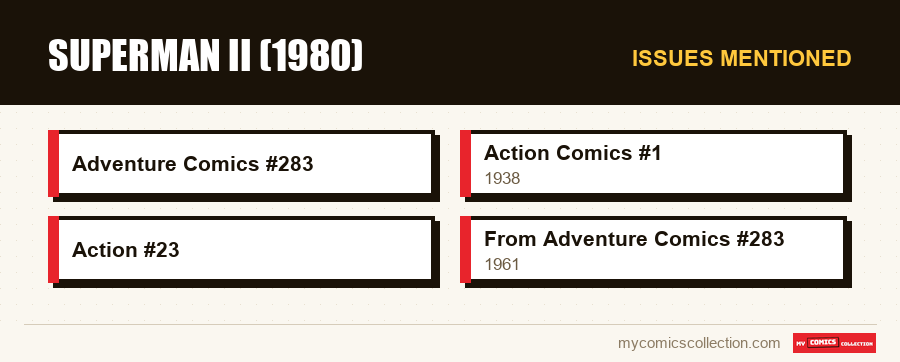
Adventure Comics #283 (1961): 1st appearance of General Zod
Action Comics #1 (1938): Superman's first appearance
The Phantom Zone: the Kryptonian prison
Lex Luthor: the sworn enemy (Action #23, 1940)
- General Zod, Kryptonian criminal.
- La Ghost Zone, prison from which Zod escapes.
- THE kryptonian powers shared by Zod and Superman.
- Lex Luthor, the manipulative nemesis.
- The ideal and meaning of sacrifice Superman.
- Zod and his sidekicks (Ursa, Non) are adapted for the film.
- Superman renounces his powers for love, original plot.
- Of the invented powers (teleportation, amnesia).
- The plot does not follow no precise arc comics.
- The suit and the world follow Donner's films.
Adventure Comics #283 (1961): General Zod, the Kryptonian enemy
Superman II pits the Man of Steel against General Zod, who appeared in Adventure Comics #283 (1961), created by Robert Bernstein and George Papp. A high-ranking Kryptonian criminal, Zod attempted to overthrow Krypton's government before being convicted and imprisoned in the Phantom Zone, a prison dimension where the planet's criminals serve their sentences in spectral form. When he escapes and reaches Earth, Zod acquires the same powers as Superman under the yellow sun, becoming an adversary worthy of him. Thirsty for domination and revenge, he embodies the antithesis of Superman: a Kryptonian who uses his powers to enslave rather than to protect. Zod is thus one of the rare enemies capable of physically challenging the Man of Steel.
The film features General Zod as the main antagonist, accompanied by his two Kryptonian sidekicks, Ursa and Non. Terence Stamp plays an imperious and icy Zod, escaped from the Phantom Zone and determined to conquer Earth. The film retains the basic idea: Kryptonians with the same powers as Superman, facing the hero in titanic battles. This confrontation between equals, faithful to the spirit of the comics, is the heart of the film. The plot itself, on the other hand, does not follow any specific arc, developing an original narrative built around the concept of Zod and the Kryptonian mythology established by the comics.
The Phantom Zone and Kryptonian powers
The film exploits two major concepts from Superman mythology: the Phantom Zone and Kryptonian powers under the yellow sun. The Phantom Zone, introduced in the comics, is a prison dimension where Krypton imprisoned its criminals, including Zod. This is where the three antagonists of the film escape, faithful to their origins. As for powers, the film respects the fundamental principle: any Kryptonian, exposed to the yellow sun of our system, develops superhuman strength, flight, invulnerability and thermal vision. Zod, Ursa and Non thus become as powerful as Superman, which justifies the spectacular confrontations of the film and its dramatic stakes.
These elements, faithful to the comics, anchor the film in Kryptonian mythology. The film, however, adds powers invented for the purposes of spectacle, such as teleportation capabilities or an amnesiac ray, absent from the comics. These liberties, typical of adaptations of the period, enrich the action at the cost of a certain coherence with the original material. Despite this, the film captures the essence of what makes a clash between Kryptonians so dramatic: Superman, usually invincible, finds himself confronted by enemies of his own strength. For the reader, this confrontation illustrates the richness of Kryptonian mythology, where the Phantom Zone and the concept of solar powers have nourished for decades some of the most epic tales of Superman, of which the film offers a spectacular and pioneering adaptation.
Superman gives up his powers
One of the film's original storylines is Superman's choice to give up his powers for his love for Lois Lane. To live a normal life with her, Clark Kent strips himself of his Kryptonian abilities, before having to face a heartbreaking dilemma when Zod threatens Earth: resume his heroic burden or preserve his personal happiness. This exploration of sacrifice-Superman abandoning love for duty-gives the film emotional depth. This narrative spring, specific to the film, does not come from a specific arc of the comics, but illustrates a recurring theme of the character: the tension between Clark's humanity and Superman's responsibility.
This dilemma between love and duty cuts to the heart of what makes Superman complex. Despite his power, the hero yearns for a normal life, for love and human connection, aspirations he must constantly sacrifice in the name of his mission. The film captures this intimate tragedy, making Superman's renunciation a powerful moment. This dimension, although developed in an original way, is in keeping with the spirit of the comics, where personal sacrifice is inseparable from Superman's heroism. For the reader, it illustrates the psychological richness of the character, well beyond his exploits. The film, by exploring this heartbreak, reminds us that Superman's true strength lies less in his powers than in his ability to choose duty and sacrifice, a theme that comics have continued to explore since 1938.
Collecting this series?
Track what you own, what you are missing and what your collection is worth. 7 day trial.
Start my trial →The characters, from paper to screen
- Superman/Clark Kent: The Man of Steel, faithful to Action Comics #1.
- General Zod: The Kryptonian criminal, faithful to Adventure Comics #283.
- Ursa & No: Zod's sidekicks, adapted for the film.
- Lois Lane: Superman's beloved journalist, at the heart of the dilemma.
- Lex Luthor: Zod's sworn enemy, occasional ally.
A clash between equals
What sets Superman II apart is the nature of its conflict: for the first time on screen, Superman faces adversaries of his own strength. Usually invincible against ordinary criminals, the hero finds himself confronted with three Kryptonians endowed with the same powers, which creates an unprecedented dramatic challenge. This idea, central to comics with characters like Zod, explores a fascinating question: what happens when the most powerful being on Earth meets his equals? The film features titanic battles in the streets of Metropolis, where Superman must not only defeat by force, but also by cunning and sacrifice.
This confrontation between Kryptonians is one of the richest sources of Superman mythology. By pitting the hero against beings of his nature but with opposing values, it questions what makes Superman a hero: not his powers, which he shares with Zod, but his ideal and his morality. The film captures this idea, making Superman's victory as much a moral triumph as a physical one. For the reader, this confrontation illustrates why Zod is such an iconic enemy: he is the dark mirror of Superman. The film, in bringing this pioneering confrontation to the screen, established a template echoed by many subsequent adaptations, confirming that Superman's greatest battles are those between equal powers and opposing souls.
“Kneel before Zod”, a replica that has become cult
Beyond its plot, Superman II marked popular culture with the imposing presence of General Zod. Terence Stamp's icy, imperious portrayal made Zod a memorable figure, whose demand for submission to Earth's rulers became one of the most quotable moments in superhero cinema. This presence has permanently associated Zod with the image of the Kryptonian tyrant, arrogant and sure of his superiority. The character's on-screen success spilled over into the comics, solidifying Zod's place in the pantheon of Superman's enemies and inspiring numerous reappearances in the comics, where he became a recurring and iconic adversary.
This posterity illustrates the reciprocal influence between cinema and comics. Zod, initially a relatively secondary character in the stories of the Silver Age, gained importance thanks to his cinematic incarnation, to the point of becoming one of Superman's most recognizable enemies. Comic book writers have since expanded on the character, exploring his psychology as a soldier committed to acting for the good of Krypton, making him a more nuanced antagonist than a simple tyrant. For the reader, this evolution shows how a successful adaptation can enrich a character and influence its trajectory in the comics. Zod remains a major figure today, whose presence established by Superman II continues to resonate in all his appearances, on paper and on screen.
Where to start reading
To extend the film, Action Comics #1 (1938) presents the first appearance of Superman, and Adventure Comics #283 (1961) that of Zod. “Superman: The Man of Steel” (1986) by John Byrne reinvents the myth. Stories featuring Zod, such as "Last Son" (2006) by Geoff Johns and Richard Donner himself, develop the Kryptonian enemy. This tour covers the film's sources.
Chronology of comics to know
- 1938: Action Comics #1: Superman's first appearance.
- 1961: Adventure Comics #283: The first appearance of General Zod.
- 2006: “Last Son”: a major story featuring Zod, co-written by Richard Donner.
Collection side: what numbers to aim for after the film
Superman II points to some major keys. Action Comics #1 (1938, first appearance of Superman) is the most sought-after and expensive comic book in history. Adventure Comics #283 (1961, first appearance of General Zod) is a key to the Silver Age that has been sought after since the character's popularity. Collections like “Last Son” are accessible targets. These numbers cover extreme budgets. As always, condition and gradation determine value; relying on real recent sales is strongly recommended.
Its place in the saga and for the collector
Superman II will remain as a classic of superhero cinema, having brought to the screen Superman's confrontation with General Zod. For the collector, it highlighted Adventure Comics #283, the key to the famous Kryptonian enemy. It illustrates the dramatic power of a conflict between equals. Beyond the film, Zod remains one of Superman's great enemies, to be discovered in the comics. By pitting the hero against an evil Kryptonian, the film reminds us that Superman's true strength lies in his ideals, not in his powers.
The verdict: a Kryptonian clash faithful in spirit
- Loyalty: General Zod, the Phantom Zone, Kryptonian powers under the yellow sun, Lex Luthor and the ideal of Superman come from the comics.
- Freedoms: Ursa and Unadapted, Superman's renunciation of his powers, invented powers (teleportation, amnesia), an original plot.
- Collectible numbers: Action Comics #1 (Superman), Adventure Comics #283 (Zod).
Superman II pits the Man of Steel against General Zod and his Kryptonian henchmen in a clash of equals. Faithful to Zod, the Phantom Zone and Kryptonian powers but developing an original plot around Superman's sacrifice, the film is a classic of the genre. For the reader as well as the collector, it is an invitation to discover Adventure Comics #283 and the stories of Zod.
Frequently asked questions
From Adventure Comics #283 (1961), created by Robert Bernstein and George Papp. A Kryptonian criminal, Zod attempted to overthrow Krypton's government before being imprisoned in the Phantom Zone. The film uses him as the main antagonist, with his sidekicks Ursa and Non.
A prison dimension from Superman mythology, where Krypton locked up its criminals in spectral form. This is where Zod and his sidekicks escape from in the film, faithful to their origin in the comics. They then reach Earth and acquire powers there.
Because he's Kryptonian like him. Under the yellow sun of our system, every Kryptonian develops strength, flight, invulnerability and thermal vision. Zod, Ursa and Non therefore become as powerful as Superman, which justifies the titanic fights of the film.
This twist, Superman giving up his powers for love of Lois, is an original plot of the film, with no specific corresponding arc. However, it illustrates a recurring theme in the comics: the tension between Clark's humanity and Superman's duty.
Action Comics #1 (1938, Superman's first appearance) is the most sought-after comic in history. Adventure Comics #283 (1961, first appearance of General Zod) is a sought-after key to the Silver Age. “Last Son” (2006) is an accessible target.
Does the film make you want to collect? Estimate the value for free of your issues (Action Comics #1, Adventure Comics #283…) with our tool based on current eBay listings.