Supergirl (1984) Jeannot Szwarc , with Helen Slater , adapts Kara Zor-El (Action Comics #252, 1959), Superman's Kryptonian cousin. A spin-off of Christopher Reeve's films, it preserves the origin of the heroine while inventing a witchcraft plot. Here is the detailed comparison, film versus comics.
The first superhero film to lead the bill, Supergirl brings to the screen the most famous cousin in the DC universe. It draws on Kryptonian mythology from the Silver Age. Source-by-source decryption.
As in each article in this series, only verified information (creators, distribution, dates, comic numbers) is stated; the comparative analysis is ours, without reproducing dialogue or protected images.
Title : Supergirl (1984)
Director: Jeannot Szwarc
Actors: Helen Slater (Kara), Faye Dunaway (Selena), Peter O'Toole (Zaltar)
Exit : November 1984
Production : Salkind (Superman universe)
Action Comics #252 (1959): Supergirl's first appearance
Kara Zor-El: Superman's cousin
Argo City: the surviving Kryptonian city
The same powers than Superman
- Kara Zor-El, Superman's Kryptonian cousin.
- His powers identical to those of Superman.
- Its origins in a kryptonian city survivor.
- Her secret identity schoolgirl (Linda Lee).
- Sa weakness with kryptonite.
- The antagonist, the witch Selena, is invented for the film.
- The plot is based on the magic, not on SF.
- Argo City exists in a parallel dimension.
- The McGuffin Omegahedron is original.
- Superman is absent (kept “off-world”).
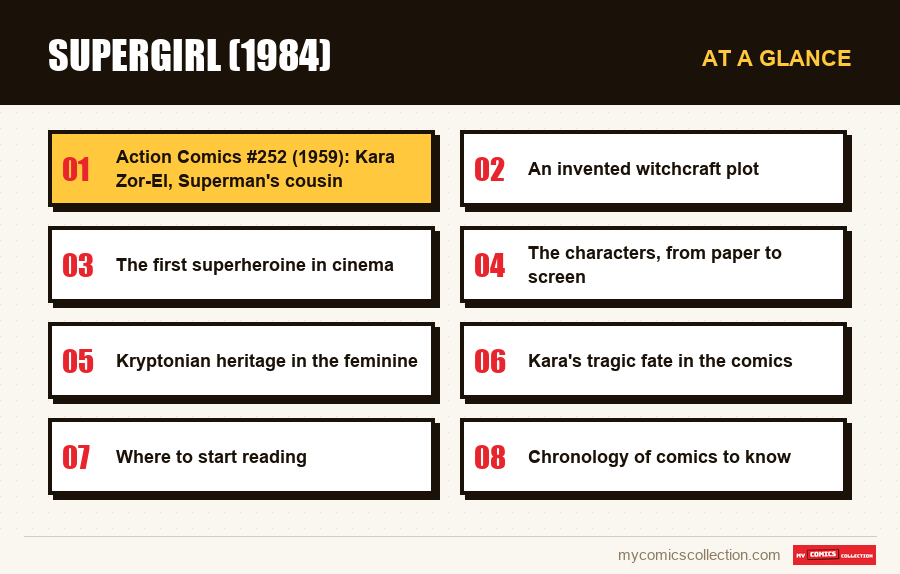
Action Comics #252 (1959): Kara Zor-El, Superman's cousin
Supergirl features Kara Zor-El, who appeared in Action Comics #252 (1959), created by Otto Binder and Al Plastino. Cousin of Superman, Kara is a survivor of Krypton: her city, Argo City, escaped the destruction of the planet by drifting in space on a fragment of soil. Sent to Earth by her parents, Kara develops the same powers as her cousin under the yellow sun: flight, superhuman strength, invulnerability, thermal vision. Adopting the secret identity of Linda Lee, she becomes Supergirl, one of DC's most famous superheroes. An emblematic character of the Silver Age, she embodies the feminine Kryptonian heritage and has become a major inspirational figure.
The film faithfully reproduces Kara's origin: her nature as Superman's Kryptonian cousin, her identical powers, her origins in a city that survived Krypton and her secret identity as a schoolgirl under the name of Linda Lee. Helen Slater plays a Supergirl who shines and discovers her powers on Earth. The film also retains its vulnerability to kryptonite. This basis respects the essence of the character established in 1959. A spin-off of Christopher Reeve's films, it places Supergirl in the same cinematographic universe as Superman, while developing an original plot centered on magic and witchcraft, far removed from the science fiction stories of the comics.
An invented witchcraft plot
The film's main freedom is its plot, which focuses on magic rather than science fiction. The antagonist, Selena, is an ambitious witch, a character invented for the film, who seizes a Kryptonian artifact, the Omegahedron, Argo City's source of vital energy, to increase her magical powers and dominate the world. Kara then leaves her city to recover the object and save her people. This witchcraft storyline, with its spells and rituals, moves away from Supergirl's science fiction origins in the comics, where her adventures are more of a classic space and superheroic adventure. The film opts for a fantastic tale tone, mixing magic and superpowers.
This reorientation towards magic transforms the story. Where the Silver Age comics anchor Supergirl in a science fiction universe (Krypton, kryptonite, extraterrestrials) the film superimposes a witchcraft plot that is foreign to it. Argo City is even located in a parallel dimension rather than drifting in space, another notable modification. These choices, motivated by a desire to differentiate Supergirl from Superman, distance the film from its source. For the reader, this gap illustrates the liberties taken by the adaptation. The film nevertheless retains the essentials of the character (her origin, her powers, her heroism) and invites us to discover the real Kara Zor-El in the comics, where her story is part of the rich Kryptonian mythology, from the classic stories of the Silver Age to the modern reinventions which have made her a complex and popular heroine.
The first superheroine in cinema
Supergirl marks a historic milestone by being one of the very first films to feature a female superhero in the lead role. At a time when the genre was largely dominated by male heroes, the film dares to feature a female protagonist, Kara Zor-El, in an action and adventure role. This approach, pioneering at the time, foreshadowed the much later rise of superhero films. Despite unfavorable critical and commercial reception, Supergirl blazed a trail and affirmed that a heroine could carry a blockbuster, a message that would only find its full resonance decades later.
This pioneering dimension gives the film historical importance, beyond its qualities. By playing Supergirl, Helen Slater offered a model of superheroine on screen, at a time when they were extremely rare. The character of Kara Zor-El, created in 1959, already carried this idea of a heroine in her own right, equal to Superman in power. The film continues this legacy. For the reader, this dimension reminds us of the important place of Supergirl in the history of superheroes and the evolution of female representation in the genre. She emphasizes that, well before the modern era of superhero films, DC already had, with Kara Zor-El, a strong and emblematic female figure, whose adaptation, despite its flaws, marked an important first symbolic step.
Collecting this series?
Track what you own, what you are missing and what your collection is worth. 7 day trial.
Start my trial →The characters, from paper to screen
- Kara Zor-El / Supergirl: The Kryptonian cousin, faithful to Action Comics #252.
- Selena: The antagonistic witch, invented for the film.
- Zaltar: Kara's mentor in Argo City, original character.
- Linda Lee: Kara's secret schoolgirl identity, true to the comics.
- Superman: Kara's cousin, mentioned but absent from the film.
Kryptonian heritage in the feminine
Supergirl embodies the idea that Krypton's legacy isn't limited to Superman. As Kal-El's cousin, Kara Zor-El carries the same blood, the same powers and the same ideal of justice. It represents an expansion of Kryptonian mythology, proving that the lineage of Krypton survivors includes more than one hero. In the comics, Supergirl has undergone many evolutions, from the candid young girl of the Silver Age to the tormented heroine of modern stories, including her significant death in a major saga of the 1980s. This richness makes Kara a much more complex character than a simple female version of Superman.
The film, by bringing Supergirl to the screen, celebrates this feminine Kryptonian heritage. It shows a heroine discovering her powers, learning to master them and embracing her mission, in the tradition of her cousin. This dimension, faithful to the spirit of the character, anchors the film in the mythology of Superman while giving Kara her own adventure. For the reader, the film is an invitation to discover the real Supergirl in the comics, where her rich and eventful story explores identity, heritage and emancipation. Kara Zor-El remains one of DC's great heroines, whose popularity has spanned the decades and inspired numerous adaptations, confirming that the heritage of Krypton also extends to the feminine, with strength and brilliance.
Kara's tragic fate in the comics
If the 1984 film presents a bright and candid Supergirl, the comics have reserved a much more dramatic destiny for the character. In 1985, in the monumental saga "Crisis on Infinite Earths", Kara Zor-El met a heroic and tragic end: she sacrificed herself to save her cousin Superman and the entire universe, in one of the most memorable moments in DC history. Her death, meant to be final, erased her from continuity for nearly twenty years, making her a symbol of ultimate sacrifice. This episode had a profound impact on readers and illustrates the important place of Supergirl in DC mythology, capable of carrying dramatic stakes of considerable magnitude.
This tragic fate contrasts with the lightness of the film, which favors adventure and the marvelous. It reveals a dimension of the character that the adaptation does not explore: that of a heroine ready for the supreme sacrifice, whose death redefined the DC universe. Kara has since returned to the comics, through various reinventions that have enriched her complexity, making her a figure of resilience and heroism. For the reader, this dramatic journey is an invitation to discover the true depth of Supergirl in the comics, well beyond the smiling image of the film. It reminds us that Kara Zor-El, far from being a simple variation of Superman, is a heroine in her own right, whose story combines courage, sacrifice and rebirth, at the heart of DC's greatest stories.
Where to start reading
To discover Supergirl, Action Comics #252 (1959) features her first appearance. “The Death of Superman” and especially “Crisis on Infinite Earths” (1985), where Kara meets a tragic fate, are major milestones. The modern series of Supergirl (2005) and the Sterling Gates run offer accessible rereads. This journey reveals the richness of the character beyond the film.
Chronology of comics to know
- 1959: Action Comics #252: The first appearance of Supergirl (Kara Zor-El).
- 1985: “Crisis on Infinite Earths”: Kara’s tragic fate, a striking moment.
- 2005: Supergirl (modern series): a contemporary reinterpretation of the character.
Collection side: what numbers to aim for after the film
Supergirl points to major keys. Action Comics #252 (1959, first appearance of Supergirl, but also of Metallo) is a crucial key to the Silver Age, very sought after. Crisis on Infinite Earths #7 (1985, The Death of Supergirl) is an iconic key to the 1980s. Modern series are accessible targets. These numbers cover various budgets. As always, condition and gradation determine value; relying on real recent sales is strongly recommended.
Its place in the saga and for the collector
Supergirl will remain as a historic milestone, the first film to star a superheroine, despite an unfavorable reception. For the collector, it highlighted Action Comics #252, key to the Silver Age. It illustrates the liberties taken by the adaptations, notably the turn towards magic. Beyond her faults, Kara Zor-El remains a major DC heroine, to be discovered in the comics. By embodying Kryptonian heritage in a feminine way, she reminds us that the mythology of Superman extends well beyond the Man of Steel alone.
The verdict: a faithful origin, a reinvented plot
- Loyalty: Kara Zor-El, her powers identical to Superman, her Kryptonian origins, her identity as Linda Lee and her weakness to kryptonite come from the comics.
- Freedoms: the invented witch Selena, the magic plot, Argo City in a parallel dimension, the original Omegahedron, the absence of Superman.
- Collectible numbers: Action Comics #252 (Supergirl), Crisis on Infinite Earths #7 (her death).
Supergirl brings to the screen Kara Zor-El, Superman's Kryptonian cousin with the same powers. Faithful to its origin and its heritage but inventing a witchcraft plot far removed from the science fiction of comics, the film marks a step forward by entrusting the poster to a superheroine. For the reader as well as the collector, it is an invitation to discover Action Comics #252 and the modern stories of the heroine.
Frequently asked questions
From Action Comics #252 (1959), created by Otto Binder and Al Plastino. Kara Zor-El is Superman's cousin, survivor of the Kryptonian city of Argo City, endowed with the same powers as him. The film faithfully reproduces this origin.
Yes. Kara Zor-El is the Kryptonian cousin of Kal-El (Superman). His city, Argo City, escaped the destruction of Krypton. Sent to Earth, she develops the same powers as her cousin. The film faithfully preserves this family connection and this origin.
No. The antagonist, the witch Selena, and the plot centered around magic and the Omegahedron are invented for the film. Supergirl comics are more science fiction and superheroic adventure than witchcraft.
The film, a spin-off of Christopher Reeve's films, justifies Superman's absence by saying he was kept "off-world" during a mission. This allows Supergirl to be the sole heroine and to carry the story alone, a first for a superheroine in the cinema.
Action Comics #252 (1959, first appearance of Supergirl and Metallo) is a key key to the Silver Age. Crisis on Infinite Earths #7 (1985, the death of Supergirl) is another iconic key to the 1980s.
Does the film make you want to collect? Estimate the value for free of your issues (Action Comics #252, Crisis on Infinite Earths…) with our tool based on current eBay listings.