
Blue Beetle (2023) Angel Manuel Soto , with Xolo Maridueña , adapts Jaime Reyes, the third Blue Beetle, appeared in Infinite Crisis #3 (2005). A Latino teenager discovers an alien beetle that equips him with powerful armor. The film stays true to Jaime and his family while expanding on the original story. Here is the detailed comparison, film versus comics.
The first Latino superhero from DC to carry a blockbuster, Blue Beetle highlights Jaime Reyes and the beetle that links him to extraterrestrial technology. It draws on a line of heroes that dates back to the 1930s. Decryption source by source.
As in each article in this series, only verified information (creators, distribution, dates, comic numbers) is stated; the comparative analysis is ours, without reproducing dialogue or protected images.
Title : Blue Beetle (2023)
Director: Angel Manuel Soto
Actors: Xolo Maridueña (Jaime Reyes), Susan Sarandon (Victoria Kord), George Lopez (Uncle Rudy)
Exit : August 2023
Studio: Warner Bros.
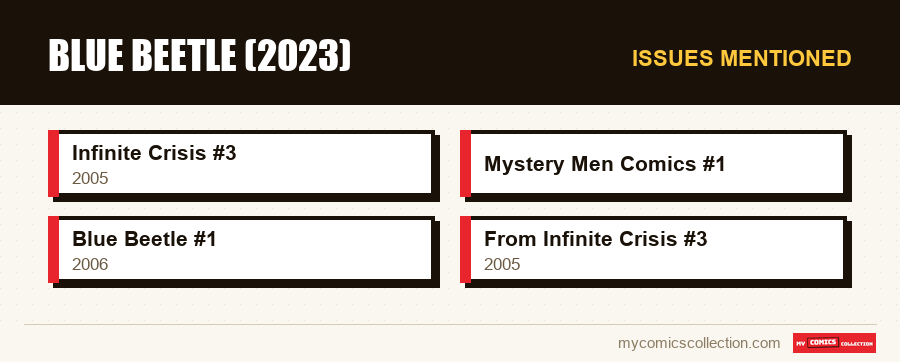
Infinite Crisis #3 (2005): 1st appearance of Jaime Reyes
Blue Beetle (vol. 8)(2006): his solo series
The Beetle: the alien technology of the Reach
The Blue Beetle lineage: Dan Garrett then Ted Kord
- Jaime Reyes, Latino teenager, third Blue Beetle.
- Le Beetle, alien technology from the Reach.
- L'armor which forms around him and generates weapons.
- Sa family, central pillar of the character.
- His origins in El Paso, Texas.
- Victoria Kord, antagonist invented for the film.
- La family Reyes is fleshed out (Uncle Rudy, Nana).
- Le Reach extraterrestrial is hardly present.
- L'OMAC armor as an adversary.
- The original story is condensed and refocused.
Infinite Crisis #3 (2005): Jaime Reyes, the new Blue Beetle
Blue Beetle stars Jaime Reyes, who appeared in Infinite Crisis #3 (2005), created by Keith Giffen, John Rogers and Cully Hamner. A Latino teenager from El Paso, Texas, Jaime discovers a mysterious alien beetle that merges with him and gives him super-powered armor, capable of generating all kinds of weapons and adapting to situations. The third character to bear the name Blue Beetle, Jaime is distinguished from his predecessors by his youth, his family and cultural roots, and his unique relationship with the Scarab, an extraterrestrial intelligence. An emblematic character of diversity at DC, he has become one of the faces of the new generation of heroes.
The film faithfully captures the essence of Jaime: an ordinary teenager, close to his family, whose life is turned upside down when the Beetle chooses him. Xolo Maridueña plays this endearing hero, torn between his family responsibilities and his new power. The film highlights the Scarab's armor, capable of creating weapons and flying, faithful to the comics. It maintains the character's El Paso roots and Latino culture, a central aspect of his identity. This loyalty to Jaime Reyes and his origins makes the film a respectful adaptation of the character, while developing the story for the big screen.
The Beetle and the Blue Beetle lineage
At the heart of the character is the Scarab, an alien technology linked to a conquering race called the Reach in the comics. This ancient artifact, which merges with Jaime, is an entity with its own consciousness, with which the hero must learn to coexist. The Scarab also links Jaime to the Blue Beetle lineage: before him, Dan Garrett (appeared at the Fox publisher in 1939) then Ted Kord (in the 1960s) bore this name. Jaime thus inherits a rich heritage, while profoundly renewing it through his symbiotic relationship with the artifact. This dimension makes Blue Beetle a unique character, mixing alien technology and heritage.
The film leverages the Scarab as its central element, showing the armor that forms around Jaime and generates adaptive weapons. It evokes the consciousness of the artifact, with which Jaime dialogues, faithful to the relationship in the comics. The film, however, condenses the mythology of the Reach, the conquering alien race being little present in favor of a more terrestrial intrigue around Victoria Kord, the antagonist created for the film. This adaptation refocuses the story on Jaime, his family and his immediate struggle, while preserving the essence of the Scarab. For the reader, the film is a gateway to the 2006 series which fully develops the mythology of the Reach and the Blue Beetle lineage, rich in decades of history.
The family, the beating heart of the story
What sets Blue Beetle apart from other DC heroes is the centrality of family. Unlike many orphaned or lonely superheroes, Jaime Reyes is surrounded by a loving and close-knit family (his parents, his sister, his grandmother, his uncle) who knows his secret and supports him. This family dimension, present in the comics, is amplified in the film, which makes it the emotional heart of the story. The Reyes family, with its colorful members like Uncle Rudy and Nana, embodies the warmth, solidarity and Latino values that define the character. The film celebrates this family as Jaime's true source of strength.
This celebration of family gives the film a distinct identity in the landscape of superhero adaptations. Where many feature isolated heroes, Blue Beetle asserts that strength comes from family ties and community. The film develops each member of the Reyes family, giving them an active place in Jaime's adventure. This approach, faithful to the spirit of comics while amplifying it, offers a welcome freshness and an authentic representation of Latino culture. For the reader, she illustrates what makes Jaime Reyes special: a hero rooted in his family and community, whose alien powers never erase humanity or his roots. The film fully captures this unique dimension of the character.
Collecting this series?
Track what you own, what you are missing and what your collection is worth. 7 day trial.
Start my trial →The characters, from paper to screen
- Jaime Reyes / Blue Beetle: The Latino teen from El Paso, faithful to Infinite Crisis #3.
- The Beetle: The sentient alien technology that merges with Jaime.
- Victoria Kord: Antagonist created for the film, linked to the Kord family.
- The Reyes family: Emotional pillar, amplified on screen.
- Ted Kord: The previous Blue Beetle, mentioned in the film.
A Latino hero at the forefront
Blue Beetle marks a milestone by bringing to the screen DC's first Latino superhero to lead a blockbuster. Jaime Reyes, created in 2005, has from the outset embodies this cultural identity, anchored in El Paso and in the Mexican-American community. The film fully honors this dimension, highlighting Latino language, traditions and family values. This authentic representation meets a growing demand for diversity in superhero stories and gives Blue Beetle a reach beyond mere entertainment. The film is thus part of the movement to renew comic book heroes, more representative of society.
This highlighting of a Latino hero illustrates the evolution of the superheroic genre, long dominated by uniform figures. By placing Jaime Reyes and her culture at the forefront, the film paves the way for broader representation and honors the vision of its creators. This dimension, faithful to the spirit of the comics, gives the film a particular resonance with an audience that has long been under-represented. For the reader, it reminds us that Blue Beetle is not just another hero, but the symbol of a more diverse generation at DC. The film captures this cultural importance, making Jaime Reyes a role model and a gateway to comics that celebrate the richness and diversity of the contemporary superheroic universe.
Armor designed by extraterrestrial intelligence
One of the most original aspects of Blue Beetle is the nature of his armor, generated by the Beetle, an alien intelligence with its own consciousness. Unlike other heroes whose equipment is inert, Jaime Reyes coexists with an entity that thinks, reacts and proposes solutions, sometimes lethal, that the young hero must temper. This symbiotic relationship, developed in the comics, creates a unique dynamic: Jaime must learn to master a partner who is as powerful as he is unpredictable, whose warrior values are opposed to his humanity. The armor can generate endless weapons, from blades to energy cannons, instantly adapting to every threat.
The film fully exploits this dimension, showing the Scarab as a character in its own right with whom Jaime dialogues, negotiates and argues. This relationship brings a touch of humor and depth, illustrating the contrast between Jaime's gentleness and the brutality of the artifact. Adaptive armor also offers a rich visual spectacle, with each construct reflecting the hero's imagination and state of mind. For the reader, this symbiosis is one of the character's most fascinating ideas, explored in depth in the 2006 series. It makes Blue Beetle much more than an armored hero: a teenager learning to coexist with an alien power, a central theme that the film aptly captures and which sets Jaime Reyes apart from all the other DC heroes.
Where to start reading
To extend the film, Infinite Crisis #3 (2005) features the first appearance of Jaime Reyes. The Blue Beetle series (vol. 8, 2006) by John Rogers and Keith Giffen fully develops the character, his family, and the mythology of the Reach: it's the ideal read. “Blue Beetle: Rebirth” (2016) offers a modern reinterpretation. This trail covers the source material for a film centered on Jaime Reyes.
Chronology of comics to know
- 1939: Mystery Men Comics #1: the first appearance of Dan Garrett, first Blue Beetle (Fox publisher).
- 2005: Infinite Crisis #3: the first appearance of Jaime Reyes.
- 2006: Blue Beetle (vol. 8): the solo series by Jaime Reyes.
Collection side: what numbers to aim for after the film
Blue Beetle points to modern keys. Infinite Crisis #3 (2005, first appearance of Jaime Reyes) is the key sought after by collectors, all the more valued since the film. Blue Beetle #1 (2006, his first solo series) is another accessible target. The collections from the 2006 series are affordable modern targets. These numbers cover various budgets. As always, condition and gradation determine value; relying on real recent sales is strongly recommended.
Its place in the saga and for the collector
Blue Beetle brought Jaime Reyes, DC's first Latino superhero to lead a blockbuster, to the screen and celebrated his family. For the collector, it reignited interest in Infinite Crisis #3, key to its first appearance. It illustrates the effect of adaptations on the modern comics market. Beyond speculation, the film invites you to discover Jaime Reyes in comics, from the founding story of 2005 to his solo series. By highlighting family and Latino culture, it reminds us that Blue Beetle embodies a new generation of heroes, more diverse and anchored in the community.
The verdict: a faithful and family adaptation
- Loyalty: Jaime Reyes, the Beetle, adaptive armor, family, origins in El Paso and Latino culture come from the comics.
- Freedoms: Victoria Kord invented, the family amplified, the Reach condensed, the OMAC armor as an adversary, the origin story refocused.
- Collectible numbers: Infinite Crisis #3 (Jaime Reyes), Blue Beetle #1 (2006).
Blue Beetle brings to the screen Jaime Reyes, the Latino teenager from El Paso chosen by an alien beetle. Staying true to the character, his armor and his family while expanding on the original story, the film celebrates diversity and family ties. For both the reader and the collector, it is an invitation to discover Infinite Crisis #3 and the 2006 series.
Frequently asked questions
From Infinite Crisis #3 (2005), created by Keith Giffen, John Rogers and Cully Hamner. Jaime Reyes is the third character named Blue Beetle, a Latino teenager from El Paso who is linked to an alien beetle. The film takes it up faithfully.
Extraterrestrial technology linked to a conquering race, the Reach, in the comics. The Scarab merges with Jaime, giving him powerful armor and possessing his own consciousness. The film exploits the artifact's armor and consciousness, while condensing the mythology of the Reach.
Yes, Jaime is the third. Before him, Dan Garrett (appeared at the Fox publisher in 1939) then Ted Kord (in the 1960s) bore this name. The film evokes Ted Kord and the Kord family, placing Jaime in this lineage.
Unlike many lonely heroes, Jaime is surrounded by a loving family who knows his secret and supports him. This dimension, present in the comics, is amplified in the film, which makes it the emotional heart and the true source of strength of the hero.
Infinite Crisis #3 (2005, first appearance of Jaime Reyes) is the sought-after key, promoted since the film. Blue Beetle #1 (2006, his first solo series) is another accessible target.
Does the film make you want to collect? Estimate the value for free of your issues (Infinite Crisis #3, Blue Beetle #1…) with our tool based on current eBay listings.