Black Adam (2022) Jaume Collet-Serra , with Dwayne Johnson, adapts the antihero born in The Marvel Family #1 (1945) by Otto Binder and C.C. Beck, endowed with the same powers as Shazam. The film features Teth-Adam of Kahndaq and the Justice Society (JSA), with Hawkman (Flash Comics #1, 1940) and Doctor Fate (More Fun Comics #55, 1940). Faithful to the ambiguity of the character, he modernizes his story. Here is the detailed comparison, film versus comics.
Adaptation of a powerful and ambiguous antihero, Black Adam brings to the screen the enemy turned antihero of Shazam. It draws on the mythology of Fawcett and the Justice Society. Source-by-source decryption.
As in each article in this series, only verified information (creators, distribution, dates, comic numbers) is stated; the comparative analysis is ours, without reproducing dialogue or protected images.
Title : Black Adam (2022)
Director: Jaume Collet-Serra
Actors: Dwayne Johnson (Black Adam), Pierce Brosnan (Doctor Fate), Aldis Hodge (Hawkman), Noah Centineo (Atom Smasher)
Exit : October 2022
Studio: Warner Bros.
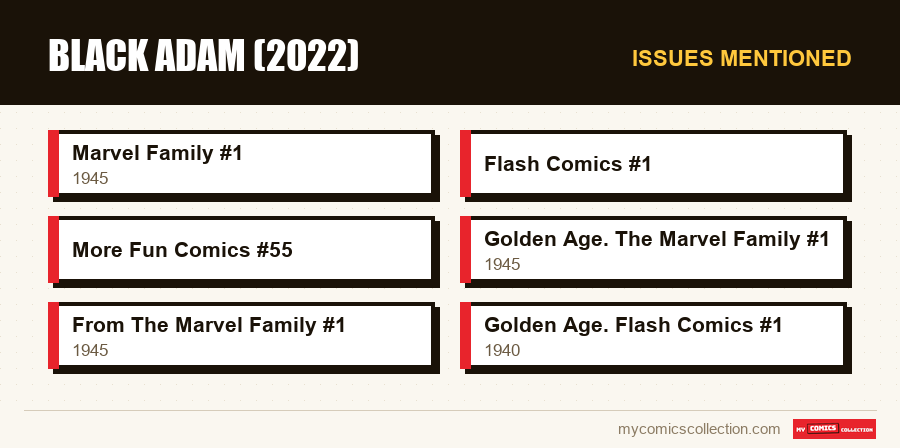
The Marvel Family #1 (1945): Black Adam's first appearance
Flash Comics #1 (1940): Hawkman's first appearance
More Fun Comics #55 (1940): 1st appearance of Doctor Fate
The Justice Society (JSA): the first superhero team
- Teth-Adam, ancient hero of the kingdom of Kahndaq.
- His powers, identical to those of Shazam.
- Her moral ambiguity, between vigilante and tyrant.
- La Justice Society (Hawkman, Doctor Fate, Atom Smasher, Cyclone).
- Le magic word “SHAZAM” and its origin.
- L'origin of Teth-Adam is reorganized (his son).
- The plot (Sabbac's crown) is original.
- Kahndaq is modernized in an occupied nation.
- The link to Shazam is sketched rather than developed.
- The tone emphasizes the spectacular action.
The Marvel Family #1 (1945): the birth of Black Adam
Black Adam appears in The Marvel Family #1 (1945), created by Otto Binder and C.C. Beck for Fawcett Comics. Teth-Adam, a former champion of the ancient kingdom of Kahndaq, is granted by a magician the same powers later bestowed upon Shazam (Billy Batson): the strength, speed, and power of the gods, invoked by the word "SHAZAM." But where Billy embodies innocence and goodness, Teth-Adam, corrupted by power and marked by the loss of his loved ones, becomes an ambiguous figure, oscillating between ruthless vigilante and tyrant. Originally an enemy of the Shazam family, he has evolved over the decades into a complex antihero, one of the most fascinating in DC, particularly under the pen of Geoff Johns.
The film takes up the essence of the character: Teth-Adam of Kahndaq, his powers identical to Shazam, his moral ambiguity, his magic word. Dwayne Johnson plays a massive and ruthless Black Adam, whose expeditious justice and violence contrast with classic heroism. The film, however, rearranges her origin, linking her to her son and the history of Kahndaq, an oppressed nation. This rereading, which modernizes the context, preserves the tragic and ambiguous dimension of the character: a man broken by loss, whose power serves as much to protect as to punish. This fidelity to the ambiguity of Teth-Adam is at the heart of the film.
The Justice Society, the first superhero team
The film features the Justice Society of America (JSA), the first superhero team in comic book history, born in the 1940s. It brings together several members: Hawkman, appeared in Flash Comics #1 (1940), winged warrior armed with a falcon mask; THE Doctor Fate, appeared in More Fun Comics #55 (1940), a magic-wielding golden-helmeted wizard; as well as Atom Smasher and Cyclone, more recent heroes. The JSA, sent to arrest Black Adam deemed too dangerous, offers the film a heroic counterpoint to the ambiguity of Teth-Adam. This introduction of the Justice Society to cinema is one of the film's notable contributions.
The Justice Society occupies a founding place in the history of DC: it is the first team of superheroes, ancestor of the Justice League, bringing together the heroes of the golden age. The film honors this heritage by bringing to the screen several of its emblematic members, including Hawkman and Doctor Fate, two major and former figures of the publisher. Their opposition to Black Adam raises a moral question: what to do with a powerful being whose brutal methods serve a just cause? This tension between the classic heroism of the JSA and the ambiguity of Teth-Adam structures the film. For the reader, the Justice Society is an invitation to discover the first superhero team in comics, whose rich history dates back to the origins of the genre.
Teth-Adam, an ambiguous antihero
The heart of the film is the moral ambiguity of Teth-Adam, neither quite hero nor quite villain. Unlike Shazam, a luminous figure, or the classic DC heroes, Black Adam applies uncompromising justice: he kills his enemies, refuses half-measures, and his power serves as much to free Kahndaq as to impose his law. This dimension, faithful to the evolution of the character in the comics, makes him a fascinating and disturbing figure. The film explores this ambiguity, showing a Teth-Adam driven by pain and revenge, whose brutal heroism questions the limits of justice. Dwayne Johnson embodies this relentless power and inner torment.
This ambiguity is what sets Black Adam apart from other DC heroes. Where Superman embodies the moral ideal and Batman the discipline, Teth-Adam represents a darker and more radical justice, in line with modern antiheroes. The film assumes this dimension, pitting Black Adam against the JSA precisely on the question of violence and morality. This exploration, faithful to the richness of the character developed by Geoff Johns in the comics, gives the film its thematic depth. For the reader, Teth-Adam is an invitation to discover this complex antihero in the comics, where his journey, from villain to ambiguous protector of Kahndaq, has fueled stories exploring power, revenge and redemption with remarkable nuance.
Collecting this series?
Track what you own, what you are missing and what your collection is worth. 7 day trial.
Start my trial →The characters, from paper to screen
- Teth-Adam / Black Adam: Ancient antihero of Kahndaq with the powers of Shazam, faithful to his ambiguity.
- Hawkman: Winged warrior of the JSA, faithful to Flash Comics #1.
- Doctor Fate: Wizard with the golden helmet, faithful to More Fun Comics #55, played by Pierce Brosnan.
- Atom Smasher and Cyclone: Newer members of the Justice Society.
- Kahndaq: The ancient kingdom of Teth-Adam, modernized into an occupied nation.
An antihero for a universe in search
Black Adam is part of the DC cinematic universe's efforts to diversify its figures and introduce new characters. By bringing to the screen such a powerful and ambiguous antihero, as well as the Justice Society, the film sought to expand the DC pantheon in cinema and provide a counterpoint to classic heroes. Dwayne Johnson, long attached to the project, embodied the ambition to make Black Adam a major figure in the saga. The film emphasizes spectacular action and the power of the character, in a register more entertaining than dramatic, seeking to appeal to a wide audience while introducing a rich mythology.
This ambition illustrates the desire to explore the richness of the DC universe beyond its most famous icons. Black Adam and the Justice Society belong to a deep mythology, born from the golden age of comics, which the film seeks to introduce to the general public. For the reader, it is an invitation to explore these figures in the comics: Black Adam, complex antihero developed by Geoff Johns, and the Justice Society, the first superhero team in history. The film, by bringing them to the screen, recalls the depth and antiquity of the DC universe, whose roots go back to the very origins of the superheroic genre, rich in ambiguous and fascinating characters.
A launch thwarted by DC's transition
Black Adam was released at a pivotal time for the DC Cinematic Universe, in the midst of a reorganization and transition. Driven by Dwayne Johnson's ambition to establish Black Adam as a major figure and to "change the hierarchy of powers" of the saga, the film had high expectations. But its mixed reception and the shake-up of the studio's strategy thwarted these plans, leaving the future of the character and the Justice Society uncertain at the cinema. This particular context weighed on the film's career, despite the appeal of its antihero and the first appearance of the JSA on screen.
This situation illustrates the challenges of a cinematic universe in search of coherence and direction. Despite these uncertainties, Black Adam had the merit of introducing to the general public a complex antihero and the Justice Society, rich and ancient figures of the DC universe. For the reader, the film is an invitation to discover the depth of these characters in the comics, from Teth-Adam, antihero developed by Geoff Johns, to the first superhero team in history. Beyond the vagaries of his cinematic career, Black Adam recalls the richness of a DC universe whose roots go back to the golden age, and whose ambiguous figures offer considerable dramatic potential, to be explored first in the pages of the comics.
Where to start reading
To extend the film, The Marvel Family #1 (1945) features the first appearance of Black Adam. “Black Adam: The Dark Age” (2007) and Geoff Johns’ run on the JSA develop the antihero. Flash Comics #1 (1940) introduced Hawkman, and More Fun Comics #55 (1940) introduced Doctor Fate. This journey covers the source material for a film rooted in the mythology of Fawcett and the Justice Society.
Chronology of comics to know
- 1940: Flash Comics #1 and More Fun Comics #55: the first appearances of Hawkman and Doctor Fate.
- 1945: The Marvel Family #1: Black Adam's first appearance.
- 2000s: Geoff Johns' run develops the antihero and the JSA.
Collection side: what numbers to aim for after the film
Black Adam points to keys to the Golden Age. The Marvel Family #1 (1945, first appearance of Black Adam) is a sought-after issue from Fawcett's golden age. Flash Comics #1 (1940, Hawkman and Flash) and More Fun Comics #55 (1940, Doctor Fate) are major keys to the Golden Age. Geoff Johns' run offers accessible modern targets. These numbers cover budgets ranging from high to reasonable. As always, condition and gradation determine value; relying on real recent sales is strongly recommended.
Its place in the saga and for the collector
Black Adam brought an ambiguous antihero and the Justice Society to the screen, expanding the DC pantheon to cinema. For the collector, it reignited interest in The Marvel Family #1, Flash Comics #1 and More Fun Comics #55. It illustrates the effect of adaptations on the market. Beyond speculation, the film invites us to discover the mythology of Fawcett and the Justice Society in the comics, as well as the complex antihero that is Teth-Adam. By bringing these ancient and ambiguous figures to the screen, he recalls the depth and richness of the DC universe, at the roots of the golden age.
The verdict: an ambiguous and spectacular antihero
- Loyalty: Teth-Adam, his powers, his moral ambiguity, the Justice Society (Hawkman, Doctor Fate) come from the comics.
- Freedoms: the origin rearranged (his son), the plot of the crown of Sabbac, Kahndaq modernized, the emphasis on action.
- Collectible numbers: The Marvel Family #1 (Black Adam), Flash Comics #1 (Hawkman), More Fun Comics #55 (Doctor Fate).
Black Adam brings to the screen the ambiguous antihero of Kahndaq and the Justice Society, true to the power and troubled morality of Teth-Adam. Faithful to the spirit of the character and the figures of the golden age but rearranging his origin, the film places the emphasis on action. For both the reader and the collector, it is an invitation to discover The Marvel Family #1 and the Justice Society.
Frequently asked questions
From The Marvel Family #1 (1945), created by Otto Binder and C.C. Beck for Fawcett Comics. Teth-Adam, ancient champion of Kahndaq, is given the same powers as Shazam, but becomes an ambiguous figure. The film faithfully captures its essence.
Yes: Teth-Adam invokes the same magic word, "SHAZAM", and draws the same powers from the ancient gods. But where Billy Batson embodies good, Black Adam, corrupt and bereaved, is an ambiguous antihero, oscillating between vigilante and tyrant.
The first team of superheroes in the history of comics, born in the 1940s, ancestor of the Justice League. The film brings together several members (Hawkman, Doctor Fate, Atom Smasher, Cyclone) sent to stop Black Adam.
An ambiguous antihero: originally an enemy of Shazam, he has evolved into a complex figure, applying uncompromising justice. He kills his enemies and imposes his law, which pits him against the Justice Society on the question of morality.
The Marvel Family #1 (1945, Black Adam) is a key to the Golden Age. Flash Comics #1 (1940, Hawkman) and More Fun Comics #55 (1940, Doctor Fate) are major keys to the golden age.
Does the film make you want to collect? Estimate the value for free of your issues (The Marvel Family #1, Flash Comics #1…) with our tool based on current eBay listings.