
Aquaman (2018) James Wan , with Jason Momoa, adapts the sea king born in More Fun Comics #73 (1941) by Mort Weisinger and Paul Norris. The film covers Arthur Curry, Atlantis, Mera , Black Manta and his half-brother Ocean Master, in a spectacular underwater epic. Faithful to Atlantean mythology, he modernizes the character. Here is the detailed comparison, film versus comics.
An underwater epic that restored the king of the seas to his former glory, Aquaman brings to the screen a hero who has long been underestimated. It draws on more than seventy-five years of Atlantean mythology. Source-by-source decryption.
As in each article in this series, only verified information (creators, distribution, dates, comic numbers) is stated; the comparative analysis is ours, without reproducing dialogue or protected images.
Title : Aquaman (2018)
Director: James Wan
Actors: Jason Momoa (Arthur Curry), Amber Heard (Mera), Patrick Wilson (Orm), Yahya Abdul-Mateen II (Black Manta)
Exit : December 2018
Studio: Warner Bros.
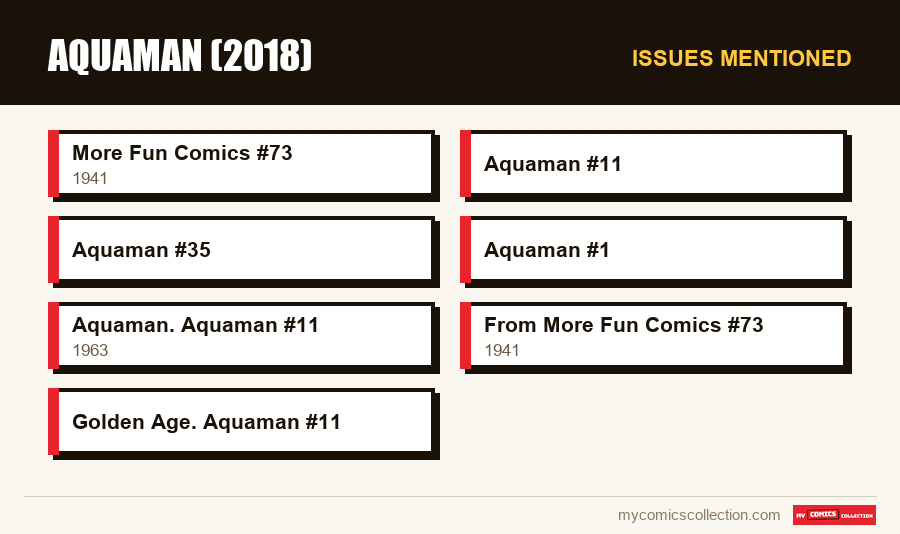
More Fun Comics #73 (1941): Aquaman's first appearance
Mera: the queen of the seas (Aquaman #11, 1963)
Black Manta: the archenemy (Aquaman #35, 1967)
Ocean Master (Orm): the rival half-brother
- Arthur Curry, born to an Atlantean and a lighthouse keeper.
- His powers: communication with marine life, strength, aquatic breathing.
- Atlantis and the throne that the brothers dispute.
- Mera, warrior and ally of Arthur.
- Black Manta and Ocean Master, his enemies.
- Arthur becomes a gruff rebel, far from the classic blond king.
- The plot (the lost Trident) is largely original.
- La initiatory quest and the adventurous tone are amplified.
- Some origins are rearranged for the story.
- The aesthetic fantastic reinvents Atlantis.
More Fun Comics #73 (1941): The Birth of Aquaman
Aquaman appears in More Fun Comics #73 (1941), created by Mort Weisinger and Paul Norris. Arthur Curry was born from the union of an Atlantean princess, Atlanna, and a human lighthouse keeper, which gives him unique powers: the ability to breathe underwater, communicate with marine life, superhuman strength and resistance adapted to the depths. Heir to the throne of Atlantis, he evolves between two worlds, the surface and the oceans. Long mocked as a minor hero, capable only of "talking to fish", Aquaman nevertheless has a rich mythology, mixing underwater royalty, Atlantean conflicts and ecological issues. The film helped rehabilitate the character among the general public.
The film takes up the essence of Aquaman: Arthur Curry, his half-Atlantean, half-human origins, his powers, Atlantis, the disputed throne, Mera, Black Manta and Ocean Master. Jason Momoa plays a charismatic and gruff Arthur, very far from the blond and noble king of classic comics. This reinvention of the character, more rebellious and modern, appealed to a wide audience. The film unfolds a spectacular underwater epic, transforming Aquaman into an adventure hero. The main freedom lies in the largely original plot, centered on the quest for a legendary trident. On Atlantean mythology, on the other hand, the film remains faithful to the spirit of the comics, bringing to the screen the richness of the underwater kingdom.
Atlantis and the brotherly conflict
The heart of the film is the conflict for the throne of Atlantis between Arthur and his half-brother Orm, aka Ocean Master. In the comics, Ocean Master is one of Aquaman's great enemies, a rival for the Atlantean throne, driven by ambition and resentment. The film picks up on this sibling rivalry: Orm, king of Atlantis, seeks to unite the underwater kingdoms to declare war on the surface, while Arthur, the reluctant rightful heir, must claim the throne to prevent him. This opposition between the two brothers, one claiming his Atlantean purity, the other his mixed heritage, structures the story and gives it its dynastic dimension.
This conflict allows the film to explore the mythology of Atlantis, one of DC's richest universes. The underwater kingdom, its different cities, its factions, its thousand-year-old history offer an epic setting for the adventure. The film visually reinvents Atlantis in a fantastic and spectacular aesthetic, bringing to the screen the excess of this submerged world. This immersion in the Atlantean universe is one of the great successes of the film, faithful to the richness of the comics while magnifying it. For the reader, Atlantis is an invitation to discover the underwater mythology of Aquaman, where royalty, wars and ecological issues nourish stories of epic scale, long underestimated but of great richness.
Mera and Black Manta
The film develops two major characters from the Aquaman mythology. Mera, appeared in Aquaman #11 (1963), is an Atlantean warrior with the power to control water, queen and companion of Arthur in the comics. The film makes her a strong and determined ally, who guides Arthur in his quest and fights alongside him. Amber Heard embodies this powerful character, true to her role as a full partner. Black Manta (David Kane), who appeared in Aquaman #35 (1967), is the hero's sworn enemy, an armored pirate driven by personal vengeance. The film develops his origin and his hatred of Arthur, setting up his role as a recurring antagonist.
These characters enrich the universe of the film and connect it to the mythology of the comics. Mera, in particular, embodies a strong heroine, far from the cliché of the damsel in distress, faithful to her status as queen and warrior in the comics. Black Manta, one of Aquaman's great villains, embodies a personal and lasting threat, whose rivalry with the hero has fueled decades of stories. The film develops his origin carefully, making him an enemy in his own right. For the reader, Mera and Black Manta are invitations to discover the richness of Aquaman's entourage in the comics, where allies and enemies populate an underwater universe of great depth, long unknown but fascinating.
Collecting this series?
Track what you own, what you are missing and what your collection is worth. 7 day trial.
Start my trial →The characters, from paper to screen
- Arthur Curry / Aquaman: King of the seas, half-Atlantean, half-human, reinvented as a gruff rebel.
- Mera: Atlantean warrior controlling water, strong ally of Arthur, loyal to Aquaman #11.
- Orm / Ocean Master: Half-brother and rival for the throne of Atlantis.
- Black Manta: Armored nemesis, faithful to Aquaman #35, originally developed.
- Atlanna: Arthur's Atlantean mother, queen of Atlantis.
The rehabilitation of an underestimated hero
Aquaman occupies a special place in the history of DC adaptations: he rehabilitated a character who had long been mocked and underestimated. For decades, Aquaman was the butt of jokes, reduced to a "fish-talking" hero, far from the stature of Batman or Superman. The film, by reinventing him as a charismatic adventure hero and deploying a spectacular underwater epic, restored the character to his former glory. Its immense commercial success, one of the greatest in the DC universe, proved that Aquaman could carry an ambitious blockbuster, transforming the image of the character among the general public.
This rehabilitation illustrates the unsuspected richness of a character whose Atlantean mythology offers considerable epic potential. By taking on the excess of Aquaman's underwater universe, the film revealed what the comics have known for a long time: the king of the seas is much more than a minor hero. For the reader, this success is an invitation to discover the richness of Aquaman in the comics, from his founding story of 1941 to the great modern runs which have deepened his mythology. The film served as a reminder that no character is intrinsically ridiculous, and that an ambitious adaptation can reveal the greatness of a long underestimated hero, reconciling the general public with the ruler of Atlantis.
James Wan and the ambition of an epic blockbuster
The success of Aquaman owes a lot to the vision of its director, James Wan. A filmmaker with a strong sense of spectacle, he approaches the character with considerable visual ambition, transforming the underwater universe of Atlantis into a teeming fantasy world. Marine creatures, sunken cities, epic battles: the film deploys excessive imagery, fully embracing the marvelous side of Atlantean mythology. This approach, which embraces excess rather than fearing it, has made it possible to bring to the screen a universe long considered difficult to adapt. James Wan thus revealed the epic potential of a hero that many thought impossible to take seriously.
This ambition illustrates an important lesson of adaptation: fully embrace the original material, however flamboyant it may be, rather than seeking to temper it. By embracing the visual and mythological richness of Atlantis, the film transformed a supposed weakness-the ridicule attributed to Aquaman-into a spectacular strength. For the reader, this success reminds us that the excess of comics is an asset, not a handicap, as long as it is brought to the screen with conviction. Aquaman will have proven that DC's underwater universe, with its kingdoms and its creatures, offers an epic playground, worthy of the greatest blockbusters, and restored the nobility of a long underestimated hero.
Where to start reading
To extend the film, More Fun Comics #73 (1941) features the first appearance of Aquaman. Aquaman #11 (1963) introduced Mera, and #35 (1967) introduced Black Manta. “Aquaman: The Trench” (2011) by Geoff Johns, “New 52” rereading, modernizes the character. This course covers the sources of a film which rehabilitates the king of the seas.
Chronology of comics to know
- 1941: More Fun Comics #73: the first appearance of Aquaman (and Green Arrow).
- 1963: Aquaman #11: Mera's first appearance.
- 1967: Aquaman #35: Black Manta's first appearance.
Collection side: what numbers to aim for after the film
Aquaman points to some major keys. More Fun Comics #73 (1941, first appearance of Aquaman and Green Arrow) is a grail of the Golden Age, doubly precious. Aquaman #11 (1963, Mera) and Aquaman #35 (1967, Black Manta) are sought-after keys to the Silver Age. Geoff Johns' run (2011) offers accessible modern targets. These numbers cover various budgets. As always, condition and gradation determine value; relying on real recent sales is strongly recommended.
Its place in the saga and for the collector
Aquaman rehabilitated the king of the seas and gave the DC universe one of its greatest successes. For the collector, it magnified the aura of More Fun Comics #73 and revived interest in Aquaman #11 and #35. It illustrates the effect of adaptations on the market. Beyond speculation, the film invites you to discover the Atlantean mythology of Aquaman in the comics, from the founding story to modern runs. By transforming a long-mocked hero into a blockbuster star, he recalls the unsuspected richness of a character whose underwater universe offers considerable epic potential.
The verdict: a successful Atlantean epic
- Loyalty: Arthur Curry, his powers, Atlantis, Mera, Black Manta and Ocean Master come from the comics.
- Freedoms: Arthur as a gruff rebel, the intrigue of the Trident, the amplified initiatory quest, the fantastic aesthetic of Atlantis.
- Collectible numbers: More Fun Comics #73 (Aquaman), Aquaman #11 (Mera), Aquaman #35 (Black Manta).
Aquaman brings the king of the seas to the screen in a spectacular underwater epic, rehabilitating a long underestimated hero. Faithful to Atlantean mythology (Mera, Black Manta, Ocean Master) but reinventing Arthur as a gruff rebel, the film was a huge success. For the reader as well as the collector, it is an invitation to discover More Fun Comics #73.
Frequently asked questions
From More Fun Comics #73 (1941), created by Mort Weisinger and Paul Norris. Arthur Curry, born to an Atlantean and a human, breathes underwater and communicates with marine life. The film faithfully reproduces its origins and its Atlantean mythology.
An Atlantean warrior with the power to control water, queen and companion of Arthur in the comics (Aquaman #11, 1963). The film makes her a strong and determined ally, faithful to her status as a full partner, played by Amber Heard.
Aquaman's nemesis, an armored pirate driven by personal vengeance, appeared in Aquaman #35 (1967). The film develops his origin and his hatred of Arthur, setting up his role as a recurring antagonist.
For decades, he was reduced to a “fish-talking” hero, far from the stature of Batman or Superman. The film, by reinventing him as a charismatic adventure hero, rehabilitated the character and revealed the richness of his Atlantean mythology.
More Fun Comics #73 (1941, premiere of Aquaman and Green Arrow) is a holy grail of the Golden Age. Aquaman #11 (Mera) and #35 (Black Manta) are sought-after Silver Age keys.
Does the film make you want to collect? Estimate the value for free of your issues (More Fun Comics #73, Aquaman #11…) with our tool based on current eBay listings.