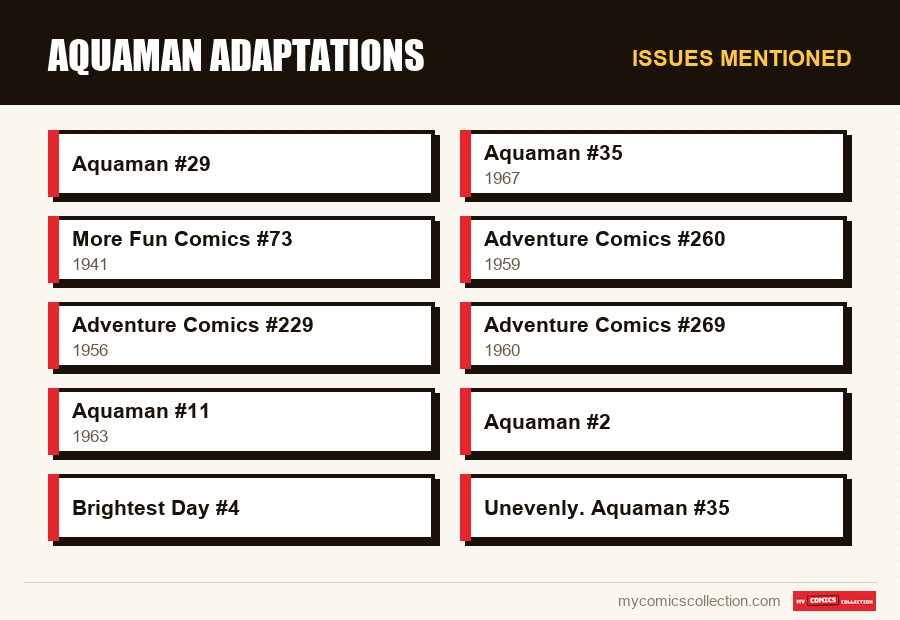
Aquaman adaptations do not have a uniform effect on the comics' ratings. The 2018 film starring Jason Momoa ($1.148 billion in worldwide revenue) caused a speculative surge in secondary keys like Aquaman #29 (first appearance of Ocean Master), followed by a correction of nearly 32% in eighteen months. Conversely, Aquaman #35 (Black Manta's first appearance, 1967) maintained lasting upward momentum. Historical pillars like More Fun Comics #73 (1941, very first appearance of Aquaman) remain driven by rarity and the CGC census, largely independent of the cinema calendar. The lesson: films create short-term noise, scarcity creates long-term value.
For decades, Aquaman was the comic sticking plaster of the DC pantheon: the "fish-talking" hero, gently mocked in sitcoms and Sunday morning cartoons. Then James Wan and Jason Momoa came along, and in the space of one feature film, The King of Atlantis became the highest-grossing DC film in the studio's history. Between these two images, there are seventy-seven years of editorial history, several costume redesigns, a handful of creators who shaped the character panel by panel, and an old comic market that reacted very unevenly to each new appearance on screen.
This article is not trying to sell dreams about “future million keys”. It unfolds, with verifiable sources (Heritage Auctions, GoCollect, Overstreet, CGC census), what really happened on the paper market each time Aquaman changed media: cinema, animation, video games. We will see that the impact of an adaptation depends less on the studio's marketing budget than on the nature of the key concerned: founding appearance, origin, or simple complementary villain.
For collectors who already own issues linked to the underwater universe of DC, or who plan to acquire them, understanding this mechanism avoids two classic traps: buying at the height of cinema hype which will subside, and neglecting historical pieces whose value owes nothing to the box office.
From the 1941 Origins to the Silver Age Redesign: The Founding of the Character
Aquaman made his very first appearance in November 1941 in More Fun Comics #73, an anthology issue that also introduces Green Arrow and his younger teammate Speedy. Editor Mort Weisinger commissioned the character, with drawing by Paul Norris: a detail that many casual collectors ignore, as Aquaman's public image has long been that of a second-rate hero. At the time, no one imagined that this issue would become one of the most sought-after Golden Age keys in the DC catalog: the print run of anthologies like More Fun Comics was modest compared to the flagship Superman or Batman titles, and the survival of so many copies over more than eight decades of wars, removals and ramming campaigns of the 1940s is almost a miracle.
The CGC census confirms this: copies in very high grade are extremely rare, with a single copy side 9.4 at the top of the census and only a handful of copies above 7.0-7.5. This structural rarity explains why the issue's value increased nearly ninefold between the 2009 Overstreet guide and the 2021 edition: an FN 6.0 copy rose from approximately $4,425 to $37,800, and a VF 8.0 from $11,000 to $82,000 over the same period. In April 2021, Heritage Auctions sold a CGC 7.5 example for $111,000, a record for the title at the time. This trajectory was built over nearly twenty years, long before Jason Momoa put on a suit of scales: proof that a Golden Age “first appearance” follows its own logic, largely disconnected from the studio schedule.
The character as we know him today, son of Atlantis and heir to the throne, did not yet exist in 1941. It was in Adventure Comics #260 (May 1959) that screenwriters Robert Bernstein and Ramona Fradon deliver the new origin that has become canonical: Arthur Curry, son of lighthouse keeper Tom Curry and Atlanna, exiled from the lost city of Atlantis. This issue lays the foundations of the Silver Age mythology and accompanies a visible evolution of the costume, with the addition of yellow gloves which will become a graphic signature of the character in the following decades. Topo, Aquaman's octopus companion, had already been introduced a little earlier, in Adventure Comics #229 (October 1956), while Aqualad, Garth's young teammate, made his debut a little later, in Adventure Comics #269 (February 1960), still under the pen of Bernstein and the pencil of Fradon.
Mera, Black Manta: the gallery of characters that built the franchise
The following decade added two figures to the corpus who would remain inseparable from the character until the big screen. Mera, the warrior queen of Atlantis and future wife of Arthur, first appears in Aquaman #11 (October 1963), created by screenwriter Jack Miller and designer Nick Cardy: the same one who would become the artist most associated with the title during the 1960s. Mera is not just a passing love interest: the character will evolve into a full-fledged queen, with her own powers of water manipulation, and will be played on screen by Amber Heard in the two DCEU films.
Four years later, in September-October 1967, Aquaman #35 introduces the character who will become the most emblematic antagonist of mythology: Black Manta. Written by Bob Haney and drawn by Nick Cardy, this late Silver Age issue is today considered the strongest key to the entire original series. Market values follow a clear curve according to the grid: around $500 in grade 6.0, around $950 in 8.0, up to $2,700 in 9.2. A CGC 9.6 copy sold for $5,877 in November 2018: that is to say at the exact time of the release of the first DCEU film dedicated to the character, in which Black Manta (played by Yahya Abdul-Mateen II) plays a central role. According to data published by GoCollect, certain grade brackets have posted cumulative returns exceeding 550% over time, driven by both Silver Age rarity and the character's continued on-screen presence, from the 2018 film through its 2023 sequel.
Another antagonist deserves to be mentioned to understand the speculative mechanics that will follow: Ocean Master, alias Orm, half-brother of Arthur, also created by Bob Haney and Nick Cardy and appeared in Aquaman #29 (September 1966). This number, long considered a niche secondary key, would become a textbook case of market behavior when faced with the announcement of a film: for the wrong reasons, as we will see later.
The 1990s: the Peter David redesign, or how a comic beat the cinema
After decades where the character struggled to emerge from the shadow of the pillars of the Justice League, screenwriter Peter David took over the title in 1994 with Aquaman (vol. 5) #1 (August 1994), as a continuation of his mini-series Time and Tide published the previous year. David carries out the most radical overhaul of the character's editorial history: long hair, beard, rougher silhouette and above all, in Aquaman #2, a plot where the villainous Charybdis has Arthur's right hand devoured by piranhas. The hero then replaces it with a metal harpoon, a radical visual choice which will become a strong symbol of this era of the character: "so that the sea creatures know that I am from the surface, and so that the men of the surface know that the sea can turn their weapons against them", sums up the narrative logic of the time.
What makes this period particularly interesting for an article on the impact of adaptations is the direction of the causal arrow: it is not a film that influenced the comics, but the opposite. The specialized press widely highlighted, at the time of the release of the 2018 film, the obvious visual relationship between the bearded and haired look of Jason Momoa and that designed for Peter David almost a quarter of a century earlier. The harpoon, on the other hand, was not retained for Arthur in the DCEU, but Peter David himself publicly raised, before the release of the sequels, the possibility of seeing the character lose a hand on screen, proof that the comparison between the paper version and the cinema version remains a live subject among the authors themselves. For a collector, this changes the reading of these issues: their heritage value is not based on a classic “first appearance key”, but on their status as a direct visual source of a major multimedia iteration of the character.
Rebirth, New 52 and the editorial relaunch that preceded the big screen
In November 2011, DC Comics relaunched its entire catalog with the New 52 initiative, and Aquaman is one of the flagship titles. Aquaman (vol. 7) #1, written by Geoff Johns and drawn by Ivan Reis, directly attacks the character's comic reputation: the very first scene of the issue features a waiter who mocks Arthur by asking him if he "talks to fish", before the story demonstrates in a few pages the real power of the king of Atlantis. This relaunch, praised by critics and by sales, permanently repositioned Aquaman as a heavyweight in the DC line-up rather than a foil, and laid the narrative foundations (seriousness of tone, ambiguity between the surface world and the underwater kingdom) which James Wan's film would take up seven years later.
The 2010 decade also saw the emergence of an important legatee figure for readers who follow recent continuity: Jackson Hyde, a young man who discovers his Atlantean powers and being the biological son of Black Manta, appears in the event Brightest Day, the first issue of which was released in August 2010, with a more developed presentation of the character from Brightest Day #4. However, it should not be confused with the Kaldur'ahm from the animated series. Young Justice (as of 2010): DC has explicitly treated the two as separate versions of the codename Aqualad, one for the comics continuity, the other for the television continuity: a nuance that is important for anyone looking for the "real" first appearance of a specific character.
Collecting this series?
Track what you own, what you are missing and what your collection is worth. 7 day trial.
Start my trial →The impact of adaptations on the rating
This is where the subject becomes most instructive for a collector-investor. Jason Momoa appears for the first time in Arthur Curry's costume in 2016 in Batman v Superman , then in Justice League (2017), before the major solo film directed by James Wan and released on December 21, 2018. The commercial result is spectacular: more than $1.148 billion in worldwide revenue, making Aquaman the most profitable film in the entire DC Extended Universe, crossing the symbolic billion-dollar milestone in mid-January 2019 according to Forbes: even though the critical reception remains described as mixed by several industry observers.
On the old comic market, this period of media hype (2016-2018) followed a pattern now well documented by GoCollect analysts: a speculative phase preceding the release, driven by collectors who anticipate a post-film surge, then a correction once the film has actually been released and the “catalyst” has been consumed. The case of Aquaman #29 (first appearance of Ocean Master, the film's main antagonist) perfectly illustrates this phenomenon: a CGC 7.5 copy was trading around $400 just before the film's release, before falling to around $176.50 sixteen months later, a drop of almost 32%. Prices have since partially rebounded, but remain, according to published data, below their peaks at the end of 2018: a textbook case of the famous “buy the rumor, sell the news” applied to the comics market.
Conversely, Aquaman #35 (Black Manta) did not experience the same brutal correction mechanics. The character, present from the first film and again central in the sequel, benefited from repeated rather than one-off screen exposure, which appears to have supported a more consistent pricing dynamic over time: with high grades continuing to post robust sales over the years following initial release. The difference between the two issues is less due to their relative rarity (both are late Silver Ages of comparable print run) than to the nature of the character concerned: a recurring antagonist exploited over several films generates more lasting interest than an antagonist confined to a single feature film.
The release of the animated miniseries Aquaman: King of Atlantis on HBO Max in October 2021, produced by James Wan with a more family and humorous tone, has however left no measurable trace on the old comics market: the series was also removed from the HBO Max catalog in August 2022. This counter-example confirms a simple rule: not all adaptations are equal in terms of market impact; the scale of the broadcast and the anchoring of the central character largely determine whether or not there will be a response to the auctions.
The second film, Aquaman and the Lost Kingdom, released at the end of December 2023, closes this cycle for the moment with a significantly more modest commercial result: around $440 million in worldwide revenue, compared to $1.148 billion for the 2018 opus, making it one of the least successful DCEU releases of its last generation. Logical consequence on the paper market side: no speculative wave comparable to that of 2018 was reported on the keys linked to the character on this occasion. This contrast between the two films offers a clear lesson to collectors: the scale of the success in theaters directly determines the intensity, and duration, of the effect on the price of the associated comics, and a film with a lackluster performance simply does not produce the same shock of supply and demand.
Buying Guide: Buy Smart on Aquaman Keys
Whether you are looking to complete a Silver Age collection or take advantage of a future revival of interest linked to an upcoming appearance on the screen, a few principles taken from the history of the market allow you to buy more confidently:
- Distinguish structural scarcity from cinema speculation. More Fun Comics #73 is worth what it's worth because of its extremely small CGC census over eight decades, not because of a movie; its price curve progressed long before Jason Momoa existed in the role. Do not pay a “film effect” premium on a key whose value is primarily driven by the physical survival of the copies.
- Beware of pre-release spikes on secondary nasty keys. The example of Aquaman #29 (Ocean Master) shows that a price peak in the months preceding a film can deflate by 30% or more once the film is released and "digested" by the market. If you buy in this window, do so consciously, not as a bet on continued upside.
- Favor characters with repeated exposure. Black Manta (Aquaman #35), present in the two films and several animated series, has lasted the distance better than a character confined to a single appearance on screen: media recurrence often counts more than the intensity of a single promotional peak.
- Systematically check the type of key claimed."First appearance", "first modern costume", "first Silver Age appearance" and "first solo print" do not refer to the same issue: Aquaman appears in 1941 (More Fun Comics #73), his modern costume and origin date from 1959 (Adventure Comics #260), and his first solo series is different again. A sales sheet that is unclear on this point deserves a cross-check before purchasing.
- Inspect the condition carefully on the Nick Cardy numbers. DC covers from the late 1960s (Aquaman #29, #35) are notoriously susceptible to peeling and yellowing on the edges; a grade advertised as “close to new” without CGC certification deserves a close photo examination before any payment.
- Consider Peter David numbers as an affordable entry point. Aquaman (vol. 5) #1-2 (1994), the origin of the bearded look popularized by the DCEU, generally remains more accessible than the Silver Age keys while carrying real historical legitimacy in the visual genealogy of the character on screen.
- Compare to actual sales rather than fixed price guides. The Overstreet type annual guides give a trend, but the market moves more quickly, particularly around adaptation releases. Cross-referencing several recently concluded sales remains the best method before validating a purchase.
If you already own one or more of these numbers and want an estimate based on actual eBay sales rather than a dated paper guide, the site's estimation tool calculates a low, middle and high range in seconds based on the series, number and condition entered. It is also a good reflex to follow the evolution of your pieces over the next announcements of adaptations, and to organize the monitoring of the overall collection via the collection management application of the site.