
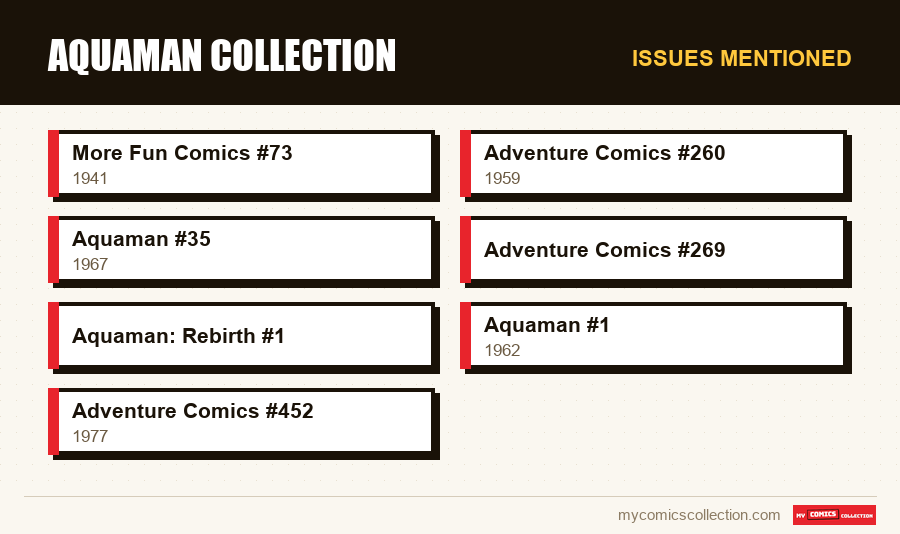
Building a coherent Aquaman collection requires knowing three layers: the birth of the character in More Fun Comics #73 (1941), its Silver Age rework initiated in Adventure Comics #260 (1959) with the arrival of Aqualad in #269 the following year, then modern milestones like Black Manta's first appearance in Aquaman #35 (1967) or the New 52 launch by Geoff Johns and Ivan Reis in 2011. The two feature films carried by Jason Momoa have revived interest in these founding issues, without eliminating the considerable differences in odds between a Golden Age copy in Near Mint and a stack of modern multi-print comics.
Aquaman occupies a special place in the history of DC Comics: he is one of the rare heroes of the golden age to have crossed the decades without interruption, from the somewhat cheesy side of the beginnings to the status of warrior king of Atlantis that he brings to the screen today. For a collector, this longevity is double-edged. It offers dense historical material (nearly 85 years of publications, several series relaunches, a gallery of villains specific to the character) but it also disperses interesting pieces over dozens of different titles: back-up in More Fun Comics Then Adventure Comics, repeated solo series, appearances in Justice League of America, 90s miniseries, and finally the New 52 and Rebirth volumes.
This guide is not intended to list all the covers that exist with Aquaman on them, the task would be endless, but to give a chronological and practical reading of the issues which really structure a collection: those which mark a first appearance, a major creative turning point, or a peak in demand linked to the character's cinematic news.
From Golden Age origins to Silver Age overhaul
Aquaman was born in November 1941 in More Fun Comics #73, a double-key issue since it also contains the very first appearance of Green Arrow. Created by screenwriter Mort Weisinger and designer Paul Norris, the character is presented as Arthur Curry, capable of breathing underwater and communicating with marine life: the foundations of the myth have, basically, hardly changed since. This issue appears in 28th place in Overstreet's ranking of the hundred best comics of the golden age, and the Photo-Journal Guide to Comic Books gives it a rarity index of 7 on its scale, in other words a print run considered "rare" which remains difficult to locate in high grade today. Documented sales give some idea of the discrepancy between states: a copy graded VG/FN 5.0 sold for $75,000 in March 2015, a VF 8.0 reached $99,000 in June of that year, and the same grade 8.0 was still worth just $10,157 in a 2008 sale: a stark illustration of how demand for very early issues of superheroes golden age has soared in a decade. After this parenthesis in the 1940s, Aquaman experienced a relative eclipse during the post-war period, a period when many superhero titles disappeared from newsstands in favor of the western, horror or romance genres. It is the Silver Age relaunch, led by screenwriter Robert Bernstein and designer Ramona Fradon, which gives the character a lasting identity. Adventure Comics #260, dated May 1959, publishes the story "How Aquaman Got His Powers!" », which establishes the origin still used in broad terms today: Arthur Curry, son of the lighthouse keeper Tom Curry and Atlanna, exiled from the lost city of Atlantis. This issue is the tipping point between the fumbling Aquaman of the golden age and the structured hero who will carry his own series. A year later, still under the pen of Bernstein and the pencil of Fradon, Adventure Comics #269 introduces Aqualad in the story "The Kid from Atlantis!" », which also lays the foundations of the mentor-sidekick duo destined to last almost two decades in the pages of the title.
The solo series and the rise of the villains
After several years in back-up in Adventure Comics, Aquaman finally got his own ongoing series in January 1962. Aquaman (vol. 1) #1, written by Jack Miller and Bob Haney with art by Nick Cardy, inaugurates a run that will go until issue 56 before the end of the series in 1971. This first issue remains one of the pillars of any Silver Age collection centered on the character: a copy graded 9.6 sold for $38,400 in August 2019, when a copy graded 6.0 was worth $795 in June 2021 before climbing to $1,092 in February 2023 - a clear signal of tension on demand in intermediate condition, often the most accessible entry point for a collector who is aiming for an iconic number 1 without aiming for the top of the market. It is also in this series that the sea king's most enduring nemesis is born. Aquaman #35, published in September-October 1967 by Bob Haney with Nick Cardy drawing and inking, marks the first appearance of Black Manta. The character is then just one villain among others in the teeming landscape of DC series of the time, but over the decades he will become the antagonist par excellence of Aquaman, to the point of being chosen as the main villain of the 2018 film. Documented sales show a wide range depending on the condition: a copy of the famous Pacific Coast pedigree in grade 9.6 sold for $9,000 in June 2019, while a CGC 8.0 example was trading for $760 in March 2023 and a more modest grade, CGC 2.5, was selling for $103 in the same month. It is a textbook case of key issue Silver Age still accessible in reading grade, but which becomes significantly tenser as soon as we approach the Near Mint. A decade later, an issue of Adventure Comics concentrates several dramatic milestones in the Aquaman mythology. #452, dated August 1977, is the story in which Black Manta removes his helmet for the first time, revealing his identity ten years after his first appearance. The same issue contained the death of Arthur Curry Jr., Aquaman and Mera's infant son, killed by asphyxiation by Black Manta: an event that precipitated the royal couple's breakup and remains one of the darkest and most cited turning points in the character's history in DC retrospectives.
Modern Relaunches: Peter David, New 52 and Rebirth
The character went through a phase of relative editorial stagnation in the 1980s, before being profoundly reinvented in the early 1990s. The mini-series Aquaman: Time and Tide (1993) revisits the origin of the character, and serves as a springboard for the following ongoing series: Aquaman (vol. 5), launched with number 0 in 1994 under the pen of Peter David. It is in this iteration that the most recognizable image of the "badass" Aquaman of the 90s is born: after the villainous Charybdis has his hand devoured by piranhas in issue 2, the hero attaches a harpoon to himself in place of the missing wrist, as a sign of defiance towards the surface as well as towards the sea. David's run on this volume extends until issue 46 (July 1998) and remains considered by a good part of the readership as the most inhabited incarnation of the character in terms of characterization, long before the cinema took hold of it. The major recent commercial turning point came in September 2011, when DC Comics relaunched its entire editorial line under the New 52 banner. Aquaman (vol. 7) #1, written by Geoff Johns with Ivan Reis as artist and Joe Prado as inker, literally opens with a scene where a secondary character taunts Aquaman by calling him a second-rate hero who "talks to fish": a way for Johns to defuse head-on decades of popular mockery and to reposition the king of Atlantis as a figure of power and command. This launch was one of the clearest critical and commercial successes of the New 52 wave, and it permanently changed the perception of the character in contemporary DC continuity, preparing the narrative ground that the cinema would then exploit. Five years later, the Rebirth editorial program is relaunching the series again: Aquaman: Rebirth #1 was released in June 2016, written by Dan Abnett with Brad Walker as artist, followed by a regular bimonthly series sold for $2.99 each. The story explores the tension between the surface heritage and the Atlantean heritage of Arthur Curry, against the backdrop of the return of Black Manta: proof, once again, of the centrality of this secondary character in the narrative mechanics of the franchise, key historical issue requires.
Collecting this series?
Track what you own, what you are missing and what your collection is worth. 7 day trial.
Start my trial →The impact of adaptations on the rating
Aquaman's move to film has followed a distinct path from other DC franchises. The character first appears as a supporting character in Batman v Superman Then Justice League, before getting his own film in December 2018, directed by James Wan with Jason Momoa in the title role. The commercial result surprised a good part of the industry: the film crossed the billion dollar mark in worldwide revenue, even surpassing The Dark Knight Rises to become, at the time, the highest-grossing DC Comics film in history at the international box office, with a worldwide total of around $1.14 billion. This performance mechanically brought the entire Aquaman mythology back into the spotlight to a wider audience, leading to a visible renewed interest on sales platforms for issues linked to the origins of the character and its emblematic villains, Black Manta in the lead: logical, since the latter played the role of main antagonist of the feature film. The sequel, Aquaman and the Lost Kingdom, released in theaters at the end of December 2023, did not replicate this success. The film grossed approximately $440 million worldwide for a production budget estimated between $205 and $215 million, with a significantly lower opening than the first installment in the United States. If the film remains, on a strictly accounting level, one of the biggest DC successes of the year 2023, its mixed commercial and critical reception had a significantly less marked effect on the demand for vintage comics than the first film had had five years earlier. This contrast illustrates a useful principle for any collector: the "cinema boost" effect on the price of a comic is neither automatic nor lasting in itself: it depends directly on the performance and cultural resonance of the film at the time of its release, and it tends to ebb once the news has died down, except on issues which have an intrinsic value of first appearance.
Buying guide for an Aquaman collection
Getting started with a collection centered on Aquaman requires a method, because the classic pitfalls (undeclared restorations, confusion between the different volumes numbered 1, printing variants) are common on such an old and often revived character.
- Clearly distinguish the volumes numbered #1. There are at least five different solo series starting with a number 1 or 0: 1962 (vol. 1), 1986 (miniseries), 1989 (miniseries), 1994 (vol. 5, Peter David), 2011 (vol. 7, New 52), and 2016 (Rebirth). Always check the copyright year on the title page before any purchase, especially online where the cover thumbnails look similar.
- Prioritize real first appearances over dramatic covers. A number like Aquaman #35 (1967) derives its value from Black Manta's first appearance, not from the artistic quality of its cover; conversely, many modern issues feature striking covers with no real narrative behind them.
- On the Golden Age, always require professional authentication. a More Fun Comics #73 ungraded presents a high risk of restoration invisible to the naked eye; At this price level, a CGC or CBCS certificate is not a luxury but a condition of purchase.
- Don't neglect the intermediate grades. The price differences documented on Aquaman #1 (1962) between grade 2.0 and grade 9.6 show that a readable copy in fair condition remains a reasonable entry point to discover the character's story without immediately aiming for the high end.
- Follow the movie calendar for purchase timing, not issue selection. The experience of the first Momoa film shows that a spike in media attention can shift demand in the short term; Buying ahead of a highly anticipated release, rather than in the weeks that follow, limits the risk of paying a temporary premium.
- Look at recent sales rather than asking prices. The differences observed on Black Manta or on issue 1 of 1962 between 2019, 2021 and 2023 remind us that the rating of a comic evolves over time; an estimate based on actual sales remains more reliable than a price displayed in an online store.
- Structure your collection around a clear axis. Following only the first appearances of villains (Black Manta, Ocean Master), or only the numbers 1 of each relaunch, makes it possible to build a coherent and readable whole rather than an accumulation of disparate titles bearing the name of Aquaman.
To organize this type of monitoring over time (location of issues already in your possession, monitoring of grades, rating history) an application dedicated to comics collection management greatly facilitates the work compared to a simple spreadsheet. If you're looking to structure your own Aquaman inventory, you can use our comic collection app to centralize this information.