
Aquaman's Bronze Age period (1971-1978) covers the cancellation of its original title with Aquaman #56, its resurrection as a backup in Adventure Comics #435-452, then the relaunch of its own series (Aquaman #57-63). The undisputed pinnacle of this era remains Adventure Comics #452 (1977), which features the death of Aquababy at the hands of Black Manta: one of the darkest and most talked about arcs of the DC Bronze Age. These comics remain relatively accessible compared to equivalent Marvel titles, but high-grade copies are becoming significantly rarer.
Unlike Spider-Man, Batman, or the This chronic instability is today the charm, and complexity, of the Bronze Age collection of the King of the Seven Seas for buyers who are interested in it.
This instability paradoxically produced some of the character's most memorable stories: Black Manta's revenge, the death of Aquaman's son, the loss of the throne of Atlantis, and a graphic identity forged almost exclusively by a single artist, Jim Aparo, whose dramatic style remains inseparable from this decade. Understanding the exact sequence of titles and numbers is essential before embarking on the search for these comics, because the back and forth between Aquaman and Adventure Comics easily creates confusion among collectors discovering this period.
This guide details, in chronological order, the issues that truly structure Aquaman's Bronze Age-from the final issue of the original series to the story's forced conclusion in the pages of Adventure Comics in 1978-with the creative, editorial, and narrative context of each publication.
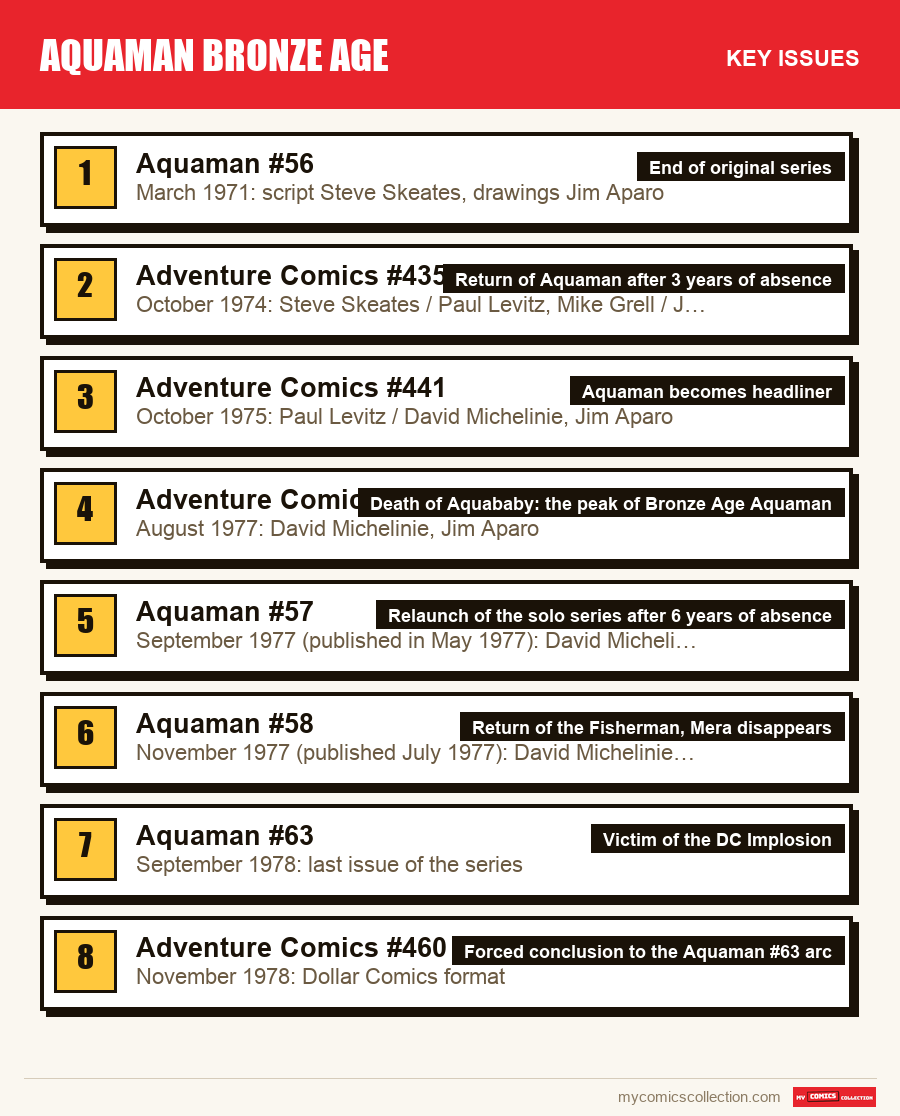
A hero tossed between two titles: the editorial context of the Bronze Age
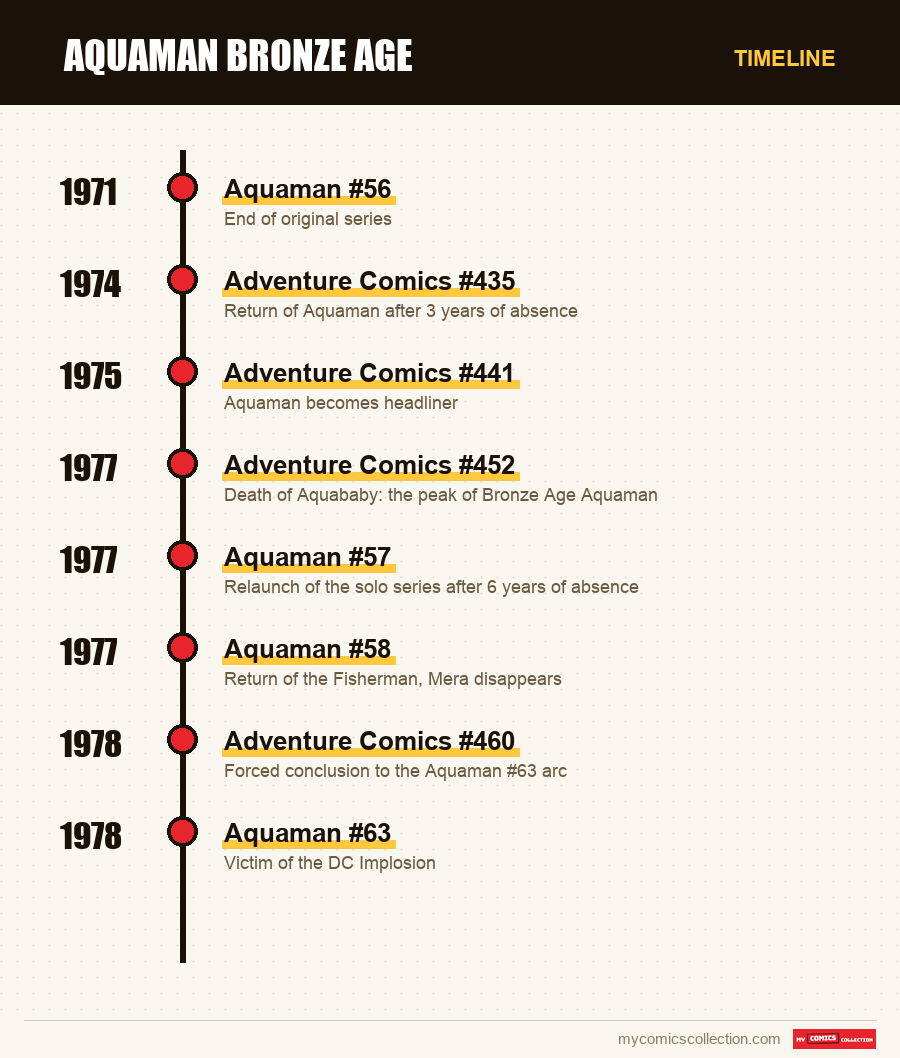
The title Aquaman (vol. 1) was launched by DC Comics in 1962 and ran smoothly through the Silver Age. But at the turn of the 1970s, sales collapsed as with most secondary superhero series of the time, and the series was canceled with issue #56, dated March 1971. The concluding story, "The Creature That Devoured Detroit!" », written by Steve Skeates, ends on an open note: to the point that Skeates himself wrote an unofficial sequel for the competition, in Sub-Mariner #72 (Marvel, September 1974), a wink that has remained famous among historians of the medium.
Aquaman then disappears from the shelves for more than three years. His return is directly linked to a phenomenon outside of comics: the success of the Saturday morning cartoon Super Friends, broadcast from September 1973, which exposed the character to a whole new audience while he was, ironically, the only member of the cast without a regular magazine. DC reacted by reintroducing it as a complementary story in Adventure Comics, starting with issue 435 (October 1974), for a trial run of three episodes (#435 to #437) notably signed by Steve Skeates and Paul Levitz on the script, with Mike Grell and Jim Aparo on the drawings.
The test is conclusive: from Adventure Comics #441 (published in September 1975, dated October 1975), Aquaman becomes the headliner of the magazine, which he occupies until issue 452. It was during this period that Jim Aparo established himself permanently as designer, and soon cover-artist, of the character, alternating with screenwriters like Paul Levitz then David Michelinie. This section of the run is also where the plot takes place that will define the entire Bronze Age of Aquaman: the return of his sworn enemy Black Manta, absent from the character's pages since his first appearance in 1967, and his vendetta against the royal family of Atlantis.
The climax of this arc came in Adventure Comics #452 (August 1977) with the death of Aquaman's son, Arthur Curry Jr., aka Aquababy: an event so significant that it pushed DC to resurrect the solo Aquaman title the following month, with issue #57, to extend the hero's vengeance against his torturer. This second life of the title, however, only lasted seven issues: the series came to an abrupt end at #63 (September 1978), victim of the massive editorial purge that remained in history under the name DC Implosion, before the plot was taken up one last time in Adventure Comics in the Dollar Comics format.
Aquaman #56
Final issue of the Aquaman series launched in 1962. “The Creature That Devoured Detroit!” » closes the original run on a plot that remained deliberately open, before the title was canceled for lack of sufficient sales. This is the obligatory starting point for any Bronze Age collection of the character: the issue which marks the end of Aquaman's Silver Age and the beginning of six years of editorial uncertainty.
Adventure Comics #435
First episode of the trial run that brings Aquaman back as a companion story in Adventure Comics, motivated by the success of the Super Friends cartoon. This issue begins the reconstruction of the character after the cancellation of his own title and launches the narrative bridge between the Silver Age and the Aparo period which will follow.
Adventure Comics #441
Aquaman goes from being a secondary story to being the main hero of the magazine, a position he will hold until #452. Jim Aparo covers the character for the first time, a role he will retain throughout this phase of the run. The main story pits Aquaman against the underwater pirate Captain Demo, who briefly takes control of Atlantis.
Adventure Comics #452
“Dark Destiny, Deadly Dreams”: Black Manta suffocates Arthur Curry Jr., the infant son of Aquaman and Mera. This story, nicknamed “Death of a Prince”, leads to the breakup of the Aquaman/Aqualad duo and prepares, in the longer term, the departure of Mera. It is also the first issue published at the price of 35 cents, a useful benchmark for distinguishing original copies from reissues. This is the most commented on and most sought after outcome of the entire period.
Aquaman #57
First issue of the Aquaman title since the cancellation in 1971: DC capitalizes on the shockwave of Adventure Comics #452 by giving the hero his own magazine again. Aquaman hunts down Black Manta to avenge the death of his son, in a story directly connected to the arc started in Adventure Comics. Michelinie and Aparo continue the darker tone established a few months earlier.
Aquaman #58
Second issue of the revived series: Aquaman returns to the Aquacave and discovers Mera missing, while his old enemy the Fisherman is waiting in ambush. This issue confirms the close continuity between the episodes of this short series of seven issues, thought of as a serial more than as independent stories.
Aquaman #63
Last issue published of the series relaunched in 1977, sacrificed during the wave of massive cancellations known as the DC Implosion, which hit the publisher's entire catalog in mid-1978. The story ends on a cliffhanger which will only be resolved two months later, in another magazine.
Adventure Comics #460
After the cancellation of Aquaman, the Sea King found a place in Adventure Comics, this time in the giant Dollar Comics format (68 pages, squarebound format larger than the standard comic). This issue directly picks up the interrupted plot of Aquaman #63, the hunt for an outlaw whale hunter, and opens a run that will continue until #466, Aquaman's last regular appearance before the 1980s.
Collecting this series?
Track what you own, what you are missing and what your collection is worth. 7 day trial.
Start my trial →The impact of adaptations on the rating
Aquaman never experienced, during the 1970s, the cinematic exposure that Batman or the Marvel heroes of the same Bronze Age enjoy today. Its only mainstream outlet at the time was Super Friends, the animated series which directly caused its editorial return to Adventure Comics in 1974: a fairly rare case where a television adaptation literally resurrected a character on paper rather than the other way around.
The situation has changed with modern cinema. The two feature films carried by James Wan, Aquaman (2018) and Aquaman and the Lost Kingdom (2023), placed Black Manta at the center of the plot as the main antagonist driven by family vengeance: a dynamic which, without being a direct adaptation of the “Death of a Prince” arc, resonates with the plot established in Adventure Comics #452 and Aquaman #57-58. Many specialist commentators highlighted this parallel at the time of the release of the first film, which mechanically renewed readers' interest in the Bronze Age origins of the Aquaman/Black Manta duel.
This recent exposure is accompanied by better access to the stories themselves: DC's digital reading platform has put the entire Adventure Comics run of the time online, allowing new readers to directly discover the Aparo episodes without having to search for the physical comics. This editorial rediscovery in turn maintains the demand on the collectible market, in particular for the issues which concentrate the beginning, the summit and the end of the Black Manta arc: namely Adventure Comics #435, #452 and Aquaman #57.
On the paper editorial level, this run was also dedicated to several bound collections devoted to the Skeates/Aparo then Michelinie/Aparo tandem, proof that the industry itself considers this period as one of the creative peaks in the character's history: a status which, in the long term, always tends to support the value of the original comics rather than cannibalizing it.
Buying guide
- Check the cover price to date the copy: Adventure Comics #452 is the first issue priced at 35 cents; a copy still displaying 30 cents cannot be this number, a simple reference to avoid any confusion with neighboring episodes.
- Inspect the binding on Dollar Comics formats: Adventure Comics #460-466 use a giant squarebound format that is larger than the standard comic, with a more fragile binding and prone to spine roll: an essential checkpoint before purchase.
- Favor complete runs rather than isolated numbers: the stories from Adventure Comics #441-452 and Aquaman #57-63 form a continuous serial; an issue taken out of its narrative context loses part of its interest for readers and storyline collectors alike.
- Prioritize the three key numbers: Adventure Comics #435 (return of the character), #452 (death of Aquababy) and Aquaman #57 (revenge) concentrate most of the demand; the other issues of the period are generally more affordable and allow you to complete the collection without a huge budget.
- Beware of invisible restorations on Aparo covers: Jim Aparo's dark, contrasting inkings easily hide color retouching on black areas; an examination under UV light or CGC/CBCS certification remains recommended on valuable items.
- Always compare with actual sales before buying or selling: the price of these niche comics fluctuates more than that of equivalent Marvel titles, due to a lack of sufficient trading volume to stabilize a single reference price: an estimator based on actual eBay sales is more reliable than a fixed list price.