
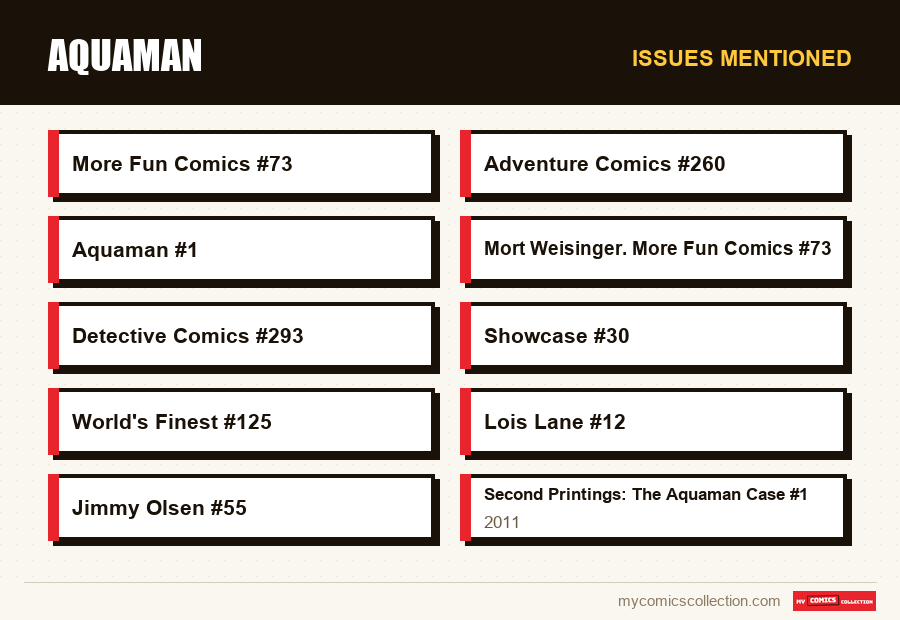
Aquaman circulates in three very distinct forms that should never be confused: the original comics (More Fun Comics #73 in 1941, Adventure Comics #260 in 1959, Aquaman #1 in 1962...), official reissues assumed as such (facsimile editions DC, Showcase Presents, Archives, modern second printings) and fraudulent counterfeits (mocked-up photocopies, covers “brides”, doctored CGC slabs). The first two categories are legitimate and are easily recognized once you know the right benchmarks; the third deliberately aims to mislead the buyer about the nature and therefore the value of the comic.
Aquaman isn't the DC superhero that attracts the most bidding, but that's precisely what makes him a prime target for commercial approximations. The character has over 80 years of publishing existence, a respectable number of official reissues published by DC Comics itself, and a handful of Golden Age and Silver Age keys whose real rarity attracts fraudulent copies or misleading presentations. On the market places, it is not uncommon to come across in the same search a vintage copy priced at several tens of thousands of dollars, a facsimile edition for 5 euros sold as if it were a century old, and a “vintage lot” whose provenance is never specified.
This guide sorts it out. It first explains the editorial context which produced the main keys to Aquaman, then details the official reissues legally published by DC (facsimiles, Archives, Showcase Presents, second printings), before moving on to the techniques of counterfeiting and undeclared restoration which actually circulate on the old comic market. It ends with a concrete purchasing method and frequently asked questions which cover the most common points of friction among both beginners and experienced collectors.
Aquaman from 1941 to today: understanding the origin of the keys before understanding their copies
Aquaman first appears in More Fun Comics #73, dated November 1941. This issue contains both his origin and his first adventure, but it also shares the poster with the debut of Green Arrow and his young teammate Speedy, making it one of the most loaded summaries of first appearances of the entire Golden Age. This accumulation of keys in a single issue largely explains why the issue is ranked 28th in Overstreet's Top 100 Golden Age and why demand remains strong despite a relatively confidential original print run for the time. The CGC census only includes a little more than sixty examples graded in all grades, the best preserved example being a CGC 9.4 from the Edgar Church collection (the famous “Mile High” stock), sold for $318,333 at its last public sale. A copy in intermediate grade CGC 7.5 sold for $111,000 in April 2021, while a much more modest copy, rated 2.5, reached $19,120, a performance partly driven by the renewed interest generated by the film adaptations of the character.
The second major editorial milestone arrives almost twenty years later with Adventure Comics #260, dated March 1959. This issue tells "How Aquaman Got His Powers!" », a Silver Age origin significantly rewritten compared to the 1941 version: it is this story, and not the Golden Age version, which served as the basis for DC continuity for several decades. The cover is by Curt Swan, and the interior story of Aquaman owes much to the work of artists from the Adventure Comics team at the time, including Ramona Fradon, who would become the character's reference artist throughout this period. This number remains difficult to find in very high conservation: only a handful of copies exceed grade CGC 8.5 in the census. According to the Overstreet Price Guide 2020 edition, a copy in VF 8.0 is worth around 840 dollars and a VF/NM 9.0 around 1,670 dollars, when a much more damaged copy in GD 2.0 was around 90 dollars in the 2016 edition of the same guide.
The third milestone, the one that most interests collectors of regular series, is Aquaman #1, released in 1962: this is the very first issue of the character in a solo series, written by Jack Miller and Bob Haney, with drawings by Nick Cardy, the artist who remained associated with the title for most of the 1960s. A record sale of $38,400 was recorded on a very high-preservation copy, but most of the market trades well below this ceiling, the series having enjoyed a significantly more generous circulation than the Golden Age publications of previous decades. Between these three historic milestones and the modern relaunches of the character, notably the 2011 New 52 launch by Geoff Johns and Ivan Reis, have accumulated several generations of official reissues, which it is now appropriate to detail one by one.
Official reissues: facsimiles, Archives and Showcase Presents, a legitimate breeding ground but never to be confused with the original
Contrary to popular belief, the majority of "old" Aquamans circulating on the market today are not fakes in the fraudulent sense of the term: they are perfectly official reissues, published by DC Comics itself, and clearly identified as such on the object itself. The problem does not come from their existence, but from the way in which some sellers present them: deliberately blurred in the photos, "reprint" written in very small letters, or simply omitted in the title of the ad.
DC facsimile editions: almost identical, but recognizable reproductions
Since the mid-2010s, DC Comics has launched a “Facsimile Edition” line which reproduces identically, or almost, historical issues that have become too rare or too expensive for the majority of readers. Two titles related to Aquaman were entitled to this treatment. Adventure Comics #260 was reissued in facsimile edition with a cover date of February 2024, released in bookstores on December 5, 2023, as part of a series of reissues paying tribute to the historic publisher Mort Weisinger. More Fun Comics #73 followed with its own facsimile edition, dated June 2025 and published on April 30, 2025, therefore reproducing the very first story of Aquaman as well as the debut of Green Arrow.
These facsimiles reproduce the original cover with real care, including advertisements and readers' letters from the period in most cases, making them valuable for reading and rebuilding a collection inexpensively. But their paper feels different (duller, without the yellowed grain of the original pulp paper) and a modern barcode, edition number, or current legal notice always appears somewhere on the cover or back cover. A facsimile edition is only worth, on the resale market, a fraction of the price of a classic collector's issue, and only increases in value if it itself becomes difficult to find in stores, which remains rare for this format printed in relatively comfortable quantities.
Showcase Presents and DC Archives: read Aquaman's Silver Age without touching the originals
For readers who simply want to read the original adventures without spending hundreds or thousands of dollars, DC has released two distinct compilation collections. The line Showcase Presents offers black and white volumes of more than 500 pages, sold at an affordable price, and the character benefits from three volumes covering the stories published between 1959 and 1968. The first volume alone brings together around fifty Aquaman stories republished from Adventure Comics #260 to #280, #282 and #284, but also from Detective Comics #293 to #300, Showcase #30 to #34, World's Finest #125 to #129, Lois Lane #12, Jimmy Olsen #55, and Aquaman #1 to #6: the character's entire Silver Age genesis rolled into one.
The line Aquaman Archives, more upscale, reproduces the same stories in color and in hardcover, for a much higher price (around $50 in the catalog), including Adventure Comics #260 to #280 and #282 as well as Showcase #30 and #31. These two collections were never intended to imitate the original issues: their format, their binding and their pagination immediately distinguish them from a classic comic book, and no serious collector confuses them with the issues they reproduce. They nevertheless remain an excellent entry point to understand why Adventure Comics #260 or Aquaman #1 are considered seminal, before investing, if necessary, in period copies.
Modern Second Printings: The Aquaman Case #1 (2011)
A third type of reissue, often misunderstood by recent buyers, concerns second printings of modern comics. When Aquaman (2011) #1, launched by Geoff Johns and Ivan Reis as part of the New 52 relaunch, sold better than expected on newsstands, DC had a second printing printed to meet distributor demand. This second printing is distinguished from the first by a different cover shade, a reddish variation recognizable at first glance once you have the two versions side by side, and it is usually explicitly mentioned "2nd Printing" in the product code or seller's description. This is in no way a counterfeit: it is a perfectly official additional print, but its collector's value remains structurally lower than that of the original print, exactly as for any modern comic with high initial demand. The most common confusion comes from listings that fail to specify that this is a second printing, leading the buyer to falsely believe that they are acquiring the very first print.
Collecting this series?
Track what you own, what you are missing and what your collection is worth. 7 day trial.
Start my trial →Spotting a fake: counterfeiting and undeclared restoration techniques targeting old comics
Unlike official reissues, certain practices explicitly aim to deceive the buyer about the real nature of the comic they are purchasing. They concern almost exclusively high-value Golden Age and Silver Age copies: a More Fun Comics #73 or an Adventure Comics #260 in good condition being much more financially attractive targets than a modern comic with a circulation of tens of thousands of copies.
Crude photocopying and the “married book”
The simplest case to spot, but which continues to circulate on non-specialized general marketplaces, is the photocopy or digital printing of an old cover, sometimes even bound with real period interior pages to give the impression. Telltale signs include a printing screen inconsistent with the offset printing techniques used in the 1940s-1960s, colors that are too uniform or, on the contrary, too saturated, the absence of the expected legal and copyright notices at the bottom of the cover, and a paper grain that does not correspond to the stated age of the issue.
A more insidious practice, documented for a long time by restaurateur communities and by CGC itself, is that of “married book” or “married” cover: an unscrupulous restorer takes the cover in good condition from a copy whose interior is too damaged to be sold, and fixes it on the block of interior pages of a completely other copy of the same issue, whose original cover has disappeared or is too degraded. The visual result can be misleading, but the object is no longer a unique and coherent copy: it is an assembly of two distinct comics. When such an example is submitted for certification, it receives a qualified label that explicitly documents this marriage, which greatly lowers its value compared to an unrestored example of the same apparent grade.
Trimming, color retouching and the famous “purple label”
Undeclared restoration remains the most common pitfall on high-value Aquaman keys. THE trimming, which involves lightly trimming the edges of a cover to remove tears or creases, is considered by the grading services community to be the most problematic form of restoration because it is irreversible and physically changes the original dimensions of the comic. A trimmed example submitted to CGC receives an “apparent” grade with a specific label indicating the restoration, and not the usual blue universal grade.
La color retouching (color touch) is evaluated according to the extent of the surface concerned: a minor touch-up covering less than half an inch by half an inch is classified as a light restoration, while an intervention covering more than four inches by four inches is considered extensive and weighs heavily on the final value. In all cases, CGC distinguishes these copies by a purple label, nicknamed by collectors the “Purple Label of Death”, which immediately differentiates them from unrestored universal examples with the classic blue label. On a sales platform, the absence of a clear photo of the label or a description that carefully avoids the word "restored" should systematically raise alarms, particularly on issues like Adventure Comics #260 or More Fun Comics #73, where the difference in value between a universal copy and a restored copy to the same apparent grade can represent several thousand dollars.
Certification slabs themselves may be compromised
A more recent phenomenon, publicly revealed by the collecting community and confirmed by CGC, concerns fraud on the certification boxes themselves. The process involves opening a sealed case containing a high-quality copy, removing the comic and replacing it with a lower-quality copy, then re-soldering the case so that it appears intact. The end buyer then pays the price of a high-end copy while receiving a lower-value comic, with the box itself continuing to display the original label. CGC confirmed that several hundred examples had been affected by this type of manipulation across different series, which prompted many experienced buyers to systematically check the consistency between the certification number written on the case and the sheet available on the organization's website, as well as to examine the manufacturing quality of the case itself: thickness of the plastic, alignment of the solder joint, texture of the label. On an issue like Aquaman #1 (1962) or Adventure Comics #260, high-end copies of which sell for several hundred or even thousands of dollars, this cross-checking is never wasted time.
The impact of adaptations on the rating of Aquaman comics
Audiovisual adaptations have a measurable effect, but not always what one imagines, on the value of the character's keys. When the film was announced and released Aquaman of 2018, directed by James Wan with Jason Momoa in the lead role, speculative interest in the first appearances of the character has clearly increased: it is in this window that the 2.5-rated copy of More Fun Comics #73 was sold at $19,120, a significant sum for such a modest grade, driven above all by the media attention surrounding the film rather than by the intrinsic rarity of this specific copy. The same phenomenon is classically observed with each announcement of casting or filming on secondary characters in the DC Extended Universe: demand reacts even before the theatrical release.
However, what followed showed the limits of this effect. The 2018 film's mixed critical reception, despite a solid box office score, ended up tempering the speculative excitement over the character's keys in the months following its release, a classic pattern where anticipation drives up prices more than the film's actual performance once it becomes available. This observation serves as a general lesson for anyone who collects with the “cinema effect” in mind: the peak in value is most often located in the weeks preceding the release, driven by media coverage and trailers, and not afterwards, once the public has moved on to the next news item. For Aquaman as for any adapted character, the substantive value of the real historical keys: More Fun Comics #73, Adventure Comics #260, Aquaman #1 - remains above all supported by their objective rarity and their place in the editorial history of the character, the cinematographic news only acting as a temporary accelerator of demand.
Buying guide: how to secure a purchase of Aquaman comics, original or reissue
Whether you are aiming for a Golden Age copy worth five figures or a simple facsimile edition costing a few euros, a few systematic reflexes drastically reduce the risk of unpleasant surprises.
- Check legal notice and barcode: any DC facsimile edition bears, somewhere on the cover or on the back, a modern barcode and often an explicit mention “Facsimile Edition”. Its total absence on a number advertised as “vintage” at a price inconsistent with its rarity should raise alarms.
- Compare paper grain and shade with known reference photos of the same issue: the pulp paper of an authentic More Fun Comics #73 or Adventure Comics #260 has yellowed in a specific way after more than 60 years, an aging that no recent facsimile edition faithfully reproduces.
- Require clear photos of the back of the CGC or CBCS case when a copy is presented as certified, and systematically cross-reference the certification number written on the label with the public database of the grading organization concerned.
- Be wary of ads that do not specify the draw on sought-after modern issues like Aquaman (2011) #1: the absence of an explicit “1st printing” mention may hide a second printing sold at the price of the first printing.
- Identify the mentions of restoration in the hollow: Wordings such as “some minor touch-ups”, “cover refreshed” or “light intervention” are often euphemisms for an uncertified restoration which should significantly lower the negotiated price.
- Favor copies already certified for any purchase above a few hundred euros on the Golden Age and Silver Age keys of the character, the cost of certification being largely offset by the peace of mind that it brings in the face of the practices mentioned above.
- Catalog each acquisition upon receipt, with its precise characteristics (edition, edition, condition, provenance), to keep a reliable trace of its collection over time and to be able to develop it calmly as discoveries are made.
For this last point, keeping a structured inventory avoids a lot of confusion a posteriori between an original, a facsimile edition and a modern reprint, especially when the collection grows and memory alone is no longer enough to distinguish each copy. A dedicated application like the one presented on/application-collection-comics/allows this information to be kept centrally rather than scattered among receipts, screenshots and rough memories.