
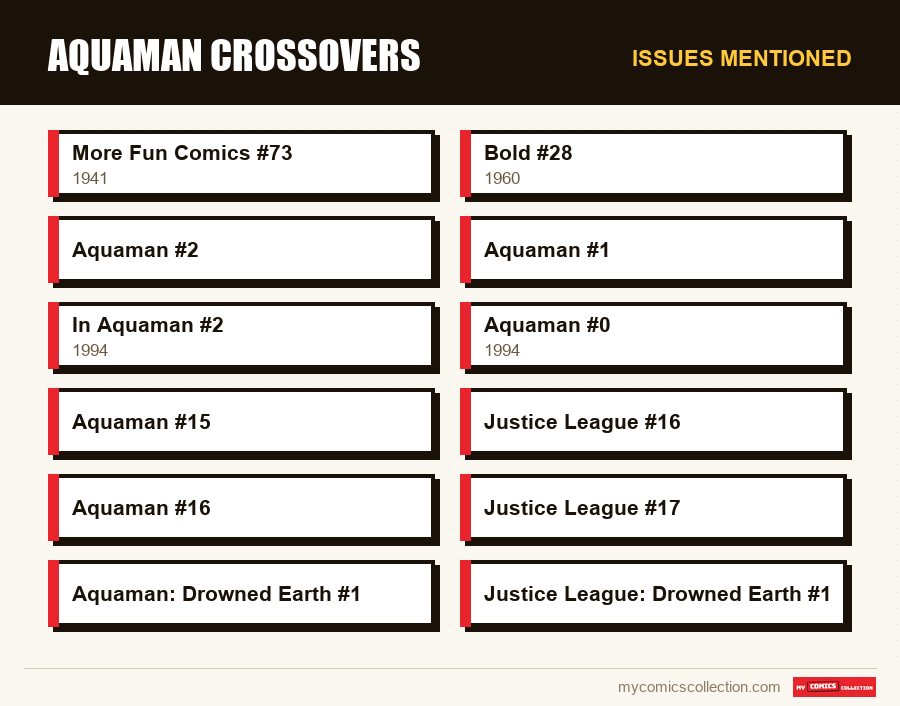
Aquaman has gone through eight decades of major crossovers at DC: his first appearance in More Fun Comics #73 (1941), his founding role in The Brave and the Bold #28 (1960, birth of the Justice League), the loss of his hand in Aquaman #2 by Peter David (1994), exile from Atlantis in JLA: The Obsidian Age (2002-2003), his resurrection in Blackest Night / Brightest Day (2009-2010), the Atlantis-Amazon war of Flashpoint (2011), the event Throne of Atlantis (2012-2013) which launched the New 52, then Forever Evil (2013) and Drowned Earth (2018). The founding issues (More Fun Comics #73, Brave and the Bold #28, Aquaman #1) remain the most sought-after pieces, with recent sales documented up to $810,000 for Brave and the Bold #28 in CGC grade 9.6.
Long considered the poor relation of the Justice League in the collective imagination, Aquaman has nevertheless occupied a central place in the architecture of DC crossovers since 1960. The King of the Seven Seas is not only a solo hero with his own series: he is one of the seven founding members of the Justice League of America, a recurring protagonist of major editorial events, and the hero whose personal arcs (loss of the hand, exile, death, resurrection) have regularly served as a detonator for inter-title crossovers.
For a collector, understanding the chronology of Aquaman crossovers is not an academic exercise: it is a reading grid which makes it possible to identify the pivotal numbers, those which mark a lasting narrative shift (loss of power, change of status, death of a recurring character) and which, historically, concentrate most of the demand on the secondary market. This guide traces, event by event, the actually documented crossovers involving Aquaman, with precise numbers, credited creators and available market data.
We will also see why media exposure (notably James Wan's film in 2018) does not automatically translate into a lasting increase in the value of original comics, a point that many beginner collectors underestimate.
From Golden Age origins to the founding of the Justice League
Aquaman makes his very first appearance in More Fun Comics #73, published by DC in 1941. This issue shares the poster with another major first appearance, that of Green Arrow and his partner Speedy, making it one of the most sought-after Golden Age comics in the DC catalog. The character was created at a time when the publisher was seeking to multiply figures capable of carrying short stories in shared anthologies: Aquaman, with his ability to breathe underwater and communicate with marine fauna, fits into this logic. The original print run being very limited and the survival rate of comics from the period very low, the CGC census for this issue remains extremely restricted on the high notes. According to specialized price guides, a copy in grade FN 6.0 was valued at $37,800 in Overstreet 2021, a VF 8.0 at $82,000, and a documented sale in grade FN 6.0 reached $55,000 in 2017. More Fun Comics #73 is ranked 28th in the Overstreet Top 100 rankings. Golden Age comics, an indicator of its relative rarity compared to other early appearances of the same decade.
The real "crossover" turning point in Aquaman's career, however, came twenty years later, with The Brave and the Bold #28, published in 1960. This issue does not tell a solo adventure: it depicts the very first meeting of Superman, Batman, Wonder Woman, Flash, Green Lantern, Martian Manhunter and Aquaman under the banner of the Justice League of America, facing the threat of Starro the Conqueror. Aquaman is a founding member in the same way as the others, which makes this issue an absolute milestone for any collector interested in the origins of the DC team-books. The market reflects this importance: a CGC NM+ 9.6 copy (the highest known grade, with no higher copy recorded) sold for $810,000 in January 2024, a record for this issue. The 2023 Overstreet values an NM-9.2 copy at $94,000. The title ranks 8th in Overstreet's ranking of the 50 best Silver Age comics.
Two years later, in February 1962, Aquaman finally got its own regular series with Aquaman #1, written by Jack Miller and drawn by Nick Cardy, who will illustrate the first 39 issues of the series. This first solo issue, entitled "The Invasion of the Fire Trolls", does not constitute a crossover in the strict sense, but it is directly part of the dynamic launched by his participation in the Justice League: it is the success of the character as a team member which justifies, in the eyes of the publisher, the launch of a series in his name. A CGC 9.6 copy sold for $38,400 in August 2019, while a 6.0 copy sold for $1,092 in February 2023 and a readable grade 2.0 copy generally trades for between $300 and $350, making it affordable for most mid-grade collecting budgets.
The loss of the hand: the internal crossover that redefines the character (1994)
If the 60s and 70s established Aquaman as a pillar of team-books, it was Peter David's run in the early 90s which produced the most lasting narrative event in the character's history, even if it was not a multi-title crossover in the classic sense. In Aquaman #2 (September 1994, drawn by Martin Egeland), the hero faces the villain Charybdis, capable of temporarily neutralizing Aquaman's powers and turning them against him: Charybdis plunges Arthur Curry's hand into a stream infested with piranhas made enraged by his own misused powers, and the hero literally loses his hand in the battle. This injury, shown in detail in the David run, leads to one of the most iconic designs in the character's history: the harpoon replacing the missing hand, revealed in full page at the end of Aquaman #0 (1994).
This editorial choice has a direct consequence on the collection: it transforms issues previously considered "atmosphere" into narrative milestones sought by collectors who follow the physical evolution of the character over time. The Peter David sequence remains today the reference for anyone who wants to understand why Aquaman has long been represented with a harpoon instead of a hand on the covers and merchandising of the 90s and 2000s.
Exile from Atlantis and Sub Diego: when mythology becomes a JLA crossover (2002-2005)
The logical extension of this period is played out in JLA: The Obsidian Age, written by Joe Kelly and drawn by Doug Mahnke, published in the pages of JLA in the early 2000s. The plot deals with the disappearance of Atlantis and Aquaman himself in the wake of the crossover Our Worlds at War (2001): the city is projected millennia into the past, its inhabitants reduced to slavery by their own ancestors, while Arthur Curry is held prisoner in the form of living water. The Justice League intervenes to free Atlantis and its king, but the outcome is bitter: Aquaman is banished from his own city, accused of treason for having caused its re-engulfment as the plot progresses.
This exile directly opens the way to the "Sub Diego" arc, developed in the solo series that follows (from Will Pfeifer's run, mid-2000s): the city of San Diego is hit by an earthquake which causes it to sink into the ocean, transforming its population into aquatic breathers like Aquaman himself. Deprived of Atlantis, the hero becomes the protector of this new submerged community, which deepens his links with the surface world at the very moment when he is cut off from his original kingdom. This sequence clearly illustrates a frequent mechanism in the character's history: a large-scale JLA crossover (Obsidian Age) serves as a detonator for a complete reinvention of the solo series that follows.
Blackest Night and Brightest Day: the editorial resurrection (2009-2010)
Aquaman is one of the characters who died and then brought back to life during the crossover Blackest Night (2009), the Green Lantern event written by Geoff Johns which sees the dead of the DC universe return in the form of Black Lanterns before a selection of them is chosen by white power for a true resurrection. The direct extension of this resurrection plays out in the event mini-series Brightest Day, whose number 0 has a cover date of June 2010 (publication April 14, 2010). Aquaman is among the group of heroes elected by the White Lantern to come back to life, alongside Hawkman, Hawkgirl, Martian Manhunter and Firestorm.
For the collection, this sequence marks an important milestone because it puts Aquaman back at the center of DC editorial news after several years where the character was relatively in the background, and directly prepares the ground for his return to the spotlight with the launch of the New 52 the following year.
Flashpoint: the Atlantis-Amazon war that redesigns the DC universe (2011)
The event Flashpoint (2011), still signed by Geoff Johns for the main five-issue mini-series, is based on an alternative reality where Barry Allen never became Flash. In this timeline, the mini-series in three issues Flashpoint: The World of Flashpoint Featuring Wonder Woman, centered on the "Emperor Aquaman" arc, features an all-out conflict between Aquaman's Atlantis and Wonder Woman's Amazons. The arranged marriage between Arthur and Diana, supposed to unite the two kingdoms, fails when Queen Hippolyta is killed while protecting her daughter: Diana, enraged, leads the Amazons in a war against Atlantis which leads to the assassination of Mera. The conflict extends to the entire British Isles, transformed into "New Themyscira", while the Atlantean forces capture and exploit Geo-Force, the prince of Markovia.
This alternative war between Atlantis and the Amazons, although located in a parallel continuity which will be erased at the end of the event, has a very concrete effect on the "normal" DC universe: it is in response to this type of latent tensions between the two kingdoms that the screenwriters of the New 52 will construct, the following year, the crossover which today remains the most studied of Aquaman's entire career.
Collecting this series?
Track what you own, what you are missing and what your collection is worth. 7 day trial.
Start my trial →Throne of Atlantis: the founding crossover of the New 52 (2012-2013)
Throne of Atlantis is undoubtedly the most structuring Aquaman crossover of the New 52 era. Written by Geoff Johns, drawn by Ivan Reis on the part Justice League and by Paul Pelletier on the part Aquaman, the event unfolds over six issues divided between the two titles: Aquaman (vol. 7) #14, Justice League (vol. 2) #15, Aquaman #15, Justice League #16, Aquaman #16 and Justice League #17, published between November 2012 and February 2013. The plot features Aquaman's half-brother, Ocean Master, who attempts to seize the throne of Atlantis and declares war on the surface, forcing the Justice League to intervene directly in the underwater kingdom.
What makes Throne of Atlantis particularly important for the collection is its status as a narrative "bridge": the event definitively establishes Aquaman as a leading player in the Justice League of the New 52, far from the dated "minor hero" image that has stuck to the character for decades in popular culture. It is also this story which served as a widely recognized plot basis for the film. Justice League from 2017 and, to a lesser extent, to certain elements of the solo film Aquaman of 2018, which reinforced the retrospective interest of collectors for these six specific issues at the time of the release of the cinema adaptations.
Forever Evil and Villains Month: Aquaman from the Dark Side (2013)
In September 2013, as part of "Villains Month" which accompanies the crossover Forever Evil written by Geoff Johns and drawn by David Finch, the series Aquaman (vol. 7) publishes two tie-in issues numbered in points: #23.1, dedicated to Black Manta, and #23.2, dedicated to Ocean Master, the two main recurring antagonists of the hero. This editorial initiative, which temporarily replaced 52 regular series of the New 52 with one-shots centered on villainous characters, made it possible to deepen the psychology of two figures whose importance in the Aquaman mythology is directly linked to previous events (Ocean Master having been the central antagonist of Throne of Atlantis the previous year).
Drowned Earth: the last big Justice League/Aquaman crossover (2018)
In 2018, at the same time as the film was released Aquaman in the cinema, DC publishes Justice League/Aquaman: Drowned Earth, written by Scott Snyder. The event is constructed in six main chapters: an opening one-shot Justice League/Aquaman: Drowned Earth #1, three numbers Justice League (#10 to #12), two numbers Aquaman (#40 and #41), and a closing one-shot Aquaman/Justice League: Drowned Earth #1, complete with a tie-in in Titans #28. The plot sees the entire Earth threatened with submergence by cosmic forces linked to Atlantis, forcing Aquaman once again into the center of the Justice League's collective action.
The timing of publication, modeled on the release of James Wan's film, is obviously not a coincidence: DC sought to capitalize on the media exposure of the character to a wider audience. It's an interesting case study to understand how editorial crossovers are sometimes calibrated to accompany a cinema calendar rather than to respond to a purely narrative necessity.
The impact of adaptations on the rating
The movie Aquaman by James Wan, released in December 2018, was a considerable commercial success: more than $1.1 billion in worldwide revenue, including approximately $335 million in the American domestic market alone, which made it at the time the most profitable DCEU film ahead of Wonder Woman. Such success naturally suggests that it must have increased the price of Aquaman comics on the secondary market. The reality, documented by sales data, is more nuanced and deserves to be known by every collector before buying "on the impulse" of a cinema release.
According to market tracking data published by GoCollect, several key numbers from the '90s Peter David run actually saw their ratings decline in the three years following the film's release. A copy of CGC 7.5 Aquaman #29 (vol. 5, run Peter David), which sold for around $400 on eBay just before the film's release, only traded for $176.50 sixteen months later, a decline of almost 32%. The same phenomenon was observed on Aquaman #35 of the same series, of which CGC 5.5 copies lost approximately 20% of their value over the period. These figures show that the "cinema hype" effect does not translate mechanically into a lasting appreciation of vintage issues: once the initial peak of interest has passed, the market often refocuses on substantive demand, driven by historical collectors rather than by the casual public attracted by the film.
Conversely, the numbers directly linked to the storyline taken up in the cinema, such as the six chapters of Throne of Atlantis, have retained a more stable interest over time, precisely because they constitute the recognized primary source of elements taken up in the adaptations (the confrontation with Ocean Master, the war between Atlantis and the surface). The lesson for a collector is simple: favor issues that have a strong intrinsic narrative value (first appearance, major plot turning point, direct source of an adaptation) rather than buying only because a character is temporarily in the spotlight.
Buying guide
Before investing in issues related to Aquaman crossovers, a few concrete principles allow you to avoid the most common mistakes among collectors who are new to this character:
- Distinguish between first appearance and simple tie-in. More Fun Comics #73 (first appearance of Aquaman), Brave and the Bold #28 (birth of the Justice League) and Aquaman #1 (first solo series) remain structurally more sought-after than event tie-ins like Forever Evil #23.1/#23.2, whose value remains more linked to the general rating of the villain concerned than to Aquaman himself.
- Systematically check the grade before purchasing Golden Age numbers. On a title like More Fun Comics #73, the difference in value between an FN 6.0 (around $37,800 according to Overstreet 2021) and a VF 8.0 (around $82,000) is considerable for two relatively close grades: a recent CGC certificate makes all the difference here.
- Do not confuse media exposure and collection fundamentals. GoCollect data on Aquaman #29 and #35 after the release of the 2018 film shows that a peak in mainstream interest can precede a downward correction rather than a lasting increase: it is better to buy an issue for its real place in continuity than for its cinematic relevance.
- Complete a run with its six chapters, not a single isolated number. For Throne of Atlantis, the collectible interest is optimal by bringing together all six issues (Aquaman #14-16 and Justice League #15-17) rather than a single volume, because the story is read alternating between the two titles.
- Be wary of poorly identified runs. The Aquaman numbering has been relaunched several times (1962, 1986, 1989, 1991, 1994, 2003, 2011, 2016): systematically check the volume and the year of publication before purchasing, because the same number (#1, #2, #14...) exists in several distinct series with very different values.
- Follow the evolution of your collection over time. Once the numbers have been identified and acquired, the application collection tracking allows you to centralize references, grades and purchase history to avoid duplicates in a series that is so often restarted.