
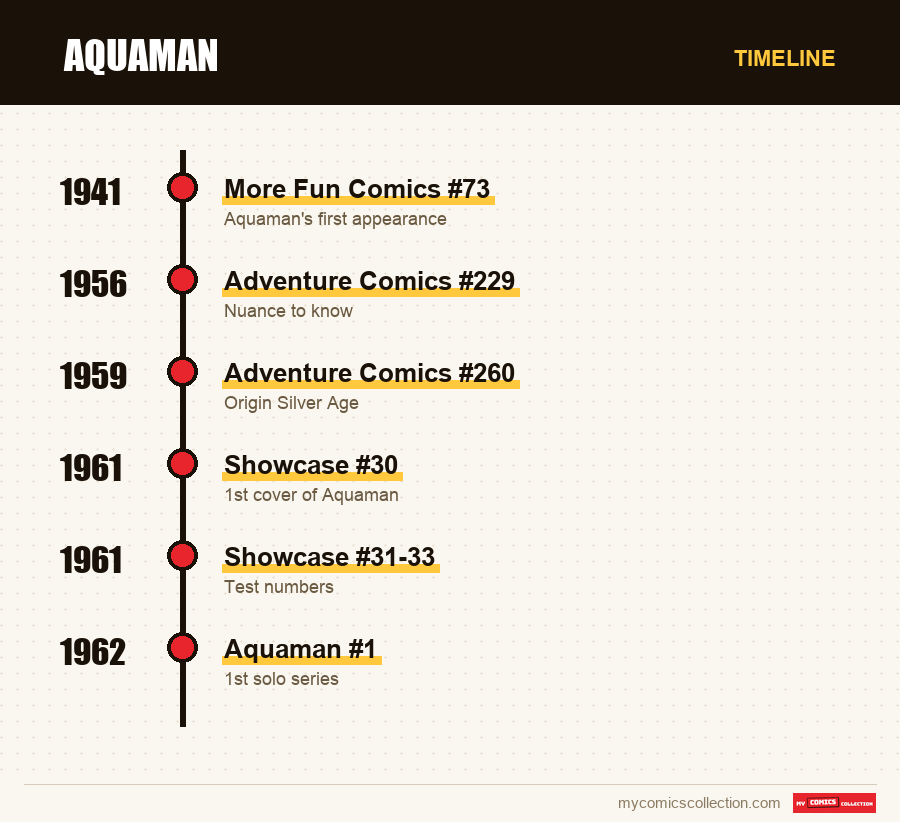
Aquaman is born in More Fun Comics #73 (cover dated November 1941), the same issue that also introduced Green Arrow and Speedy: making it one of the most sought-after Golden Ages in the DC catalog. The character survives in a secondary feature for twenty years before his rebirth Silver Age: origin redefined in Adventure Comics #260 (1959), first covers in Showcase #30-33 (1961), then first solo series with Aquaman #1 (1962). Rating-wise, only More Fun #73 reached six-figure peaks; Silver Age key issues remain much more affordable.
Aquaman has an unfair reputation as a minor hero, the one who gets trashed because he “talks to fish”. However, in terms of collecting, its first appearances are among the most historically charged pieces in the DC stable. The character has the rare distinction of having passed through the Golden Age, the Interregnum and the Silver Age without interruption, changing host series twice before finally gaining his own title.
Understanding the real value of these comics requires untangling a somewhat tortuous editorial history: the same hero, several origins, two distinct golden ages and a shower of “key” issues not all of which are equal. Some are authentic six-figure trophies, others remain accessible for a few hundred euros. Confusion over what really constitutes the “first Silver Age appearance” fuels many purchasing errors.
This article reviews the founding issues of Aquaman, from the very first More Fun Comics to his 1962 solo series, relying only on verifiable facts: publication dates, creators, and market values actually documented where they exist.
Historical and editorial context
Aquaman is a creature from World War II. It appears for the first time in More Fun Comics #73, an anthology issue of DC (then National Comics) dated November 1941, in a story called "The Submarine Strikes", written by Mort Weisinger and drawn by Paul Norris. The very first panel shows him sinking Nazi submarines: an assumed war propaganda context, very far from the Atlantean monarch we know today.
What makes More Fun #73 so coveted isn't just Aquaman: the same issue also contains the first appearance of Green Arrow and his partner Speedy, in a story by Weisinger and George Papp. Two enduring DC franchises are therefore born in the same issue, which concentrates enormous demand on a print run more than eight decades old. The work is now among the hundred most sought-after Golden Age comics according to the Overstreet guide.
Aquaman continued his career in More Fun Comics until issue #107, in 1946. That year, DC reorganized its anthologies and transferred several superheroic features, including Aquaman, to Adventure Comics, starting with issue #103. The character will remain there for almost fifteen years, as a secondary story behind the star of the title, Superboy. During this entire period, he was never entitled to a cover or a series in his name: it is a discreet back-up feature but of remarkable longevity, which spans the end of the 1940s and the entire 1950s.
Aquaman's Silver Age renaissance is gradual rather than brutal. Unlike Flash or Green Lantern, who are completely reinvented with new identities, Aquaman is the same character in continuity: he never "disappeared" to be revived. Its modernization mainly involves a recasting of its origin and its mythology, under the leadership of the artist Ramona Fradon, before it finally gets its own covers and then its own title at the turn of the 1960s.
Keys from the first series of Aquaman
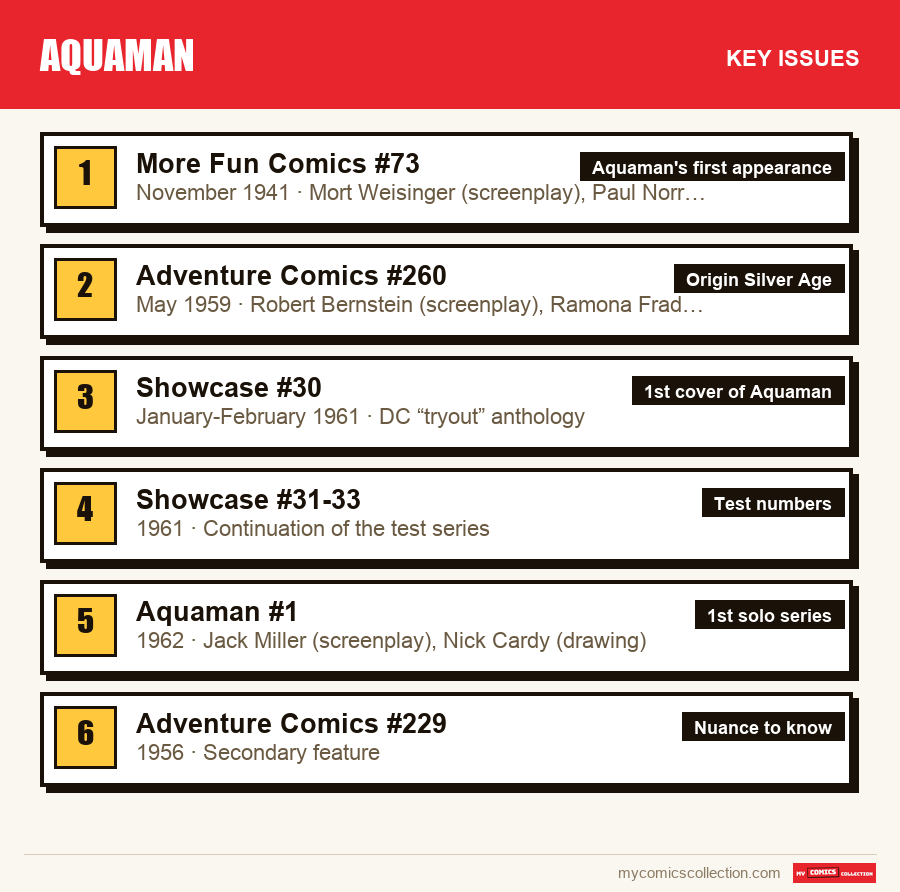
Here are the founding issues, ordered by historical and collecting importance. We can clearly distinguish the absolute summit (More Fun #73) from the Silver Age milestones, which are much more accessible.
More Fun Comics #73
The absolute Holy Grail of the Aquaman collector, and one of the most prized Golden Ages in the entire DC catalog. This issue contains the origin and first appearance of Aquaman in "The Submarine Strikes", but also the first appearance of Green Arrow and Speedy: a franchise double that explains the extreme demand. The work is included in Overstreet's list of the hundred most sought-after Golden Age comics. High grade copies are extremely rare: certified copies in near mint condition can be counted on the fingers of one hand.
Adventure Comics #260
The true birth certificate of the modern Aquaman. The story “How Aquaman Got His Powers!” » rewrites its origins: we meet the lighthouse keeper Thomas Curry and his Atlantean love Atlanna, whose union gives birth to Arthur Curry. It is this mythology (Atlantean mother, human father, royal heritage) which will found all the subsequent versions of the character, up to the cinema adaptations. An essential key issue, still relatively affordable in medium grades.
Showcase #30
After twenty years as a secondary feature, Aquaman finally gets the spotlight. Showcase #30 is his very first cover: on any comic, Golden Age and Silver Age alike. It opens a series of four test issues (#30 to #33) intended to gauge whether the character could bear his own title. The success of this test will determine the launch of the solo series the following year. #30 offers a new presentation of the origin.
Showcase #31-33
The three issues that complete Aquaman's "tryout" in Showcase. These are also his first regular covers and a decisive editorial step: without the favorable verdict of these essays, the solo title would undoubtedly never have seen the light of day. Less iconic than #30 but inseparable from the same historical sequence, they are especially of interest to collectors who want the complete Showcase run of Aquaman.
Aquaman #1
The first issue of Aquaman's first solo title, "The Invasion of the Fire Trolls". It also marks the arrival of Nick Cardy, whose elegant style will visually define the series: he will draw the first 39 issues and sign all the covers until the last, #56 (1971). #1 also introduces Quisp, an aquatic creature. This is the starting point of the first “modern” era of the character, the one which will lay the foundations of all Atlantean lore.
Adventure Comics #229
Often billed as the "first Silver Age appearance" of Aquaman because he appeared after the official start of the era (Showcase #4, 1956). In reality, this is still the Golden Age version of the character, in uninterrupted continuity; this issue is most noted for the introduction of his pet octopus, Topo. The real Silver Age overhaul only came with Adventure Comics #260 in 1959. Know so as not to overpay for an issue on a misleading label.
Collecting this series?
Track what you own, what you are missing and what your collection is worth. 7 day trial.
Start my trial →Golden Age or Silver Age: do not confuse the two “firsts”
The main source of error for a novice buyer is the coexistence of two “first appearances” depending on the age considered. There first appearance at all, it’s More Fun Comics #73 (1941), unambiguously. But as soon as we talk about the Silver Age, the ground becomes slippery.
As Aquaman never stopped publishing between 1941 and the early 1960s, there was no real "relaunch" with a new founding #1 issue, like The Flash. Result: several issues compete for the label of “first Silver Age”. Some sellers cite Adventure Comics #229 (1956) simply because it appeared after the era had kicked off. Others, more rigorous, point to Adventure Comics #260 (1959), which truly redefines the origin and mythology of the character.
For the collector, the distinction has concrete consequences. The number that concentrates the historical and narrative value is #260, because it is there that the Aquaman that everyone knows is born: son of a lighthouse keeper and an Atlantean princess. Paying a premium for an “early Silver Age” #229 is often overestimating a minor milestone. If you're just starting out, notice the difference in your collection management application to avoid duplication of intentions and poor budget decisions.
Nick Cardy and the visual identity of the first series
We can't talk about the first solo series without mentioning Nick Cardy. Where the Golden Age and early Silver Ages offered a functional but graphically unremarkable Aquaman, Cardy gave him a look. During the first 39 issues of Aquaman (1962), he provided the interior drawings, and he signed all of the covers for the series until its conclusion, #56, in 1971. That's nearly a decade of visual consistency under the hand of a single artist.
This aspect has a direct impact on the collection. The Cardy covers are sought after for their own sake, regardless of narrative content, and they elevate the desirability of many issues in the series that would otherwise remain anecdotal. For those who want to create a coherent “run”, the first series from 1962-1971 forms a homogeneous and aesthetically dated whole, more affordable than the keys from the origins.
The impact of adaptations on the rating
As with most DC characters, the value of Aquaman's first appearances is reacting to the media spotlight. The character has long suffered from an image as a second-rate hero, which kept his Silver Age key issues at modest levels compared to those of other members of the Justice League.
The arrival of Aquaman in cinemas, played by Jason Momoa in James Wan's 2018 film, changed public perception and reignited interest in his seminal numbers. The Silver Age origins, Adventure Comics #260 in the lead, are the main beneficiaries of this type of exhibition, because they are the ones who carry the mythology transposed to the screen: Arthur Curry, Atlantis, the royal heritage.
More Fun Comics #73 plays in a different category. Its value is driven by its absolute rarity and by its status as a double first appearance (Aquaman and Green Arrow), much more than by a film. It is a "blue chip" collector's asset whose long-term trajectory depends above all on the supply available in high grade, structurally tiny for a 1941 print run. Recent records, several hundred thousand dollars for a copy in near mint condition, reflect this rarity more than a passing news effect.
Buying guide
Before embarking on the first series of Aquaman, keep in mind a few principles that will help you avoid the classic pitfalls:
- Distinguish the two “firsts”. More Fun #73 = first appearance at all. Adventure Comics #260 = Silver Age origin. Do not pay a “first Silver Age” premium on Adventure #229, which remains the Golden Age version.
- Require certification on expensive parts. For More Fun #73 as for the high grade Silver Age key issues, a certified copy (slabbed) by an independent third party secures both the grade and authenticity. Undeclared restorations are common on Golden Ages.
- Grade is everything about the Golden Age. The difference in value between an average copy and a near mint copy of More Fun #73 is measured in tens, if not hundreds of thousands of dollars. On these pieces, every half grade point counts a lot.
- Target middle grades to start. Adventure Comics #260 and Showcase #30 remain accessible in intermediate grades. This is the logical gateway to owning a real historical key issue without aiming for a five or six figure investment.
- Check the rating on recent actual sales. Paper guides provide a guide, but the market moves. A free estimator based on current eBay listings reflects current value better than any annual guide.
- Build a run rather than a single number. The 1962 series with the Nick Cardy covers forms a coherent and affordable whole; It's often more satisfying to collect than hunting for a single overpriced key issue.
- Document each acquisition. Note grade, provenance, price paid and date. A tool for Collection tracking allows you to track changes in value and avoid duplicates over time.