Aquaman and the Lost Kingdom (2023) James Wan , with Jason Momoa , continues the story of Arthur Curry (More Fun Comics #73, 1941) facing Black Manta (Aquaman #35, 1967), now king of Atlantis. The film develops the underwater mythology while moving away from a precise narrative. Here is the detailed comparison, film versus comics.
Following the adventures of the king of Atlantis, this film combines revenge of Black Manta, brotherhood with Orm and ancient threat. It draws on more than eight decades of aquatic mythology. Source-by-source decryption.
As in each article in this series, only verified information (creators, distribution, dates, comic numbers) is stated; the comparative analysis is ours, without reproducing dialogue or protected images.
Title : Aquaman and the Lost Kingdom (2023)
Director: James Wan
Actors: Jason Momoa (Arthur Curry), Patrick Wilson (Orm), Yahya Abdul-Mateen II (Black Manta)
Exit : December 2023
Studio: Warner Bros.
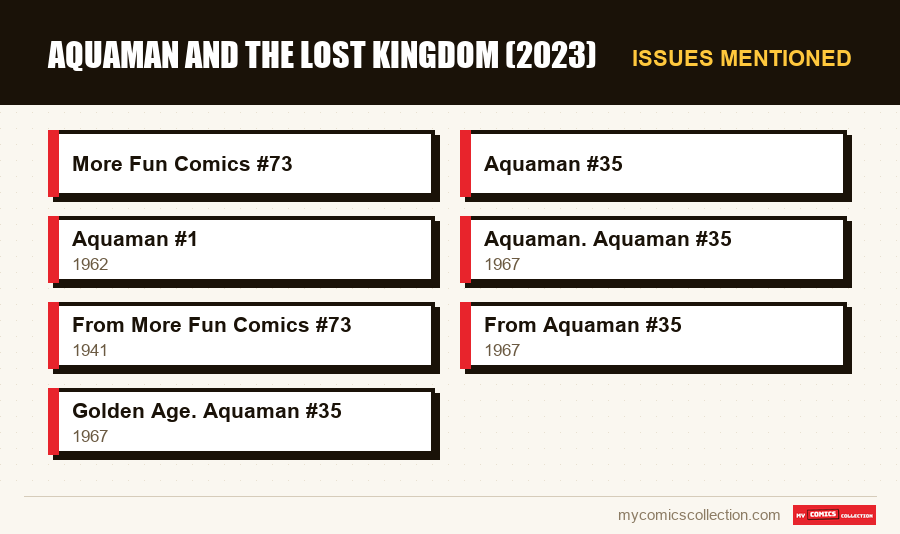
More Fun Comics #73 (1941): Aquaman's first appearance
Aquaman #35 (1967): Black Manta's first appearance
Orm / Ocean Master: Aquaman's half-brother
Atlantis: the underwater kingdom and its cities
- Arthur Curry, king of Atlantis, and his aquatic powers.
- Black Manta, sworn enemy driven by vengeance.
- Orm, the rival half-brother, the Ocean Master.
- Le kingdom of Atlantis and its many cities.
- La communication with sea creatures.
- The “lost kingdom” and the black trident are inventions of the film.
- L'alliance between Arthur and Orm is unprecedented.
- Manta's power comes from a cursed artifact.
- A plot ecological around warming.
- The story does not follow any specific arc from the comics.
More Fun Comics #73 (1941): Aquaman, King of the Seas
Aquaman and the Lost Kingdom continues the story of Arthur Curry, who appeared in More Fun Comics #73 (1941), created by Mort Weisinger and Paul Norris. The son of a lighthouse keeper and a queen of Atlantis, Arthur possesses the ability to breathe underwater, superhuman strength, prodigious swimming speed, and the power to communicate with sea life. King of Atlantis, he rules over a vast underwater kingdom while serving as a bridge between the surface world and the oceans. A founding member of the Justice League, Aquaman was long underestimated before being rehabilitated as a powerful and complex hero, ruler of a threatened aquatic empire.
The film faithfully resumes the character established in the first part: Arthur Curry, now king of Atlantis, torn between his royal responsibilities, his family life and his heritage. Jason Momoa plays this charismatic ruler, faithful to the modern version of the character. The film depicts his aquatic powers, his communication with sea creatures and his kingdom of Atlantis, rich in cities and peoples. This loyalty to Aquaman and his underwater mythology anchors the film in the universe of the king of the seas. The story develops this universe while moving away from a specific arc of the comics, favoring an original adventure.
Aquaman #35 (1967): Black Manta, the sworn enemy
The main antagonist of the film is Black Manta, who appeared in Aquaman #35 (1967). Aquaman's sworn enemy, Black Manta is a sea pirate dressed in a characteristic suit with a helmet with large eyes, capable of shooting energy rays. Driven by a deep hatred towards Aquaman, he is one of the hero's most iconic and implacable adversaries. In the comics, their rivalry is marked by personal tragedies, making it much more than a simple confrontation: a visceral vendetta. Black Manta embodies the recurring threat to Aquaman's reign.
The film takes on Black Manta as the central antagonist, driven by revenge after the events of the first part. Yahya Abdul-Mateen II embodies this implacable enemy, faithful to his iconic appearance and his tenacious hatred. The film, however, develops the character by giving him increased power via a cursed artifact: the black trident and the lost kingdom, elements invented for the story. This invention raises the threat of Manta and justifies the unprecedented alliance between Arthur and his half-brother Orm. The film retains the essence of the Aquaman-Black Manta rivalry while placing it in an original plot combining revenge, ancient magic and ecological issues, without following a specific arc from the comics.
Orm, the half-brother who became an ally
The film features Orm, Arthur's half-brother, known in the comics as Ocean Master. Aquaman's long-time rival, Orm claims the throne of Atlantis and embodies the tension between the two brothers, one turned towards the surface, the other towards the depths. Antagonist of the first film, Orm here becomes an unlikely ally of Arthur in the face of the common threat of Black Manta. This unprecedented alliance between the two brothers is one of the major narrative drivers of the film. It explores the theme of fraternity, forgiveness and reconciliation, giving the story an emotional dimension beyond the action.
This evolution of Orm, from enemy to ally, illustrates the freedom that the film takes compared to the comics, where the rivalry between the brothers is more constant. By bringing them together in the face of a common threat, the film develops their relationship and offers a redemption arc for Orm. Patrick Wilson plays this torn character, whose alliance with Arthur gives rise to moments of complicity and tension. This fraternal dynamic, central to the film, is inspired by the relationship in the comics while reinventing it. For the reader, it is an invitation to discover Ocean Master and the complex history of the two brothers in the comics, where their rivalry for the throne of Atlantis has fueled some of the richest stories of the king of the seas for decades.
The characters, from paper to screen
- Arthur Curry / Aquaman: The King of Atlantis, faithful to More Fun Comics #73.
- Black Manta: The sworn enemy, loyal to Aquaman #35, with increased power.
- Orm / Ocean Master: The rival half-brother who becomes an ally in the film.
- Mera: The queen of Atlantis and wife of Arthur.
- The lost kingdom: An ancient city invented for the film.
Collecting this series?
Track what you own, what you are missing and what your collection is worth. 7 day trial.
Start my trial →Atlantis and underwater mythology
The film unfolds the rich underwater mythology of Atlantis, developed in the comics over the decades. A sunken kingdom populated by multiple cities and peoples with varied characteristics, Atlantis is much more than a setting: it is a complex political empire, with its rivalries, traditions and threats. Aquaman, as king, must navigate these factions while protecting the oceans. The film exploits this richness, showing different Atlantean cities, creatures and technologies, faithful to the breadth of the mythology of the comics. This world-building dimension makes Atlantis one of DC's most developed universes.
This exploration of Atlantis illustrates the depth of a mythology built since the 1940s. The film adds original elements, such as the lost kingdom and its ancient magic, while building on the foundations of the comics. It also integrates an ecological dimension, linking the threat of the lost kingdom to warming and pollution of the oceans, a contemporary theme. This richness makes Atlantis an ideal setting for epic stories mixing fantasy, science fiction and current issues. For the reader, the film is a gateway to the aquatic mythology of comics, where Atlantis and its sovereigns have for decades offered a universe of a richness comparable to the greatest fantasy sagas, to be discovered number after issue.
Aquaman, from a mocked hero to a respected king
Aquaman's editorial history is one of spectacular rehabilitation. Long perceived as a minor hero, mocked for his power to “talk to fish,” the king of the seas has been profoundly reinvented over the decades to reveal all his power and complexity. Modern runs, notably that of Geoff Johns from 2011, have made Arthur Curry a formidable ruler, torn between two worlds, carrying the weight of a kingdom and a legacy. This evolution transformed Aquaman into one of DC's richest characters, capable of raising tidal waves, commanding Atlantean armies, and standing up to the Justice League's mightiest heroes.
The film is fully in keeping with this modern and respected version of the character. Jason Momoa's Arthur Curry is a charismatic and powerful king, far from the cliché of the minor hero. The film highlights his strength, his authority and his ability to command sea creatures like a formidable weapon, faithful to the rehabilitation carried out in the comics. This royal and warrior dimension gives the character an epic stature. For the reader, the film is an invitation to discover the transformation of Aquaman in the comics, from the mocked hero of the beginnings to the majestic ruler of modern runs. This rehabilitation illustrates how a character can be reinvented to reveal unsuspected potential, making the King of the Seas one of DC's greatest editorial successes.
Where to start reading
To extend the film, More Fun Comics #73 (1941) features the first appearance of Aquaman. Aquaman #35 (1967) introduced Black Manta. Geoff Johns' run ("The Trench", 2011) reinvents the character in a modern and accessible way. Peter David's run (1990s) is another reference. This course covers the sources for a film centered on the king of Atlantis and his mythology.
Chronology of comics to know
- 1941: More Fun Comics #73: Aquaman's first appearance.
- 1967: Aquaman #35: Black Manta's first appearance.
- 2011: “Aquaman: The Trench”: Geoff Johns’ modern run.
Collection side: what numbers to aim for after the film
Aquaman and the Lost Kingdom points to some major keys. More Fun Comics #73 (1941, first appearance of Aquaman) is a crucial key to the Golden Age, very rare and sought after. Aquaman #35 (1967, first appearance of Black Manta) is another important key to the Silver Age. Geoff Johns' run (2011) is an accessible modern target. These numbers cover a wide variety of budgets. As always, condition and gradation determine value; relying on real recent sales is strongly recommended.
Its place in the saga and for the collector
Aquaman and the Lost Kingdom concluded James Wan's duology by expanding on the underwater mythology and the rivalry with Black Manta. For the collector, it has maintained interest in More Fun Comics #73 and Aquaman #35, keys to the king of the seas. It illustrates the effect of adaptations on the market. Beyond speculation, the film invites you to discover Aquaman in the comics, from the founding story of 1941 to modern runs. By exploring Atlantis, brotherhood and ecology, it reminds us that the king of the seas reigns over one of DC's richest universes.
The verdict: an original underwater adventure
- Loyalty: Arthur Curry, Black Manta, Orm, the kingdom of Atlantis, aquatic powers and communication with sea life come from the comics.
- Freedoms: the lost kingdom and the invented black trident, the unprecedented Arthur-Orm alliance, the cursed artifact of Manta, the ecological intrigue, a story outside the arcs of the comics.
- Collectible numbers: More Fun Comics #73 (Aquaman), Aquaman #35 (Black Manta).
Aquaman and the Lost Kingdom continues the story of Arthur Curry facing Black Manta, now king of Atlantis and allied with his half-brother Orm. Faithful to the characters and underwater mythology while inventing the lost kingdom and the fraternal alliance, the film deploys a rich aquatic universe. For both the reader and the collector, it is an invitation to discover More Fun Comics #73 and Aquaman #35.
Frequently asked questions
From More Fun Comics #73 (1941), created by Mort Weisinger and Paul Norris. King of Atlantis, Arthur Curry breathes underwater, possesses superhuman strength and communicates with marine life. The film faithfully continues the character established in the first part.
From Aquaman #35 (1967). Sworn enemy of Aquaman, this sea pirate with the characteristic helmet is driven by a deep hatred towards the hero. The film takes him as the central antagonist, giving him increased power via a cursed artifact invented for the story.
No. The lost kingdom, the black trident and the alliance between Arthur and his half-brother Orm are inventions of the film. The story is based on the characters and mythology of Atlantis, but offers an original adventure combining revenge, ancient magic and ecological issues.
Arthur's half-brother, known in the comics as Ocean Master. A long-time rival with a claim to the throne of Atlantis, he was the antagonist of the first film. Here, he becomes an unlikely ally against Black Manta, a brotherhood arc invented for the film.
More Fun Comics #73 (1941, first appearance of Aquaman) is a crucial key to the Golden Age. Aquaman #35 (1967, first appearance of Black Manta) is another key to the Silver Age. Geoff Johns' run (2011) is an accessible modern target.
Does the film make you want to collect? Estimate the value for free of your issues (More Fun Comics #73, Aquaman #35…) with our tool based on current eBay listings.