Shazam! (2019) David F. Sandberg , with Zachary Levi and Asher Angel , adapts the hero born in Whiz Comics #2 (1940) by Bill Parker and C.C. Beck. The film features Billy Batson, the child who transforms into an adult hero by pronouncing "SHAZAM", the magician, the Dr Sivana and the Seven Deadly Sins. Faithful to the childish and magical spirit of the character, he modernizes the context. Here is the detailed comparison, film versus comics.
A light-hearted family comedy, Shazam! brings to the screen one of DC's most atypical characters: a child with the powers of an adult hero. It draws on a character born at Fawcett Comics. Source-by-source decryption.
As in each article in this series, only verified information (creators, distribution, dates, comic numbers) is stated; the comparative analysis is ours, without reproducing dialogue or protected images.
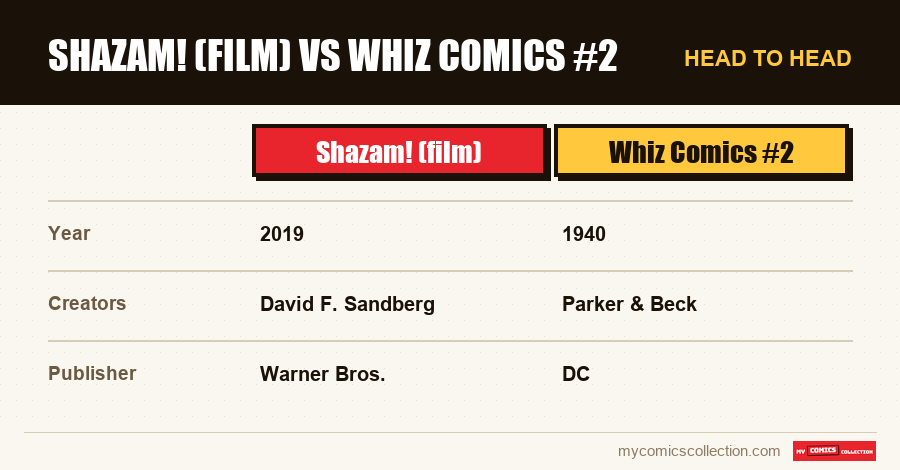
Title : Shazam! (2019)
Director: David F. Sandberg
Actors: Zachary Levi (Shazam), Asher Angel (Billy Batson), Mark Strong (Dr. Sivana), Jack Dylan Grazer (Freddy)
Exit : April 2019
Studio: Warner Bros.
Whiz Comics #2 (1940): Shazam's first appearance (Parker & Beck)
Billy Batson: the child who becomes an adult hero
Dr Sivana: the scientific nemesis
The Seven Deadly Sins: evil creatures
- Billy Batson, a child who becomes an adult hero.
- The magic word “SHAZAM» and the magician.
- THE powers ancient gods and heroes.
- Le Dr Sivana, sworn enemy.
- THE Seven Deadly Sins, evil creatures.
- Billy lives in a host family, a central addition.
- Le Dr Sivana gains powers via the Deadly Sins.
- The tone is that of family comedy.
- La Shazam family is modernized.
- The plot is largely original.
Whiz Comics #2 (1940): The Birth of Shazam
Shazam, long known as Captain Marvel, appears in Whiz Comics #2 (1940), created by Bill Parker and C.C. Beck for Fawcett Comics. Billy Batson, a young orphan, is entrusted by an ancient magician with the power to transform into a powerful adult hero by pronouncing the magic word "SHAZAM", an acronym of the gods and heroes from whom he draws his abilities: Solomon (wisdom), Hercules (strength), Atlas (endurance), Zeus (power), Achilles (courage) and Mercury (speed). This concept, a child with the powers of an adult hero, is one of the most original in comics. Immensely popular in the 1940s, the character was later purchased by DC, which integrated him into its universe.
The film faithfully takes up this founding concept: Billy Batson, the orphan child, the magician, the word “SHAZAM”, the transformation into an adult hero, the powers of the ancient gods. Zachary Levi plays the adult hero with infectious childish enthusiasm, while Asher Angel plays young Billy. This duality, a child in a superhero’s body, is at the heart of the film, which exploits its full comic and emotional potential. The film modernizes the context, making Billy a child placed in foster care, but respects the essence of the character: magic, innocence, the dream of a child who becomes a hero. This loyalty to Shazam's childish spirit is one of his great achievements.
The host family, the emotional heart of the film
The film adds a central element missing from the original concept: Billy's foster family. Placed with the Vasquez, Billy meets other children there, including Freddy, a superhero fan who becomes his best friend and accomplice. This family dimension, which explores Billy's quest to belong and his difficulty in becoming attached, gives the film its emotional heart. The theme of family-chosen rather than suffered-is at the center of the story, culminating in Shazam's sharing of his powers with his foster siblings. This plot, largely developed for the film, anchors the character in a contemporary emotion.
This addition, although it moves away from the original concept, is in keeping with the spirit of the character and its modern developments. Recent retellings of Shazam in the comics, notably that of Geoff Johns, have developed the "Shazam family", a group of heroes sharing Billy's powers. The film draws inspiration from this, making the sharing of power and the chosen family the central theme of its conclusion. This family dimension, warm and moving, distinguishes Shazam! from other superhero films and gives it its uniqueness. For the reader, it is an invitation to discover modern reinterpretations of the character, where the Shazam family embodies the idea that heroism, like belonging, can be shared and chosen.
Dr. Sivana and the Seven Deadly Sins
The film pits Shazam against Dr. Sivana, his sworn enemy, who appeared as early as Whiz Comics #2 (1940). A brilliant scientist and megalomaniac, Sivana is, in the comics, the scientific antithesis of Shazam's magic. The film takes the character, played by Mark Strong, but gives him supernatural powers via the Seven Deadly Sins, demonic creatures from the character's mythology. These entities, incarnations of human vices (pride, envy, anger, etc.), are freed by Sivana, who thus becomes a magical threat equal to Shazam. This rereading anchors the antagonist in the magical dimension of the hero's universe.
The Seven Deadly Sins, authentic elements of the Shazam mythology, provide the film with visually striking and thematically relevant antagonists. They embody the temptations and vices that the hero, guided by the wisdom of Solomon, must combat. This opposition between the benevolent magic of Shazam and the demonic forces gives the film its fantastic dimension. Dr. Sivana, by allying himself with these creatures, becomes a devious and powerful enemy. For the reader, Dr. Sivana and the Deadly Sins are invitations to discover the magical mythology of Shazam in the comics, where the conflict between science and magic, between virtues and vices, nourishes a rich and singular universe, inherited from the golden age of Fawcett Comics.
Collecting this series?
Track what you own, what you are missing and what your collection is worth. 7 day trial.
Start my trial →The characters, from paper to screen
- Billy Batson / Shazam: Orphan child turned adult hero, faithful to Whiz Comics #2.
- Freddy: Billy's best friend, superhero fan, accomplice in the film.
- Dr Sivana: Scientific archenemy, endowed with powers via the Deadly Sins.
- The Wizard Shazam: The one who entrusts his powers to Billy.
- The Seven Deadly Sins: Demonic creatures, antagonists of the film.
A light and family tone, going against the grain
Shazam! stands out from other films in the DC universe by its light and family tone, going against the gravity that characterized previous productions. By taking on comedy, humor and emotion, the film captures the childish and joyful spirit of the character, long one of the brightest in DC. This approach, closer to family entertainment than a dark blockbuster, has won over critics and audiences, bringing a welcome freshness. The film proves that the DC Universe can also embrace lightness and optimism, true to the diversity of tones of its characters.
This bias is deeply faithful to the essence of Shazam, a character designed from the outset with a childish and fanciful tone, very different from the darkness of a Batman. By exploiting the comic gap between the mind of a child and the body of an adult superhero, the film gets to the heart of what makes the character unique. For the reader, Shazam! is an invitation to discover a long-atypical hero, whose story, born at Fawcett Comics in the 1940s, combines magic, innocence and wonder. The film reminds us that DC is not limited to dark stories, and that joy and wonder are also part of the richness of its universe, happily embodied by Shazam's smile.
Captain Marvel, a long-disputed hero
The story of the character Shazam is one of the most unique in comics. Created in 1940 under the name Captain Marvel by Fawcett Comics, he rivaled Superman in popularity, to the point that DC sued for plagiarism, judging the character too close to its Man of Steel. This dispute, as well as declining sales, led Fawcett to cease publication of the character in the 1950s. Decades later, DC bought the rights and integrated Captain Marvel into its universe. But in the meantime, Marvel Comics had trademarked "Captain Marvel", forcing DC to publish the character under the title "Shazam!" », named after its magic word: hence its current name.
This eventful story explains the character's name and his special status in the DC universe. Long disputed, eclipsed, then rehabilitated, Shazam is a survivor of the golden age, whose original popularity rivaled the greatest. The film, by bringing him to the screen, revives interest in this historical figure and his timeless childish charm. For the reader, the story of Shazam is an invitation to explore a little-known part of the history of comics, that of Fawcett and the competition of the golden age. She reminds us that behind each character there is sometimes a fascinating editorial saga, made up of rivalries, trials and rebirths, like this hero with the dazzling smile.
Where to start reading
To extend the film, Whiz Comics #2 (1940) features the first appearance of Shazam (Captain Marvel). “Shazam!” » (2012) by Geoff Johns and Gary Frank, “New 52” rereading, modernizes the character and develops the Shazam family. Fawcett's tales of the golden age offer original charm. This journey covers the sources of a film faithful to the childish spirit of the hero.
Chronology of comics to know
- 1940: Whiz Comics #2: the first appearance of Shazam (Captain Marvel) and Dr. Sivana.
- 1940s: The golden age of Fawcett Comics and the character's immense popularity.
- 2012: “Shazam!” » (Geoff Johns): modern rereading and the Shazam family.
Collection side: what numbers to aim for after the film
Shazam! points to a major key to the Golden Age. Whiz Comics #2 (1940, first appearance of Shazam/Captain Marvel and Dr. Sivana) is a highly sought after and valuable issue, one of the great classics of the Golden Age. Fawcett's other issues from the period are of interest to fans. The collection “Shazam! » by Geoff Johns (2012) is an accessible modern target. These numbers cover various budgets. As always, condition and gradation determine value; relying on real recent sales is strongly recommended.
Its place in the saga and for the collector
Shazam! brought to the screen an atypical and luminous character from DC, bringing a welcome freshness to the cinematographic universe. For the collector, it revived interest in Whiz Comics #2, a Golden Age classic. It illustrates the effect of adaptations on the market. Beyond speculation, the film invites you to discover the magical mythology of Shazam in the comics, from its founding story from 1940 to modern rereadings. By assuming a family and joyful tone, it recalls the diversity of tones of the DC universe and the charm of a hero born from the childish imagination of the golden age.
The verdict: a loyal and cheerful child hero
- Loyalty: Billy Batson, the word "SHAZAM", ancient powers, Dr. Sivana and the Seven Deadly Sins come from the comics.
- Freedoms: the central foster family, Dr. Sivana with powers, the family comedy tone, the original plot.
- Collectible numbers: Whiz Comics #2 (Shazam), “Shazam!” » by Geoff Johns (2012).
Shazam! faithfully adapts the childish and magical spirit of the hero (Billy Batson, the magic word, the Seven Deadly Sins) by adding a moving foster family storyline. Faithful to the luminous tone of the character and bringing freshness to the DC universe, the film seduces. For the reader as well as the collector, it is an invitation to discover Whiz Comics #2.
Frequently asked questions
From Whiz Comics #2 (1940), created by Bill Parker and C.C. Beck for Fawcett Comics. Billy Batson transforms into an adult hero by saying "SHAZAM". Long called Captain Marvel, the character was then bought by DC. The film faithfully takes up this concept.
It's an acronym for the ancient gods and heroes from whom Billy draws his powers: Solomon (wisdom), Hercules (strength), Atlas (endurance), Zeus (power), Achilles (courage), and Mercury (speed). The film faithfully reproduces this mythological origin.
It's a development of the film, but inspired by the "Shazam family" of modern retellings (Geoff Johns), where Billy shares his powers with other children. This family storyline is at the emotional heart of the story.
Shazam's sworn enemy, a brilliant scientist and megalomaniac, appeared as early as Whiz Comics #2 (1940). The film gives him supernatural powers via the Seven Deadly Sins, demonic creatures from the character's mythology.
Whiz Comics #2 (1940, premiere of Shazam/Captain Marvel and Dr. Sivana) is a highly sought-after Golden Age classic. The collection “Shazam! » by Geoff Johns (2012) is an accessible modern target.
Does the film make you want to collect? Estimate the value for free of your issues (Whiz Comics #2…) with our tool based on current eBay listings.