Superman Returns (2006) Bryan Singer , with Brandon Routh, pays homage to the Man of Steel (Action Comics #1, 1938) by showing him returning to Earth after a long absence. Conceived as an extension of the films of Richard Donner, it draws on the myth of Superman facing Lex Luthor. Here is the detailed comparison, film versus comics.
Return of the Last Son of Krypton, this film explores Superman's place in a world that has learned to live without him. It draws on the founding myth of the Man of Steel. Source-by-source decryption.
As in each article in this series, only verified information (creators, distribution, dates, comic numbers) is stated; the comparative analysis is ours, without reproducing dialogue or protected images.
Title : Superman Returns (2006)
Director: Bryan Singer
Actors: Brandon Routh (Superman), Kate Bosworth (Lois Lane), Kevin Spacey (Lex Luthor)
Exit : June 2006
Studio: Warner Bros.
Action Comics #1 (1938): Superman's first appearance
Lex Luthor: the nemesis (Action Comics #23, 1940)
Lois Lane: the Daily Planet journalist
Krypton: the missing home planet
- Clark Kent / Superman, last son of Krypton.
- His powers: flight, strength, vision, invulnerability.
- Lois Lane and the Daily Planet.
- Lex Luthor, the manipulative nemesis.
- La weakness with kryptonite.
- Lois and Superman's child is an invention of the film.
- Superman returns after a absence of several years.
- The film extends the Donner movies, not a specific comic.
- Luthor's real estate plot is unique to the film.
- The melancholic and introspective tone.
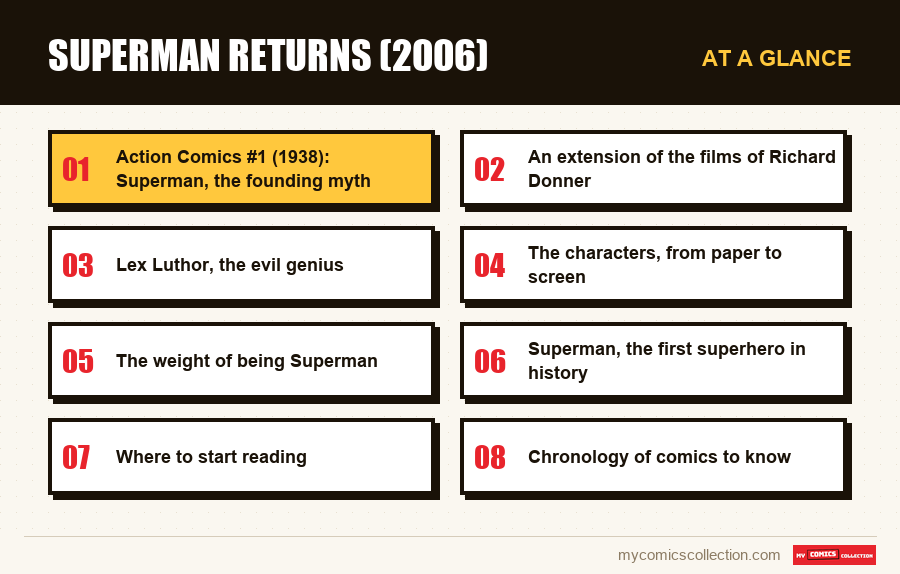
Action Comics #1 (1938): Superman, the founding myth
Superman Returns pays homage to Superman, who appeared in Action Comics #1 (1938), created by Jerry Siegel and Joe Shuster. The first superhero in comic book history, Superman defined the entire genre. Last son of the planet Krypton, sent to Earth by his parents before the destruction of his world, Kal-El was raised under the name Clark Kent by the Kents in Kansas. Endowed with immense powers (flight, superhuman strength, invulnerability, thermal and x-ray vision, icy breath) under the earth's sun, he becomes the protector of Metropolis and the symbol of hope. His dual identity, journalist at the Daily Planet by day, hero by night, is at the heart of the myth.
The film faithfully captures the essence of Superman: his powers, his dual identity as Clark Kent, his love for Lois Lane, his Kryptonian origin and his role as protector. Brandon Routh plays a classic Superman, in line with Christopher Reeve's interpretation. The film features the Daily Planet, Metropolis, kryptonite as a weakness and the confrontation with Lex Luthor, faithful to the myth. This loyalty to the founding character anchors the film in the tradition of the Man of Steel. Conceived as a tribute and an extension, it is however not inspired by a specific arc of the comics, but by the overall myth and cinematographic legacy of Richard Donner.
An extension of the films of Richard Donner
Superman Returns is notable for being intended as a spiritual sequel to Richard Donner's films Superman (1978) and Superman II (1980), starring Christopher Reeve. The film ignores later episodes and picks up where Donner left off: Superman returns to Earth after an absence of several years, searching for the remains of Krypton. This nostalgic approach is manifested in the tone, the music (taking up John Williams' theme), the costume and the interpretation of Brandon Routh, a tribute to Reeve. The film is thus more in keeping with cinematographic continuity than in a direct adaptation of the comics, a singular choice in the landscape of superhero films.
This connection with Donner's films gives Superman Returns a particular identity. Rather than reinventing the character, it celebrates the classic incarnation of Superman, with reverence. This nostalgic bias explains certain choices, such as Lois' child, an invention of the film absent from the comics of the time, which extends the relationship begun in Superman II. The film explores Superman's place in a world that has learned to live without him, an introspective and melancholy theme. For the reader, this approach reminds us that the Superman myth has been shaped as much by cinema as by comics. The film is an invitation to discover Action Comics #1 and the founding story, while celebrating the visual and emotional legacy of Donner's films that have marked generations.
Lex Luthor, the evil genius
The film's antagonist is Lex Luthor, who appeared in Action Comics #23 (1940), Superman's archenemy. A criminal genius devoid of superpowers but endowed with formidable intelligence and excessive ambition, Luthor embodies the antithesis of Superman: where the Man of Steel represents altruism and hope, Luthor embodies pride, manipulation and the thirst for power. He compensates for the absence of powers with his genius, his wealth and his mastery of kryptonite, Superman's only weakness. A complex character, Luthor often sees himself as the true protector of humanity, jealous of the adoration devoted to an extraterrestrial.
The film features Lex Luthor as the antagonist, played by Kevin Spacey. True to his intelligence and manipulation, this Luthor hatches a crazy real estate plot using Kryptonian technology to create a new continent, specific to the film. The film highlights his mastery of kryptonite, which he uses to weaken Superman, faithful to the comics. This version, in line with the Luthor of Donner's films played by Gene Hackman, favors a lighter and more theatrical tone than the cold genius of modern comics. For the reader, the film is an invitation to discover Lex Luthor in all his complexity, particularly in modern stories which explore his psychology, his philosophical rivalry with Superman and his conviction to act for the good of humanity, making him one of the greatest villains in comics.
Collecting this series?
Track what you own, what you are missing and what your collection is worth. 7 day trial.
Start my trial →The characters, from paper to screen
- Clark Kent / Superman: The Last Son of Krypton, faithful to Action Comics #1.
- Lois Lane: The Daily Planet journalist, mother of a child in the film.
- Lex Luthor: The sworn enemy, manipulative genius.
- Jason: Lois' child, invention of the film.
- Martha Kent: Clark's adoptive mother in Kansas.
The weight of being Superman
The film explores an introspective dimension of the character: the weight of responsibility and the solitude of Superman. By showing him back after a long absence, in a world that has learned to do without him, the film asks profound questions about his place and his role. Does the world really need a savior? Can Superman have a personal life? This melancholy and reflective tone distinguishes the film from more traditional action stories. Superman appears as a Christ-like and solitary figure, carrying the weight of the world while yearning for a human connection, notably with Lois who has rebuilt her life.
This exploration of loneliness and sacrifice touches the heart of the character. Superman, despite his power, is a profoundly alone being, the last survivor of a vanished world, forced to conceal his true nature. The film captures this tragic dimension, making Superman's power also his burden. This introspective approach, if it moves away from pure action, is part of a tradition of comics which explore the psychology of the Man of Steel, in particular his humanity and his isolation. For the reader, the film reminds that Superman is not just an invulnerable colossus, but a character carrying universal themes (belonging, sacrifice, the solitude of the hero) which have been his source of richness in comics since 1938 and nourish the greatest stories of the Man of Steel.
Superman, the first superhero in history
Superman's importance in popular culture goes far beyond comic books. By appearing in Action Comics #1 in 1938, he didn't just create a character: he invented an entire genre. Before him, there was no “superhero” in the modern sense. Superman defined the founding codes (the dual identity, the colorful costume, the superhuman powers used for good, the commitment to protecting the innocent) which thousands of heroes would then take up. His immediate success launched the golden age of comics and made him a global icon, a symbol of hope and justice spanning generations and media.
The film respects this founding heritage. By presenting a classic and reverential Superman, it celebrates the original myth rather than deconstructing it. This approach reflects the particular stature of the character: Superman is not one hero among others, but the archetype from which all others descend. The film honors this position by taking care of the iconic elements: the costume, the flight, the spectacular rescue, the relationship with Lois. For the reader, this dimension reminds us that collecting Superman means touching on the very origins of the superheroic genre. Action Comics #1 is not just a collector's key: it is a historical artifact, the starting point of an entire culture, which explains its unique status and its unparalleled value in the comics market.
Where to start reading
To extend the film, Action Comics #1 (1938) features the first appearance of Superman. “Superman: Birthright” (2003) and “Superman: Secret Origin” (2009) tell his origins in a modern way. Grant Morrison’s “All-Star Superman” (2005) is a must-see masterpiece that captures the essence of the character. This journey covers the sources of the myth celebrated by the film.
Chronology of comics to know
- 1938: Action Comics #1: Superman's first appearance.
- 1940: Action Comics #23: Lex Luthor's first appearance.
- 2005: “All-Star Superman”: a major modern story.
Collection side: what numbers to aim for after the film
Superman Returns points to the absolute key to comics. Action Comics #1 (1938, first appearance of Superman) is the most sought-after and expensive comic in history, a legendary piece out of reach for most. Action Comics #23 (1940, first appearance of Lex Luthor) is another major key to the Golden Age. Modern collections like “All-Star Superman” are accessible targets. These numbers cover extreme budgets. As always, condition and gradation determine value; relying on real recent sales is strongly recommended.
Its place in the saga and for the collector
Superman Returns paid homage to the Man of Steel by continuing the legacy of Donner's films and exploring the hero's loneliness. For the collector, it has maintained interest in Action Comics #1, the supreme key to comics. It illustrates the weight of the Superman myth in popular culture. Beyond speculation, the film invites you to discover Superman in comics, from the founding story of 1938 to modern masterpieces. By exploring the place of the hero in the world, it reminds us that Superman, history's first superhero, remains a symbol of hope and a figure of inexhaustible depth.
The verdict: a nostalgic homage to the myth
- Loyalty: Clark Kent / Superman, his powers, Lois Lane, the Daily Planet, Lex Luthor, kryptonite and the Kryptonian origin come from the comics.
- Freedoms: Lois's invented child, the return after a long absence, the extension of Donner's films, Luthor's real estate plot, the melancholic tone.
- Collectible numbers: Action Comics #1 (Superman), Action Comics #23 (Lex Luthor).
Superman Returns pays homage to the Man of Steel by showing him returning to a world that has learned to live without him. Faithful to the founding myth, to Lois Lane and Lex Luthor but designed as a nostalgic extension of Donner's films rather than an adaptation of a specific comic, the film explores the solitude of the hero. For the reader and the collector, it is an invitation to discover Action Comics #1 and “All-Star Superman”.
Frequently asked questions
From Action Comics #1 (1938), created by Jerry Siegel and Joe Shuster. The first superhero in history, the last son of Krypton raised under the name Clark Kent, he defined the entire genre. The film faithfully reproduces the character and his founding myth.
No. The film is intended as an extension of the films by Richard Donner (1978, 1980) with Christopher Reeve, not as an adaptation of an arc from the comics. It draws from the overarching Superman mythos and pays homage to the classic cinematic incarnation of the character.
Jason, the child of Lois and Superman, is an invention of the film, absent from the comics of the time. It continues the relationship started in Donner's Superman II. (A son of Lois and Clark, Jon Kent, will appear much later in the comics, unrelated to the film.)
Superman's nemesis, appeared in Action Comics #23 (1940). A criminal genius without powers but of formidable intelligence, he embodies the antithesis of the hero. In the film, he hatches a real estate plot using Kryptonian technology, specific to the story.
Action Comics #1 (1938, Superman's first appearance) is the most sought-after and expensive comic book in history. Action Comics #23 (1940, Lex Luthor's first) is another key to the Golden Age. “All-Star Superman” (2005) is an accessible modern target.
Does the film make you want to collect? Estimate the value for free of your issues (Action Comics #1, Action Comics #23…) with our tool based on current eBay listings.