Superman III (1983) Richard Lester , with Christopher Reeve and Richard Pryor, adopts a comic tone and features a synthetic kryptonite which splits Superman between his good and his bad side. The film invents its plot but draws on themes true to the character. Here is the detailed comparison, film versus comics.
Third part of the Reeve saga, Superman III focuses on comedy and explores the inner duality of the hero. It draws on the myth of Superman while moving away from the comics. Source-by-source decryption.
As in each article in this series, only verified information (creators, distribution, dates, comic numbers) is stated; the comparative analysis is ours, without reproducing dialogue or protected images.
Title : Superman III (1983)
Director: Richard Lester
Actors: Christopher Reeve (Superman), Richard Pryor (Gus Gorman), Robert Vaughn (Ross Webster)
Exit : June 1983
Studio: Warner Bros.
Action Comics #1 (1938): Superman's first appearance
Kryptonite: the iconic weakness of the hero
The Clark/Superman duality: a recurring theme
Smallville: Clark's childhood town
- Clark Kent / Superman and its powers.
- La kryptonite as a weakness of the hero.
- The return to Smallville, his childhood town.
- La duality between Clark and Superman.
- Her inner struggle between good and bad.
- The antagonist, Ross Webster, is invented for the film.
- A synthetic kryptonite corrupts Superman.
- The tone is comic, centered on Gus Gorman.
- The plot does not follow no bow comics.
- Un supercomputer as a final threat.
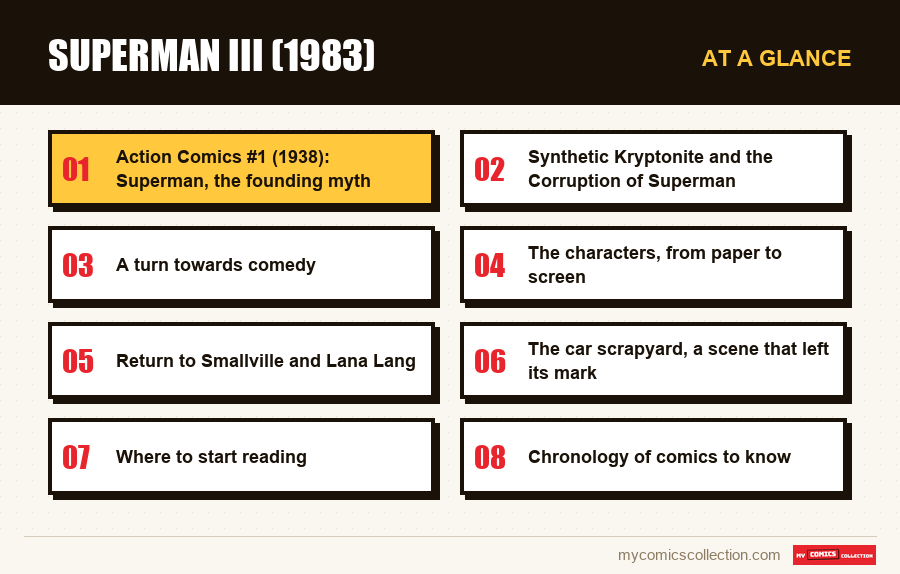
Action Comics #1 (1938): Superman, the founding myth
Superman III features Superman, who appeared in Action Comics #1 (1938), created by Jerry Siegel and Joe Shuster. The first superhero in history, the last son of Krypton raised under the name Clark Kent, Superman possesses immense powers (flight, superhuman strength, invulnerability, thermal vision) and embodies hope and justice. His dual identity, journalist at the Daily Planet and hero of Metropolis, as well as his weakness to kryptonite, are at the heart of his myth. Superman is a global icon, symbol of the highest moral values, whose perpetual battle pits good against evil. The third film in the Reeve saga draws on this established figure to develop an original story.
The film takes up the character established in the previous parts: Christopher Reeve plays a faithful Superman, with his powers, his dual identity and his ideal. The film exploits several elements faithful to the comics: kryptonite, the return to Smallville, the duality between Clark and Superman. However, it adopts a much more comical tone than its predecessors, carried by the character of Gus Gorman, played by Richard Pryor, a clumsy computer scientist. The plot, centered on a crooked businessman and a supercomputer, is entirely invented for the film and does not correspond to any arc of the comics, marking a turn towards a lighter and more fanciful register.
Synthetic Kryptonite and the Corruption of Superman
The most interesting element of the film, faithful in spirit to the comics, is the synthetic kryptonite which corrupts Superman. In the film, Gus Gorman makes an artificial and imperfect version of kryptonite, which, instead of weakening Superman, alters his personality: the hero becomes selfish, careless and malicious, his dark side taking over. This corruption culminates in a famous sequence where Superman, split in two, physically confronts his good double, Clark Kent, in a car scrapyard. This inner confrontation, symbolizing the struggle between good and evil in everyone, is the highlight of the film and one of the most memorable in the Reeve saga.
This exploration of Superman's duality, although developed in an original way, resonates with themes present in the comics. Kryptonite exists in many variations in Superman stories, some of which alter his behavior-red kryptonite, in particular, causes unpredictable effects. The idea of a Superman corrupted or confronted with his dark side has also been explored several times. The film captures this fascinating concept: what would happen if the most virtuous hero gave in to his baser impulses? The heist sequence, where Clark confronts the corrupted Superman, visually embodies this inner struggle. For the reader, this duality illustrates the psychological richness of Superman, whose heroism is based on a constant moral choice. The film, despite its light tone, thus touches on a deep dimension of the character.
A turn towards comedy
Superman III differs from previous installments by its much more comical tone. The film relies heavily on the character of Gus Gorman, a clumsy and likeable computer scientist played by comedian Richard Pryor, whose antics take up a lot of space. This orientation towards humor, desired by the production, distances the film from the gravity and wonder of the first Superman. The burlesque register, visual gags and crazy situations dominate, sometimes to the detriment of the dramatic stakes. This shift divided audiences and critics, with many regretting the loss of the epic breath that was the strength of previous films.
This choice of tone illustrates a freedom of adaptation which moves away from the spirit of the comics of the time. If Superman has known light stories, particularly during the Silver Age, the film pushes comedy to a new level for the cinematographic saga. This direction reflects trends in mainstream cinema of the early 1980s more than a fidelity to the original material. For the reader, this comic turn contrasts with the dramatic richness of the great Superman stories in the comics. The film nevertheless retains strong moments, notably the duality sequence, which touches the essence of the character. He reminds us that adaptations can explore different registers, from the most epic to the lightest, and that Superman, a malleable figure, lends itself to varied interpretations, even if the most memorable remain those which honor the depth and ideal of the hero.
The characters, from paper to screen
- Superman/Clark Kent: The Man of Steel, faithful to Action Comics #1.
- Gus Gorman: Clumsy computer scientist, comic character invented for the film.
- Ross Webster: The antagonistic crooked businessman, original.
- Lana Lang: Clark's childhood sweetheart in Smallville, from the comics.
- The supercomputer: The final threat, invention of the film.
Collecting this series?
Track what you own, what you are missing and what your collection is worth. 7 day trial.
Start my trial →Return to Smallville and Lana Lang
An aspect faithful to the comics is Clark's return to Smallville, his childhood town, during a reunion of former students. The film features Lana Lang, Clark's childhood sweetheart, a well-known character from the comics where she plays an important role in Superman's youth in Smallville. This return to basics allows us to explore the hero's roots, his past as a young Kryptonian raised in a small American town, and his relationship with Lana. This intimate dimension, anchored in the mythology of Smallville, brings to the film a warmth and authenticity faithful to the spirit of the character.
Smallville and Lana Lang are essential parts of the Superman universe. The city embodies the American values and idealized childhood that shaped Clark, while Lana represents his first love and a connection to his earthly origins. The film honors these elements, providing a touching counterpoint to the comedic plot. This fidelity to the mythology of Smallville anchors the story in Superman's personal history. For the reader, this return to the sources is an invitation to discover Clark's youth in the comics, where Smallville and Lana Lang nourish numerous stories exploring the formation of the hero. The film, by integrating these elements, reminds us that Superman is not only a god from the sky, but also a child of Kansas, whose values and human ties are the basis of his heroism and his deep humanity.
The car scrapyard, a scene that left its mark
Despite its overall light tone, Superman III contains a sequence unanimously hailed as one of the peaks of the Reeve saga: the confrontation, in an automobile scrapyard, between the corrupt Superman and his virtuous alter ego, Clark Kent. Under the effect of synthetic kryptonite, the hero splits physically, embodying the struggle between his dark side and his light side. This scene, where Superman literally fights against himself, offers a powerful visual representation of the inner struggle between good and evil. Christopher Reeve delivers a remarkable performance, playing both sides of the character with an intensity that contrasts with the rest of the film.
This sequence illustrates how the film, beyond its comedy, touches on a deeper dimension of Superman. The idea that the most virtuous hero carries within him an element of darkness, and that his greatness lies in the constant choice of good, is at the heart of the character. The car wreck materializes this moral dilemma in a spectacular and memorable way, making this scene an anthology moment. For the reader, it resonates with the many stories in the comics that explore the psychology and temptations of Superman. She reminds us that, even in a film with a comedic orientation, the essence of the character, his fight to remain good despite everything, can be expressed forcefully. This duality, embodied by Reeve, remains Superman III's most enduring legacy.
Where to start reading
To extend the film, Action Comics #1 (1938) features the first appearance of Superman. “Superman: The Man of Steel” (1986) by John Byrne reinvents the myth and develops Smallville and Lana Lang. Grant Morrison’s “All-Star Superman” (2005) is an unmissable masterpiece. The stories exploring red kryptonite and Superman's duality enrich the reading.
Chronology of comics to know
- 1938: Action Comics #1: Superman's first appearance.
- 1986: “The Man of Steel”: the reinvention of the myth by John Byrne.
- 2005: “All-Star Superman”: a major modern story.
Collection side: what numbers to aim for after the film
Superman III points to the absolute key to comics. Action Comics #1 (1938, first appearance of Superman) is the most sought-after and expensive comic book in history. Modern collections like “The Man of Steel” (1986) or “All-Star Superman” (2005) are accessible and acclaimed targets. These numbers cover extreme budgets. As always, condition and gradation determine value; relying on real recent sales is strongly recommended.
Its place in the saga and for the collector
Superman III will remain as the lightest part of the Reeve saga, focusing on comedy, with the highlight being the sequence of the duality of the hero. For the collector, it recalls the importance of Action Comics #1, the supreme key to comics. It illustrates the liberties taken by the adaptations, notably the comic turn. Beyond its flaws, the film touches on a profound dimension of Superman: the fight between good and evil in everyone. By exploring this duality, he reminds us that the hero's true strength lies in his moral choices, a central theme of comics.
The verdict: a comedy that touches on the duality of the hero
- Loyalty: Superman, his powers, kryptonite, the return to Smallville, Lana Lang and the theme of the duality between good and evil come from the comics.
- Freedoms: Ross Webster invented, synthetic kryptonite, the comic tone carried by Gus Gorman, an original plot, the final supercomputer.
- Collectible numbers: Action Comics #1 (Superman), “The Man of Steel” (1986).
Superman III adopts a comedic tone and features a synthetic kryptonite which corrupts Superman, culminating in his confrontation against his dark double. Faithful to kryptonite, to Smallville and to the theme of duality but inventing its plot and focusing on humor, the film nevertheless touches on a deep dimension of the hero. For the reader as well as the collector, it is an invitation to discover Action Comics #1 and the great stories of Superman.
Frequently asked questions
No. The plot, centered on businessman Ross Webster, computer scientist Gus Gorman and a supercomputer, is entirely invented for the film. She doesn't fit any arc in the comics, even though the film draws on themes true to the character.
An artificial and imperfect version of kryptonite, made by Gus Gorman. Instead of weakening Superman, she corrupts his personality, bringing out his dark side. This leads to the famous sequence where Superman confronts his good double, Clark Kent, in a junkyard.
The theme yes, even if the sequence is specific to the film. The comics explore red kryptonite with unpredictable effects and have repeatedly depicted Superman being corrupted or confronted with his dark side. The film captures this concept of the inner struggle between good and evil.
The production oriented the film towards humor, focusing on comedian Richard Pryor in the role of Gus Gorman. This burlesque tone, reflecting the cinema trends of the early 1980s, distances the film from the epic gravity of the previous parts and divided the public.
Action Comics #1 (1938, Superman's first appearance) is the most sought-after comic in history. Modern collections like “The Man of Steel” (1986) by John Byrne or “All-Star Superman” (2005) are accessible and acclaimed targets.
Does the film make you want to collect? Estimate the value for free of your issues (Action Comics #1, The Man of Steel, etc.) with our tool based on current eBay listings.