Superman IV (1987) Sidney J. Furie , with Christopher Reeve, pits the Man of Steel against Nuclear Man, a villain created for the film and absent from the comics, against the backdrop of nuclear disarmament. The film remains faithful to Superman and Lex Luthor but invents its plot. Here is the detailed comparison, film versus comics.
Latest part of the Christopher Reeve saga, Superman IV combines pacifist message and unprecedented confrontation. It draws on the myth of Superman while moving away from the comics. Source-by-source decryption.
As in each article in this series, only verified information (creators, distribution, dates, comic numbers) is stated; the comparative analysis is ours, without reproducing dialogue or protected images.
Title : Superman IV (1987)
Director: Sidney J. Furie
Actors: Christopher Reeve (Superman), Gene Hackman (Lex Luthor), Mark Pillow (Nuclear Man)
Exit : July 1987
Studio: Warner Bros. / Cannon Films
Action Comics #1 (1938): Superman's first appearance
Lex Luthor: the nemesis (Action Comics #23, 1940)
Nuclear Man: villain invented for the film
The Daily Planet: the Metropolis newspaper
- Clark Kent / Superman and its powers.
- Lex Luthor, the manipulative nemesis.
- Le Daily Planet and Metropolis.
- L'moral ideal of Superman, protector of humanity.
- Sa dual identity and his bond with Lois.
- Nuclear Man is invented, absent from the comics.
- Superman disarm the world, original political intrigue.
- Of the invented powers for the purposes of the story.
- The plot does not follow no bow comics.
- The message pacifist in the foreground.
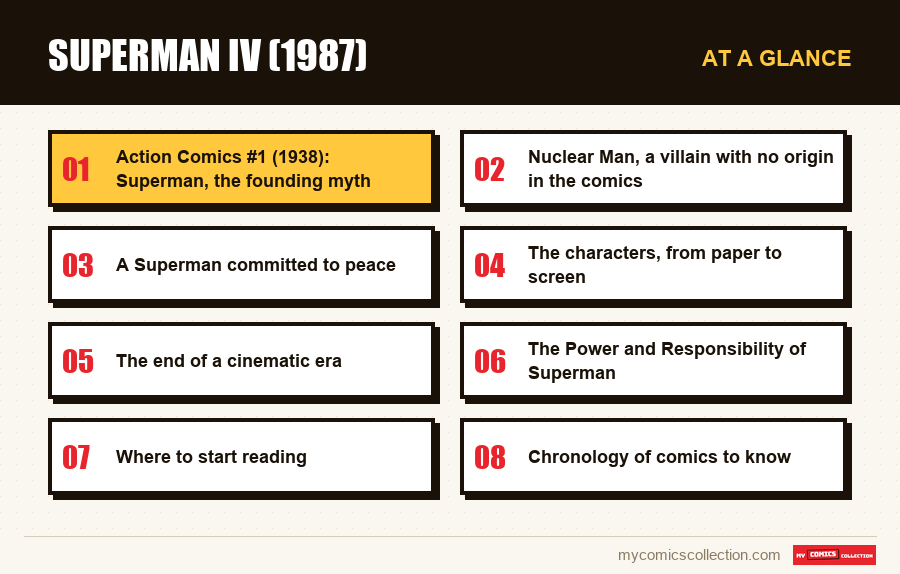
Action Comics #1 (1938): Superman, the founding myth
Superman IV features Superman, who appeared in Action Comics #1 (1938), created by Jerry Siegel and Joe Shuster. The first superhero in history, the last son of Krypton raised under the name Clark Kent, Superman possesses immense powers (flight, superhuman strength, invulnerability, thermal vision) and embodies hope and justice. His dual identity, journalist at the Daily Planet and hero of Metropolis, and his unshakable moral ideal are at the heart of his myth. A symbol of the highest values, Superman protects humanity while aspiring to a normal life. The fourth and final film in the Reeve saga draws on this established figure to develop a story with a strong political dimension.
The film takes up the character established in the previous parts: Christopher Reeve plays a faithful Superman, with his powers, his dual identity and his ideal. The film retains elements faithful to the comics: the Daily Planet, Metropolis, Lois Lane and especially Lex Luthor, the sworn enemy. However, it develops an entirely original plot, centered on nuclear disarmament and the confrontation with Nuclear Man, a villain created for the film. This political orientation, carried by the context of the Cold War of the 1980s, distances the film from the stories of the comics, while extending the reflection on the role of Superman in the face of the threats weighing on the world.
Nuclear Man, a villain with no origin in the comics
The film's main antagonist, Nuclear Man, is an original creation with no equivalent in the comics. In the film, Lex Luthor makes this being from Superman's hair exposed to solar energy, giving birth to an evil double with powers comparable to those of the Man of Steel. Nuclear Man, powered by solar energy, becomes an adversary equal to Superman, capable of physically challenging him. This artificially created concept of “dark double”, although it remotely evokes certain stories, does not correspond to any specific character in the comics. Nuclear Man is a purely cinematic invention, designed to offer Superman a spectacular confrontation in this final installment.
This creation illustrates the total freedom taken by the film with respect to the original material. Unlike previous installments which drew from the comics' gallery of villains (like Zod, from Adventure Comics #283) Superman IV invents its antagonist from scratch. This approach, motivated by production constraints, deprives the film of the mythological anchoring which was the strength of the previous ones. Nuclear Man, despite his dramatic potential, remains a generic adversary without the depth of the great enemies of the comics. For the reader, this invention illustrates the liberties that adaptations can take. The film nevertheless invites us to discover Superman's real enemies in the comics, whose richness and depth, from Lex Luthor to Brainiac via Doomsday, far exceed that of a villain designed solely for the needs of a feature film.
A Superman committed to peace
The film stands out for its political and pacifist message, at the forefront of the plot. In a world marked by the arms race and the nuclear threat, Superman makes a radical decision: rid the planet of all its nuclear weapons, by throwing them into the sun. This position, which makes Superman an actor in global disarmament, reflects the concerns of the Cold War of the 1980s. The film thus explores the role of the hero in the face of geopolitical issues, raising the question of his responsibility and the limits of his intervention. This ambitious theme gives the film an idealistic dimension, in line with Superman's values.
This exploration of the committed Superman resonates with the spirit of the character, symbol of justice and hope. If the comics have generally avoided making Superman a direct political actor, to preserve his neutrality, the film assumes a militant position in favor of peace. This dimension, although generous, was considered naive by some, raising the complex question of whether such a powerful being should impose its choices on the world. The film thus touches on a fascinating debate about power and responsibility. For the reader, this reflection illustrates a side of Superman: that of a hero who aspires to make the world a better place, but must deal with the limits of his role. She reminds us that, behind his powers, Superman embodies above all a moral ideal, that of a fairer and more peaceful world.
Collecting this series?
Track what you own, what you are missing and what your collection is worth. 7 day trial.
Start my trial →The characters, from paper to screen
- Superman/Clark Kent: The Man of Steel, faithful to Action Comics #1.
- Lex Luthor: The archenemy, creator of Nuclear Man.
- Nuclear Man: The evil solar double, invented for the film.
- Lois Lane: Superman's beloved journalist.
- Lenny Luthor: Lex's nephew, comic character in the film.
The end of a cinematic era
Superman IV marks the conclusion of the Christopher Reeve saga, which began in 1978 with Richard Donner's seminal film. This series of four films defined the image of Superman in cinema for an entire generation, making Christopher Reeve the definitive incarnation of the character in the eyes of many spectators. Despite an unfavorable reception for this last part, weighed down by budgetary constraints, the Reeve saga remains a major milestone in the history of superhero films. She proved that a comic book character could carry a credible and moving blockbuster, paving the way for all subsequent adaptations. Superman IV, although the weakest in the series, constitutes its end point.
This heritage dimension gives the film an importance that goes beyond its intrinsic qualities. By closing the Reeve era, he closes a founding chapter in superhero cinema. Christopher Reeve's incarnation of Superman, with his dignity, warmth and humanity, had a lasting impact on the perception of the character, to the point of influencing subsequent adaptations and the comics themselves. For the reader, the Reeve saga recalls the close link between cinema and comics, each nourishing the imagination of the other. It invites you to discover the Superman of the comics, whose essence Reeve was able to capture on screen. Superman IV, despite its flaws, remains part of the legacy of a character who has become, since 1938, the very archetype of the superhero and a timeless global icon.
The Power and Responsibility of Superman
At the heart of Superman IV is a major philosophical question: How far should a being as powerful as Superman intervene in world affairs? By unilaterally deciding to rid the planet of its nuclear weapons, the Superman of the film assumes the role of planetary guardian which goes beyond that of simple rescuer. This position raises a fascinating dilemma: does an individual, however well-intentioned, have the right to impose his vision, even for a cause as noble as peace? This tension between the desire to do good and respect for the free will of humanity is one of the deepest questions attached to the character of Superman.
Comics have often explored this dilemma, generally preferring to show a Superman aware of the limits of his intervention, careful not to substitute himself for the choices of humanity. This restraint is precisely what distinguishes the hero from a well-intentioned tyrant: Superman inspires rather than imposes. The film, by showing him acting unilaterally, touches on this delicate border, even if its treatment remains idealistic and not very nuanced. For the reader, this reflection is at the heart of what makes Superman interesting: his unlimited power only makes sense when tempered by his humility and respect for the freedom of others. The great comic book stories explore this responsibility, reminding us that Superman's true greatness lies in his ability not to abuse his power, despite the constant temptation to save the world in his own way.
Where to start reading
To extend the film, Action Comics #1 (1938) features the first appearance of Superman. “Superman: The Man of Steel” (1986) by John Byrne reinvents the myth. Grant Morrison's "All-Star Superman" (2005) is a must-see masterpiece that captures the idealism of the character. These stories reveal the depth of Superman beyond the film.
Chronology of comics to know
- 1938: Action Comics #1: Superman's first appearance.
- 1940: Action Comics #23: Lex Luthor's first appearance.
- 2005: “All-Star Superman”: a major and idealistic modern story.
Collection side: what numbers to aim for after the film
Superman IV points to the absolute key to comics. Action Comics #1 (1938, first appearance of Superman) is the most sought-after and expensive comic book in history. Action Comics #23 (1940, first appearance of Lex Luthor) is another major key to the Golden Age. Modern collections like “All-Star Superman” are accessible targets. These numbers cover extreme budgets. As always, condition and gradation determine value; relying on real recent sales is strongly recommended.
Its place in the saga and for the collector
Superman IV will remain as the imperfect conclusion of the Reeve saga, carried by a pacifist message and an invented villain, Nuclear Man. For the collector, it recalls the importance of Action Comics #1, the supreme key to comics. It illustrates the liberties taken by the adaptations, to the point of creating an enemy from scratch. Beyond its flaws, the film closes a founding era of superhero cinema. By making Superman a peacemaker, he reminds us that the hero embodies above all a moral ideal, that of a better world, a central theme of comics since 1938.
The verdict: a faithful ideal, an invented villain
- Loyalty: Superman, his powers, Lex Luthor, the Daily Planet, Lois Lane and the moral ideal of the hero come from the comics.
- Freedoms: Nuclear Man invented, the nuclear disarmament plot, original powers, a story outside of the comics, the pacifist message in the foreground.
- Collectible numbers: Action Comics #1 (Superman), Action Comics #23 (Lex Luthor).
Superman IV pits the Man of Steel against Nuclear Man, a solar double invented for the film, while Superman commits to global disarmament. Faithful to the hero, to his ideal and to Lex Luthor but inventing his antagonist and his political intrigue, the film ends the Reeve saga on an idealistic note. For the reader as well as the collector, it is an invitation to discover Action Comics #1 and the great stories of Superman.
Frequently asked questions
No. Nuclear Man is a villain created especially for the film, with no equivalent in the comics. In the story, Lex Luthor makes it from Superman's hair exposed to solar energy, giving birth to an evil double. It is a purely cinematic invention.
No. The plot, centered on nuclear disarmament and the confrontation with Nuclear Man, is entirely original. It does not follow any arc from the comics, even if the film retains faithful elements such as Superman, Lex Luthor, the Daily Planet and the moral ideal of the hero.
The film, anchored in the context of the Cold War, makes Superman a peacemaker: he rids the planet of its nuclear weapons by throwing them into the sun. This pacifist message reflects the concerns of the 1980s, but raises the question of the power and responsibility of the hero.
Yes. Superman IV (1987) is the fourth and final installment of the Reeve saga, which began in 1978. This series defined the image of Superman in cinema for a generation, making Christopher Reeve the definitive incarnation of the character in the eyes of many spectators.
Action Comics #1 (1938, Superman's first appearance) is the most sought-after comic in history. Action Comics #23 (1940, Lex Luthor's first) is another key to the Golden Age. “All-Star Superman” (2005) is an accessible modern target.
Does the film make you want to collect? Estimate the value for free of your issues (Action Comics #1, Action Comics #23…) with our tool based on current eBay listings.