Superman (1978) Richard Donner , with Christopher Reeve, adapts the first superhero in history, born in Action Comics #1 (1938) by Jerry Siegel and Joe Shuster. The film faithfully takes up the myth: Krypton, Smallville, Clark Kent, Lois Lane, Lex Luthor: and establishes modern superhero cinema. It modernizes the origin while respecting the spirit of the character. Here is the detailed comparison, film versus comics.
Founding film of the genre, Superman by Richard Donner brings the very first superhero to the screen. It draws on forty years of mythology born in the pages of DC Comics. Source-by-source decryption.
As in each article in this series, only verified information (creators, distribution, dates, comic numbers) is stated; the comparative analysis is ours, without reproducing dialogue or protected images.
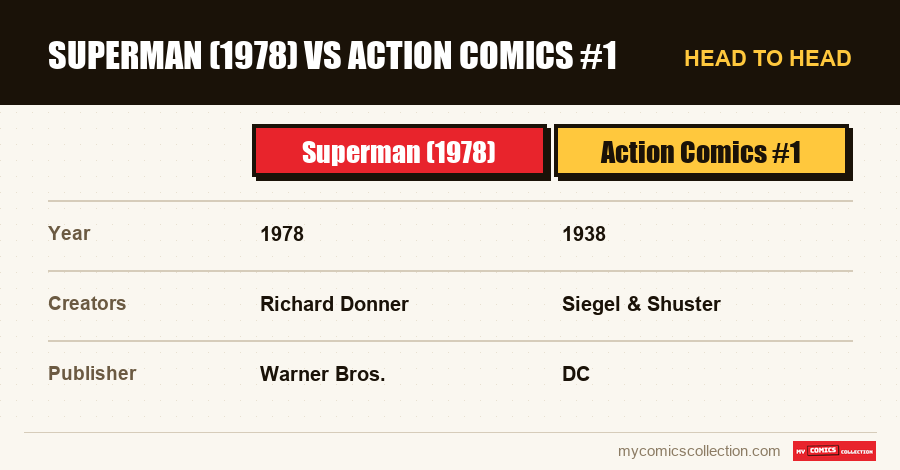
Title : Superman (1978)
Director: Richard Donner
Actors: Christopher Reeve (Superman), Margot Kidder (Loïs Lane), Gene Hackman (Lex Luthor), Marlon Brando (Jor-El)
Exit : December 1978
Studio: Warner Bros.
Action Comics #1 (1938): Superman's first appearance (Siegel & Shuster)
Krypton and Jor-El: Kryptonian origins
Clark Kent, Lois Lane, the Daily Planet: the universe of Metropolis
Lex Luthor: Superman's archenemy
- The origin kryptonian: The escape from Krypton, Jor-El.
- Childhood Smallville at the Kents.
- Clark Kent, journalist at the Daily Planet, and Loïs Lane.
- THE powers: flight, strength, vision, invulnerability.
- Lex Luthor, the criminal mastermind, sworn enemy.
- La Fortress of Solitude and Jor-El are amplified.
- Lex Luthor is treated with a touch of humor.
- Le back in time final, specific to the film.
- The plot (Luthor's real estate plan) is original.
- Some details of the origin are modernized.
Action Comics #1 (1938): the first superhero
Superman appears in Action Comics #1 (1938), created by Jerry Siegel and Joe Shuster. This seminal issue not only marks the birth of Superman, but that of the superhero himself: the first being with extraordinary powers, dressed in a colorful costume and cape, working for good. Kal-El, last survivor of the planet Krypton, sent to Earth as a child by his parents before the destruction of his world, is taken in by the Kents in Smallville. As an adult, he leads a double life: the shy journalist Clark Kent at the Daily Planet, and the powerful Superman, protector of Metropolis. This myth founded an entire genre and became one of the most universal icons of popular culture.
Richard Donner's film brings this myth to the screen with remarkable fidelity and breadth. It takes up each stage: the destruction of Krypton, the sending of the child, childhood in Smallville, the revelation of powers, the double life in Metropolis, Lois Lane and Lex Luthor. Christopher Reeve plays an iconic Superman, both powerful and humble, whose interpretation has defined the character for generations. The film modernizes some details and amplifies certain elements (the Fortress of Solitude, the role of Jor-El) but scrupulously respects the spirit of the character: hope, justice, the humanity of a being from elsewhere. Its motto, loyalty to the founding myth, is total.
Christopher Reeve and the embodiment of the myth
One of the film's great accomplishments is Christopher Reeve's portrayal of Superman. The actor manages to give substance to a character known to be difficult to play, embodying both the majestic power of Superman and the touching clumsiness of Clark Kent. This double performance, of rare accuracy, made Reeve the definitive face of the character for the public. His ability to make a quasi-divine being credible while keeping him deeply human is at the heart of the film's success. Reeve captures the essence of Superman: not a distant god, but a benevolent protector, guided by simple and noble values.
This incarnation illustrates the film's fidelity to the spirit of the character. Superman, in the comics, is not a tormented hero but a figure of hope and goodness, a moral model embodying the best of humanity despite his extraterrestrial origins. Reeve conveys this dimension with sincerity, avoiding cynicism to embrace the character's idealism. For the reader, this incarnation reminds us of what makes Superman great: his ability to inspire, to represent an ideal of justice and compassion. The film honors this essence, making Superman not a display of power, but a celebration of goodness and hope.
Lex Luthor and the plot of the film
The film pits Superman against Lex Luthor, his most iconic enemy. Self-proclaimed criminal genius "greatest mind in the world", Luthor is, in the comics, the antithesis of Superman: human intelligence in the face of extraterrestrial power, pride in the face of humility. The film takes this character, played by Gene Hackman, but gives him a touch of humor and a certain eccentricity, surrounding him with comic sidekicks. His plan, to cause an earthquake to collapse California and get rich on real estate, is an invention of the film, illustrating the character's devious mind. This version, lighter than the dark Luthor of modern comics, remains faithful to his nature as a megalomaniac genius.
The film also takes a notable liberty in its outcome: to save Lois Lane, Superman turns the Earth upside down, going back in time. This scene, specific to the film, illustrates an almost unlimited power which has caused debate, but conveys the idea of a Superman capable of anything for those he loves. These freedoms (Luthor's plan, the return in time) are part of an adaptation which, essentially, remains very faithful to the myth. For the reader, they are inventions of the film; the Lex Luthor of the comics, especially in his modern versions, is an otherwise complex and threatening figure, whose rivalry with Superman has fueled stories of great richness.
Collecting this series?
Track what you own, what you are missing and what your collection is worth. 7 day trial.
Start my trial →The characters, from paper to screen
- Superman/Clark Kent: The first superhero, faithful to Action Comics #1, played by Christopher Reeve.
- Lois Lane: Journalist at the Daily Planet and love interest of Superman, true to his role.
- Lex Luthor: Criminal genius, sworn enemy, treated with a touch of humor.
- Jor-El: Superman's Kryptonian father, amplified and played by Marlon Brando.
- The Kents: Clark's adoptive parents in Smallville, guarantors of his values.
A founding film of the genre
Richard Donner's Superman occupies a crucial place in the history of cinema. Released in 1978, it was the first major successful superhero film, the one which proved that such a character could be brought to the screen with seriousness, scale and emotion. Its tagline promised to make people believe that a man could fly, and the film delivered on that promise, with revolutionary special effects for the time. This success founded the superhero film genre, paving the way for all the adaptations that would follow, from Batman to Spider-Man and the Marvel Universe. Superman is the direct ancestor of a whole section of contemporary cinema.
Beyond its historical importance, the film has lastingly defined the image of Superman in the collective imagination. Christopher Reeve's interpretation, the majestic musical theme, the aesthetic of the film have shaped the perception of the character for generations. For the reader, this film is a gateway to the universe of Superman in the comics, where the first superhero has experienced eighty years of adventures and evolutions. It recalls the greatness of a founding character, a timeless incarnation of hope and justice, whose influence on popular culture is immeasurable. Donner's Superman remains an absolute reference of the genre.
A universal and timeless myth
Superman is not only the first superhero: he is also one of the most universal myths of modern popular culture. Sent to Earth by his parents before the destruction of his world, raised by a modest family, endowed with immense powers but choosing to use them for good, he embodies an ideal of hope, justice and compassion. This mythological, almost messianic dimension goes beyond the simple framework of entertainment to touch on universal themes: immigration, belonging, responsibility, the choice of good. Donner's film captures this scope, making Superman a timeless figure of inspiration.
This universality explains the longevity and influence of the character. Since 1938, Superman has crossed the ages without losing any of his symbolic force, constantly reinvented while retaining his essence. The 1978 film magnified this myth for cinema, offering an incarnation that marked generations. For the reader, it is an invitation to discover the richness of the Superman universe in comics, where the first superhero explored themes of unsuspected depth, from the founding story to modern rereadings like “All-Star Superman”. Donner's Superman reminds us that, behind his powers, the character above all embodies the best of humanity, an ideal that continues to inspire.
Where to start reading
To extend the film, Action Comics #1 (1938) features the first appearance of Superman. “Superman: Birthright” (2003) and “Superman for All Seasons” (1998) revisit his origins in depth. Grant Morrison's "All-Star Superman" (2005) is a modern pinnacle of the character. This journey covers the sources of a founding film, faithful to the myth of Superman.
Chronology of comics to know
- 1938: Action Comics #1: Superman's first appearance.
- 1998: “Superman for All Seasons”: an intimate rereading of the origins.
- 2005: “All-Star Superman”: a modern peak of the character.
Collection side: what numbers to aim for after the film
Superman points to the most valuable key in comic book history. Action Comics #1 (1938, first appearance of Superman) is the absolute grail, the most sought-after and expensive comic in the world. Superman #1 (1939) is another major key to the Golden Age. Modern stories like “All-Star Superman” offer much more accessible targets. These numbers cover budgets ranging from inaccessible to reasonable. As always, condition and gradation determine value; relying on real recent sales is strongly recommended.
Its place in the saga and for the collector
Richard Donner's Superman founded superhero cinema by bringing the first of them to the screen with fidelity and scale. For the collector, it magnified the aura of Action Comics #1, the absolute holy grail of the market. It illustrates the effect of adaptations on a character's mythology. Beyond speculation, the film invites you to discover the universe of Superman in the comics, from the founding story of 1938 to modern rereadings. By sincerely embodying hope and justice, he defined the character for generations and paved the way for all of superhero cinema.
The verdict: the founding myth magnified
- Loyalty: the Kryptonian origin, Smallville, Clark Kent, Lois Lane, the powers and Lex Luthor come from the comics.
- Freedoms: the Fortress of Solitude amplified, Luthor treated with humor, the return to final time, the real estate intrigue.
- Collectible numbers: Action Comics #1 (Superman), Superman #1 (1939), “All-Star Superman.”
Richard Donner's Superman brings the first superhero to the screen with a fidelity and emotion that founded the genre. Faithful to the myth (Krypton, Smallville, Lois, Luthor) and magnified by Christopher Reeve, the film modernizes a few details without betraying the spirit of the character. For the reader as well as the collector, it is an invitation to discover Action Comics #1.
Frequently asked questions
From Action Comics #1 (1938), created by Jerry Siegel and Joe Shuster. This issue marks the birth of Superman, but also that of the superhero himself. The film faithfully reproduces its Kryptonian origin and its myth.
Very faithful to the essentials: the origin, Smallville, Clark Kent, Lois Lane, Lex Luthor. It modernizes some details and amplifies the Fortress of Solitude and Jor-El, but scrupulously respects the character's spirit of hope and justice.
The final scene, where Superman goes back in time to save Lois, is unique to the film. It illustrates an almost unlimited power which has caused debate, but reflects the idea of a hero ready to do anything for those he loves.
Released in 1978, it was the first major successful superhero film, which proved that such a character could be brought to the screen with seriousness and scope. It founded the genre and paved the way for all subsequent adaptations.
Action Comics #1 (1938, Superman premiere) is the absolute holy grail, the most expensive comic in the world. Superman #1 (1939) is another key to the Golden Age. “All-Star Superman” is an accessible modern target.
Does the film make you want to collect? Estimate the value for free of your issues (Action Comics #1…) with our tool based on current eBay listings.