
Captain America: Brave New World (2025), directed by Julius Onah with Anthony Mackie , stages Sam Wilson became Captain America, a passing of the torch that the comics carried out in 2014. Facing him, Thaddeus Ross transforms into Red Hulk , appeared in Hulk #1 (2008) by Jeph Loeb. The film also summons the Leader (Tales to Astonish #62, 1964) and Isaiah Bradley (2003). It retains the essence of these characters while weaving a new political intrigue. Detailed comparison, film versus comics.
The first film dedicated to Captain America played by Sam Wilson, Brave New World adapts one of the great passing of the torch in recent comics. Under the direction of Julius Onah, the film draws on several aspects of the Hulk and Captain America universe to compose a political thriller. Source-by-source decryption.
As in each article in the series, only verified information (distribution, dates, numbers, creators) is stated; the comparative analysis is ours, without reproducing dialogue or protected images.
Title : Captain America: Brave New World (2025)
Director: Julius Onah
Actors: Anthony Mackie (Sam Wilson / Captain America), Harrison Ford (Thaddeus Ross / Red Hulk), Danny Ramirez (Joaquin Torres / Falcon), Tim Blake Nelson (the Leader), Carl Lumbly (Isaiah Bradley)
Exit : February 14, 2025 (United States)
Studio: Marvel Studios
Sam Wilson becomes Captain America (2014-2015)
Hulk #1 (2008): 1st appearance of the Red Hulk (Jeph Loeb & Ed McGuinness)
Tales to Astonish #62 (1964). The Leader (Samuel Sterns)
“Truth: Red, White & Black”(2003): Isaiah Bradley
- Sam Wilson as Captain America, chosen by Steve Rogers to succeed him.
- Le Red Hulk, a red and furious version born from Thaddeus Ross.
- Le Leader, genius with an overdeveloped brain, historical enemy of the Hulk.
- Isaiah Bradley, the forgotten super-soldier of history.
- Le political thriller tone, inherited from Captain America's runs.
- Thaddeus Ross becomes president, a role specific to the film.
- The Leader sees its plan and appearance adapted to the cinematic story.
- Joaquin Torres becomes the new Falcon, extending the passing of the torch.
- The plot mixes political conspiracy and adamantium, a mixture specific to the film.
- Sat has no superpowers, which accentuates his heroism.
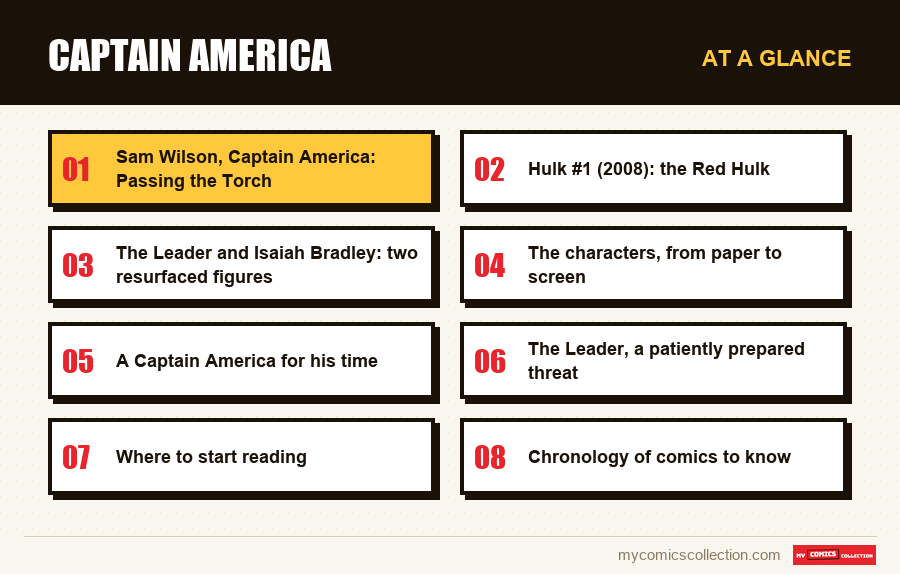
Sam Wilson, Captain America: Passing the Torch
The heart of the film is the consecration of Sam Wilson as Captain America. In the comics, this passing of the torch occurs in the mid-2010s: Steve Rogers, weakened, chooses his former partner the Falcon to carry the shield, making Sam Wilson the new Captain America (notably in the series by Rick Remender then Nick Spencer, from 2014). The film faithfully adapts this transmission, already initiated on the screen, and its profound issue: the legitimacy of an African-American hero to embody a national symbol. A notable feature is that Sam has no superpowers, no super-soldier serum, which accentuates his heroism: he wears the shield by the sole force of his convictions and his courage. Anthony Mackie embodies this new kind of Captain America, faithful to the spirit of Nick Spencer's run.
This choice of a Captain America without powers, human and fallible, extends a reflection present in the comics: the shield does not make the hero, it is the values that he defends. The film makes this the heart of its subject, questioning what it means to wear such a symbol today.
Hulk #1 (2008): the Red Hulk
The main antagonist, the Red Hulk, is a recent comic book creation: he appears in Hulk #1 (2008), created by Jeph Loeb and Ed McGuinness. Its particularity was, originally, an editorial mystery: the identity of the Red Hulk was hidden for a long time, before being revealed as that of General Thaddeus "Thunderbolt" Ross, the Hulk's sworn enemy transformed into the creature he was chasing. The film takes this strong idea, Ross becoming a Hulk himself, while adapting it to its continuity, where Ross became president. This transformation of a military antagonist into a red and furious monster gives the film its spectacular climax. Harrison Ford plays this Ross consumed by anger, whose metamorphosis embodies the loss of control and the excesses of power.
The Leader and Isaiah Bradley: two resurfaced figures
The film summons two characters from very different eras. THE Leader, Samuel Sterns, is a historical enemy of the Hulk, appearing in Tales to Astonish #62 (1964): a genius with a deformed skull after gamma exposure, he embodies devious intelligence. The film takes up the character, sketched from The Incredible Hulk from 2008, and in fact a shadow manipulator. Isaiah Bradley, meanwhile, comes from a much more recent and poignant story: “Truth: Red, White & Black” (2003), which revealed that before Steve Rogers, African-American soldiers had been unwilling guinea pigs in super-soldier experiments. Isaiah, forgotten survivor of these trials, embodies a painful and hidden memory. His presence gives the film a historical and political depth, faithful to a striking comic.
The characters, from paper to screen
- Sam Wilson / Captain America: Faithful to the passing of the torch in comics (2014), a hero without powers.
- Thaddeus Ross / Red Hulk: Faithful to Hulk #1 (2008), with the new role of president.
- The Leader: Historical enemy of the Hulk, manipulator of the shadows, sketched in 2008.
- Isaiah Bradley: The forgotten super-soldier from “Truth” (2003), painful memory.
- Joaquin Torres / Falcon: The new Falcon, extending the passing of the torch.
Collecting this series?
Track what you own, what you are missing and what your collection is worth. 7 day trial.
Start my trial →A Captain America for his time
Brave New World continues a reflection that has been present in comics for decades: what does it mean to be Captain America? By entrusting the shield to Sam Wilson, an African-American hero without superpowers, the film questions the national symbol and its relationship to history, in particular via the character of Isaiah Bradley and the hidden past of the super-soldier's experiences. This political dimension, inherited from runs like that of Nick Spencer (“Sam Wilson: Captain America”), makes the film a thriller anchored in contemporary questions of representation, memory and legitimacy. The film assumes that the shield is not neutral: wearing it, when you are a black man in today's America, engages a symbolic weight that the story explores head-on.
This approach, faithful to the spirit of modern comics, distinguishes the film from a simple action story. By making Sam a Captain America who must conquer his legitimacy rather than passively inherit it, the film continues the tradition of a character always thought of as a mirror of his time: from World War II to current debates on identity and justice.
The Leader, a patiently prepared threat
The presence of the Leader in the film illustrates the patience of the saga in constructing its threats. The character of Samuel Sterns was introduced as early as 2008's The Incredible Hulk, where we witnessed the beginning of his gamma transformation: a seed planted more than fifteen years before his flowering. The film finally harvests this seed, making the Leader a shadow manipulator whose plans structure the plot. This delayed reward, where a detail sown years earlier finally finds its payment, is a practice inherited from comics, where long-term intrigues and the returns of forgotten characters are part of the pleasure of reading. By resurrecting the Leader, the film forges a link with the very first films in the saga and recalls its overall coherence.
This way of constructing long-term threats, by reactivating characters left in suspense, demonstrates a narrative ambition that goes beyond the simple film. It joins the spirit of comics, where nothing is ever truly forgotten and where a villain sketched decades earlier can resurface in the foreground. For the collector, this logic has a concrete interest: it reminds us that even secondary characters from old films can, one day, return to the spotlight and see the prices of their first appearances rise.
Where to start reading
To discover the Sam Wilson of comics, the series “Sam Wilson: Captain America” by Nick Spencer (2015) is the reference, extending the passing of the torch from 2014. For the Red Hulk, Hulk #1 (2008) by Jeph Loeb is the source. The Leader is discovered in Tales to Astonish #62 (1964), and Isaiah Bradley in “Truth: Red, White & Black” (2003), an essential story. Finally, Ed Brubaker's run sheds light on the universe of Captain America. From 1964 to 2015, this journey covers the sources of a film that combines several decades of continuity.
Chronology of comics to know
- 1964: Tales to Astonish #62: First appearance of the Leader.
- 2003: “Truth: Red, White & Black”: Isaiah Bradley and the hidden experiences.
- 2008: Hulk #1: first appearance of the Red Hulk (Thaddeus Ross).
- 2014-2015: Sam Wilson becomes Captain America.
Collection side: what numbers to aim for after the film
Brave New World highlights keys from various eras. Hulk #1 (2008, first appearance of the Red Hulk) is a sought-after modern issue, whose popularity has soared with the character's arrival on screen. Tales to Astonish #62 (first appearance of the Leader) is a key to the Silver Age. The issues of “Truth” (2003) and “Sam Wilson: Captain America” (2015) are accessible modern targets, important to the characters’ trajectory. These numbers cover all budgets. As always, condition and gradation determine value; relying on real recent sales is strongly recommended. Hulk #1 (2008) is a great target for a collector interested in recent creations brought to the screen.
Its place in the saga and for the collector
Brave New World dedicates the passage of the shield to Sam Wilson, a major transition for the saga, and introduces the Red Hulk as a new threat. For the collector, the film reignited interest in Hulk #1 (2008) and in stories related to Sam Wilson and Isaiah Bradley. This film illustrates the effect of cinema on recent creations, the popularity of which can increase with an adaptation. Beyond speculation, it invites us to discover important stories on memory and representation, notably "Truth: Red, White & Black", one of the most significant comics of the 2000s. By bringing to the screen an African-American Captain America and the hidden past of the super-soldier's experiences, the film extends the historical vocation of the character: to reflect, in each era, the tensions and ideals of his time.
The verdict: the shield passed on, the past exhumed
- Loyalty: the passing of the torch to Sam Wilson, the Red Hulk, the Leader and Isaiah Bradley come from the comics.
- Freedoms: Ross becoming president, the intrigue mixing political conspiracy and adamantium, the Leader's plan adapted.
- Collectible numbers: Hulk #1 (Red Hulk), Tales to Astonish #62 (the Leader), “Truth” (2003).
Brave New World adapts the passing of the shield to Sam Wilson into a political thriller anchored in questions of memory and legitimacy. Faithful to the passing of the torch from the comics, to the Red Hulk and Isaiah Bradley, the film weaves a contemporary intrigue. For reader and collector alike, it's an invitation to discover essential stories about what it means to bear the shield, and a recent creation to watch, the Red Hulk. By affirming that a hero is defined by his values and not by his powers, the film remains faithful to the soul of a character thought, since 1941, as a mirror of the ideals of his time.
Frequently asked questions
Yes: in the mid-2010s, Steve Rogers chose his former partner the Falcon to carry the shield, making Sam Wilson the new Captain America (series by Rick Remender then Nick Spencer, from 2014).
A red, angry version of the Hulk, appearing in Hulk #1 (2008) by Jeph Loeb and Ed McGuinness. His identity, long mysterious, was revealed as that of General Thaddeus Ross, the Hulk's sworn enemy.
An African-American super-soldier, unwilling guinea pig in experiments carried out before Steve Rogers, revealed in “Truth: Red, White & Black” (2003). He embodies a painful and obscured memory of the history of super-soldiers.
No: unlike Steve Rogers, Sam did not receive the super-soldier serum. He wears the shield by the sole force of his convictions and his courage, which accentuates his heroism, faithful to the comics.
Hulk #1 (2008, first appearance of the Red Hulk) on the modern side, and Tales to Astonish #62 (first appearance of the Leader) on the Silver Age side. The issues of “Truth” (2003) are other important targets.
Does the film make you want to collect? Estimate the value for free of your issues (Hulk #1, Tales to Astonish #62…) with our tool based on current eBay listings.